PBR’s Customer Brass Program

No, not Pabst Blue Ribbon – Parabellum Research.

They are a small company in Buda, Texas (just south of Austin) crafting ammunition. From their website:

One of the driving forces behind the creation of PBR was the disappointment we had with the quality of practice ammunition being sold by some small manufacturers. It doesn’t take many jammed cartridges or inconsistent firings to make you start to wonder if those “cheap” rounds really represent a savings at all. Having had our semi-automatic handguns reduced to single-shot pistols frustrated us and we decided to do something about it.

In addition, we also recognized that many people don’t want to stand in front of a press for hours on end to “save” money by loading ammunition themselves. In many cases this is a false economy for anyone who puts a realistic value on their time. So, we decided to use our combined 25 years of ammunition loading and engineering experience to create a company that can produce a viable and affordable practice round that is still top quality. Remember, time spent pulling a handle on a press is time that could be used to pull a trigger and more time is one thing you can’t buy.

I have heard of them before, but have never tried their ammo, mostly because I reload my own. That said, I appreciate what they’re doing because I like reloading for the higher quality and cost savings. But it is true, it’s only cost savings if you have time to spend.

Rog posted on Facebook tho that perked my interest: the Customer Brass Program.

Basically, you send them your new or once-fired brass, and they’ll load it up for you. The cost savings? No Firearms and Ammunition Excise Tax. Plus brass is generally the most expensive component, and so you’re not having to pay for that component.

Prices seem reasonable, if the prices listed on their website are in fact the price you pay. Hard to say exactly what the final cost is as there are some other factors they have to take into account. Plus there’s always shipping, but if you’re in the area I would imagine you could drop off and pick up (don’t know for sure).

Nevertheless, this seems like a neat solution. They offer numerous calibers, and if in fact it can keep your costs down, that’s a win.

Tune Up Your Gun Handling

Karl Rehn’s latest article, “Tune Up Your Gun Handling” is now available at the USCCA website and also their print magazine.

It’s a great article showing various gun safety violations. I’m sure you’ve seen them, and you may have committed them yourself. It’s an opportunity to learn about them, then take a step back, swallow pride, and let’s all work to improve our gun handling.

What you do with a gun when you’re NOT shooting it is more important than what you do when you shoot.

Why am I making this so hard?

I went to the local indoor range today to do a little more investigation with the M&P.

Last time I had determined everything was hitting low, but it was difficult to get a good feel for things because my eyes were hating it. So today I went and started at 25 yards. Bench rest. Speer Gold Dot 124 grain +P. Let’s see how my chosen carry ammo performs. The intent is to figure out what size/height sights I need to get my point of impact to be the same as my point of aim at 25 yards. Dawson Precision has this nice diagram and equation to help figure it out. Just what sights should I order….

On the whole I’d say things came in about 4.5″ low. My eyes still hated it, but groups were in the 3-4″ range and likely could be better under better conditions with a better shooter.

Due to that, I opted to try again at 10 yards. It should give me a reasonable similar number when I do the sight height math, and help me control the eyes factor.  Here things were about 2″ low and mabye 1.5″ groups.

Doing the math, things came out about the same, but nothing really meshed with products Dawson sells.

And then it hit me.

This is all hinged upon the rear sight height remaining the same.

That will not be the case. I will be changing the rear sight too.

*sigh*

So none of this matters. All this work for nothing. I could have just ordered a set of sights and been done with or. Or rather, at least get the rear sight I knew I wanted, then start to adapt the front sight from there. This is the sound of me banging my head into the desk for being stupid. *sigh*

Oh well.

I want a Dawson Charger rear sight. So looking at all the ones they have, this is the model. Plain (well, serrated) black; no tritium, no dots, no fiber, no nothing. 0.125″ width notch. They say to pair with a specific front sight, but I can’t find that (maybe some old stock number?). But at least it needs to be a 0.180″ high sight. I do want a fiber there, so I’m using this model. Red fiber, 0.180″ tall, 0.100″ wide.

I’m going to phone Dawson to put in the order, so I can ensure I get the right stuff.

I’ll get these, get them installed, then try yet again to see how the POA vs. POI is, and if I THEN need to get a new front, then I will.

I’ve been dry firing this gun every day and am very anxious and eager to get it dialed in and on my hip in regular rotation. I put another 50 rounds of Gold Dot through it today, and then another 50 of the 124 grain American Eagle. Boy… that AE fluctuates a lot. I’d have some rounds that would jar me, others that felt like a mouse fart. The way the vents were blowing air behind me, every time I’d shoot an AE round there’d be this cloud of smoke in my field of vision… ugly stuff. I should have shot some of my reloads for comparison.

On reloads, make sure you have one first

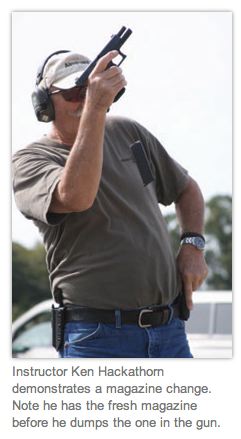
I was reading this article over at the USCCA website. The article itself is fine but secondary to the one thing that stood out to me. This picture and its caption:

It’s a picture of legendary instructor Ken Hackathorn performing a reload. The picture could come across contrary to the caption, but the picture is but a moment in time. The caption is really what you need to pay attention to:

Note he has the fresh magazine before he dumps the one in the gun.

This is so critical when reloading, at least in the context I care most about: self-defense.

First, you do carry a reload, right? If you do not, you should. In part it’s there because you may need more ammo. But it’s also there because the magazine is a fairly good point of failure in a semi-automatic handgun, and what are you going to do if that magazine fails in the middle of a fight for your life? Having a reload can help you remedy the situation and stay in the fight.

Second, there are many ways to reload a gun, but there’s really only one that matters in a gunfight: the speed reload. That is, you press the magazine release button on the gun, let the magazine drop out of the gun onto the ground (it doesn’t matter if it’s full, partially full, or empty), and insert a new magazine and keep going. This is the fastest way to get the gun back into action, and every moment matters. While looking for something else the other day, I came across an old article by Todd Louis Green about the “Tactical Reload” and his reasons against it.  There is a place for all the styles of reloading, but that’s another discussion for another time.

Now, in doing this reloading, order of execution is important. All too often people realize they need to reload and the first thing they do is hit the magazine release button. Sometime after that, they go for their spare magazine. Can you see a possible problem here? What if you don’t have the spare magazine? It could have fallen out. You may have already reloaded (yes, in the heat of the fight you won’t be able to keep track of all things). Chances are good that the magazine you dropped from the gun was a partially full magazine. So now you have a magazine on the ground, no magazine in your hand, and if you’re lucky, one shot left in the gun. Not good.

Because you may have a partially loaded gun when you choose to reload, don’t empty that gun until you KNOW you can reload it. For those wondering why you’d reload a gun that’s (partially) loaded, if there was a lull I’d like to get my gun topped off. I won’t know how many rounds I fired and thus have left. I don’t know if there might be a second fight (yes it can and does happen). Having a full tank serves me better. I can speed reload, minimize my downtime, and then once there’s enough time I can bend down and recover the partial magazine (if needed).

So when it’s time to reload, FIRST go for the magazine, confirm it’s there, THEN you can drop the existing magazine and continue with the reload. There’s really no time lost in doing things in this order. Or even if there is any time lost, you’ll lose a lot more time off your life if you ever find yourself standing around with a gun you just unloaded in the middle of the fight. The fractions of a second “saved” aren’t worth it.

Hot Shots

A new show on NBC Sports Outdoors called Hot Shots.

There’s a lot of shooting sports and gun-related TV shows, and a lot of it I just don’t care for. I like shooting, I don’t care about drama, especially “reality” drama. But this “Hot Shots” show seemed, from the advertisements, to be fairly drama-free. The impression I received was it was going to follow some of the top names in shooting sports as they do their thing. Any drama is just what comes up in life, perhaps with narration and bed music to add some drama, but no “reality” drama. Thus, the show seemed like it might be worth watching. And hey… Jerry Miculek? Any chance to see him shoot I’ll take.

So I watched the premiere episode. I enjoyed it. Sure there was drama, but it was “life drama” not “reality drama”.

I did find it interesting there wasn’t much background biography given on the guys. A little bit, but I wondered if you didn’t already know who these guys were, would the casual viewer really know who they were watching? As well, not a lot of explanation of things. For instance, this episode had a lot about the Steel Challenge, and they didn’t talk much about it to help those that didn’t know understand just what it was.

But as I think about it, I think it’s a fine balance being struck. It needs to cater to viewers that know what’s going on as well as those that do not. As someone who has some idea what’s going on, I appreciate they didn’t waste a lot of time explaining things. But they did explain enough, I think, to at least provide context. I’d like to see if future episodes add to the exposition and explanation to help viewers put it all into perspective.

Lots of shooting, not a lot of filler, but what non-shooting stuff there was cool towards showing all that these guys have to do… behind the scenes, if you will.

I enjoyed it. Good entertainment. I’ll watch again.

First time success

“Old Painless” from The Box O’ Truth took his 8 year old grandson to the range for the first time.

Not only do I think it’s great to see some great grandfather-grandson time together, but I like what Old Painless had to say about how to make a first range trip successful. He said these are good for taking a kid to the range, but I think it’s good advice the first time you take anyone to the range:

1. Stress Safety, first thing and constantly.
2. Have ear and eye protection for the kid.
3. Let them shoot a gun that doesn’t have heavy recoil.
4. Let them get really close to the target so that they hit something.
5. Give them praise for doing well.
6. Let them help load the firearms if they would like to.
7. Watch them very carefully, stay very close to them, and never let them break any Safety rule.
8. Help them hold the firearm if it is heavy for them.
9. Let them shoot until they are tired and then quit.
10. Make sure it is fun, so that they will want to go shooting again.

Most of it is about being safe and having fun, as it should be. And I think most people understand those aspects. But there are a few that sometimes get overlooked.

#3 – please people, we have enough YouTube videos of assholes (often “boyfriends”) giving guns with massive recoil to little people (often girlfriends) that have never shot a gun before, and while it gives the asshole filming the video a good laugh, it leaves a horrible impression in the mind of the shooter… not to mention some horrible pain. Please don’t do this. Let people start with something like a .22 LR and work up from there.

#4 and #5 – these are very important. Shooting a gun isn’t hard, but it isn’t easy either. Do you want this person to foster a love and enjoyment of the activity? Then do what you can to foster their success, because people like doing things they can succeed at. People understand the notion is to point the gun at something (target, tin can, steel plate, etc.) and try to hit that something. Imagine someone trying over and over and over and over and never hitting the target; they’re going to get discouraged. Move them as close as is safe (e.g. I wouldn’t go closer than 10 yards with steel targets), and let them shoot from there. They know being close is easier, so once they succeed at that distance, they’ll probably want to try making it a little harder, so you step back a few yards and try again. They’ll get it. They’ll understand. And when they do start missing, they’ll have enough success already under their belt that the misses won’t be discouragement but rather revelation that there’s something to learn and to come back again to try later. That’s good.

#6 is one I’m guilty of not always doing. I often will load the magazines and load the firearm for them. I do this because there’s enough stuff for a new shooter to have to deal with, so I try to ensure they focus on the critical things and let me handle the extra stuff.  But once they get the hang of things yes, you should let them load the magazine, insert the magazine, load the cylinder, and unload things too. Whatever the firearm’s mechanism is for loading and unloading, yes you should eventually let them do it. Not only do they learn how to do that, but there’s something about loading and unloading that makes for a more complete and satisfying experience.

The bottom line is, again, ensuring it’s safe and fun. You want them to smile. You want them to laugh. You want them to succeed. You want them to enjoy it. Doesn’t matter if it’s a kid or an adult, this is what you want to sow a seed that can grow and flourish.

The Give-A-Way. Pass it on.

AGirlAndHerGun is doing a Give-A-Way.

No strings, no nothing. A true give-a-way.

The prize:

I will pay $300 towards any reputable beginning self defense shooting course in the United States.

Who Can Enter:

Any female who is interested in taking the next step in learning how to defend herself in the event that she may need to. I would really prefer it be a new shooter that hasn’t had any formal training to this point.

How to enter? Go read her blog post and find out. It’s not hard.

*sigh*

SAN DIEGO – A 22-year-old Navy SEAL was gravely wounded early today when he shot himself in the head at his Pacific Beach home while trying to convince a companion that the pistol he was showing off was safe to handle, authorities said.

[…]

The serviceman, who had been drinking with a woman at a bar before they returned to his residence, was showing her his 9 mm handgun when the accident occurred, SDPD Officer Frank Cali said.

The man offered to let his friend hold the weapon, which he mistakenly believed was unloaded, according to Cali. When she declined, he tried to demonstrate how safe it was by putting it to his head and pulling the trigger.

*sigh*

That is NOT the way to verify the state of a gun.

Never point a gun at anything you are not willing to destroy. I would suspect for most people their own head is something they don’t wish to destroy.

Alcohol of course degrades your ability to make proper judgments. Guns and alcohol don’t mix.

How to verify a gun is unloaded?

Pick it up. Point it in a safe direction. Ensure your finger is off the trigger the entire time you perform this procedure. With a semi-automatic handgun, remove the magazine from the gun. Fully retract the slide and lock it in the open position. Visually inspect the chamber to ensure no round is in the chamber. Visually inspect the magazine well to ensure there is no magazine in the gun. Use your finger to tactilely verify the same (both chamber and magazine). Check again. Check a third time. If it builds your confidence in ensuring it’s unloaded, check a fourth or fifth time. If you have someone with you, have them check as well. Once you have verified it is unloaded, you can release the slide.

If you are handing the gun to someone else, first you verify the gun is unloaded. Keep the action locked open. Hand the gun to the other person. If the other person doesn’t verify the gun is unloaded on their own accord, have them verify the gun is unloaded.

If you ever set the gun down or have it otherwise out of your control for even a moment, when you pick it back up, verify the state of the gun. Gremlins exist.

We are human. We are prone to make mistakes. But we can also work to minimize our chances of making tragic mistakes by following rules.

Please do your best to avoid making the same mistake this man made.

The M&P, Third Impressions

The next chapter in my investigation of the Smith & Wesson M&P.

For reference, here’s first, here’s second.

The focus now is accuracy. The factory barrel is pretty bad, with 6-8″ groups at 25 yards. But, it seemed to vary with ammo, such as Gold Dot 124 grain +P was about 3-4″ at 25 yards. I installed my KKM barrel and off to the local indoor range I went. I didn’t want to go to the indoor range (more on it shortly), but it would allow me the easiest means of benchrest shooting at various distances. Plus it’s the closest range to the house and time matters right now.

Also note from the first round of shooting tests, I discovered the rear sight was off in the dovetail. A few days ago I went to my workbench and did my best to center the rear sight, measuring as best I could with calipers (it was difficult to get a flat surface given the cuts in the slide back there). FWIW, the sights seemed to be reasonably “on” during today’s tests. More later.

So given the ammo issue, I took 3 types of ammo with me: my 115 grain plinking handloads, which shoot pretty well (generally better than factory target loads); 124 grain American Eagle target loads; 124 grain +P Gold Dot. I asked at the gun counter if they had any 147 grain ammo but alas they had none. Since both the Gold Dot and the AE seemed to shoot better in the factory barrel, I was just curious what sort of results I’d get with 147 in the KKM.

My general plan was to shoot 5 shot groups from benchrest at 3, 7, 15, and 25 yards. Shoot each type of ammo at the same distance, compare and contrast results, tape the target, go to the next distance.

General results? Everything shot low. Exactly how low varied based upon distance and ammo, with the 124 AE generally shooting lowest of the 3 (makes sense) and the Gold Dot shooting highest of the 3 (makes sense). Still, every ammo at every distance had point of impact (POI) below the point of aim (POA). Interesting was that the Gold Dot tended to shoot towards the middle, the reloads slightly to the left, and the AE slight to the right. For the most part, the reloads and the AE shot to similar behavior in terms of grouping, and the Gold Dot of course shot a bit tighter.

I started having a rough time shooting at 15 and 25 yards. My eyes were blurring. I’m sure part of it is age. I’m sure part is just eyes getting tired from all that squinting. But I also know part of it is range-induced. The lighting there has improved, but it’s still a lot darker than being outdoors. Furthermore, the range was rather busy so there was a lot of smoke and such floating around. I find myself not wanting to breathe when I’m there — totally subconscious, but I realized how shallow my breathing was. A few times I set my gun down on the bench and went into the store area just to take 10 deep breath of clean(er) air. When I went back in, my eyes were a lot happier, but it just delayed the inevitable need to stop because my eyes and lungs couldn’t take it any more. Like I said, I really don’t like going to the indoor range, but sometimes you have to make compromises.

I’m still disappointed with the group sizes. It’s not the KKM itself, but that I have to get a replacement semi-match barrel in order to get similar accuracy that I get out of my factory barrel in my Springfield XD-9. Overall the KKM’s accuracy and grouping was acceptable and I am pleased with its results, but I don’t think it’s right that I should have to get an aftermarket barrel in order to get acceptable accuracy.

I should also caveat that due to my eyes, I just couldn’t shoot very well at 15 and 25 yards, so in my mind the final verdict is still out on performance at those ranges. Even still, the groupings I did get were still better than I got the first time with the factory barrel.

After I did the benchrest shooting, I put up a fresh target at 7 yards and just did some two-hand “freestyle” shooting. Couldn’t do anything fast or fancy due to range restrictions, just put the gun out there and pressed off a shot every second. Drilled a nice hole in the middle of the target, just a little low. Acceptable. I’d say about 150 or so rounds went through the gun today. So the barrel still isn’t broken in, but so far so good. Of those, 45 were Gold Dots (5 GD’s shot at the first range session), so I feel comfortable that this barrel will feed my carry ammo.

So far I’m pleased. Annoyed at the factory barrel. Annoyed about auto-forward. But I’ve been dry-firing the gun every day, it’s feeling more comfortable, and it felt more natural today (need to do some “real” shooting tho). The KKM is certainly a keeper, but if that rumored Apex-designed BarSto happens I’m likely to upgrade to it. From here, I need to find new sights because I have to do something about the low POI vs. the POA.

Off to Dawson Precision’s website I go!
Correcting Handgun Shooting Problems – a little more information

One of the most popular pages on my blog is this one about correcting handgun shooting problems.

The page is popular due to the targets, but I’m not sure how well the targets actually work for folk. Sure it tells you what you’re doing wrong, but it doesn’t tell you how to fix it.

Based upon what I see in my stats, I don’t think many are clicking through to the Rangemaster 2009 Newsletter article that has not just “here’s what you’re doing wrong” information, but also suggestions on how to fix those things you’re doing wrong!

If you still don’t want to click, here’s a few suggestions to help you hit the bullseye:

  • Slow down. Don’t take forever to get off the shot (fatigue, oxygen deprivation if you’re holding your breath, eye strain, etc. can all set in and make it harder to get the shot), but don’t rush. Don’t go faster than you can get good, successful hits. No unacceptable hits allowed!
  • Think about your grip. While there are better and worse ways to grip a gun, most people will generally do better by ensuring whatever grip they use it is consistent in terms of hand placement and grip pressure (both the crush of the grip and any lateral forces your grip places on the gun AND that your 2 hands place against each other). For some more grip tips, watch this video with champion pistol shooter Todd Jarrett.
  • Slow, smooth trigger press. This goes along with point #1 – slow down.
  • Follow through. Don’t worry about checking the hole in the target — it will be there 5 seconds from now, it will be there 5 minutes from now. Finish the shot all the way through. You have sight picture, slow smooth trigger press, gun goes bang, your eyes don’t move, gun recoils and comes back to where it started, and you regain your sight picture as if to take a second shot. To take a second shot doesn’t matter, follow through on the first shot as if you will take another. Once you have that second sight picture, THEN you can set the gun down and look at your target.
  • Slow down. Seriously.
  • Have you slowed down yet?
  • If you’re still having problems, make sure it isn’t the gun. Are the sights loose? are the sights properly zeroed/aligned? Is the gun not too big nor too difficult for you to handle, either in terms of things like improper gun fit thus reaching/pressing the trigger are difficult, or perhaps too much recoil and it causes you to flinch. Here’s a great article on gun fit. If you’re still working to master fundamentals, try shooting a handgun chambered in .22 LR. It has minimal recoil, not a lot of noise (relatively speaking, for a gun), and can help you master fundamentals. Sometimes it’s better to take a step back so you can later take two steps forward.
  • If you’re still having problems, consider seeking formal training. Having an knowledgable eye watching you could shed more light on and do more towards correcting problems and helping you succeed.

The bottom line? It’s all about fundamentals of sight alignment, trigger control, and follow-through. Even the top shooters in the world still have to practice and apply these fundamentals.