Went into the garage this morning and worked out with the heavy bag (Wavemaster XXL… I’d prefer a real hanging bag but don’t have the infrastructure to handle the abuse). Worked on various things. Some random notes:
If you want to “get off the X”, you cannot open with a kick…. feet gotta be used for moving, not attacking.
Continuing to work on “eyes level“. Eyes need to be in a middle ground between focused and uninvolved. Aware, I guess is about the best term I can come up with. Helps spin kicks and spin back/side kicks too. Even just turning for moving.
Continuing to work on hand positioning. The more I work with this, the more I like it. I find more and more how it fits the combatives approach/road I’m going down.
I want to hang a tennis ball (or something) from the garage ceiling to help work on bobbing, weaving, dodging.
I also finally circumscribed my bag. I’ve got an older Wavemaster XXL with logos and words running vertically up the length of the bag, so I knew about where the “S” was was about the level of the solar plexus, and other relative locations to body parts. Trouble was, if you weren’t facing that side of the bag, you could only guess. So I finally got a magic marker out and drew circles around the bag about where things are. I opted to draw lines at the level of the waist, solar plexus, nipples, and chin. This helps when looking for areas to target, with whatever you’re using.
Kuk Sool Won of St. Paul keeps a blog, and they just posted an entry about “A homeschooling perspective.” The posting, IMHO, doesn’t have much to do with homeschooling or martial arts, but it has a lot to present about life and good things to teach your kids (or even yourself).
Such a simple exchange, but I found it so moving. I’m so glad my son is getting these messages early from strong, compassionate teachers. You can keep going after you make a mistake. You can ask for help. You just have to keep practicing.
It reminds me a little of a story I read once about a famous modern-dance choreographer-I can’t remember which one now. Maybe Martha Graham? One of her dancers fell flat on her butt during a rehearsal and sat there with a stunned expression on her face, not moving, not getting up. The choreographer swooped over to the dancer and exhorted her, “Don’t stop now! Make it into something beautiful!”
I wrote my piece On Dan Bong and completely forgot to mention something, so I’ll mention it now. 🙂
I have found dan bong to be a versatile weapon. Apart from some striking drills, e.g., the 12 angle drill I mentioned from Modern Arnis, what else can you do to explore dan bong?
Take whatever you know, put a dan bong in your hand, and see what you can do with what you already know. That’s a good place to start.
So what do I mean by that? Easiest way for me to explain is within the context and nomenclature of Kuk Sool.
Let’s take Maek Chi Ki. First, perform Maek Chi Ki as the empty-hand set that it is. Now, pick up your dan bong and perform Maek Chi Ki but instead of using your empty hand to strike, use the dan bong. Maek Chi Ki 1-3 would involve a normal “whipping strike” with the side of the tip. Maek Chi Ki 4 would involve a tip thrust into the armpit. Maek Chi Ki 6 could be a butt-end strike to the temple or an inverted tip strike to the temple. And so on. Ki Bohn Soo is a good place to start for locking and leverage applications.
Will every technique work exactly the same? Probably not. Some techniques may require a small modification, some techniques could have multiple approaches/interpretations, some may require you to invert the technique (e.g. performing it “other side/mirror image”), and some techniques may just flat out not work. But the point is to use existing knowledge as a foundation for exploring what you can do with a dan bong. Explore.
So everyone goes on about the rising cost of ammo, the reluctance to shoot what little ammo you have, the difficulty in getting to the range, and whatever excuse possible. I don’t disagree… I don’t get to the range nearly as much as I want to either, and even shooting a .22 is getting expensive! However, that’s OK. Dry fire is a fantastic way to keep your chops up.
One great thing about dry fire is you can practice skills that you just can’t practice at the gun range. For instance, does your range let you draw from a holster? If not, that’s ok, you can do it as a part of your dry fire practice at home. Can you do movement drills at the range? If not, you can do it at home with dry fire.
Really, there’s no excuse not to dry fire.
When (not if) you dry fire, you must do it safely. Kathy Jackson has a great article on safety practice for dry fire. The biggest thing is to ensure a clear cut distinction between your dry fire session and the time before and after the session. That when you start, you verify the gun is unloaded and ensure a safe environment. While you practice, you practice uninterrupted and if for some reason you are interrupted you ensure when you pick up the gun again that you start practice all over again (i.e. verify the state of the gun). When practice is over, it’s over. Yes it might seem silly to recite aloud that the gun is unloaded, but there’s nothing silly about a negligent discharge. Frame your practice time appropriately.
I forget who said this, but one of the top shooters said something to the effect of for every live round you wish to fire at the range, you should do 10 dry fires. So if you want to go through 200 rounds at the range, you better dry fire 2000 “rounds” at home beforehand. You will be much better off, and the time and ammo you spend at the range will be time and ammo much better spent. Don’t believe me? Try it.
You can find lots of great dry fire training aids online. Some of my favorites:
Just about any shooting drill can be adapted for dry fire. Remember: slow is smooth, smooth is fast. Strive to be correct, perfect, and smooth. Once you can do that at a given (slow) speed, speed it up by 10%. Practice the things you like, practice more the things you hate. Don’t focus on your mistakes and failures, envision your success.
If you carry a concealed handgun, you owe it to yourself to be the best you can be. Handgun skills are perishable, so you have to keep your chops up. Even if it’s nothing more than doing 10 draws and presentation from concealment, you can find the 5 minutes a day to do it. Someday, your life may depend on it.
Kuk Sool claims a wide array of weaponry. I personally don’t care for much of the weaponry taught because I find them impractical. These days one just doesn’t fight much with a trident or spear or halberd, and they’re a bit hard to conceal when you walk down the street. That said, one of given intents of Kuk Sool is to be a preservation of Korean martial traditions, so including such weaponry makes sense. Still, I have only so much time in a day to practice things, so I prefer to practice things that are practical and that I can use. Weaponry such as cane, rope, fan, staff, and what I want to speak about here: dan bong.
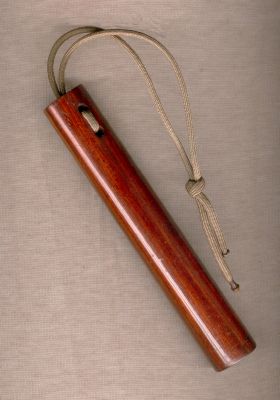
A dan bong is a short staff, 1.0″ – 1.25″ in diameter, 8″ – 14″ long, made from a hard wood such as oak. Some dan bong’s have a thong attached to one end, but that tends to be more from Hapkido than Kuk Sool. In fact, it’s useful to bring up now that dan bong tends to be a weapon of Korean flavor, and seen in the “Hapkido family of martial arts” (for lack of a better term) such as Hapkido, Kuk Sool and Hwa Rang Do. However, Kuk Sool takes a slightly different approach, which I’ll discuss later. Note as well that fighting with sticks is not unique to any one art. I am discussing a particular approach, but as you research you’ll discover how other approaches to stick fighting can complement one’s study and use of dan bong.
The intent of the dan bong is as a close-range fighting weapon. Due to it’s small size you cannot gain much distance from it (although you do gain some and when in close inches can matter), but you can gain a harder striking surface as well as a tool for leverage and locking. Furthermore, due to its small size, it can easily be concealed in a handbag or up a sleeve. In fact, due to this, some recommend that the ideal length of a dan bong should be (no greater than) the length of your forearm. Where the dan bong came from isn’t certain, but the story goes that it could have been drum sticks, or from wandering monks carrying bamboo flutes with the flute serving double duty. However it came about, it does show how dan bong techniques can be applied from non-standard objects such as a hairbrush, wooden spoon, or my favorite, the Vaughan Superbar! 😈
The primary attack mechanism of the dan bong is striking. You can strike sideways with the dan bong, you can thrust with the tip, thrust with the butt, even perform lateral strikes. A couple examples:
Dan bong tip thrust to the throat.
Dan bong block, then striking downward with the butt.
Notice how the dan bong is being held in the middle of the staff? This is the primary differentiator of Kuk Sool dan bong. In Kuk Sool, the basic dan bong technique emphasis is placed on holding the dan bong in the middle and performing a “double strike” where you strike first with one end (usually the lower) then snap your fingers/wrist to strike a second time with the other end (usually the upper). Other arts that study dan bong may mention this sort of grip and striking, but it is not the key emphasis. I personally don’t care for this “double strike” because I find it impractical in the heat of a fight. If you try it yourself, you’ll often find on the first strike that the dan bong will hang up on whatever you are striking, or if you try to compensate to not hang up then you miss. This sort of strike may work fine in forms and other controlled practice, but in the aliveness and gross motor skills of combat I just don’t see it happening. Typical grip puts the hand about 1/3 of the way up from the butt-end of the dan bong, striking primarily with the tip-end. This allows a great deal of surface for striking, provides improved reach, provides space for locks and leverage application, yet still allows some butt-end to be exposed for use.
So how do you strike? A dan bong is not a club. A club is just a basic motion of the (stiff) arm striking a surface. With dan bong, the difference is involving more of your arm – especially the wrist — to increase acceleration and “snap” and thus increase the force of impact. As a result, ideal striking points are pressure points and/or other sensitive areas of the human body. In the above pictures you see two such examples: the throat, the top of the foot. This article provides a nice overview of the 18 points that Kuk Sool teaches as dan bong striking points, as well as additional information on Kuk Sool dan bong.
Dan bong can also be used as a locking and grappling tool. Think of it as an extension of your hand, that can apply greater force and leverage. While the following video isn’t Kuk Sool (it’s Hwa Rang Do), it provides a good illustration of how dan bong can be applied.
As I mentioned before, fighting with sticks is not limited to Korean martial arts. Japanese arts have stick fighting, but I would say the Filipino martial arts are probably best known for their use of sticks. Consider the 12 attacks of Modern Arnis. These attack points apply just as well to any sort of fighting, and I’ve found study of Arnis theory and technique useful in my study of dan bong.
If you’ve spent any time reading my blog, you’ll see that I favor a different sort of weapon. However, I find dan bong to be a useful tool. It can be used for striking, blocking, locking, throwing, and adding to their impact. It’s small, practical, and the techniques can be applied to a wide variety of common objects. The only weapon I find more practical is a cane, but that’s a topic for another time. Explore dan bong.
I was at the dojang today and because we only had a few people and thus space to do so, we spent time working with staff. One thing I did was work on a staff form, Joong Bong Il Hyung (middle staff, 1st form). You can see a portion of the form here:
Notice at the beginning of that clip how the gentleman is doing 360º turns? I spent a lot of time on that today because I always have problems with that movement. I know the theory of what to do, like a figure skater that you need to turn your head all the way and focus your eyes on some point, keeping your head level, and so on, yet still it gives me trouble. However something hit me today that worked like a dream.
I took a cue from my motorcycle riding. On a motorcycle you look where you want to go. Where you look, that’s where you will go. So if you look down, you will go down. If you look through the turn, you’ll glide gracefully through the turn. Looking is very important to motorcycle riding. I noticed when I was turning that while I looked, I was only looking at the end points… that I start facing north (if you will) and look north, then I perform the 360º pivot and work to lock my eyes 360º around at the end point. But what am I doing with my eyes during the turn? Well, I wasn’t looking at much of anything… my eyes just went, wherever, I couldn’t tell you.
What I did was ensured that as I turned, my eyes stayed involved. No I didn’t still focus on any points during the turn, but your eyes still have to do something… they will still be looking, they will still be taking in whatever whirrs past them. So what I did was kept my eyes level the whole time. My eyes were semi-actively scanning and taking in everything on a plane parallel to the ground… kept it all level, kept my eyes involved. And lo… I was steady. I could pivot and rotate without any problem.
This has other implications too. Not just for empty hand martial arts skills (e.g. helping with 360º spin kicks, turning back kicks, etc.), but even for other tactical matters. I did notice while I was turning, while I wasn’t actively looking at anything, I was certain that I was taking in a great deal of visual information… I was far more aware of what was going on around me (duh!). Just goes to show that we’re not always aware of what we’re doing, and these little things can matter.
The second set of techniques one learns in Kuk Sool (at yellow belt level) is Sohn Mohk Soo — wrist techniques.
Many people put down defenses against wrist grabs, and I can understand why. It’s complicated, and in a “real fight” situation a lot of it is unlikely to work unless you’ve had a lot of training, practice, and know how to set it up. There’s merit to learning how to escape from wrist grabs because they do happen, but you just don’t always need a lot of fancy flowery moves. If what you want is to just break their grip on your wrist so you can get away, there’s really nothing special: work against their thumb (weakest point of the grip), use your fully body (weight):
Other simple movements can work too, e.g. stomp on their instep.
Back to Sohn Mohk Soo.
What has to be considered here isn’t so much that you are learning “defense against wrist grabs” but that you are also learning body mechanics. Sohn Mohk Soo teaches more about how the body works: how the wrist, arm, shoulder work, or perhaps more importantly how they don’t work. It also teaches ways for you to move your body: methods of grabbing, methods of entry, body positioning. Furthermore, just because these techniques are set up from a same-side wrist grab position, that doesn’t mean they are only applicable in that instance: an arm bar is an arm bar no matter how you enter into it. When viewing and learning these techniques, don’t stop at the surface, look deeper. There is a lot taught and much to learn.
Honestly, this doesn’t surprise me too much to see. The body can only move in so many ways, you can work against the body in only so many ways, and in the end it’s all either a push, a pull, or a twist. It’s not like it’s possible to suddenly discover some new way the body moves or doesn’t move and thus invent some new attack vector. When you get down to it, all martial arts ultimately teach the same stuff, the same movements, the same techniques; what differs is mentality, focus, approach, philosophy.
The more I read about Blauer’s approach to combat, the more I like it. It’s modern in approach, it builds upon natural body reactions and movements, but he also doesn’t totally dismiss more traditional arts. If there’s anything he dismisses it’s martial arts bullshit, which I appreciate.
For instance, Blauer understands the value of “forms” practice (kata, hyung, poomse). Many modern martial artists poo-poo the notion of it, but in the end any sort of repetitive practicing of movements is forms practice. IMHO there’s a lot of good in forms practice, so long as it’s a meaningful form and meaningful practice. If you’re just flailing and dancing, there’s no point to that other than perhaps some physical exercise and ego feeding. If however you are practicing actual martial movements to ingrain them as natural actions, if you train with the proper mindset, that has utility. Some forms practice is like moving meditation, and there’s utility in that as well (Kuk Sool’s Baek Pahl Ki Hyung is that for me). In the above-linked article, Blauer presents a “Close Quarter ‘Muscle Memory’ Form”. You must first obtain the correct mindset: visualizing where the strikes are landing, visualizing the reactions so you properly flow with their movement. Then imagine that you’re in a situation, you tried to avoid physical confrontation but the attacker/bully presses the issue and you must physically react.
Start from a “Submissive Posture” Legend: YOUR ACTION ‑ opponent’s reaction
SHORT LEAD FACE SLAP ‑ opponent flinches and closes his eyes.
PALM STRIKE UNDER CHIN ‑ opponent steps back, growls and rushes in to nail you with a “big Haymaker.”
Intercept with the S.P.E.A.R. ‑ opponent is jammed and hesitates.
VERTICAL ELBOW ‑ catches opponent under the chin, snapping his head back.
DOWNWARD RAKE (flows from same elbow #3) ‑ scratching attacker’s face, he flinches forward.
HORIZONTAL ELBOW (opposite arm) ‑ hits opponent in the nose.
REVERSE RAKE (same arm #5) ‑ causes opponent to clutch his face and turn away.
DIAGONAL ELBOW (opposite arm/up and downward, slashing motion) ‑ hits attacker in the temple (clavicle, ear, etc.) region causing him to buckle.
HAIR GRAB & KNEE ‑ grabbing the opponent’s hair, you drive a knee solidly into his face. He clutches his face and starts to stand up.
LEAD FRONT KICK ‑ seizing the opportunity to attack the groin, you step in and snap a hard, quick kick to the groin. Your opponent doubles over, clutching his groin.
REAR LEG FRONT KICK ‑ With the opponent doubled over, drive a powerful front kick, and use the shin as a striking surface, into his hands. Turn and run.
Is that a form? Sure is. Is it useless to practice? I don’t think so.
Blauer’s got an interesting approach. Well worth the read.
Updated: Found a video demonstrating the form. Tony himself made the video, narrates it.
Many of the techniques in Kuk Sool (and many other martial arts that involve more than striking) involve grabbing, trapping, locking… basically that you’re grabbing your opponent and then manipulating them in some way. There’s no denying that some degree of strength is involved in these actions. You hear the stories claiming a 90# woman can disable a 300# man… well, maybe. Let’s be honest, there’s certainly a size and strength disparity here that is difficult to overcome; difficult, but not impossible. It’s a matter of knowing how to use what strength and size you have to its maximum advantage. I’m not going to say it will allow that little woman to out-muscle the big man, but at least perhaps she can use what she has to its fullest.
One key aspect to this is to use your center. Bring things to your center, as this is where you are strongest. The best analogy is the pickle jar. When you have to open a jar (pickles or otherwise) and the lid is stuck and tough to get off, what do you do? Most people bring that jar into their center, somewhere around their belly button. You’re able to apply more strength to the lid by holding and working the jar in this location as opposed to say holding the jar at arms length and working on it there. So when you apply physical techniques to people, bring them to your center. If you cannot bring the person/joint/lock to your center, move yourself in a manner that places your center closer to the point at which you are trying to work. So you move yourself or you move them, either way it’s putting what you’re working on closer to your center. Your center is where you can best apply your strength.
Related to this, don’t forget to keep yourself towards your center. Try this experiment. Have a friend hold their forearms vertically in front of their chest, forearms pressed together, hands clenched in fists, fists in front of their chin, elbows in front of their belly button. Now you come up to your friend and place your hands atop their fists and press down as hard as you can; your friend should resist, not so much as to throw you off but just enough to counter your force. When you press down, first try pressing down holding your elbows out to the side (your forearms parallel to the ground). Then try pressing again, this time with your elbows pointing down (perpendicular to the ground). If I described this correctly and all goes well, you ought to be able to exert more force when your elbows are in. You’ve kept your elbows in, towards your center. This isn’t saying there’s magic about the center, but it’s about how our body physiology is set up and how much more effective we can work when we angle ourselves in a manner that allows our body to work to its maximum potential.
Of course, there’s a lot of philosophical implications of “finding strength from your center” as well, but that’s perhaps a discussion topic for another time. 🙂
So as you work, consider your center and keeping to it. This is where you can find much strength.


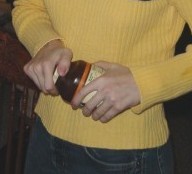 One key aspect to this is to use your center. Bring things to your center, as this is where you are strongest. The best analogy is the pickle jar. When you have to open a jar (pickles or otherwise) and the lid is stuck and tough to get off, what do you do? Most people bring that jar into their center, somewhere around their belly button. You’re able to apply more strength to the lid by holding and working the jar in this location as opposed to say holding the jar at arms length and working on it there. So when you apply physical techniques to people, bring them to your center. If you cannot bring the person/joint/lock to your center, move yourself in a manner that places your center closer to the point at which you are trying to work. So you move yourself or you move them, either way it’s putting what you’re working on closer to your center. Your center is where you can best apply your strength.
  Stuff From Hsoi