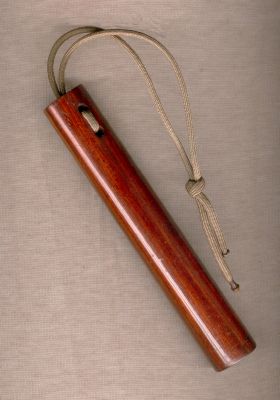
 Kuk Sool claims a wide array of weaponry. I personally don’t care for much of the weaponry taught because I find them impractical. These days one just doesn’t fight much with a trident or spear or halberd, and they’re a bit hard to conceal when you walk down the street. That said, one of given intents of Kuk Sool is to be a preservation of Korean martial traditions, so including such weaponry makes sense. Still, I have only so much time in a day to practice things, so I prefer to practice things that are practical and that I can use. Weaponry such as cane, rope, fan, staff, and what I want to speak about here: dan bong.
A dan bong is a short staff, 1.0″ – 1.25″ in diameter, 8″ – 14″ long, made from a hard wood such as oak. Some dan bong’s have a thong attached to one end, but that tends to be more from Hapkido than Kuk Sool. In fact, it’s useful to bring up now that dan bong tends to be a weapon of Korean flavor, and seen in the “Hapkido family of martial arts” (for lack of a better term) such as Hapkido, Kuk Sool and Hwa Rang Do. However, Kuk Sool takes a slightly different approach, which I’ll discuss later. Note as well that fighting with sticks is not unique to any one art. I am discussing a particular approach, but as you research you’ll discover how other approaches to stick fighting can complement one’s study and use of dan bong.
The intent of the dan bong is as a close-range fighting weapon. Due to it’s small size you cannot gain much distance from it (although you do gain some and when in close inches can matter), but you can gain a harder striking surface as well as a tool for leverage and locking. Furthermore, due to its small size, it can easily be concealed in a handbag or up a sleeve. In fact, due to this, some recommend that the ideal length of a dan bong should be (no greater than) the length of your forearm. Where the dan bong came from isn’t certain, but the story goes that it could have been drum sticks, or from wandering monks carrying bamboo flutes with the flute serving double duty. However it came about, it does show how dan bong techniques can be applied from non-standard objects such as a hairbrush, wooden spoon, or my favorite, the Vaughan Superbar! 😈
The primary attack mechanism of the dan bong is striking. You can strike sideways with the dan bong, you can thrust with the tip, thrust with the butt, even perform lateral strikes. A couple examples:

Dan bong tip thrust to the throat.

Dan bong block, then striking downward with the butt.
Notice how the dan bong is being held in the middle of the staff? This is the primary differentiator of Kuk Sool dan bong. In Kuk Sool, the basic dan bong technique emphasis is placed on holding the dan bong in the middle and performing a “double strike” where you strike first with one end (usually the lower) then snap your fingers/wrist to strike a second time with the other end (usually the upper). Other arts that study dan bong may mention this sort of grip and striking, but it is not the key emphasis. I personally don’t care for this “double strike” because I find it impractical in the heat of a fight. If you try it yourself, you’ll often find on the first strike that the dan bong will hang up on whatever you are striking, or if you try to compensate to not hang up then you miss. This sort of strike may work fine in forms and other controlled practice, but in the aliveness and gross motor skills of combat I just don’t see it happening. Typical grip puts the hand about 1/3 of the way up from the butt-end of the dan bong, striking primarily with the tip-end. This allows a great deal of surface for striking, provides improved reach, provides space for locks and leverage application, yet still allows some butt-end to be exposed for use.
So how do you strike? A dan bong is not a club. A club is just a basic motion of the (stiff) arm striking a surface. With dan bong, the difference is involving more of your arm – especially the wrist — to increase acceleration and “snap” and thus increase the force of impact. As a result, ideal striking points are pressure points and/or other sensitive areas of the human body. In the above pictures you see two such examples: the throat, the top of the foot. This article provides a nice overview of the 18 points that Kuk Sool teaches as dan bong striking points, as well as additional information on Kuk Sool dan bong.
Dan bong can also be used as a locking and grappling tool. Think of it as an extension of your hand, that can apply greater force and leverage. While the following video isn’t Kuk Sool (it’s Hwa Rang Do), it provides a good illustration of how dan bong can be applied.
As I mentioned before, fighting with sticks is not limited to Korean martial arts. Japanese arts have stick fighting, but I would say the Filipino martial arts are probably best known for their use of sticks. Consider the 12 attacks of Modern Arnis. These attack points apply just as well to any sort of fighting, and I’ve found study of Arnis theory and technique useful in my study of dan bong.
If you’ve spent any time reading my blog, you’ll see that I favor a different sort of weapon. However, I find dan bong to be a useful tool. It can be used for striking, blocking, locking, throwing, and adding to their impact. It’s small, practical, and the techniques can be applied to a wide variety of common objects. The only weapon I find more practical is a cane, but that’s a topic for another time. Explore dan bong.
Updated: Forgot to talk about practice and application drills.


Pingback: Martial Arts News 4.5.09 « Striking Thoughts
Pingback: Dan Bong drills « Stuff From Hsoi
Pingback: Slacking, sorta « Stuff From Hsoi
Pingback: Kuk Sool Won Seminar 2009 « Stuff From Hsoi
Pingback: Raising cane « Stuff From Hsoi
Pingback: A New Journey – Part 2: Things Fall Apart « Stuff From Hsoi
Pingback: The Best Improvised Weapons « Stuff From Hsoi