Hardcore music saved my life

My friend W turned me on to Hatebreed… little did he know it would literally save my life.

🤘 Metal! 🤘

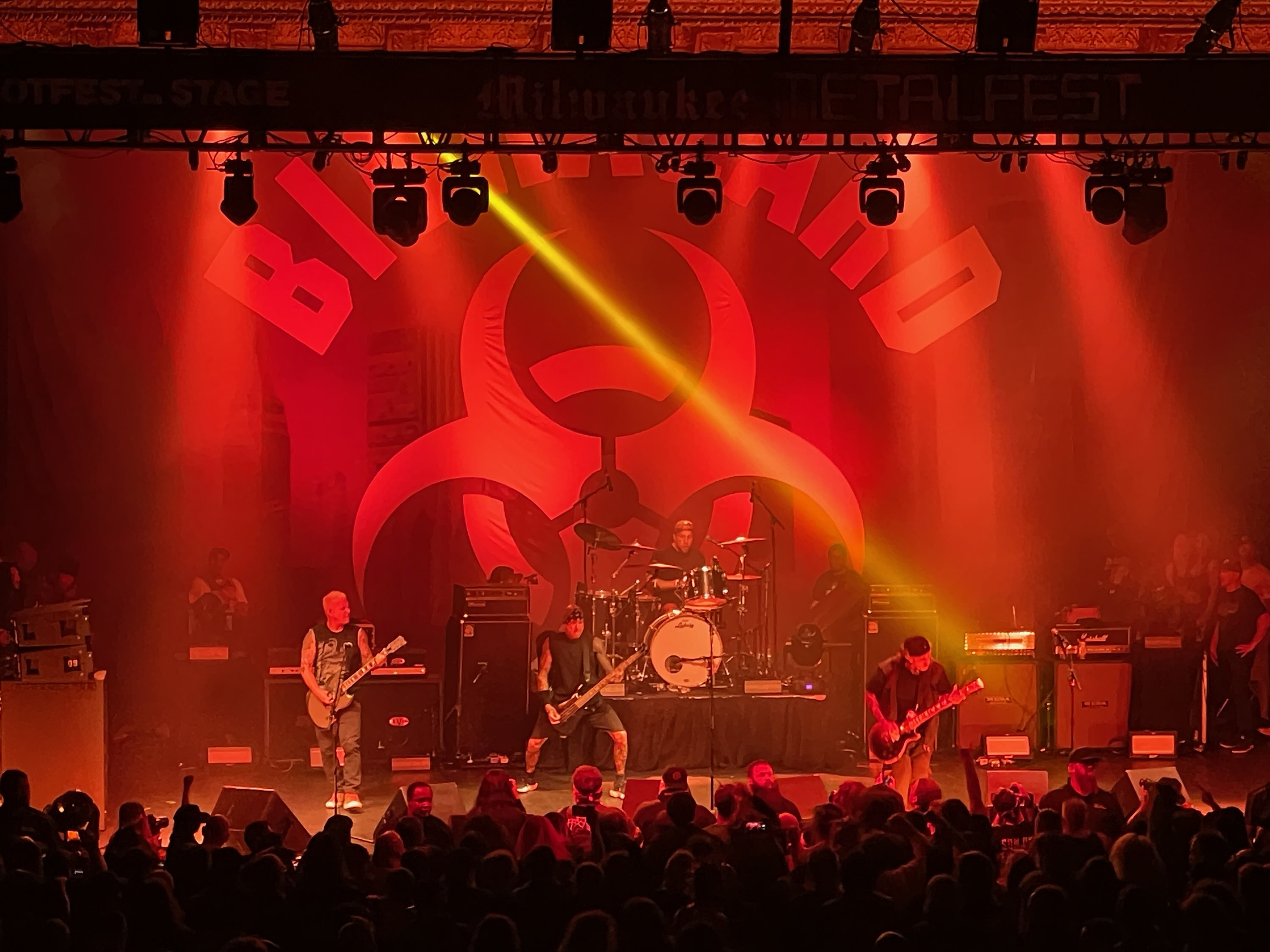
My default music genre is heavy metal. My happy music is hair metal – give me a good Winger song any day (Reb Beach is a monster and you know it). And to be consistently of-the-80s, I also love thrash metal: Metallica, Slayer, Overkill, Anthrax, Sepultura, Dark Angel – the band I went to Milwaukee Metal Fest 2023 for – more recent bands like Havok, Lazarus A.D., Municipal Waste, and Angelus Apatrida (who I first learned of at MMF23). Heavy Metal Parking Lot was my teenage reality.

A related genre always interesting to me was punk and hardcore. I grew up in the 1980s in the Washington D.C. area. I remember a punk kid in high school with his sky-high mohawk and “Marginal Man” leather jacket. I recall learning about the Bad Brains overhearing a couple dudes talking at the Tower Records over in Tysons Corner. Dischord Records. Minor Threat. I never got deeply into the DC scene at that young age, but I was aware, curious, and influenced.

College radio naturally exposed me to many things. Got see Suicidal Tendencies live a few times. Being Metal Director at WXJM in the early 1990s I got exposed to albums by bands like Agnostic Front and Cro-Mags, and getting “on the list” to see live shows like the New Titans On the Block tour which exposed me to Sick of It All.

Then one day in the early 2000s, my friend W turned me on to Hatebreed and that was it.

Hatebreed – I Will Be Heard

NYHC (New York Hardcore)

While Hatebreed isn’t from New York (they’re from Connecticut) it’s that New York Hardcore sound and foundation. That raw brutal anger from and of the city streets – not just any city, but New York City. Biohazard’s Wrong Side of the Tracks presents the city’s ethos at a mid-way break where Evan shouts: “…and when you’re in fuckin’ Brooklyn, you best watch your back!”. This ain’t L.A., baby.

I was exposed to this music and scene through working metal radio in the early 1990s. Biohazard’s Urban Discipline was released in 1992 and I was drawn to it. The rawness, the anger, the aggression. And there was something more: a morality.

I liked Biohazard (Punishment) and again the Bad Brains (Soul Craft). (Fun fact: Bad Brains got “Banned in DC“, moved to NYC, and heavily influenced the burgeoning music scene that fed into NYHC). Hatebreed is the one that really did it for me. I think it was the heavy crunch of the guitars and “chugga” rhythm – that mixing of punk and metal – Jamey’s aggressive vocal delivery, and the particular direction of the lyrics. 

Hatebreed – Before Dishonor

These days I’ve found myself rediscovering the Cro-Mags (No One’s Victim). Yeah, original band members John and Harley have issues; those are their issues, not mine. I like them both: Harley’s music sings to me, and John’s writings speak to me (I’m reading his book The PMA Effect). It’s about that PMA (Positive Mental Attitude).

And you see, that’s the thing. There’s a dichotomy between the music and the message. The music is brutal, but so is life. And the message is about life, about survival, rage, persevering, growing stronger. Some of the NYHC dudes were Hare Krishna, Bad Brains are Rasta, and that came through in their music.

And that’s the difference…

It is positive

The aggression of the music: the loud guitars, the barking vocals singing how you should “destroy everything“, which sounds bad on the surface. However, upon looking deeper one discovers it’s directing ourselves to “obliterate what makes us weak” – it’s very inward. That is a song to (re)build strength by.

Bad Brains would go from manic 30 second songs to stoney reggae numbers like I Luv I Jah, a song about being “cool that way” and how “I gotta keep my PMA”. In fact, the notion of “Positive Mental Attitude” originates in Bad Brains’ song Attitude:

Don’t care what you may say,

We got that attitude!

Don’t care what you may do,

We got that attitude!

Hey! We got that PMA!

Hey! We got that PMA!

Bad Brains – Attitude

Legend has it when H.R. was a teenager his father gave him a copy of Napoleon Hill’s book Think and Grow Rich. “It was saying, if you do it in your mind, if you get your mind right, you can do anything.” H.R. spread that message through his music.

Back to the Cro-Mags. Drag You Under

Sometimes life is a real motherfucker. 

Sometimes it feels like life is going to drag you under.

But you just can’t quit.

Cro-Mags – Drag You Under

Couple that with the juggernaut chugga of the song lead by Harley’s aggressive delivery. It injected me with something. “You just can’t quit” sticks in my head… a lot. A drum beat. A mantra. A drill sergeant (in the best possible way). An external voice always in my ear. In No One’s Victim Harley snarls:

You can’t let your circumstances define who you are.

Cuz only death is certain – everything else optional.

Your happiness depends on no one else but you.

Cuz no one else can live your life or fill your grave but you.

Cro-Mags – No One’s Victim

Very memento mori. “We cannot choose our external circumstances, but we can always choose how we respond to them.” – Epictetus

Hardcore-adjacent would be Suicidal Tendencies. You’d think with a name like that their songs wouldn’t be about life and living, but they are – they are about the struggle (How Will I Laugh Tomorrow) but also the triumph (The Feeling’s Back). Behold the epic outro rant by Mike Muir on You Can’t Bring Me Down:

Just cuz you don’t understand what’s going on don’t mean it don’t make no sense.

And just cuz you don’t like it don’t mean it ain’t no good.

And lemme tell you something

Before you go takin’ a walk in my world, you better take a look at the real world; cuz this ain’t no Mr. Rogers neighborhood!

Can you say “Feel like shit?” Yeah maybe sometimes I do feel like shit. I ain’t happy about it but I’d rather feel like shit than be full of shit.

And if I offended you? Oh I’m sorry but maybe you need to be offended! Well here’s my apology and one more thing… FUCK YOU!

Suicidal Tendencies – You Can’t Bring Me Down

That sermon – especially the opening lines – has been a plank in my personal philosophy since 18-year-old John first heard the song. And lately, the whole “rather feel like shit than be full of shit” has held true.

Hatebreed brings it the most for me. The entire Perseverance album, each song and the album vibe as a whole. That’s the voice in my head. The title song:

You can’t accept what you’ve been told. Anchored in sin you must reverse your descent.

Declare the weight of the world has yet to claim you, and admit that your faults will not restrain you.

Glimpses of fate bring light to your despair; realize hope isn’t short of your grasp!

Resurrect every dream that you’ve buried alive – and never succumb to the war that you fight in your heart!

Your world is coming apart? Remain steadfast!

Perseverance!

Against all opposition!

Crushing all limitations!

Pure strength through solitude!

Discipline and determination!

Hatebreed – Perseverance

Because we must persevere. That song is a sonic reminder – the music becoming a functional ear-worm, constantly beating important words into my head. That drill sergeant telling me to: “Keep. Showing. Up.”

Recently I found myself drawn to the title track from Hatebreed’s eighth studio album Weight of the False Self:

If you want to make a difference in the world (it means) you have to be different from the world (you see).

No victim mindset, raise your standard. Your true self calls and you must answer!

Lift the weight of the false self crushing you

Lift yourself up from malevolence

Lift the curse of the fatalist haunting you

Lift yourself out from the death grip

Lift the burden upon your shoulders

There’s a challenge that’s begging to be risen to! There’s a voice and it’s your true self calling you. End the cycle, kill all willful self-abuse. Never justify another excuse!

Lift the weight of the false self and you will be set free

Hatebreed – The Weight of the False Self

I wasn’t deeply familiar with the concepts of “true self” and “false self”, so I started reading about them, learning more. So THIS is where my imposter syndrome comes from! Learning about the notion of false self has given me much to consider. I’ve found myself doing a lot of inward examination, seeing how I have been living my false self. It’s been sobering… it’s been ego-crushing to learn how I have been living my false self; in fact, I’ve been living a number of false selfs. And while hard to accept that ego-crushing pain, I know it’s good for the false self to be crushed so I can bring my true self forward. It’s like a phoenix: “rebuild and start again, obliterate what makes us weak”.

Saving myself

I am human. I am an imperfect and flawed creature. I am just trying to get through this life (in my own way). I need ways to let off steam. I need ways to draw strength. I find both through hardcore music.

The obvious aggression of the music is motivating and fueling. As you might expect, my gym playlist has numerous songs by hardcore bands, especially Hatebreed. Loud music cranked in my AirPods while I crank out reps with heavy-ass weight? A zone of happy. 😄 Or simply just cranking loud music and air guitaring around the house! There’s motivation, but there’s also release. The music fuels a release of that energy! As a table once said, “I want my anger to be healthy.

The lyrical content provides another angle. It provokes me to examine myself, finding where I am weak, pushing me to build myself into something stronger. The lyrics provide me with oft-needed reminders, especially as life’s journey has taken me through dark roads. I wanted to quit – really quit – a number of times. I’ve battled depression since I was a teenager. I kept telling myself to just keep showing up. All storms pass.

I hear Harley barking in my ear: “…but you just can’t quit“.

Truly. Hardcore music saved my life.
Don’t be decrepit

That is my “vision statement”: I don’t want to be decrepit.

Why do I go to the gym? Sure being bigger and stronger is cool, but it’s because I don’t want to be decrepit.

I made noises getting up and down from the ground to cuddle and play with my then-infant son – I was in my mid-20s? Not right. I was a smoker and got winded walking 2 flights of stairs to the office. Not right. I saw people, middle-aged-and-up, struggling to negotiate a “flight” of 3 steps. Not right.

I made up my mind: I don’t want to be(come) decrepit.

I don’t know when I will die, and I have so little control over it. I’m not rushing headlong into death, but I’m not out to avoid the unavoidable either. What I am doing is enabling myself to live this life while I have it. I don’t need to be wicked strong, but I need to be strong. I don’t need to have wicked endurance, but I need endurance. Being leaner is better. I need to be able to move and used my body in its entirety – picking up something that fell on the floor shouldn’t be an ordeal.

And yes, sometimes my definition of living life includes doing some stupid things and getting hurt (e.g. my pec strains), and understanding that while lifting is generally good for me it does wear on me too – but I enjoy it and I’m ok with the trade-off. And yes I know that despite my best efforts, I will still age, I will still fail, I will still fall apart, and I may become decrepit.

Yet… someday, I want to be like Sonny:

Discomfort grows

My “freak out” around TacCon22 is because I was uncomfortable.

When Tom Givens asked me to present at TacCon21, holy shit – I had never felt so uncomfortable in my life. I embraced it, because I knew I would grow. And grow I did.

I was asked back for TacCon22. Of course I presented AIWB Skills, but I wanted to present something of my own. I presented my Minimum Competency stuff.

My discomfort level spiked.

I’m putting myself out there. I’m seeking to grow a body of knowledge, but I gotta make some assertions and back them up. And doing it in front of the TacCon audience? An audience of new impressionable minds, and seasoned “they forgot more than I know” veterans – my peers, my mentors. I mean… tough crowd, but that’s who I want. If I’m full of shit, I need to know.

It’s a little scary putting yourself out there like this.

I came out on the other side.

We’ll see where this goes… and how I grow.

Because it is through discomfort that we grow. When your discomfort (level) grows, remember that the discomfort (that you’re feeling is what) grows (you).

I’m not freaking out… no…

No… not at all. Not freaking out at all. 🤪

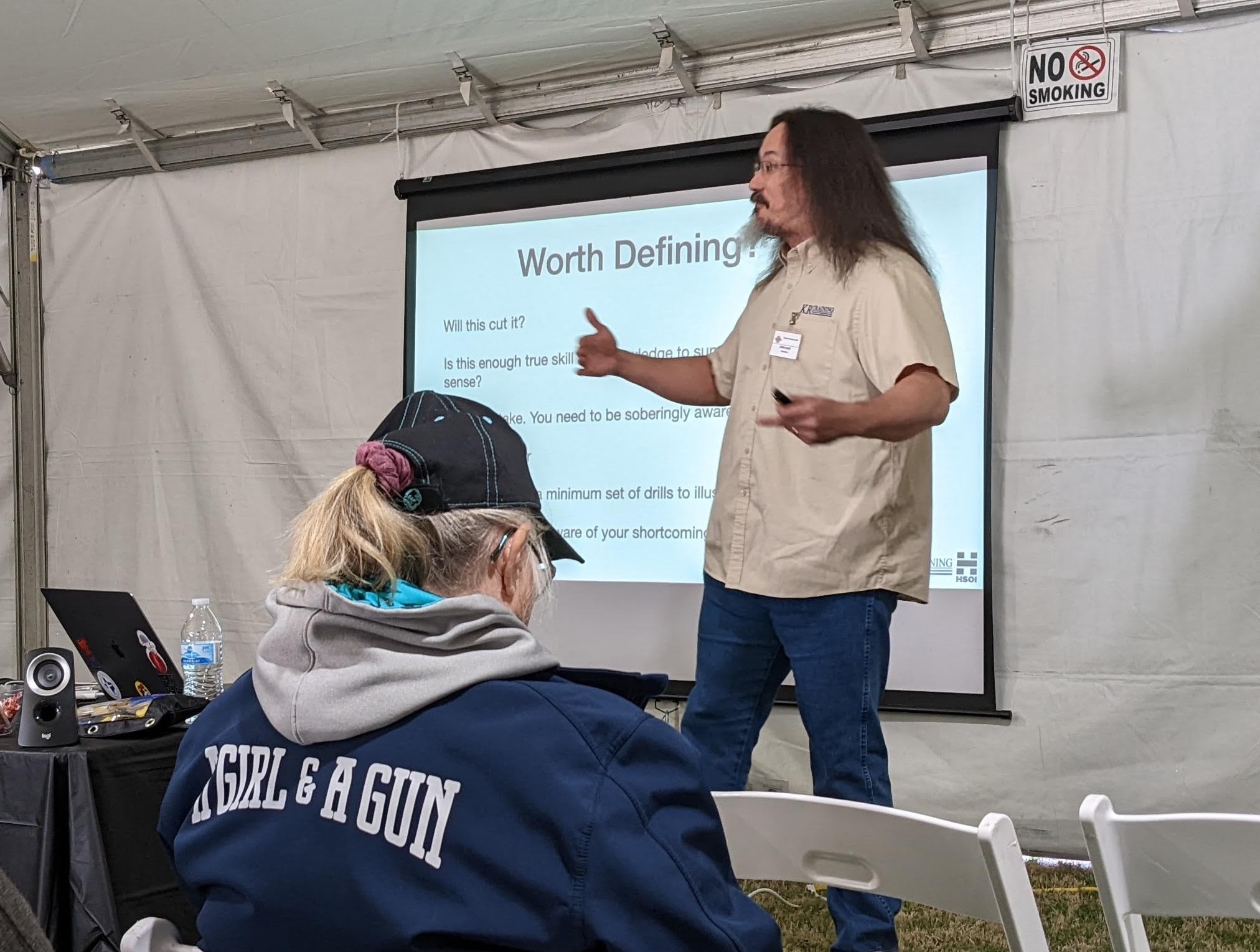
Next week is TacCon22. I am presenting 4 blocks on 3 topics: 2 AIWB Skills live fire blocks, 1 panelist with Erick Gelhaus and Lee Weems on “The Aftermath”, 1 presenter on my pet project: “Minimum Competency for Defensive Pistol” including presenting new thinking on the topic. I’d be lying if I wasn’t a little stressed. 😬

When Tom Givens asked me to step in for Spencer Keepers at TacCon21, of course I answered “Yes, sir!”. My imposter syndrome spiked to 11. But I presented 3 live fire blocks and I guess I didn’t totally suck because I was asked back for TacCon22. I’m almost finished with my prep (as prepped as I can be). It’s been stressful, but I know the Conference will be good.

Some people are surprised to learn I’m not an extrovert. Sure, I’m good at peopleing, but it consumes a lot of energy, and I need alone/quiet time to recharge (introvert). TacCon is a LOT of peopleing. It’s good, I have a great time, but it’s still a lot of peopleing. Then the added energy of teaching (“being on stage”), and it’s a draining time for me. Doing the math on that right now is building up some anxiety. I know it’ll all be fine and I’ll live, nevertheless I’ve had the stress-tick of bouncing my foot/leg creeping back in.

The Aftermath stresses me minorly. I’ve told this story before, so it’s a matter of ensuring I mind time constraints and ensure topic mindfulness. That’s all that gets me. Plus it’ll be nice to meet Erick.

AWIB Skills stresses me a bit more, but not tons. I developed the curriculum, but I don’t get to run it much so it’s not as “in my head” as say a KR Training Defensive Pistol Skills 1 class. I also made some iterative refinements, and I think it’ll work better this year. One lesson from last year? Print it out, put it on a clipboard – I can do it from my head, but there’s a lot of details to convey so having a reference on-demand is good.

But the presentation about Minimum Competency? That’s got me stressed. It’s not the public speaking part – I’m good at that. It’s the topic – but meta stuff about the topic. The original blog post has been around since 2013 and the reprint in our 2019 book. I reckon if I was totally off base someone might have called my ass out by now? Or maybe no one gives a shit – my brain naturally gravitates towards the latter. Thing is, I termed the session “a discussion” because I want to present but I want to then open the floor. I want to be questioned! The audience is the right one to ask this to, but I’d be lying if I wasn’t a little intimidated by the potential of who may be in the audience and the questions that may be asked. But that’s what I want and why I’m doing it. I want to seek truth, this is how we get there. It’s uncomfortable to go through, but ain’t gonna grow otherwise.

It’ll be a good time. I’ll be thankful for it when it’s over, but right now I’m prepping and managing my stress/anxiety about it. 😄

See you on the other side.

Subscribe

2020-05-03 – While my publishing pace has slowed, I’m still writing.

If you’re interested in whatever I may have to say, subscribe/follow.

Thanx.

PS. Sunday Metal will never die. 🤘

What is Good Enough?

We all want to know…

What is good enough?

Am I smart enough?

Am I strong enough?

Am I capable enough?

Am I able to do what needs to be done? To achieve the thing I wish to achieve?

I can’t answer that for you.

And I’m not sure anyone really can provide a single concrete answer.

For me in my world – where I like to lift weights – what is “strong enough”? There are strength standards. And more thoughts. And other thoughts. And if you search around, you’ll find even more. But look at their bias. Do they consider sex/gender (because that matters)? Do they consider age? Do they consider capabilities (e.g., someone with one arm)?

It’s good to have some indications like these, because they help us understand what is at least possible. To go from zero to world records, that gives us the continuum of what’s possible in the realm of human capability. But we all know that world records are outliers, people with a particular gift to go along with work ethic and time invested. So still, along that continuum, where can we go?

I know a cop who is a large mammal – almost gorilla-like strength. His physical strength was a huge asset in his job. But then, he couldn’t run a foot pursuit worth a damn. He worked to be able to run well, but lost so much strength. Today he’s found a medium between the two. So do these standards consider context? do they consider situation and need?

My chief profession is a software developer. As an iOS developer, my world is narrow in a sense, but one can go quite deep within it. I see web developers, and the vast choice of technologies and approach one can take is staggering. How many languages, how many platforms, how deep, how broad – what makes one a top developer?

Or how about another part of my world, with defensive pistolcraft.  Karl and I may have spoken and written about “Top 10 Drills”, but when you think about it each one of those is a particular standard. And there are so many more. What makes this one a better standard? Which one really qualifies you as “good enough”?

I was teaching this past weekend, and this topic came up. What is “good enough”? What is “sufficient”? It doesn’t really matter the context in life, it’s a general topic that applies to anything.

And all I could think of as a good and acceptable rule?

Just be better today than you were yesterday.

on “Waiting for José”, and Harel Shapira

In “Bowling Alone”, [Robert] Putnam’s diagnosis of America’s decline is rooted in the loss of civic engagement and the decline in associated life. What America has lost, Putnam argues, are institutions – ranging from churches to book clubs – in which people can come together and do things as a part of a collective, as members of a shared community; what America has lost are Americans who seek institutions; what America has lost is the spirit that is at the heart of our democracy. It is the spirit that Alexis de Tocqueville noticed in the eighteenth century and claimed as the source of America’s strength. The Minutemen agree. And the Minutemen have that spirit. What they lack is not a democratic ethos. They are what people like Putnam and de Tocqueville and our whole liberal democratic political tradition want out of citizens; engaged, active, concerned.

From “Waiting for José” by Harel Shapira.

I met Harel about a year ago. He was a student in a class I was teaching at KR Training. As far as I knew, he was just another student. Turns out that’s not quite the case. 🙂 He’s also an assistant professor of sociology at the University of Texas, Austin.

Harel’s sociological interest is in guns, gun culture, firearms education, the culture of armed citizens, and the people within. He wants to understand why people join social movements, and a large part of that is the “doing” of those movements – and so, he seeks to immerse himself in the movements and “doing” them as well. He’s still an observer and tries to remain as such, but yet he must also participate. It’s quite interesting.

Harel wanted to speak with me (beyond class) on some topics. In part because of my role as Assistant Lead Instructor at KR Training, and also in part because of the incident I was involved in on January 5, 2015. More recently, we’ve started talking again regarding phase 2 of his research (which I don’t believe I can disclose at this time, but it’s a logical progression of his research). I have maintained I will always speak about that incident, because in doing so others can learn and perhaps the world can become a little wiser, a little better. We’ve had a few long lunches, talking at great length about all manner of things (and I truly enjoy our talks). But that’s not why I write today.

Harel’s PhD dissertation became a book: “Waiting for José – the Minuteman’s Pursuit of America“. Harel gave me a copy. On a long flight to Seattle I was finally able to read it – and I’m so glad I did.

The book is thought-provoking. It caused me to reflect. It made me think deeper, not so much about The Minuteman movement or guns and gun culture – but about modern society, and our humanness. For this alone, I think this book well worth reading by anyone, and hopefully they too can step back from the specific subject matter and consider the grander implications of modern society in the USA as well as that strange thing we call “human nature”.

The Minutemen

Briefly, the book chronicles a lengthy period of time Harel spent with the Minutemen. These are people who volunteer to sit at the US-Mexico border, watching for “José” to cross illegally, and work to assist the Border Patrol in their capture.

In the pages of everything from local to international newspapers were photographs of camouflaged men prowling the desert, seemingly a moment away from committing violence. You have probably read these articles and seen these images. The liberal media describes the Minutemen as “sorry-ass gun freaks and sociopaths,” while the conservative media characterizes them as “extraordinary men and women… heroes”. In some accounts these people are patriots; in others, they are lunatics.

One thing is certain, these men and women, whatever their given labels suggest, have come to play an enormous role in our country’s debates about immigration. The problem is that our standard judgements, whether damning them or praising them, sidestep the complex dynamics of who these people are and what they do on the border.

Liberal media accounts suggest that when it comes to immigration, what the Minutemen and their supporters lack is sympathy. If only they understood the plight of the people coming across the border, they would change their minds. But if we are to understand the Minutemen, we need to understand how anger and sympathy can coexist.

Harel writes direct from his experience – he’s the one telling the story. He tells of his experiences: his first arrival, his getting thrown out, his return and initial gaining of trust, the times going out on patrol, sitting in the comms room, and other stories of his experiences with these men and women. He works to analyze and understand why these people do what they do, and become the people they become as a part of this movement.

For example, he tells the tale of Gordon. Gordon was a man without the same background as so many other Minutemen – no military, no law enforcement. Just someone who felt a pull to the movement, had no idea how to participate, but had a burning desire to do so. Then how seeing Gordon over the course of two years, how Gordon grew, how he changed, and how being a Minuteman defined his life and gave him solid purpose.

It becomes very easy to dismiss these people because they are different from you. It’s not a movement you’d join, and it seems a little weird, right? So that must mean these people are weird too. And so, they are dismissed as weirdos and written off.

But what Harel works to do? To find and show their humanness.

Because they are human, just like you.

They want to belong. They want to feel worthwhile. They want to contribute. They want to make a difference. They want to be meaningful.

Just like you.

Sure, the specifics will vary – and they even vary within this grouping. But what I found compelling about Harel’s research – and remember, that Harel is very much an outsider in almost every way – is his desire to understand. Sure, he can’t totally remove his own bias, his own filters, but it’s that very lens that makes the book the worthwhile read. Harel is naive, green, ignorant of this world, with his own preconceived notions. Sure it’s interesting to read the picture painted about The Minutemen, but it’s also worthwhile to watch Harel’s own evolution through this experience.

For me, it was especially interesting to watch because the Harel I met and know is not the same Harel as in the book. So for me, it was neat to see that further backstory to enable me to better understand where Harel is coming from, and where he’s trying to go to with his continued research.

It all boils down to a simple thing: to understanding. Why people are as they are. What makes us human. And you will find that they may not be like you, yet you are more like them than you could ever imagine.

Beyond José

To that, Harel’s latest research (as of this writing) has been published in the March 2018 issue of Qualitative Sociology, entitled “Learning to Need a Gun”. I was a participant in the research, I’ve read his paper, and while sometimes it was a hard read, I felt it was an accurate picture. Hard read? Because there are aspects of modern gun culture that are hard to accept, but to me that just means there’s work ahead towards improving how things are.

If you want to go forward with Harel, I suggest you go backwards a bit. Here’s an interview he did with the UT Sociology department back in 2013 that explains a lot about where he’s coming from.

And for the record, there’s a number of things Harel and I do not agree on. But I’ve found him to be fair and honest, and earnest in his research. I’ve also found that I really enjoy our lunches together. He’s engaging, thought-provoking, and open. I greatly enjoy talking with him, even if we may not agree (what a concept these days, eh?).

I know a lot of people are into the work of David Yamane and his “Gun Culture 2.0” research. Harel and David know each other, and Harel presented at Wake Forest back in 2016. If you dig what David is doing, you should also be following what Harel is doing.

And a great place to start? Reading Harel’s book, “Waiting for José“.

When your past affects your future

Dude, that’s not just a funny bumper sticker about your weekend hobby. It’s also discoverable evidence about your mindset should you ever have to defend yourself.

Kathy Jackson, Facebook post.

Recently Kathy reposted it, and I privately messaged her about it. I went private because I didn’t feel like bringing it up in public. Kathy responded:

There are some excellent points in that, John. Wish it weren’t sensitive, because it’s the type of thing that needs to be said. Lots there to ponder. Thanks for sharing it with me.

So I thought about it, and I’m sharing it here. It is important and meaningful, just a little awkward for me to globally share. But that’s OK – if my experiences and my awkwardness improves things for the grander community. I’ve edited it slightly, for composition and presentation.

The Message

That post you just shared about the cute t-shirt, anger issues, discoverable evidence…

So back when my home invasion incident happened, my lawyer wanted my online presence to go dark (a reasonable thing). So blog went private, Twitter, etc..

As I looked back on it, I realized it wouldn’t really have mattered. First, the media already combed the Internets for everything they could – it was interesting to watch the things uncovered and reported about me in the hours immediately after the incident. So they had likely already exhausted my blog.

But that’s the thing – there was no dirt to be found. My blog isn’t full of stupid shit – well, except maybe for the Sunday Metal music posts. 😉 You read my blog and find that I like music, lifting weights, and when I do write about self-defense and guns and such, it may not be something you agree with but it’s not “crazy”. In fact, a lot of what I write is reasonable enough I felt it would help my case if in fact it did go to trial. It would be (then) 7-ish years of proof as to my mindset and stance on everything.

So yeah, it’s a good lesson in living your daily life. Because you don’t get to choose the moment your past becomes relevant to your future.

Beware Simple Answers

Beware simple answers. They are reassuring but may not achieve the desired results given our framework of government, practical realities, and the flawed nature of human beings.

I’ve been following David’s writing and research for some time. It’s compelling and interesting.

Understanding…

I’m still waiting for all the facts to come in before I comment on this event in specific.

But as a general comment, I’ll say this.

What people like this do will always “smell off” to people like you and me – people who have a normal sense of morals, of ethics, values and virtues. It’s difficult for us to wrap our heads around their behavior.

For example, a cop friend of mine was relaying a story of an incident where 2 women were shoplifting, with their infant children in tow. When store security confronted the women, the women used their infant children to beat the security guards away. Can you fathom that? Using your baby as a cudgel?

To us? That’s unfathomable. To them, it was totally acceptable.

And we can’t understand how someone can do that, but yet they did.

You get paid by having a job. There are those that view burglary and robbery as their way to “get paid”. So it’s perfectly normal to them to commit crimes.

Every day there are stories and events of people doing inhuman and unimaginable things. This is why violence and crime are such hard things for many to understand – because those who commit it are so far removed from our sense of morals, values, ethics.

It’s very human to look for the motivations, to try to understand why; especially because we hope it will allow us to prevent it from happening again. It’s also important for us to accept some things we’ll never understand, and some people may not be worth understanding – just accepting they are out there.

(The above was a comment I made on a friend’s Facebook posting about the recent incident, slightly edited for grammar. I felt it worth sharing to a larger audience).