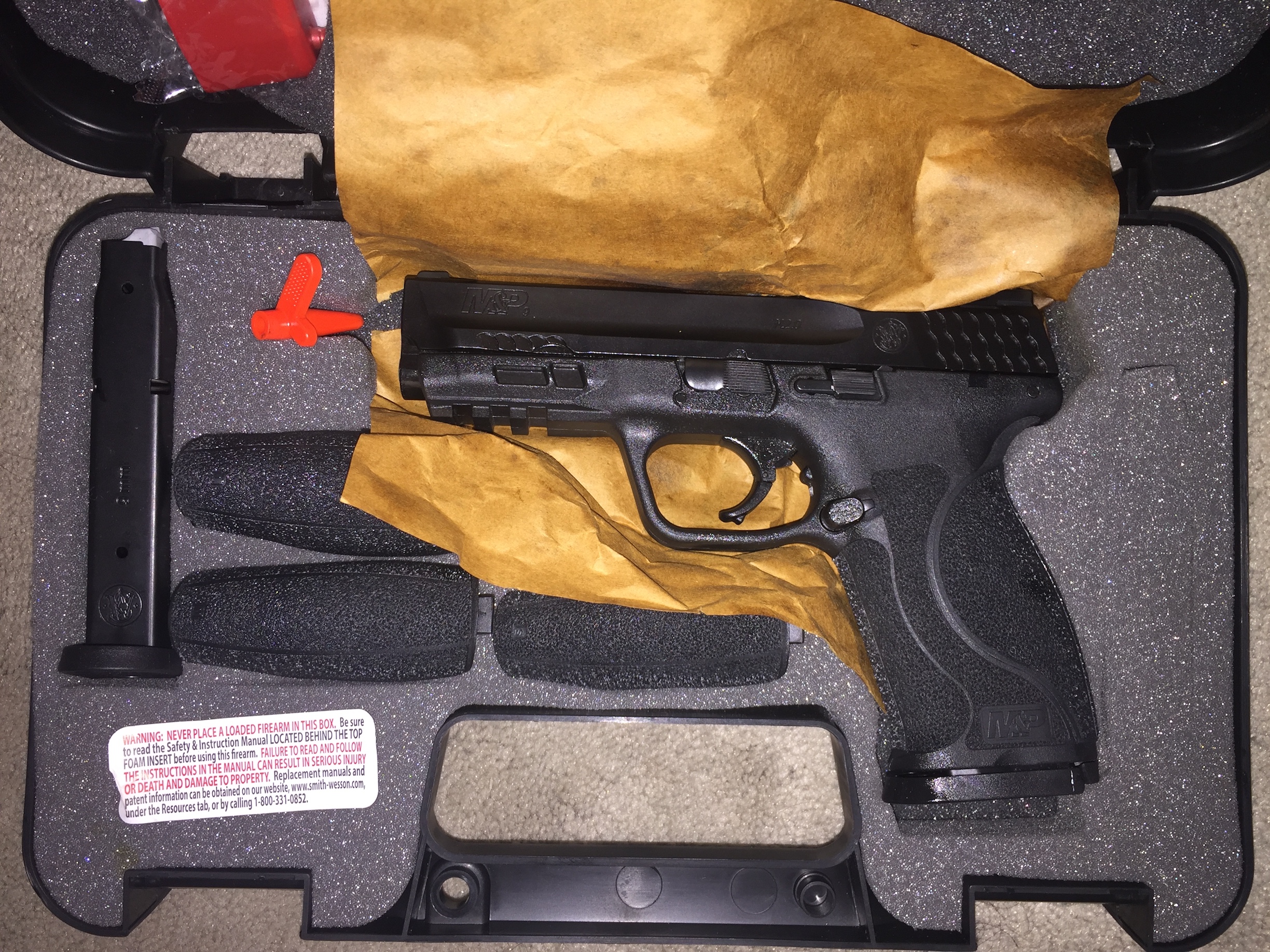
A little more with the M&P 2.0

So more live fire work with the new M&P9 M2.0.

Again, I’m generally pleased with it. It’s performing well. There is less felt recoil. It’s consuming whatever ammo I feed it. Accuracy of the gun does appear better than my 1.0, but it’s still a factory mass-produced gun with looser tolerances. I did notice some additional hardware differences vs. the 2.0: the barrel profile is a little different, and the ejection port seems to be opened up a little bit.

But all in all, it’s good.

What’s not good is my own shooting. For sure I got rusty during the winter break. I’ve been shooting my normal host of standards and drills for comparison of my own progress, and some things are better, some things are worse. One thing that I’ll be curious to see is how some of the distance shooting changes once I change the trigger innards to the Apex Tactical parts. While the factory trigger isn’t bad, for sure I feel that weight and “heavier break” when I’m shooting at longer distances and attempt a little more finesse. So getting an improved trigger ought to help a little bit. Still tho, most of the suck is on me, not the hardware. 🙂

To that, I do have the Apex Tactical kit and some Dawson sights. I’ll work to put them on soon. Then some live fire with them to see how things fare. Then I reckon I’ll put this gun into regular duty.

KR Training 2017-02-04 – Lone Star Medics Dynamic First Aid Quick hits

Caleb Causey of Lone Star Medics returned to KR Training on February 4, 2017 to put on his Dynamic First Aid course. I like to describe Dynamic First Aid as “First Aid 102”. That is, First Aid 101 is things like dealing with cuts and Band-Aids and such first-aid fundamentals. Dynamic First Aid continues from there talking about dealing with severe bleeding (tourniquets, pressure dressings), shock, burns, splinting, scene safety, and the like. It’s a great course and I think one everyone should take.

Yes, everyone.

In one of my first interactions with Caleb years ago he made a great point. He asked the class how many people had seen a gunshot in the past year? No hands go up. Then he asked how many people had seen a car wreck in the past year? Hands go up. Don’t you think that’s a situation that may warrant first aid skills?

And think about simple things like cuts, or nosebleeds – solving those are first aid skills! The preservation of life isn’t just about “self-defense”; first aid is very much a part of that, and essential skills for all people to possess. Because we ALL encounter such issues at some point in our lives.

Something else to think about? There are people that believe when things go pear-shaped they will rise to the occasion. That may happen, but in a first aid situation? Explain to me how you will rise up and suddenly have the knowledge of how to stop severe bleeding? or administer CPR? You won’t. These skills and knowledge will not just come to you: you must have taking the time to acquire them beforehand.

I made it one of my 2017 training priorities to get more non-gun skills, like medical training. But this class became a little different for me: I wanted my family to take it. And yes, Wife, Oldest, Daughter, and Youngest all attended and participated in the class. Yes, Dynamic First Aid is suitable for children, but within reason. For example, part of first aid has realities of body parts; so if there are issues with words like “penis” and “vagina”, they may not be ready for the class. That’s something I admire and respect about Caleb: he called me before class and wanted to check on all of this. His sensitivity towards his students is part of what makes him a great teacher.

Class

Class ran well. A good and motivated group of students. Caleb balances the class well. There’s a time for lecture, a time for demonstration, and then a time to have everyone practice and try it for themselves.

What’s especially good? The class culminates in some scenario training. This is invaluable training, because it not only forces you to put your knowledge to work, but it adds some pressure and realism to make you have to think.

I also find scenario work to be a good source of inoculation, so when problems happen you don’t freak out but instead can handle the situation with some degree of aplomb. For example, in one scenario Wife was a resucer and Youngest was a victim. When Wife saw Youngest, she was truly shocked and broken up at the sight, but went to work because that’s what Momma has to do. Afterwards, Wife told me how it was hard for her to see it, but I told her it was good because now if something does happen to Youngest, instead of emotions taking control of her, she can know that she’s seen it before, that she’s got the skills to address the problem, and she can get to work.

That’s why such training is so important, and I’m so thankful that Caleb puts a high value on scenario training in his classes.

Get out and do it

Get the knowledge, get the skills. You don’t know when you may need first aid, but I feel safe in saying that you will at some point in your life – you just don’t get to choose when, so it’s important to have that knowledge beforehand.

My family is one of the most precious things to me. I’m willing to put their well-being in Caleb’s knowledgable and proficient hands. If you get a chance to train with him, you should.

Thank you for teaching me and my family, Caleb. Drink water.

Smith & Wesson M&P9 M2.0 – Live Fire

Previously I had written about my “first impressions” of the new Smith & Wesson M&P9 M2.0. Those impressions were from bringing the gun home and doing some dry fire work with it, along with some other general exploration (e.g. equipment compatibility).

What people really want to know is: how does it shoot?

Live Fire

At this point I’ve put about 1000 rounds through the gun across 3 range sessions. Mostly Freedom Munitions 9mm 124 grain RN New and Reman, but also some Speer Gold Dot 9mm 124 grain +P.

I shot numerous drills, such as: Three Seconds or Less3M Test, Rangemaster Bullseye. I also shot a lot of steel.

My goals were to put a lot of rounds through the gun, to break it in and just see if it runs without problems. To assess how it shot, how it felt, accuracy, reloads (especially the whole auto-forward issue), etc.. Just see if it really addressed my gripes with the 1.0 or not.

tl;dr Answer

I’m happy.

Details

The first thing I noticed was less felt recoil. I was surprised at first, so I switched back to my 1.0. Did some back and forth between the two guns, and no question: there’s less felt recoil. It’s not some huge difference, but I noticed it.

It also appeared to be less muzzle flippy. Is this because of the steel frame inserts? Or maybe because of the aggressive grip texturing? Probably both. Bottom line is I found myself back on target faster.

Functioned just fine. There was one failure to fire, but it was the ammo and not the gun. Things went bang. Extraction and ejection was fine. I did clean and oil the gun when I first got it, haven’t cleaned it since then. I don’t plan on cleaning it for a while (tho I may add a little oil now and again).

I don’t find the factory sights great, but as far as factory sights go they’re not the worst I’ve seen. For sure I’ll be switching to some Dawson Precision (0.100″ red fiber front, 0.125″ serrated Charger rear).

Again, the trigger is serviceable. It’s not too bad for a factory trigger. Main place I noticed was doing 25 yard group shooting, and there I did feel the pull weight. But even  tho it was a little heavy, it was workable. Yes, I’ll be switching to a Apex trigger, because it will be better.

To that, I’ve said before and I’ll say again that I wish I had this gun during the Rangemaster Advanced Instructor course some months back. My first range session with this gun was actually my first live-fire in some time due to the holidays and such. I know I had to shake a little rust off. That said, if I had shot 25 yard groups like this during the Instructor class, I’d have been thrilled (all shots inside the 9-ring @ 25 yards, consistently – and again, with the factory sights and trigger and FM’s reman ammo). I did some further accuracy (group) shooting from 5, 7, 10, 15, 25 yards. Just drilled things. I know how I shoot. I know how my groups normally look. There’s no question the hardware simply improved things. Is that tho a statement of how well the 2.0 shoots? Or how horrible my 1.0 shoots? Probably a little of both.

Grip texture really got in my way during my drawstroke. Clothing snagging, hand dragging. I’m sure I can adjust, but I just normally don’t shoot with a heavily textured grip. That said, the more I use it, the more I like it – from a shooting standpoint. From a concealed carry against my skin standpoint, not so much.

The auto-forward. This is the curious part. Try as I might, I couldn’t get it to auto-forward. I put the mag in the gun, locked the slide back, and HAMMERED the gun on the bench repeatedly with a great deal more force than one would normally use to seat a magazine. The slide never dropped out of battery. Great! And for the most part, every (re)load I would do, never a drop. But, there were a couple times where it did! That was curious, and a little bothersome. I’m trying to figure out why it happened. My current hypothesis? The slide stop wasn’t fully engaged to begin with. The new design requires explicit force to engage and disengage (vs. just spring tension and pushing). It may be that the stop wasn’t over the little metal “hump”, so it’s easy to slide back down. But that’s just a guess, and of course the next question would be: why isn’t the stop then going fully over the hump? Again, this is all a guess right now, as this is something that’s difficult to catch and notice before it happens so you can know to pay attention to why it happened. But at this point I don’t consider it a showstopping problem. I mean, when I can smack my 1.0 and have no problems getting it to autoforward, but I can beat on this and autoforwarding is rare. I’m going to keep my eye on this, but so far I’m not going to sweat it too much.

What troubles me more is that it revealed I do have a training scar from contending with the auto-forward issue for so long. I stutter on my reloads because I’m diagnosing the issue. Well there isn’t any more issue, but still I stutter. Just means lots of dry practice on reloads to overcome this. Just how it goes.

Where to next?

At this point, I’m pretty happy with the gun. Happy enough to go ahead and press it into service.

I’m going to order an Apex trigger kit, Dawson sights, and work on the grip texturing a bit. I know it’s a hot topic about having to change the sights and trigger, like it should just be awesome right out of the box no changes needed. I can see that, and again I think for many people the gun will be just fine out of the box. On just about any gun I would buy, I would be changing the sights and trigger because it’s rare the factory trigger and sights will be awesome (and I’m talking mass-produced guns, not hand-crafted custom pieces or really high-end like Wilson Combat or Nighthawk Custom).

Once I get those in and installed, I’ll be making this gun my primary.

We’ll see how things go over time. It may continue to live up to expectations, or it may fall from grace.

Time will tell.

KR Training 2017-01-29 – BP1/SB Quick Hits

It felt good to be back out on the range teaching at KR Training. We take a quasi-haitus during November & December as a nod to our neighbors during deer hunting season. And 2017 is hitting the ground running.

Since Karl is now retired, he’s able to pour a lot more time into KR Training. One thing we’re trying out is more class times, such as offering classes on Sunday. This was one such class, and we had a good turnout for both classes.

Basic Pistol 1

Another change for 2017 is acknowledging a gap we had growing into our curriculum.

For many years we had Basic Pistol 1, which was a handgun selection, safety, and basic fundamentals course. The next step would be Basic Pistol 2, which worked on foundational marksmanship towards gaining the skills needed to pass the Texas CHL/LTC live fire test. Early on we had time in class to cover a host of little – but important – things, like how to load magazines, explaining the different action types on guns, and so on. Over the years things like that faded from class, not because we intentionally dropped them, but we’d find areas of greater importance to address and as time went on and class duration didn’t change, something had to give and we found some of these important things not always being covered from lack of time. Consequently, we acknowledged a growing gap on our curriculum and over the past some months have been evaluating means to address it.

What we landed upon is essentially this: what was Basic Pistol 1 (gun selection) is now a new course called “Handgun Selection”. Basic 1 is now about safety, range etiquette, basic technique, gun functionality (loading magazines, (un)loading the gun across different types and styles of guns from single action cowboy revolvers to DA/SA’s with decockers to 1911’s to Glocks), and then some live fire range time working on basics and fundamentals. Basic 2 remains what it always has been, a Defensive Pistol Skills Essentials class.

What’s nifty is the new Basic 1 is essentially based upon the new NRA Basic Pistol course. We found that what we needed to offer dovetailed well with the NRA course. That means you can register to take the NRA Basic Pistol online, then our class works for the live-fire portion of the NRA course. We will submit your records so you can also receive credit and a certificate from the NRA for the course.

As for the class itself, it ran great. We had a great set of students and fantastic weather. Everyone was open, engaged, and I saw noticable improvement across the board. We had a mix of students, including one teenager that was a little nervous but I could tell by the end of class she had a great time.

As it was my first time with the new approach, I was generally happy with it. I’ve long appreciated some of our “buffet-style” approaches in beginner classes. For example, having women shoot an airweight .38 snub-nose revolver. Not because we recommend it, but because precisely we don’t. But the sad reality is there are too many sales people behind the gun counter that think an airweight snub is the ideal gun for a “little lady”. (rolleyes). I like to have women (and men) shoot one just once, because that gives them the ability to look that salesman right in the eye and say not just “no” but “hell no”. An educated customer is the worst thing for a salesperson. 🙂  And so in this class, adding in the buffet of gun types and actions to have everyone load and unload them, yes it’s time consuming but it was quite educational. For example, small semi-autos must have very tight and strong springs, and thus the slide is harder to rack. Putting an M&P Shield in someone’s hands, then putting a full-sized Glock in their hands and watching their eyes open with relief when they see how easy the Glock is to work, that sort of knowledge and education is important at this student level.

That said, one thing we will need to work on is timing and class rhythm. For a first run it went really well, so it’s just small refinements. But that’s something I like about working at KR Training: we are constantly working, constantly evolving, constantly examining what we do to ensure it’s of highest quality. And if you have feedback for us, we always want to hear it.

Skill Builder

The afternoon was our Skill Builder course. This is always a fun and challenging class, no matter your skill level. We had a good group of students, including a good number of repeat students. It’s great to see people working hard to improve their skills.

All in all, a good day. I’m happy to be back out on the range. Tho I have to say, if the weather is this great in January, I’m afraid of what it’s going to be like come July and August. 😉

Thank you all for coming out and training with us. We look forward to seeing you again.


Smith & Wesson M&P9 M2.0 – First Impressions

This is my Smith & Wesson M&P9 M2.0. There are many like it, but this one is mine.

Background

I’ve carried and shot an M&P9 (version 1.0, if you will) for a number of years now. Thousands upon thousands of rounds downrange. It’s what I’ve taught classes with, took classes with, hours of dry fire. I’ve got a lot of time behind that M&P.

But in all of that time, I’ve not been entirely happy with it.

It started with accuracy issues – or rather, lack of accuracy. When I first bought the gun the accuracy was horrible. I wasn’t the only one nor the only gun experiencing that problem. I did put in a KKM barrel and that addressed things to an acceptable level.

But the most annoying part was the auto-forward “feature”. Seat the magazine and the slide will automatically drop and go into battery. Or not – it wasn’t consistent. Sometimes when it would go forward, it failed to chamber a round. And during the Rangemaster Advanced Instructor class back in September 2016, it auto-forwarded right into a double-feed (don’t ask me how, but it happened). My frustration with the gun was at the tipping point and I was about to leave the class and head to the store to pick up either a Glock 19 or a SIG 320. However, at the time a little birdie told me that Smith was working on a major revision to the gun that worked to address “all the problems” AND would maintain compatibility.

See that’s the big problem with switching: it’s expensive. You buy the one gun, add better sights and better trigger. Well, now you need 2 guns (with sights and trigger) because redundancy is important. Then you need holster and mag pouches, well really two sets of those as well. I’d want at least 2 dozen magazines. And the cost of switching platforms just rises fast. So I figured I could wait a few more months to see what this “next gen M&P” would be like. If it fixed things, great; I wouldn’t have to invest in anything more than the gun (and sights and trigger). In fact, I’d be in no rush to get a second gun because I could always fall back to my old guns for redundancy if needed.

And a few weeks ago, the M&P9 M2.0 was revealed. I purchased one as quickly as I could.

Note: this is my own private purchase of the gun. No sponsoring, no T&E, no nothing. This is all my money, my experiences, my opinion.

First Impressions

Looks like an M&P.

I of course had to start dry. Bought the gun, brought it home, looked it over, a little dry work.

Here’s what came from that time.

Grip

Holy crap! That is some majorly aggressive grip texture.

I have to wonder who’s idea this was, and what market is S&W trying to hit?

I mean, it’s really good grip, but very abrasive. I would love this for competition shooting, because you don’t shoot much but when you do you shoot hard. Such an aggressive grip is great for that.

Shooting 2000 rounds in a weekend class? That’s going to get old really quick.

EDITED TO ADD: Based on some comments I saw, I want to clarify the above. I’m not trying to say anything about competition vs. self-defense type shooting. It’s merely a statement of shooting volume. That is, if your time shooting the gun is short, like a 30 round stage, plinking in the back pasture, or other things where it’s just a short amount of time spent with the gun, lots of rest/breaks, etc. then the texturing is likely to not be a problem. In fact, I’m sure it’s going to help because you will be able to grip the gun better. But if you’re shooting with a lot of volume: long practice session, weekend classes, etc., the texturing is going to wear on your hands. It’s just a matter of abrasion and how long your hands can handle it.

And concealed carry? I have no idea how that’s supposed to happen. Maybe I’m supposed to build up a callous on my torso? I wear against my skin and it took all of a couple seconds to know this is a no-go for me. Plus clothing snags way too easily.

If this gun pans out, I’m going to take some sandpaper to the grip to reduce the aggressiveness of the texturing. I didn’t mind the original texturing at all, but then I also have a strong grip so YMMV.

One thought I did have was to see if I could be judicious about where I smoothed it down. I may smooth down the sides but leave some aggressiveness on the front and back straps. TBD.

As for the backstraps, there are now 4, adding a “medium-large” to the mix. I’m still playing around to see what works for me. In the 1.0, the large is too large for me, but medium was workable tho always felt a little small. So I’m currently trying out the medium-large and so far it feels alright. I’ll continue to switch around a bit until I land on what works for my hands, and before I start sanding things down. The more size options are nice.

Another change to the grip is the removal of the extended beavertail. So far I’m good with this. I have other M&P’s, including M&P9c, which also lacks the beavertail. I haven’t really noticed any issues – shooting or comfort-wise when holstered – and I actually wonder if I’m able to get slightly higher up in my grip now. It feels like it, but it’s hard to measure.

Accessory Fit

I checked to see how accessories would work.

Existing magazines? No problem. I saw a few things online that gave the impression there’s a new “2.0 magazine” out there, but unsubstantiated. To my eye there’s no difference between the old and new mags. Or even if there is, the old mags worked fine with no problems I could determine.

Existing holsters? YMMV. I tried in all my M&P holsters and had no problems. I did notice a couple had a slightly tighter fit, but just barely. I saw someone measured and found the 2.0 is just a hair thicker than the 1.0, so it is possible you may have fit issues with your particular holster. But as well, since many holsters have tensioning screws, likely a slight adjustment will address fit issues. So I see no major problems here.

It does look like Apex Tactical has new/different parts for the 2.0. I’ll look into these at a later date.

I’m going to guess that aftermarket sights will be the same as the 1.0.

Trigger

I’m quite impressed. For a factory trigger, this is pretty good.

Measured the pull weight around 6 lb., but it does not feel like a 6# trigger. Karl tried it too and agreed it feels really good. I did notice during some later live fire that during some 25 yard slow-fire bullseye shooting I did think to myself “OK, this is a 6# trigger”, but overall not bad.

There’s a little travel for sure. You do get a good tactile reset. Some have asked about grit and I don’t feel any in mine, but I’ve seen some YouTube videos showing some – so again YMMV. I expect as the gun breaks in the weight will drop maybe to 5.5# and of course things will continue to smooth out.

I am finding the factory trigger to be quite usable. Oh I do expect I’ll get an Apex kit because there is room for improvement. But honestly? This is a gun where I don’t feel any rush to get an improved trigger.

Sights

The same Novak’s S&W has been putting on the M&Ps for a while now. I don’t find them all that bad; pretty good for factory sights at least. I did of course take a Sharpie to the dots on the rear sight and blacken them out. Only mod I’ve made on the gun.

I’m sure I’ll change these to Dawson Precision at some point.

Magazine Release

The mag release button is all metal. I’m not sure if this was to address some sort of problem, but it’s no big deal to me either way.

One thing I will be curious about is long-term. I noticed over time that my 1.0’s mag release got sluggish. I would disassemble and clean and it’d be fine again. I wonder if the added weight of an all-metal button might help with that. We’ll see.

Slide Stop

This is probably the most interesting and most-talked about change on the gun.

The engineering is different, and unlikely anything I’ve seen. I asked Karl if he’s seen such a thing before and he hasn’t. I’d be curious from any of the real gun-history buffs out there if this is truly a new approach or something rehashed from before.

Basically there’s a piece of metal “embedded” into the frame, and the slide stop lever folds over it. It’s a bump. So this bump now physically holds the lever up. It takes intentional force to push the lever down vs. in most guns where spring tension just returns the lever downwards. Building upon that, the slide stop’s notch in the slide is very small and shaped like a triangle. Why? Because retraction of the slide doesn’t just release friction and the stop drops. Instead, the front-edge of the notch is angled so retracting the slide applies force to the stop and pushes the lever downwards.

It’s an interesting solution to trying to keep the slide from auto-forwarding.

I’ve banged on it a bunch of times as hard as I could, harder than one would normally hit. The slide hasn’t fallen.

That’s great.

Unfortunately, it’s not perfect. Because there have been a couple times when the slide has dropped on me. I’m not sure why. My wild guess is perhaps the slide stop lever didn’t fully ride over the little metal bump, so it was on the windward side of sliding down anyways. But just a totally wild guess.

What I wonder? How robust is this solution?

You now have 2 pieces of metal in constant contact, riding over each other with tension and friction. Directly that means wear. But as well, the way the metal is folded over for the slide stop lever, every time it goes over the bump the metal has to flex a bit at the “hinge” point. How long until that breaks?

I would guess from the design of things if the slide stop tab did break off the gun would continue to function just fine – just no tab for your thumb to flick. Still…

Only time will tell.

Dry Fire

Working with the gun in dry fire was generally positive.

One hard part is again the aggressive grip texture. My draw technique apparently has me coming in contact with the grip and sliding my hand around the grip to achieve a proper hold. This is almost impossible with all that texturing; well, at least if I want to keep the skin on hands. 🙂

Trigger feels good.

Overall weight and balance feels good. S&W impregnated some metal into the frame of the gun, apparently to make the frame stiffer. Can’t comment on the stiffness in dry fire, but it doesn’t feel like the gun has become front-heavy. Some of the cosmetic changes to the front-end may have been to remove a little bit of weight to compensate for the addition of the stiffeners.

I’m not used to the factory sights (all my other guns have Dawson Precision, with 0.100″ red fiber optic fronts and 0.125″ serrated black rear Charger sights). But that’s no big deal.

Working the slide, slide-stop, etc. feels a little different, but the manual of arms is unchanged. It just feels stiffer, a little more work to do things, but when you’re working at speed you’re unlikely to notice. However, those of you that like to drop the slide by flicking the slide stop lever? That’s going to be harder to do with this gun: it’ll be interesting to see if S&W loses or gains ground in IDPA and USPSA competition with this 2.0 model due to that issue.

Live Fire

I’ve done some live fire with the gun, and while results are generally good, I’ve had some things that have given me pause.

I’ll be having another live fire session soon, and hopefully that will solidify what I’ve seen so far: either for good or for bad.

I’ll report on that soon.

Overall First Impressions

In general my first impressions have been positive.

The aggressive grip texture is the big negative for me, but because my primary context is concealed carry and that grip against my bare torso all day just isn’t going to happen. I can’t expect the average Joe to sandpaper their gun’s frame or even realize they could.

In terms of my reasons for buying and trying a 2.0? So far so good. But the jury is still out.

KR Training January 2017 newsletter

The January 2017 KR Training newsletter is out.

We’re offering a bunch of specials and deals, in addition to the usual news and guest instructors.

Come train with us in 2017!

See you on the range.

Life lessons from a weekend hunt

This past weekend I had the pleasure of going hunting with an old friend, Charles Coker of TacticalGunReview.com. We were able to harvest 2 whitetail does and a feral hog. From the 48-ish hours together, I took a few things from it.

Sometimes you have to be a little impulsive if you want to succeed in life.

I’m a planner. Deer and hogs don’t care about your plans. They’ll be here one moment, then gone the next. You may only have a few seconds of opportunity, so sure… plan so you’re ready when the opportunity comes, but the moment the opportunity presents itself, you better jump on it.

But on the same token, if you’re not totally certain, let it go; rushing in can lead to failure.

Suppressors are good things.

Suppressors, silencers, whatever you call them. They have this stigma of being some bad evil thing that must be banned or at least heavily regulated.

Why?

You know what a suppressor is?

A muffler.

Next time some dude on a Harley-Davidson motorcycle blares by you with his loud-pipes and rattles your dental fillings loose – those are straight pipes, no muffler. That’s how loud engines are, and why mufflers were invented. That’s how loud your car would be if you didn’t have a muffler on the exhaust.

See why mufflers are nice and desirable things?

Same with suppressors.

Good friends are those that put up with your shit, and still want to hang out with you.

Charles has invited me out hunting on numerous occasions over the years, and most of the time I have to say no because I’m busy (day job commitments, or KR Training weekend commitments). He gives me some friendly and well-deserved ribbing about it, but he understands. And despite all my turn-downs, he always keeps the door open and keeps asking me.

On top of that, he was a top-notch and most-generous host.

Those are the sort of people you cherish in your life.

Thanx, Charles for everything.

The waiting is the hardest part…

I’m waiting for something to arrive.

I finally have a tracking number, but not only do I have to wait for it to be delivered, I have to wait to be told when I can come pick it up.

I am hoping to have it in time for an event, because I’m itching to see if things truly will be better. It’s all about timing, and it’s all out of my control.

Sigh.

But I reckon you’ll be curious to hear my reports once I can deliver them.

Stay tuned…

Good fitness is self-defense

If you read my blog you may have noticed that I don’t write as much as I used to, but I sure lift weights at the gym a lot. 🙂

I lift because it’s the form of exercise I enjoy the most. Why do I exercise? Lots of reasons, but my main motivator is I don’t want to become decrepit.

Look around you. Look at how people struggle to do basic things like walking up and down stairs, getting in and out of a chair, or picking something up off the ground. There’s no need to start talking about things like running when people struggle to do even basic life functions.

Ever watch videos of self-defense events? They are rapid, dynamic, and to some extent or other involve physicality. Sometimes that physicality could be a brawl, or sometimes it’s just a need to run like a bat out of hell in the other direction.

If you struggle to get out of a chair, if you get winded walking up stairs (or you know you will so you avoid it and always take the elevator), if you can’t bend over to tie your shoes (or you say “fuck it” and always wear flip-flops) – how do you think you’re going to fare when the flag flies?

You don’t even have to be old or fat. Does your job involve you sitting in an office chair crumpled down in front of a computer all day? Cliché as it is, but there is truth to “use it or lose it”, and desk jockeys (and I’m one of them) are losing it.

I see it with students in classes. Shoot the gun, reload and drop magazine on the ground, then it’s a struggle to bend down to pick up the magazine off the ground. And yes, maybe your self-defense incident may be solvable purely by your gun and your wits, but when do you get to choose what your self-defense incident will look like?

This isn’t to say you have to bench press 300 lb., be able to run a 5 minute mile, and be as sexy as Dwayne Johnson. It just means you need to be able to function.

Speaking from personal experience, another useful reason for having some level of fitness is it improves your ability to deal with the physiological effects of the event and the aftermath. Given all I experienced both during and afterwards, I firmly believe a high-level of physical fitness helped me manage the intense stress. Heck, I lost 6 lbs. that day! My event in and of itself was not physical (wasn’t some brawl), but rare in one’s life is such a degree of stress and pressure, and being able to have a physically strong heart and body was unquestionably a benefit.

Or we can just look at it in a simpler way.

Your chances of being killed in a terrorist attack? Supposedly 1 in 20,000,000

Your chances of dying from a firearm? Supposedly 1 in 25,000

Your chances of dying in a car accident? Supposedly 1 in 100

Your chances from heart disease? Supposedly 1 in 400.

Of having a heart attack? 1 in 4.

Regardless of the specific numbers (data varies by source), the pattern remains: you have a far greater chance of death from poor health choices than violent crime.

If self-defense is all about protecting and preserving your life, then self-defense starts with taking care of yourself.

This doesn’t mean you need to stop reading this article, radically change your diet, join CrossFit, and do things that you won’t stick with 2 weeks from now. No, small things can make a big difference.

Season 4 Episode 183 of Ballistic Radio had Larry Lindenman as the guest. Larry spoke quite well about the role of fitness in self-defense, and provides an excellent overview of the topic as well as some good suggestions on how to get started. I was listening to it while doing my cardio at the gym the other morning, and it served as the impetus for this article. Thank you Larry (and John Johnston).

Take care of yourself first, so you’ll be around to take care of others.