How to get both faster AND more accurate

Whenever we’re teaching new skills to students, we’re always going to push them to go faster. I know that seems wrong on the surface, but class isn’t the time to master a skill. Class is a time to learn skills, be exposed to new realms, and to get pushed outside of your box. Some people have never shot a handgun at a speed faster than they can casually plink a can off a fencepost, so pushing them to go faster is an attempt, especially in defensive pistol skills classes, to show them how fast they’re going to have to go and show them where their present skills lay in relation to certain standards of performance. It’s about showing students what to work on after they leave class using the new skills learned during the class.

If you ask people what’s more important, speed or accuracy, many will probably say accuracy. Or certainly, when they shoot you can see they’re focusing on accuracy. Then we push them to go faster, and their accuracy goes to pot, typically because they’ll slap the trigger and/or forget about good sight picture, or both, because now they’re focusing on speed and trying to get the shots off before the buzzer or because they’ve got some instructor hollering for them to go faster. So which is more important, speed or accuracy? Neither. They are both important. The world’s fastest miss isn’t going to get the job done, be it in competition or self-defense. The world’s slowest hit more likely means you got taken out, either of the competition or the fight. Neither of those are acceptable. The trouble is, the two tend to be inversely related: if you want to be accurate, you have to slow down; if you want to be fast, you’re going to lose accuracy. The trick is finding the balance that YOU can do that allows you to get acceptably fast, acceptably accurate hits. What is acceptable depends upon the context.

So how to get better at both speed and accuracy?

This isn’t THE way, it’s just one way.

First, you are going to need a timer. PACT makes some good  timers. There’s Competitive Edge Dynamics. I know there are shot timer apps for smartphones, but they can vary… some aren’t the best quality, I know that recent iPhone’s (iPhone 4’s) have a noise-cancelling mic so the shot timers don’t really work so well any more. But you need a timer, else you’ll never be able to work on the speed portion of the equation.

Now, pick some sort of drill or standard. For simplicity of explanation, I’m going to pick a defensive standard of “3 shots, 3 yards, 3 seconds” in a 6″ circle. That standard is based upon the average statistics of a gunfight, and if you carry a gun for personal defense you ought to be able to set up a 6″ paper plate at 3 yards and from a concealment draw get 3 shots into that plate within 3 seconds. So our acceptable speed is 3 seconds (start from concealment, draw; end after the 3rd shot was fired). Our acceptable accuracy is all 3 hits within the 6″ circle.

If you want, shoot the drill “as written” to see how you do. Who knows, you may have a skill level that can already clean it, on demand, every time. If so, great. Then you’ll skip most of what I’m saying and move to the end where I talk about how to make it harder. If you can’t clean the drill, don’t be hard on yourself. Consider it your current ability, mark it down, and set a goal to improve.

Now, remove the par time from the equation. You’ll shoot the drill (3 shots at 3 yards into a 6″ circle), with no time limit. Remove the pressure of time, just focus on being able to clean the drill, consistently, on demand. This is working on the accuracy leg. Work to get it so you CAN shoot the drill. If you are unable to shoot the drill at all, then there’s something else that needs addressing, perhaps you don’t yet have the fundamental skills necessary — give us a call, we’ll help you out.

Once you are able to shoot the drill with no time limits, now you should time yourself. This isn’t adding a timer to pressure yourself, rather, this is merely putting a stopwatch against what you are already shooting. See how long it takes you to shoot the drill. Perhaps it takes you 5 seconds to shoot this drill. Fine. Don’t sweat the details or agonize over “sucking, because it’s not under published par time”. This is what you can do, this is where your present balance of speed and accuracy lies. That’s fine, because you are working to improve it. So, focus on that improvement.

Now that you know how long it takes you, that becomes your first par time. So it took you 5.0 seconds? Set the timer’s par time for 5.0 seconds and now shoot the drill against the buzzer. You should have no problem shooting it because you’ve already demonstrated you can shoot it in that time. However, now with the knowledge of the timer pressure on you, it’s going to mess with your head and you will perform differently. Don’t. Remind yourself that 5 seconds is 5 seconds. Just shoot it exactly like you always have and you’ll be fine. You may also find that you shot it in less time and surprise yourself. If that’s the case, that’s fine. If you shoot the drill less than 100%, then start to analyze what you’re doing wrong.

Once you demonstrate to yourself you can shoot within that par time, now it’s time to lower the par time. This begins work on the speed leg. So you shot it in 5.0 seconds? Lower the par time to 4.5 seconds and try again. If you’re able to do that on demand, consistently, repeatedly, within the par time and 100% clean? Drop the par time again. Eventually you’ll get to a point where you cannot shoot it 100% clean within the time, so you’ll stay at that par time and analyze why you’re not getting the job done. Are you too slow clearing your concealment garment? Too slow getting the gun out and getting off the first shot? Presentation too slow? A shot timer that records each shot is useful here so you can see things like how long it takes from start buzzer to first shot; how fast your “split times” are (time between each shot). There are zillions of things that could be in play here, no way I can analyze within the scope of an article. But this is how it goes.

Note that there may be multiple issues to resolve, and it may take fixing a couple small things to add up to get you there. For instance, shaving 0.2 seconds off your draw and getting your split times from 0.40 to 0.35 may add up to enough improvement. It’s all dependant upon your particular situation. But you need to be able to analyze what’s going on.

Not only does a timer help with analysis, have someone watch you. It’s generally better if the eyes upon you are knowledgeable ones. You could take video of yourself and post it for folks to critique. There’s always taking classes or private lessons with instructors. Yes, we KR Training instructors are open to private instruction, just contact us.

But this is the general cycle of things. You have to pick a drill/standard because you need something you can repeat. You need to time yourself and keep clean targets so you can measure your progress. Consider keeping a diary and record of what you’re doing. Start by shooting the drill with no concern for time just to ensure you can shoot it; if you can’t, analyze why and work to correct. If you can, then time how long it takes you to cleanly shoot the drill and make that your starting par time. From there, work to decrease your par time. What you should see is your speed increases, your accuracy decreases. Eventually accuracy decreases too much, so you stop going faster and focus on the accuracy. When accuracy improves, you go back to working on speed. It’s an alternating series.

Once you’re able to nail a drill and the drill is no longer challenging, change the drill. Lower the par time. Make the target smaller. Shoot from a further distance. Shoot it one-hand-only. Add in a mandatory reload. There’s numerous things you can do to work on your skills and continue to challenge yourself to improve.

Finally, remember to be patient. Improvement takes time and dedication. You will get there.
He’s not from Austin

Sheriff Chuck Wright opened his news conference by saying, “Our form of justice is not making it,” and he said, “I’m really aggravated.”

He said, “Carry a concealed weapon. That’ll fix it.”

[…]

He encouraged women to walk in groups, and he ended by saying again, “I want you to get a concealed weapons permit. Don’t get Mace. Get a firearm.”

Full Story.

Yeah, there are more gun owners in Austin than you might think… but Austin’s Police Chief, Art Acevedo? You’d never hear him say something like that.

Chief? I’d love you to prove me wrong.

More bitter clingers

As a follow up to the jackass CHL instructor story, Karl sent me this editorial from The Washington Times.

By comparison, Gallup found the number of Democrats willing to come out and admit to having a sidearm jumped 8 points from 32 percent to 40 percent. Since Mr. Obama’s inauguration, the ranks of gun-toting women swelled by 10 points to 43 percent.

[…]

There are now more Democrats with guns than there are liberals who want to take them away.

Mr. Keller is welcome to hold his opinion, no matter how based in ignorance it is. Facts are difficult to argue against, and in the face of them he’s not doing much to help things.

Range Observations

Let’s try “Range Observations” as a title for these things. And since there’ll be a bunch of them, how to delinate them? Well, I’ll figure it out.

I spent the morning at KR Training helping with Defensive Pistol Skills 2. But, I left after that. The plan was to be there all day helping with all 3 classes but I was able to leave early because 1. some students dropped at the last minute so headcount was down 2. we had some additional helpers show up that I didn’t originally expect to see, so 3. that made the ratios a little better and things able to be handled so… I was able to come home early and tend to other important family matters. So, thank you to Karl, John, Tom, Brian, and Steve for letting me bail early.

Anyways….

So what did I see in DPS2?

First, I’m still pleased as punch to see a few more women showing up for more advanced training, especially gunfighting-type training. Saw some come in for the Force-on-Force scenarios as well, which is great!

Second, to all the students in class? Of course, practice the things we taught in class, like malfunction clearing, reloads, scanning, use of cover/concealment… all that good stuff. But more than that? Continue to work on your fundamentals: trigger control, sight alignment (and remembering to USE the sights, don’t just throw the gun out there and spray and pray), presentation, all that good and fundamental stuff. Slow down, work to get good hits. Remember: unacceptable hits are just that: unacceptable. I’d rather you be a half second slower and get acceptable hits, because in the long run you’ll be faster.

The fundamentals will always be where it’s at. Work on the new stuff, it’s important, but always focus on the fundamentals and devote time to constant improvement of those.

And don’t forget…. SCAN! SCAN! SCAN!

Why can’t he be a jackass?

Apparently there’s a CHL instructor here in Texas that doesn’t want everyone’s business:

“If you are a socialist liberal and or voted for the current campaigner in chief, please do not take this class. You have already proven that you cannot make a knowledgeable and prudent decision as under the law.”

The ad continues, going on to say,”If you are a non-Christian Arab or Muslim, I will not teach you the class with no shame; I am Crockett Keller, thank you and God bless America.”

Of course, a lot of people have their panties in a bunch over this.

What I’m wanting to understand is… why is this a problem?

Why can’t this man conduct himself as he wishes? Why can’t this man conduct his business as he wishes?

He’s not hurting anyone, he’s not depriving anyone of anything. There are lots of CHL Instructors in Texas (I’m one), so take your business elsewhere. That’s one of those wonderful little things we like to call “freedom” in this country. He’s free to act as he wishes, so long as it doesn’t hurt anyone. You’re free to not associate with him if you don’t like him and what he’s doing.

The thing is folks, if someone wishes to behave like a jackass, why should we stop them? They will reap what they sow; karma is real; how ever you want to look at it. You know the saying… “Better to remain silent and be thought a fool than open your mouth and remove all doubt”? Well… when they open their mouth, at least then we know who the fools are and can (re)act accordingly.

As for DPS well… one can argue that being a DPS-certified Instructor, he reflects upon all CHL Instructors and DPS and the Texas CHL program. As the article notes, DPS is going to look into this. DPS has every right, authority, and responsibility to maintain the CHL program, and if revoking his instructor license is deemed proper, then so be it. Mr. Keller can still run his private business as he sees fit, but the state doesn’t have to associate nor condone it.

I don’t share Mr. Keller’s line of reasoning; I understand where he’s coming from, but I do not agree with him. Note, there are NRA/TSRA A-rated Democrats. As well, someone hell-bent on killing you isn’t going to seek a CHL. However, if we truly believe in freedom then yes, you need to let the man conduct himself as he is. He’s not hurting anyone, depriving anyone, abridging anyone (except perhaps himself). All he has is what some might call an unpopular opinion, and he’s willing to stand up for his beliefs. You “Freedom of Speech” lovers must remember that 1A is about protecting unpopular speech. As Evelyn Hall said, “I disapprove of what you say, but I will defend to the death your right to say it.”

Do you believe in freedom? Or don’t you?

I need a better title for these things

I spend about 2 weekends a month at KR Training and like to write up something about the experience. What I saw from students, lessons we can learn, maybe some things to share with those students towards furthering their study and improvement. Whatever ends up striking me as relevant from the class(s). But for whatever reason I can’t think of a good way to title the postings… it’s not really an after-action-report (AAR) tho I guess it is. Oh well, I’ll figure out a good title eventually. 🙂

This past Saturday was Basic Pistol 2 and Defensive Pistol Skills 1. Both classes sold out, weather was awesome, things were looking good. More than half the folks in BP2 were women, and many of them repeats. Looks like a lot of these ladies are going through the program together, which is awesome. I hope to see the same groups back for future classes like Defensive Pistol Skills 1 or Beyond the Basics: Pistol. What was very cool to me was seeing 20% of the DPS1 class was women. For whatever reason, I just don’t see many women taking higher levels of training, which is a shame. Our culture and society puts a lot of emphasis on woman empowerment, on women’s self-defense. Many women desire to have a handgun for personal defense, and they’ll come to get basic training, but that basic training is just that — basic. The realities of gunfighting, of actually using a gun to defend your life, I’m not sure why more women don’t pursue that level of training. So to slowly see more women doing so is wonderful to me. You ladies need to preach the word. 🙂   As for other demographics, men and women, young and old, various ethnic backgrounds, various social strata… folks, you just can’t pigeonhole what a “gun owner” is, no matter how much your prejudice wants to.

For the students of both BP2 and DPS1, I have the same bit of advice: practice putting the gun on target. We may have referred to it as the press-out, the present, presenting the gun, presentation, going from step 3 to step 4 of the draw, it’s known by numerous names. But it’s all the same. It’s going from that (high-compressed) ready position with the gun pointed at the target, finger off the trigger, your eyes looking at the target (that string connecting your eyeball to the target), then on the “go” you simultaneously press the gun out towards the target (and up into your eye-target line) and press the trigger in with the shot breaking when you reach extension. Eyes don’t break the eye-target line, but focus will shift from the target to the front sight as the front sight comes into view.

THAT skill is the one skill that students from both classes should focus on. Sure there were other things to focus as well, and I’ll talk about a few of those below, but if there was only one thing to practice, it would be this.

This skill is used in so many areas of pistol handling, it’s so vital to do and to get right — you use it more than you’re aware. As well, doing this will help with some of those other areas, like trigger control. Practice this skill in dry fire. When the gun goes *click* the front sight shouldn’t move — it shouldn’t dip down. If it dips, you’re smashing the dickens out of the trigger, don’t do that. Lighter press. Remember, when first working on this skill work to get it right, work to get it correct. Take your time, let it be slow. Speed will come.

Dry fire is your friend. It will help you more than blasting away at the range. Use dry fire to develop your skills. Use time at the range to confirm them.

As for some other things…

Defensive Pistol Skills is about that — skills needed to help you defend your life with a pistol. That implies that somehow your life is in the line, that you are in danger. You have to put your training in such perspective, that your life matters and you need to move — now!  Things move fast, you must move faster. This isn’t a casual day at the range. Granted, DPS1 is the first exposure to a lot of people so I don’t expect you to walk in with that mentality, but I hope you walk out with that mentality and keep it when you practice these skills and when you come back for future classes like DPS2 and DPS3. You will fight like you train, so train like you’re fighting.

About speed. Don’t worry about it right now. Yes, we will put you under pressure to make a point, because within a 3 hour class we want you to get information and introduction to the skills — it’s up to you to go home and practice those things to retain and get better at them. But don’t try to go at those fast, pressured speeds in your practice. Slow down. Memorization, Precision, Smoothness. For instance, we teach that 4-step draw with each step being discrete. Then we have you go fast and those 4 steps suddenly become this smear from holster to extension… the steps disappeared. Don’t do that. Keep the draw with 4 discrete steps; they will eventually smooth into one motion, but all 4 steps are identifiable and there. So, work on things like the draw, keep all 4 steps in there, be correct, and speed will come.

Finally… hardware. Seeing a growing number of XD’s, especially the XD(M). There were 3 H&K’s in the DPS1 class, which was unusual. I know at least one of those H&K owners considered shopping for a new gun — that long double-action trigger is just way too much trouble to shoot well. Too many fiddly bits (if it’s got a decocker, just say no). If you find yourself at the gun range only wanting to shoot such guns after first manually cocking the hammer? Then you know it’s no fun to shoot it in DA mode, so why bother with the gun at all? We also had 2 students with Kahr’s, which I thought was awesome. First, they ran well. Second, they were the guns these people chose to carry, and they chose to learn with them. Too many people desire to have X gun for carry, but they grant all the issues about X gun and won’t use it in class instead opting for some big easier to shoot gun. Well folks, when the fur flies, it’s going to be pretty hard to perform… if X gun is so undesirable to use when there’s no pressure, how desirable will that gun be under pressure? If you’re going to fight with X, you better know how to fight with X. So train with it. These folks chose the Kahr for carry, and they chose to train with the gun they’ll fight with. Good for them.


Another episode of “What can we learn from this”

A grandfather accidentally negligently shoots his grandson. (h/t Unc)

A man unloading a rifle from his SUV accidentally shot his grandson in the head today in the parking lot at Cabela’s sporting goods store in Kansas City, Kan.

[…]

Police spokesman Capt. Ronald Kaminski said the man was bringing an antique .22-caliber rifle to the store to get it appraised. As he was unloading it the gun discharged. The bullet went through the vehicle and struck the boy, who was standing outside.

The boy is in the hospital but expected to survive.

Let us learn from this so we do not repeat the mistakes.

  • Why was the gun’s state (i.e. loaded/unloaded) not verified when it was taken out of storage? I am making the assumption that the state was not checked at that time, but I figure it’s a reasonable one because it’s unlikely he desired to haul around a loaded gun since he was bringing it in for appraisal.
  • On the same token, why was the gun’s state not verified when it was originally put into storage? Unless, gremlins got into the gun safe (or closet or wherever it was stored)?
  • Why was the gun’s state not verified when it was taken out of the car? Now I will say, you shouldn’t check the state in the parking lot because where is a safe direction? But a greater point is, every time you pick up a firearm, verify it’s state to ensure it’s in the state you expect it to be.
  • How was it the gun was able to fire? It may be possible the gun itself is mechanically faulty, but more likely something came in contact with the trigger and the trigger was pressed. It could have been his hand/finger when he took the rifle out of the car. It could have been as he was pulling the rifle out the trigger snagged on something in the car. Was the rifle in a case? Was there anything covering/protecting the trigger to prevent undesirable things from coming in contact with the trigger?
  • Note that it was “a little .22″… but the bullet still penetrated the vehicle. You know… steel and other materials. .22’s are still worthy of respect.

Those NRA Safety Rules exist for a reason. All 3 appear to have been violated.

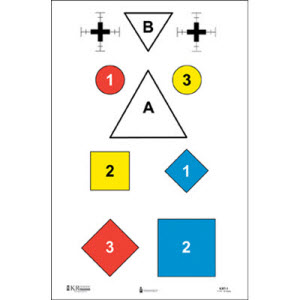
The KRT-1 Target is now available

Finally, we can reveal it to the world!

The KRT-1 target.

The KR Training instructor crew spent quite a while hashing this out, designing, revising, arguing, testing. But finally it’s here, available from Law Enforcement Targets.

If you go to LE Target’s website you’ll see tons of targets already in existence. Why in the world create another one?

The main reason? it fits on 18″ target frames, the same frames used for IPSC and IDPA targets. These are the frames we use at KR Training.

With few exceptions, most targets are designed to fit on 24″ frames. There are lots of useful targets, but when you put a 24″ target on an 18″ frame, the uprights won’t last long, nor will your training session (and it doesn’t help towards keeping cost and maintenance issues down either).

We designed a target that could be used for the KR Training curriculum, from defensive pistol training, to competition, command work, group shooting, you name it. It’s rather versatile. It has A and B zones that map to head and chest areas; and the numbered, colored shapes can be used for many drills. It includes two sight in areas with 1″ grid marks.

Of course, we hope this will be useful to shooters around the world, especially those similarly frustrated by using 24″ targets on 18″ stands. 🙂

Glock, the book

Paul Barrett wrote a book, Glock: The Rise of America’s Gun. I was offered a preview copy of the book but had to decline — I don’t have the spare cycles to read it, and am rather behind in my own reading list anyways. *sigh*

Nevertheless, it seems an interesting book and now has a new web home.


You’ve got a hammer, but everything isn’t a nail

Michael Bane and Michael Janich discuss an important construct in self-defense: that one solution isn’t always the appropriate answer.

Can’t embed the 5 minute video… you just have to click the above to watch it.

I like Janich and he speaks a lot of truth here. I’ve dealt with two realms of “self-defense” training: guns, and empty hand martial arts. In the past and even today, people tend to choose one or the other. As well, many schools tend to only teach one or the other, tho thankfully that’s improving in recent years.

The reality is, like Janich points out, if you have a gun that’s great but that is not the appropriate nor possible response in all possible situations. It doesn’t mean you need to become a black belt in some deadly art, but having more responses programmed in, from simple verbal commands, to escapes, to perhaps basic empty-hand strikes can be a useful thing to allow you to respond appropriately to what’s presented. Insights Training Center is a good place for this sort of integrated methodology. If you want to go a more traditional route, consider Filipino arts, like Pekiti Tirsia Kali (in Austin, check out Leslie Buck).

On the other side, a lot of people take empty hand training but won’t progress to the level of firearms. Well, many traditional martial arts will teach weaponry, but it’s interesting how much of that ends up being demonstration and never application. Granted, it’s difficult to apply sword or nunchaku in a modern context, but what’s the point in learning a weapon if you do not know how to actually fight with it? However, I’d argue to move beyond those weapons because technology has evolved (else we’d all be using clay tablets and not iPad’s) and firearms are the modern sword. Empty hand skills can take you far, but not far enough because I’m sorry… a 5’4″ 95# woman no matter how skilled is just going to have a tough time against a 6’6″ 275# strong man hell-bent on raping her. A gun is a force equalizer.

I know some argue against the notion of “another tool in the toolbox” because then you start to collect a zillion tools and won’t know how to deploy anything. This is true. But there’s a balance point, and it starts by having to acquire more tools. Let’s be literal with the notion of toolbox. If the only thing you have in your toolbox is a hammer, yes everything looks like a nail. You’ll pound screws, if you need a hole in something you’ll just have to whack the hammer through it, if you need to measure something it will be “3 hammers long”, and so on. Well sure that might work, but it’s not very efficient and could cause collateral damage. That’s why you have to acquire more tools for your toolbox: to have a screwdriver, to have a drill, to have a tape measure. There are enough basic tools that one needs in order to have a complete toolbox. The problem starts to arise when you start to acquire too many tape measures… how many rulers does one need? For me, a simple 25′ tape measure is fine and covers all my needs. But a professional carpenter might want a carpenters ruler. Most people only need a claw hammer, but the handyman might also have a drywall hammer, and the roofer a roofing hammer.

So most people don’t need a taser and handcuffs, but a police officer does. A bouncer at a nightclub needs a lot of empty hand arrest and control techniques, as well as good verbal skills. So you can see, toolbox contents, literal or figurative, can vary from person to person and situation to situation. What matters in this self-defense context is that you can go too far. Bragging about having 3608 techniques means… what? Consider Bruce Lee: “Take what is useful and discard the rest”. Or Antoine de Saint-Exupéry, “Perfection is achieved, not when there is nothing more to add, but when there is nothing left to take away.”  Whether you listen to the martial artist or the writer, they are both saying that it’s about stripping away, but first you must have something to strip away. If all you have is a hammer, you have nothing to strip away. If you have 3608 techniques, you have a lot you can strip away. In the journey of life, we start with nothing and acquire as we go along. This is the way it has to be, because how else can we find what is useful? How else can we discover what we need? How else can we know what to discard if we’ve never acquired it in the first place? The key, however, is to not just collect, but ensure you periodically review and discard the useless so your collection is meaningful. So, “another tool in the toolbox” is good, but only if it’s useful to you. If all you have is a hammer, it should be because you had an entire hardware store and were able to discard everything else.