 It was a lucky find.
I’ve been intrigued by things like the Seecamp LWS32 and North American Arms Guardian for some time. Why? Just because. They’re so tiny, about the smallest “practical” semi-auto pistols you can buy and use for personal defense. But it’s not been a serious obsession or anything, just a passing interest.
But when I was out in Kerrville, TX last weekend with some extended family, one of them took me to a pawn shop. I don’t frequent pawn shops (just not my habit), but on this day I’m glad I did because right there in the case was a NAA Guardian .32 ACP.
I bought it on the spot.
Why?
My interest in guns started with personal defense, and that remains my primary motivator. Sure, my first purchase was a small gun, a Springfield XD-9 Subcompact. Well, it was a mistake purchase because small guns are hard to shoot and shoot well, which really works against someone learning how to shoot, build competence, and gain confidence. Shortly after I started, I ended up buying another gun, an XD-9 with the 5″ barrel, and things went much smoother. 🙂
While I prefer full-sized guns for a host of reasons, there’s no question small guns have their role. They are NOT a first choice, and probably not even a second or third choice, but sometimes they are the right tool for the job. I mean, I have a screwdriver that has a 24″ shaft, which I bought and used once because it was the needed tool for the job. You tend to be more successful when you use the right tool for the job, and being as a gun is merely a tool, you should use the right one for the job at hand. Sometimes, small is what you need.
For a while my small gun was a S&W 442 J-frame “snub-nose” revolver. There’s a lot of positive to such a choice, but after a few years of trying to make it work for me I came to accept that it just wasn’t the best choice for my needs. The S&W M&P Shield 9mm has worked out pretty well, but the Shield’s size is in an odd slot where it’s a little big for small jobs and a little small for big jobs. It does work and fills a fair role, but it’s still not always what’s needed.
I’ve considered Kahr’s for a long time, like a PM9/MK9 or maybe a CM9, and frankly during my shopping in Kerrville I did look for one of these Kahrs and may well have bought it if one was available. Alas, the only Kahrs they had at the couple places we went to were other calibers or larger sizes.
But then, the NAA Guardian came up, and I figured what the hey, why not?
It’s a (very) small gun for when you need that. I’ve had a few times in life where I’ve had to go somewhere and wanted the smallest possible gun I could legally carry. I made do with what I had, but still wished for something smaller. And now, perhaps I have it.
Plus why this particular gun? As an instructor, we get people asking all sorts of questions, and it’s often useful to give tangible answers. Being able to have such a gun on hand to let people handle, shoot, and see first-hand why we might answer as we do – it enables people to convince themselves, which is far more educational and persuasive than saying “just trust us”.
As well, it’s simple novelty, and “just because”. It’s the first time I’ve seen one for sale (tho maybe if I got out more I might have seen one sooner), so I figured I better buy while I can. 🙂
The Gun
The NAA Guardian was introduced in 1997. If you search around for those “mouse gun comparison charts” is one of the smallest around. This version, in .32 ACP (not .32 NAA), is all steel, DAO, holds 6+1, barrel 2.49″, OAL 4.4″, 3.3″ tall, 0.85″ wide, 13.6 oz empty and 16 oz full.
That’s small.
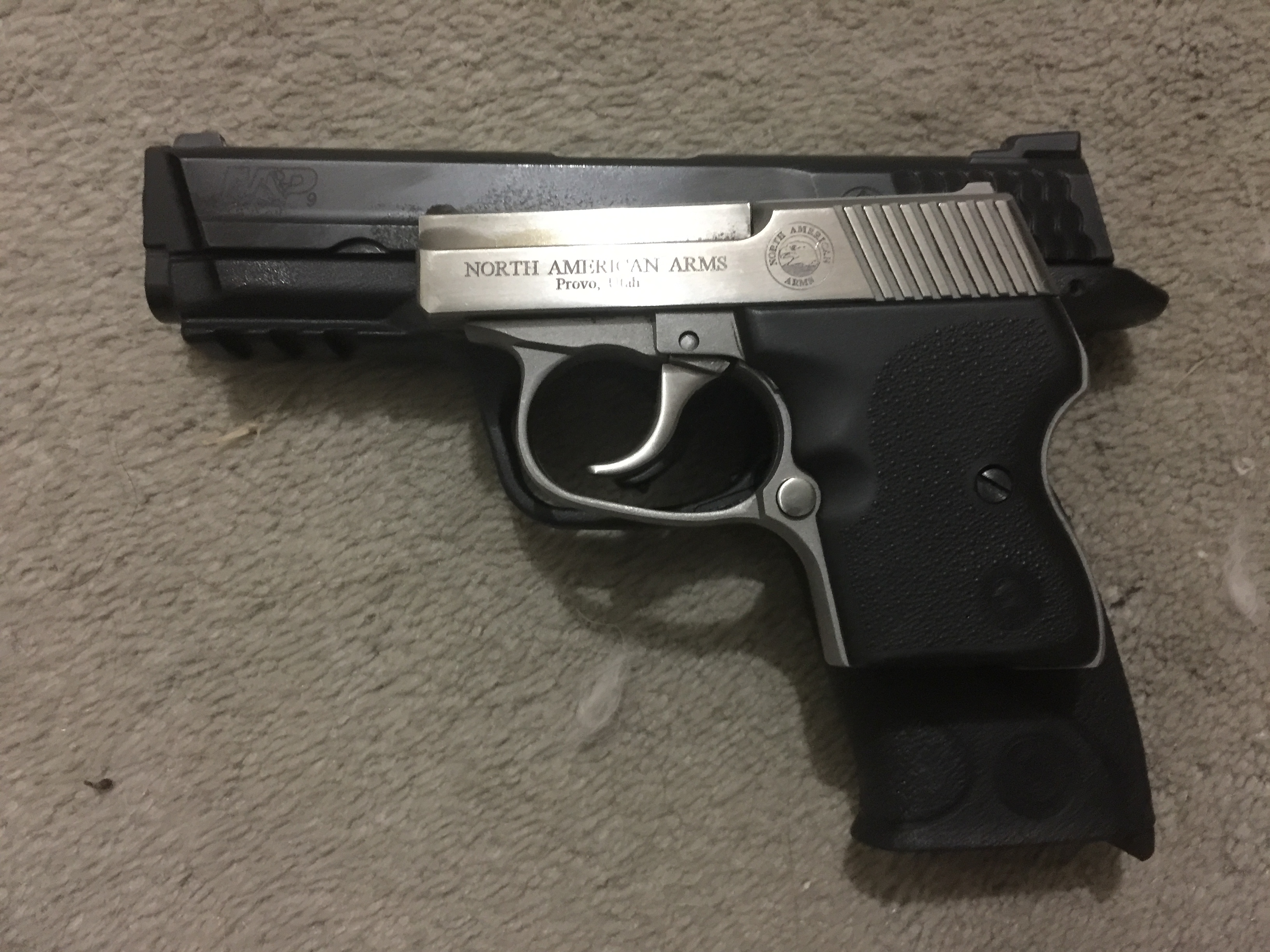
NAA Guardian .32 ACP vs. S&W M&P9
So small that most people can only get 1 finger on the grip, with your ring and pinky fingers dangling off. Yeah, that’s a bit of a problem. Good luck getting that 2-handed grip on it. 🙂
This particular gun seems to be on the older side. I’ve emailed NAA asking questions, but as of this writing I’ve yet to hear back. I’m curious about the gun because it does seem older. For example, the 2 magazines are all metal, whereas the new production magazines have plastic baseplates. Some other details make me wonder about the history here, but I’ll save that for another time.
Overall it seemed to be in good shape. Obviously fired, but reasonably maintained.
Then there’s .32 ACP. Yeah… it’s not the best cartridge. If you’re curious about .32 ACP, search around as there’s lots of information out there. But long-short made relevant here? It seems the best choice is loads with Hornady XTP bullets, as they will have reasonable penetration AND will expand. Is it still great performance? Nope; I still consider it sub-optimal. But it’s not the worst thing in the world, and it’s better than nothing.
You just have to remember that it’s all about trade-offs. This is not a gun of first choice, or even second or fifth choice – this is a gun of “no other choice”.
First Shots
Before I took it to the range I took it apart to clean and oil it. Yeah, it was dirty, and I could also tell… old. The recoil springs were old. Still, I cleaned what I could, oiled it up well, and put it back together. The fact it lacks any way to lock the slide back is a little annoying, but it’s what it is.
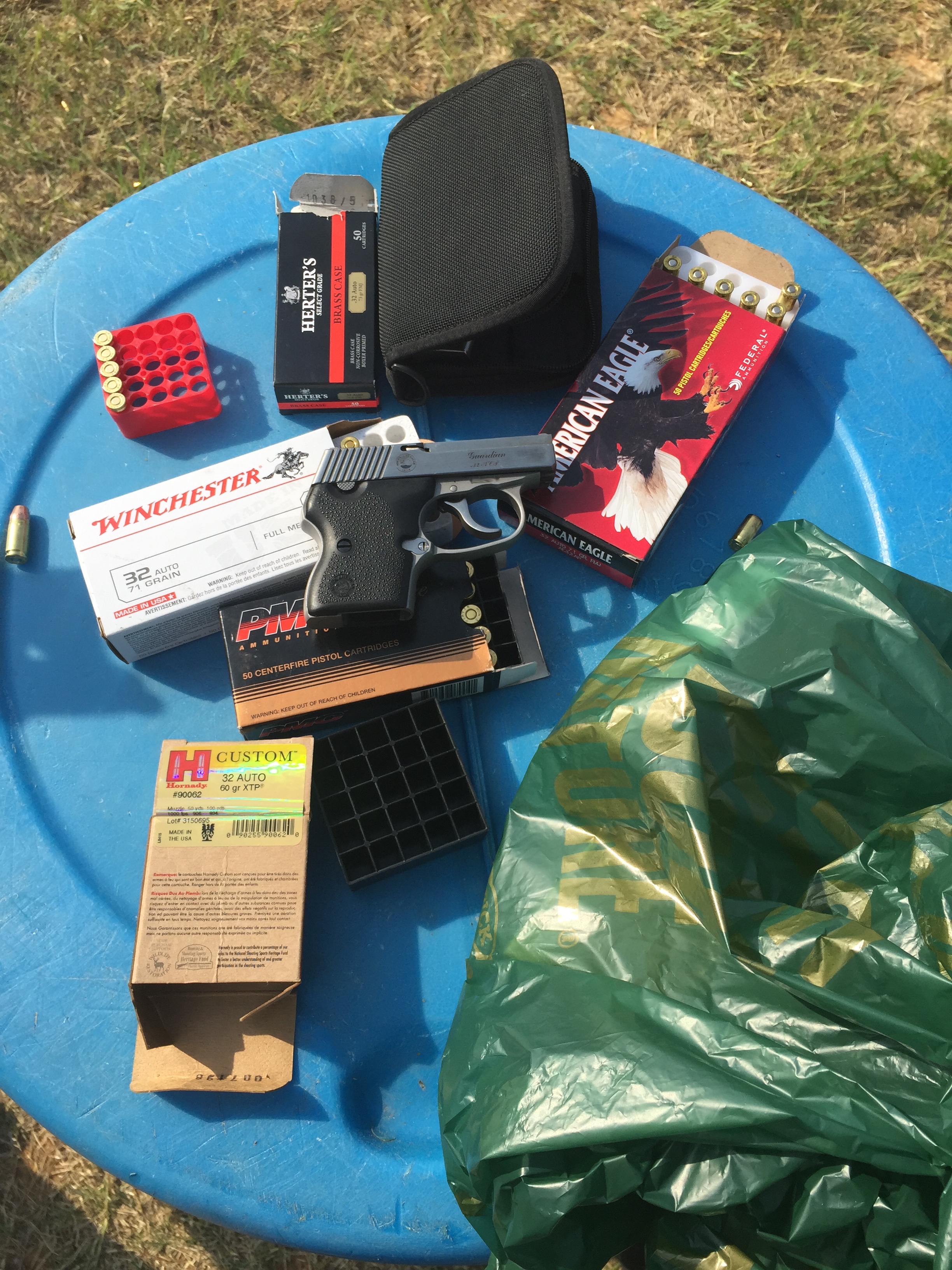
I purchased single boxes of a variety of ammo:
- Federal American Eagle 71 grain FMJ
- Herter’s 73 grain FMJ
- Winchester “white box” 71 grain
- PMC 71 grain FMJ
- Hornady’s “Custom” 60 grain with the XTP bulet (2 boxes)
Ran through all 250 rounds between myself, a friend, and Oldest. Here’s how it went.
There were numerous malfunctions, mostly failures to feed. Sometimes the last round would stovepipe in the magazine, sometimes it might start feeding then the slide closed and things munged up. Considering how and when it would happen (many times the last round in the magazine), that it happened with all ammo types, under various shooting circumstances, best we can figure is old springs. The magazines are likely original springs, and given the gun uses the upward pressure of the magazine as the ejection mechanism, it’s likely that. So I’m going to purchase some new magazines (and new recoil springs) and try again. If it continues to malfunction after that, then it’s off to the gunsmith. If it continues to malfunction after that, then it becomes a conversation piece. Certainly at this point I do not trust the gun for personal protection.
The inability to lock the slide back? That’s a major hamper when it comes to clearing the malfunctions. I reckon any malfunctions or reload needs here will be better served by dropping this gun and drawing a second gun, which you’re unlikely to have if you’ve been pressed into having to carry this gun in the first place. :-\
Overall tho, all ammo performed fairly well. The Herter’s had noticeably more felt recoil than the others. But regardless of bullet shape – and they were all different – all either fed or malfunctioned the same. I could detect no pattern of success or failure, so likely in the future practice ammo purchases will be “whatever is cheapest”.
Felt recoil wasn’t as bad as I thought it would be. I expected some bite, but didn’t get it. Would I want to do a 1000 round weekend class with it? Probably not (and not just because felt recoil). But something like KR Training’s Defensive Pistol Skills – Back Up Gun (4 hours, 150-200 rounds) oh sure. I will say tho, a couple times we gripped the gun up higher than it should be gripped and the felt recoil was greater and hurt a little bit. Will have to see how that pans out in reality in terms of quick drawing.
We did no draw work, tho I did get lucky and found a DeSantis Nemesis at Cabela’s (hrm.. I wonder if I can get a Safariland ALS for it so I can open carry it come January 2016… that’s a joke, folks). Everything was from the ready position. At this point it was just trying to determine if the gun was reliable enough, if and what any issues were, what ammo would it consume, and just how it ran and felt.
Some stuff was slow fire. I was surprised at the accuracy. We were shooting a 8″ steel plate at probably 15 yards and had no problems when using the “sights”. Yes, “sights” in quotes because it does have some bumpy things up there, but I doubt you’ll ever use them in a fight because they are hard to find and use (tiny tiny, hard to find, hard to determine “equal height, equal light”). Shots did land slightly right, and it was easy to see why. The barrel and frame are 1 piece, with the front sight is on the barrel; the rear sight is on the slide. The slide locks up fine, but looking at the rib that runs the length of the top of the gun, you can see the slide isn’t perfectly square on lockup. Bug or feature? I don’t know, and maybe new recoil springs will help. But because of that the sights don’t line up mechanically, so when you visually line them up the muzzle points a little to the right. Still, the groupings were tight and consistent, and I was pleasantly surprised.
Still, what made it a bitch to shoot right and well was the fact it was a 1 lb. gun with long heavy trigger press. The manufacturer states it has a 10 lb. trigger press! I went looking for Karl’s digital gauge but couldn’t find it, just an old spring one. The spring one’s scale topped at 8 lb. but it looked like the gauge could go to 10 lb. before it bottomed out. Well, it’s at least that then, because it wasn’t until it bottomed out that I could get the trigger to break. Could be the gauge had weak/old springs, so I don’t know how accurate it all was, but it’s reasonable to say it’s got a damn heavy trigger.
So consider that: a very tiny gun which is hard enough to get a good grip on, to have good “gun fit” and a proper trigger press. Then you have a pull weight that’s 10x the weight of the gun. Yeah, it’s going to be DAMN hard to shoot well.
Of course we tried some fast stuff, because this isn’t a bullseye gun. This is a personal defense gun that’s likely going to be shot from 0-5 yards, quickly, multiple rounds. On the one hand, the lack of proper sights can be ok there because at that distance and speed an index off the slide is reasonable. Dumping magazines as quick as we could landed just fine on a 18″x24″ steel plate at 10 yards. But that’s still not awesome. Certainly we had times when we’d shoot and not hear the DING of the steel — it’s very easy to get unacceptable hits with this gun. I didn’t take any cardboard out to see how it’d perform, but that wasn’t the point of the day. Still, once I get the new magazines and springs, I’ll give it a full run through (like doing the DPS-BUG class drills, maybe just running “3 Seconds or Less“). Again, this day was about seeing if the gun would just run.
All in all tho, I was pleasantly surprised with the gun. It performed better than I thought it would, and was much more enjoyable to shoot than I expected it to be. The fact ammo is rather expensive (it’s more than 9mm) hurts, so I don’t think I’ll be shooting it all that often. But still, I think it’s going to find a place.
What’s Next?
Next up is buying magazines and springs, then another round of testing. That testing will be just to see if the gun runs and how it runs with new springs, and I plan to do more structured shooting. Some simple “just does it work?” shooting. Some slow accuracy, and certainly some proper and appropriate drills on paper (e.g. “3 Seconds or Less” drill).
Buying magazines and parts, seems I have to go to the manufacturer, which is fine. I just hope they’re more responsive with the sales than they seem to be so far with customer service questions.
When it comes to ammo, the only loads I can find with the XTP bullet are Hornady’s own load and the Buffalo Bore. I expect the BB would hurt like hell. 😉 But it does document 943 fps out of a 2″ Seecamp barrel and 1080 out of a 3″, so maye 1000 out of the 2.5″ Guardian, which would be quite good. Other .32 ACP loads where I can find info on tend to be 1000-ish out of a 4″ barrel so…. I’m going to pick up at least 1 box of the BB to see how it goes. Otherwise for practice ammo, whatever is cheapest. I see MidwayUSA has Fiocchi 73 grain FMJ for $15.49, cheapest stuff available so…
Anyways, time to do a little shopping. 🙂


 Stuff From Hsoi