A little range time

Practice Time

I wanted to run just a few live-fire drills today as a diagnostic. So I picked 2 challenging ones that fit the bill for diagnostic: the 3M Test, and the Rangemaster Handgun Core Skills Test. Yes, both from Rangemaster. I didn’t pick them because of that, they’re just good diagnostics. And I’ve never shot the Core Skills Test before, so I figured this should be good.

I did have to modify the drills slightly: using and IDPA target because that’s what was available. When i in doubt, I scored harder.

3M Test

I started with this cold. Scored 114, which is good but not great. I shot it a few more times and my score averaged into the 140-150 range, which was much better. But I had some obvious problems.

First, I had a hardware problem. This mag pouch is just not working for me. In order to have enough retention on the mag, it makes it difficult to withdraw the magazine. If I make it easy to withdraw, there’s no retention. I know it’s something with this specific pouch because others in the past have not had this problem. In this case, my pouch broke, I ordered a new one from Comp-Tac, it wasn’t done right so it was sent back. I am not sure if they made a new one or just tried to bend/fix this one, but I got it back and it’s been this way. Again, this is not what I’ve typically experienced from Comp-Tac. I’ll figure something out.

Second, I do need to work on my reloads. This was a combination hardware and software problem. On the hardware side, I’m shooting a different M&P9 (my primary is in the shop), and this one doesn’t like to auto-forward as much. I’ve gotten used to the auto-forward and I think too used to it, because I find myself slamming the mag home and going right back to shooting – but now the slide is still locked back. Dang it — so that’s a fumble to get things going again. Also, during the Kathy Jackson class a little bit ago, I had multiple times when it did auto-forward but did NOT strip a round! I’m back to my old feeling that this auto-forward is a bug and not a feature (if it’s not 100% then there’s a bug somewhere). So I found myself fumbling my reloads because of the hardware issues. BUT really it’s straight-up me because I really should never have gotten used to the auto-forward and just always racked the slide. Even if it meant a round on the ground, meh. This is really reinforcing in me that I need to fix that, and just get better on my reloads.

Speaking of, another problem I had was gaming the drill. I found myself anticipating the malfunction a few times and thus I stuttered and added a second or two onto my time. Stupid. I need to just be in the drill, be in the moment, and let what happens happens.

Third, I just need to go faster. I can go faster and still get acceptable hits, but my brain is so wired towards accuracy first. Towards the end I shot the 3M a few more times and just pushed myself hard. Yes I had a couple shots outside the circle, but I really need to push myself more. I can do more, and I just have to really drill that into my head.

Anyways, this was good. Big takehomes: fix my gear, work on my reloads, be in the moment, allow myself to be faster.

Core Skills Test

Again, this was a first time shooting it. It’s not necessarily a tough drill, but because it’s scored Comstock it is tough — if you want a good score. You need to be fast, but you also need to be accurate.

I found myself holding back on this as well — didn’t want to miss, but I also know I can pick up the pace. I scored an 80, which is at the bottom edge of the “very good” range. Again, I know I was going slower than I could have, plus on the longer distances I dropped a couple outside the -0 ring. Honestly, I’m not sure how the official scoring on that would be, if it’d still be 5 points but I counted those as 3. Regardless, my score is “very good” but that’s still not good enough.

My take-homes from here are about the same as everything else I need to work on: getting faster on my draw and time to first shot (which wasn’t bad, just can still be improved), weak-hand, and working at longer distances (15 yards and up).

One thing that I think I’m going to have to do? Less dry fire. Well, not really that, but more live fire. Sure, there’s stuff to work on in dry fire that will help me, but I think I just need more live fire work to really fix some of the problems I’m working through. My brain knows the difference between dry and live and I need it to allow me to do in live what I can do in dry.

Overall

So, it’s about the same old same old for me.

The weather was great. It was good to get out and shoot a bit. And I’ve got more homework to do. 🙂

Is it worth dying for?

A lot is being said about the man in Arlington, TX that inserted himself into a situation and died as a result.

Claude Werner has a fine take on the whole incident.

I’ve said it before and I’ll say it again: make choices that maximize your enjoyment of beer & TV.

Or put it even simpler: is it worth dying for?

I can totally understand the man’s feeling, the pull to want to intervene and help. We often lament about how good people stand idly by and don’t step in to help. The whole
“All that is necessary for the triumph of evil is that good men do nothing.” thing. But we must look deeper than a quotation, and we must consider: is it not evil that this man has now left behind a wife and children? Did this man’s choice actually allow evil to triumph? Would it not also be a good thing for a good man to continue to be a good husband, a good father, a good business owner, a good citizen of his community?

If you are going to carry a gun, you also carry a great responsibility.

You must look beyond the hard physical skills of marksmanship, and look towards the deeper issues of mindset and mentality. You must understand the legal factors. You must understand the deeper philosophical requirements. You must know what you can and will do, and what you will not do. Your line must be clear, it must be articulable to yourself, your family, the police, the judge and jury, to God, to whomever. It may come off as hard, cold, callous, and you may have to find your balance, you may have to come to terms with such dichotomy. Regardless, you must do it. You must know before you must act upon it.

Else, you get what you have here.

AAR: Cornered Cat Instructor Development Course – KR Training April 2016

Always be learning.

From April 22-25, 2016, KR Training hosted Kathy Jackson of The Cornered Cat and her Instructor Development Course. From the course description:

During this four-day course that includes both classroom and range time, we will focus on teaching defensive handgun skills to adult students. With personalized instruction designed to help you become a better teacher, our lecture and discussion subjects will include firearms safety, emergency protocols, classroom management, principles of adult learning, gendered learning styles and classroom dynamics, developing student confidence, legal considerations for use of force, instructor liability, writing and documenting course materials, effective coaching, and holster/carry method selection. Range work includes left- and right-handed manipulations with semi-auto pistols and revolvers, developing student accuracy, teaching trigger control, demonstrating techniques, developing your range presence, giving effective voice commands, observational safety skills, malfunction clearances, teaching drawstroke, working with instructional teams and assistants, diagnosing and solving shooting problems, and sight or vision issues.

Although we will enjoy many shooting activities during this class and will coach each other to shoot better, please be aware that we will primarily focus on teaching skills development, not shooting skills development. You will have an opportunity to assess your own shooting skills against several objective standards, which will give you some idea of where to focus your efforts for personal growth. If you find that your current shooting abilities are not up to standard, that’s a subject you can and should address in classes designed specifically to improve the skills you need to improve.

Come prepared to teach and learn during our time together.

It was a long but fun and fruitful 4 days.

Background

While Karl Rehn is certainly mentor #1 for me, I would say Kathy Jackson is one of my earliest influences. When I was first getting serious with firearms, I found Kathy’s website and read just about everything she wrote. Still to this day I find her work on “Kids & Guns” to be the best resource on the topic, and always refer folks to that series of articles.

I don’t recall how Kathy and I first crossed paths, but I do have a comment here on my website from her from back in 2009, so at least since then (Kathy and I talked about it and we believe it was even earlier but… whatever). So we’ve known of each other for some time; she’s linked to my blog numerous times and I hers, and we’ve conversed online from time to time. But it wasn’t until this weekend we finally got to meet.

I will confess one reason for attending was just to finally meet her. In fact, I was the impetus for this class. I had read about Kathy’s first time offering this class (either Tam’s or Melody’s), and around the same time Karl and us other KRT instructors were talking future class schedule. I mentioned Kathy’s class to Karl one morning and by lunch time they had come to agreement. Huzzah! 🙂 So of course I had to attend.

Some have asked me why I’d want to attend this class. What would I expect to get out of it?

Learning.

Improvement.

Growth.

The older I get, the more I learn, the more I realize how much I don’t know and how much more there is to learn. Given my background, I didn’t expect everything that Kathy taught to be a novel realization for me, but I knew there’d be something. Her training and lineage is different from mine (tho with some overlaps), her approach and attitude are different. And I know that even hearing about things I already know, I’ll hear about it from a different perspective. I know some new light will be shed, I know something will expand and grow. I know I will come out better than I went in.

Achievement unlocked.

General Stuff

Class was small. There was Kathy, her assistants Don and Tina, then 8 students. Three of the students were male (myself, Karl, one other), and five were female. I knew half of the students, the other half I met for the first time. While I had hoped for a sold-out class, I was happy for the smaller class which meant an improved teacher-to-student ratio. Weather was good, facilities were in order, and away we went.

Classes were generally 9-to-5 each day, and we worked through lunch. I appreciated the timing because with the KRT facility being where it is, having that drive in and out every day adds to the total time investment, plus it wears on you. Running a sharp 9-to-5 instead of an 8 until we run long and maybe get out of there whenever we do, was appreciated. Right there is a key factor in a good instructor: classroom time management, and Kathy ran things well.

After introductions and generalities to get up and running, class officially began.

Course Focus

Usually I break down my AAR’s by day, but this time I don’t want to do that because it doesn’t do the course justice.

What did we talk about? A lot of things.

Some of the class was presented in the context of a basic/introductory firearms familiarization class. As Kathy said, then we’re “pulling the sheet rock” off the wall to actually see the wiring, the pipes, and other “behind the scenes” things that are necessary to make such a class go. The learning then had 3 facets:

  1. You learn how to have such a class. How to have an introductory class, what to talk about, drills to do, and other things to allow you to formulate your own such class.
  2. You learn how to run such a class. You learn how to run the line, keep it safe, keep it orderly. How to present (e.g. tell, show, do, feedback).
  3. And here’s the subtle one: you learn by watching how Kathy actually runs her own class. You have to remember that we’re here in a class ourselves, that Kathy is teaching it, so pay attention to the things she’s doing to run this class itself! There are things you can pick up.

Consequence? A lot of information.

While of course we had trigger time, this was not a class about guns, about learning to shoot. The fact we shot guns was merely a necessary thing  because that’s the topic realm in which we are teaching. This is a course about becoming a better instructor.

You learn how to run a classroom. You learn how to run the range.

But most of all? You learn about people.

I think that’s what really sets this class apart from other classes I’ve taken. Other classes primarily focus on the nuts-and-bolts. While we certainly received a lot of nuts-and-bolts discussion here, a lot of time was spent on people. On developing our people skills, on being able to work with our students as people. I know that seems like a “DUH” thing, but honestly I see it so much in this industry and in others where “those in charge” and “those teaching” seem to forget their audience/students are people – with needs, emotions, baggage, and differences.

If our goal is to improve our students, then we have to connect with them. We have to have their respect, their trust, and their personal interests in mind.

Kathy threw out a quote from Massad Ayoob (and hopefully I recorded it correctly):

Sooner or later every instructor realizes students don’t come to you for competence, but for confidence.

Sure, competence is what we might be teaching, but confidence is what we want people to leave with. You need people skills, you need to remember and work with your students as people.

And like it or don’t, men and women are different in this regard. Yes, sweeping generality, but go around the block enough times and no matter what modern culture wants to espouse, even underlying their commentary is acknowledgement that men and women are (generally) different. Kathy’s material is not exclusively woman oriented, but she does bring up women topics. Some of the topics work to address everyone regardless of gender. Some topics may touch on how one gender may respond and adjustments that can be made or sensitivities that can be taken. Others are flat out gender-specific. For example, we finished Monday with a great discussion of holsters and other carry equipment, and without a doubt there were female-specific solutions discussed. I saw some products I hadn’t seen before, and I must admit that some are pretty darn cool.

I think the main problem with this class? It’s a lot of information. 🙂  Rough problem to have I know. It’s just the reality of things: that there’s lots of topics to cover, and only so much time to do so. I think Kathy did a great job getting to important topics, ensuring the “must do” topics were covered, but there’s no question people wanted to continue to dig deeper on many topics. In a way, that’s ok — always leave them wanting more. I think what will help is post-class supporting materials, be it discussion groups, reading materials, etc.. One thing that’s great about Kathy is it’s evident she herself is a student, and is always learning, always trying to improve.

Personal Take-Homes

While I don’t have a resumĂŠ like Karl or Kathy or Massad Ayoob or Tom Givens or John Farnam, I’ve got some things under my belt. Consequently, a good portion of what Kathy talked about was stuff I already knew. BUT! I consider that to be a very good thing! What it does is it provides affirmation and reinforcement about what we know. Kathy’s background is different than mine, and while our lineages and circles overlap, they are different. When you find people from different areas coming to the same conclusions as you, that speaks strongly to the validity of those conclusions.

For example, over the years I’ve been frustrated at how we “teach stance”. I think it takes too long, becomes too complicated of a process. So I started to think about a simpler, easier way to do it. What I landed upon was a runner’s stance. Not getting down into the starting blocks, but “Imagine you and I were going to have a quick little race down to the end of the hallway – when I say “on your mark”, get your body into the position you’d take to start the race”. And everyone does what you’d think, which is precisely the stance we want people to be in. It works great! It makes it simple, it makes it relatable, student’s don’t think they have something new to learn because this builds upon what they already know. There’s so many good things about this approach. So when Kathy started teaching stance (how to teach stance), I couldn’t help but smile when she used the exact same approach!

But of course, there were a lot of new things I learned. The most obvious is some aspects of working with women. I’m very proud of the fact KR Training has a lot of female students: we aren’t some high-speed-low-drag #OperatorAsFuck school. We can do that stuff, but it’s not our image. We aren’t out to be intimidating (it’s just not good business). I’ve received numerous complements from female students about how comfortable they feel, how happy to are to have chosen us, etc.. Still, there just are things I hadn’t thought about.

For example, it’s good on the reholster to look the gun back into the holster. I admit, I never realized that some women cannot see their holsters because boobs are in the way. Solution? Just move the bodypart of the way (same holds for men and their guts). I know that seems like a small thing, but that’s life for me at this point: little refinements, little details, to continue honing my skills to an even finer point.

Another good thing I got was new perspectives on existing material. Take grip. We teach that thumbs-forward grip. Kathy teachings the crush grip (thumbs are curled, clamping down over them). We do use the crush grip, but typically as an alternative to the thumbs-forward when we see someone whose strong-hand thumb keeps gripping hard and pressing their weak-hand off the gun. Is it as ideal a grip? Long-term, no. But Kathy’s fresh perspective to me was that the crush grip is easier for people to learn. Why? Because people understand crushing with their fingers/hand/grip — we all understand how to squeeze something in our fist. The thumbs forward grip does imply some additional muscular forces (e.g. use of pectorals). Me? I never really noticed because I’m pretty big and strong, but breaking down the mechanics in class, hearing Kathy’s perspective, made me realize that yes I can see how a crush grip may sometimes be the best and right grip to teach someone right out the chute (then teach them thumbs-forward down the line). There’s more to it than what I can convey in this write-up, but the larger point is I appreciate getting fresh perspectives on known material.

And this is why I like taking classes, even “beginner” classes from others: because I know there’s going to be something to learn. Even if it’s “everything I’ve heard before”, I know there will be something I can pick up and grow from.

One thing I need to work on? Being concise, especially in my range commands. For sure I can tighten up my delivery.

Fun Stuff

Class was tremendously fun. We had such a great group, so much laughter, so much cutting up.

Karl shot the class with an M&P Shield, left-handed the whole time. It was a challenge for him and he had some good take-homes from it.

During one part of the class we were working with revolvers. I had my S&W 640. I haven’t shot a revolver in… a very long time, and that gun in even longer. As we got on the line, Kathy was going to pull me off to have me work the line. Well, a fly had landed on my target and I joked “But I want to shoot the fly!” So OK, if I was going to be a smart-ass about it, they had me do it. In fact, they called the line such that only I made ready (and everyone else watched). I aimed, pressed off the shot, and got it. 🙂  I had no idea I did, because holdover — I couldn’t see the fly in order to aim properly to hit it (we were at 5 yards). And I haven’t shot that gun in ages, couldn’t remember where it’s precise holdover was at that range, with that ammo, etc..  So skill? Certainly, but a bit of luck as well. 🙂

Kathy and myself, vouching for the target.
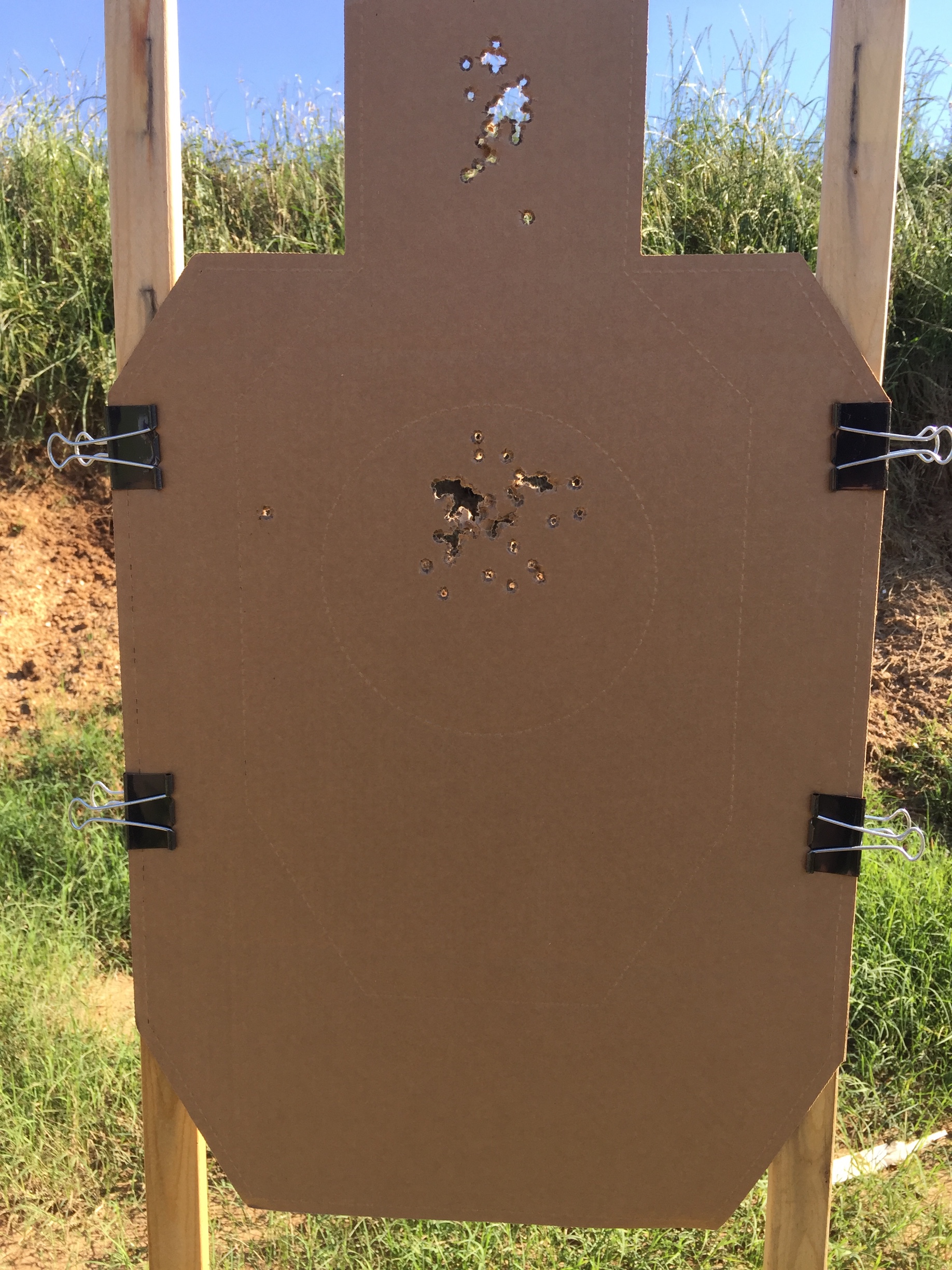
The target. Note the one “fly”-er on the left
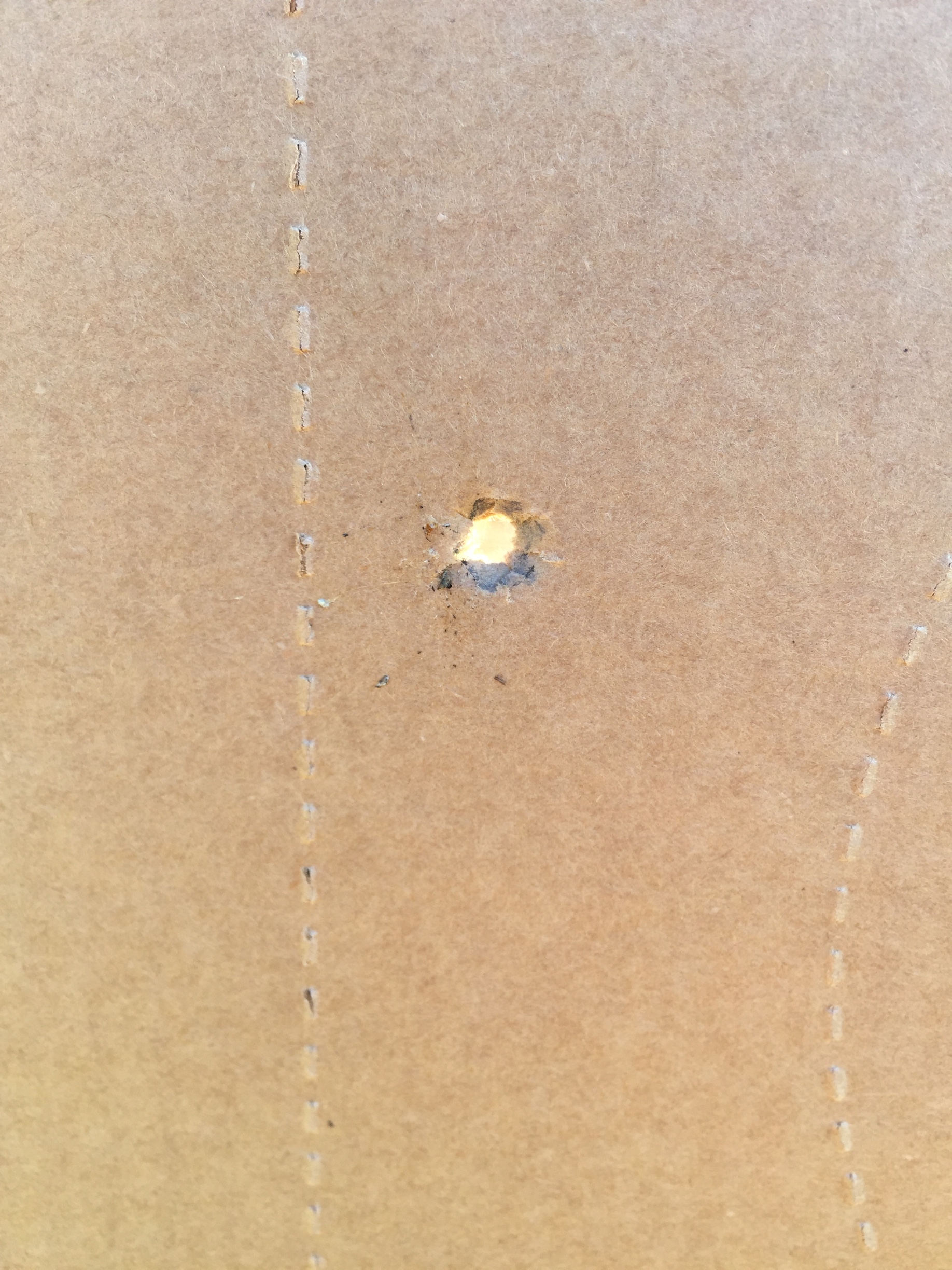
Close-up. Note the splatter of bug guts


Conclusion

I had a great time. 32 hours of instruction on becoming a better instructor. Am I a better instructor? Time will tell as I put the learning into practice.

I recommend this class for anyone seeking to become a better firearms instructor. Note the operative word: better. Anyone can become a firearms instructor, and a lot of people are content to just get their NRA Instructor certification or their state’s handgun license certification and call it done – that’ll be the extent of their education, forever. Alas, the consuming public doesn’t always know what makes for a good instructor, but that does seem to be changing. The more we can have an informed consumer base, the better things will be for everyone. Continuing education is important, and that includes how you can become better at the job you do.

Again, what I appreciate about this class is it’s not just a nuts-and-bolts class, but one that’s big on people skills. You just don’t find (enough of) that in other places, but it’s so key to running a successful program.

Kathy kept going on about how she’s not the best marketer in the world. Maybe so, but I can tell you one thing I noticed about her was her tremendous people skills and insights into people. She groks people. She has a keen insight into human nature and adult education. You have to not only look at the things she’s directly teaching, but look at how she herself operates: how she talks with you, the other students, how she conducts herself. Yes she’s very real and very human, and so of course things weren’t perfect. But even from those things she handles herself well and there’s learning to be had. I appreciated finally getting to meet her after all these years, that we got to spend 4 days (and even a wonderful dinner) together, and that I can now officially call her one of my instructors. I look forward to what else I can learn from her, and I hope you too can have a chance to learn from her.

Catching up

I just spent an intensive 4-days in Kathy Jackson’s Cornered Cat Instructor Development Class.

I’m tired, but enriched.

I’ll have a write-up on it soon.

This also serves as my training log for today. Should be a squat day, but I’m opting to rest. I’ve got some pain in my legs. In part it’s from all the standing over the 4 days, but the large part is actually from sitting! Folding chairs, trying to remain comfortable, would extend my right leg, and between balancing it upright in my boots, my other leg crossed over it, etc., the slight hyperextension at my knee and all that “back-pressure” placed on my knee… things just aren’t too happy.

Best not to squat right now.

I’m bummed because it’s now 2 weeks in a row of not squatting (I never thought I’d say that), but it’s better this way.

Anyways, returning to the Land of Daily Routine, so I’ve got a bunch to catch up on.

KR Training 2016-04-16 BP2/DPS1 Quick Hits

This past Saturday, April 16, 2016 we had another Basic Pistol 2 (Defensive Pistol Skills Essentials) and Defensive Pistol Skills 1 day at KR Training.

Karl had to be out of town, so class was headed by Tom Hogel, with myself, Ed Vinyard, and a special 4th assistant. Our scheduled 4th blew out her knee a few days prior thus was unable to join us, so my son, “Oldest”, joined us to be our gopher and safety officer. He was a tremendous help, and the day wouldn’t have been successful without him. Thanx, son. 🙂

We had threats of rain all day, and a few sprinkles here and there, but for the most part the day ran smooth and good. But it was a rather interesting class. About 1/2 of the students were there for both classes, but regardless of the makeup, we had an interesting variety of equipment. A lot of SIGs, a lot of DA/SA guns, and a lot of tiny guns. And an interesting observation? Not a single student had a Glock (a number of M&Ps tho). I point this out because it plays into some of the take-homes.

Gun (and gear) selection

Karl has an excellent write-up about gun selection. A relevant excerpt:

When most people go gun shopping or get advice from gun salespeople or gun owner friends, typically their ‘search criteria’ list looks something like this:

size (small is good), weight (light is good), cost (cheap is good), caliber (bigger is better), magazine capacity (bigger is better), night sights (good), laser (cool), color (blued, stainless, green?)

A lot of those assumptions are wrong. As it turns out, what really matters when you try to hit a target with it is this:

gun fit (can you reach the trigger), trigger pull weight, trigger pull distance, barrel length, sight radius, sight quality, gun weight proportional to caliber.

Let’s put this in perspective. The whole point of shooting is to hit your intended target quickly. If you miss or you are too slow, the consequences could run from just wasting ammo to giving up a game animal, a prize at a shooting match, or your life. There’s no award for ‘had a big caliber’, ‘carried the lightest gun on the market’, or ‘had plenty of ammo in the gun’. You either hit or you don’t. Choosing the right equipment will get you to a higher level of skill in less time, and whether you only shoot 50 rounds every 4 years because the state requires it for your carry permit, or you shoot multiple days a week with dreams of winning the Nationals, equipment will make a difference for you.

Emphasis added.

And let me restate it:

The whole point of shooting is to hit your intended target quickly.

Certainly skill matters, but gear matters too. If your gear gets in the way you will be unable to put your skill into play and won’t be able to hit your intended target quickly.

And so we had a number of people with very tiny guns, like SIG P938‘s, other sub-compact and ultra-compact type guns. They just could not run them well:

  • Couldn’t work the safety (properly)
  • Couldn’t get both hands on the gun and get a good grip
  • Couldn’t get a good sight picture
  • Hands too big and/or gun too small, so couldn’t press the trigger smoothly to the rear
  • etc.

What is our solution? We got them to shoot larger guns. As soon as they did that, they were drilling the centers out of the targets. They had the skill, but their gear was in the way.

Hopefully people are going shopping this week. 🙂

Yes, small guns have their place. But the reality is small guns are much harder to shoot. For lack of a better way to put it? Small guns are expert guns. When you are at this stage, when you are working to acquire fundamental skills, you need to focus on skill building (not gear). So get yourself something like a Glock 17 or Glock 19, S&W M&P9 (full-/service-size), and focus on your skills. This gear will run well, will be a lot more fun and productive to shoot, and now you can focus on skills and not frustration caused by gear.

In addition to the small guns, we had a number of DA/SA guns. That long, heavy first DA trigger press is just a lot to overcome. Can you do it? Sure. Can you train around it? Sure. But there’s a lot of dedication and work required. Or, could you get a Glock or M&P and have a consistent good trigger and just move on?

As well, guns like this often get more complicated: decockers, external safety levers, magazine disconnects, etc.. I know people hate working all those gizmos, but if you’re going to have a gun with all of them you MUST work the gizmos; you must run every drill string from that decocked and long-heavy undesirable DA trigger press. If you hate running all the gizmos, get a simpler gun.

Then there’s other stuff like holsters. Saw a number of students with the hybrid holsters (a backing made of leather or something soft/flimsey, then a kydex shell on the other “half”). While I’ve not been as down on hybrids as some other instructors, I gotta say the hybrid situation in class was pretty bad — people just had a hard time reholstering because the backer was collapsing due to “body shapes”. As well, some of these holsters were riding so low that folks couldn’t get a solid grip on the gun during the drawstroke. Yeah that holster might be inexpensive or “comfortable”, but you get what you pay for.

At the end of DPS1 I spoke further to this point.

As an engineer, I want my machines to be as simple as possible (but no simpler). When you start adding things on, it just provides more points of breakage, failure, etc.. A Glock and a SIG ultimately accomplish the same task, but the SIG takes a more complicated route to get there. So if you are going to add all of this extra stuff into the mix, you need to have an articulable reason as to what advantage that extra stuff gives you. USPSA Production shooters that really work to game it are now shooting CZ’s and Tanfoglio’s because, while they have that DA/SA trigger, the weight of that gun provides improvement in recoil management so it’s worth the tradeoff. Plus people going that route are heavily dedicated to competition shooting and so they are willing and able to put in the time and effort to make the system work. Thus, an articulable reason for the more complex choice. Point being, make sure you can articulate the reasons behind your choices and that they are sound for accomplishing your goal in the most effective and efficient manner possible.  If the gizmo isn’t helping, get rid of it.

OODA

There’s a lot of things out there about OODA.

There’s a lengthy video lecture from Boyd himself:

That’s just part 1. Look at the playlist/sidebar for the further parts.

I’d also recommend you give Claude Werner’s further examination of the “OODA Loop” some investigation. Claude’s one of the most analytical minds in the shooting world, and has spent a good deal of time trying to get people to correctly understand what OODA is about.

Ballistic Radio Podcast episode

Article

Decisions Determine Outcomes

Drawstroke

And if you wanted to watch that Paul Gomez drawstroke video again:

Thank you

It was a good day out to be out on the range. Thank you to all the students that were willing to spend their time and money to come out, learn, and grow. Thank you as well for choosing and entrusting us at KR Training to help you in your journey. We hope to see you back out on the range.

Meantime, if you have questions about anything – including gear, because we’re happy to save you some heartache and money before you go buying – just drop us a line. We’re happy to help.


That’s not what I wanted

Well, that didn’t go as desired.

I have 2 guns: a S&W M&P Shield 9, and an NAA Guardian .32 ACP. The Shield was manifesting accuracy issues, the Guardian was a pawn-shop-find that needed some love. Both were sent back to their respective factories to be worked on. Both came back a couple weeks ago. I was finally able to take them to the range to see how things went.

Alas, I’m not happy with how things went.

Protocol

I figured this was mostly about function checking, including accuracy checking. I’d want to run about 200-250 rounds through each gun, mostly target ammo but some self-defense ammo as well.

I was going to start with Claude Werner’s drill (2 mags with 5 rounds each; 1 round, 2 rounds, 3 rounds (including a reload), then 4 rounds; repeat at 3, 5, 7, 10, and 15 yards). This would be good as there’s no timer, no pressure, done from ready position, and all about accuracy. So I could check out accuracy as well as basic function. If all went well, I’d shoot the Texas CHL test, which would do much of the same but adding in par times so a little more pressured use of the gun. That’d be 100 rounds of practice ammo. Then I’d use 20 rounds of self-defense ammo and do the “3 Seconds or Less” drill. Finally, I’d shoot another 50-100 rounds of just whatever I felt like doing, probably running the steel targets, including the 4″ flapper plate @ 25 yards.

I’d do this with each gun, and see how it went.

Alas, it didn’t.

Shield

Started with the Shield. Remember, it’s problem was accuracy. I couldn’t get it to group well, Karl couldn’t, Hank (gunsmith) couldn’t. Sent it back to S&W, supposedly all they did was “adjust the sights” (grr), but supposedly they did something because Hank’s testing upon its return and it was shooting better. Hank even showed me the target he produced at 10 yards.

So I started shooting. 3 yards was fine. 5 yards fine — but if there’s failure at this point that’s really bad. I did notice it was shooting high and a little to the left (e.g. 11 o’clock position). Hrm. I got to 15 and it was all over the place. Could it be me? I know I don’t suck THAT bad. But it was becoming difficult to tell. I tried more shooting of steel targets, flapper, etc.. I could get some hits, some not. It was getting difficult to tell if it was me or the gun, but for sure something is off with the gun — could just be sights. But for sure, something else seems amiss.

I ran some different ammo through, similar results.

So I bagged the gun, didn’t run through everything. Why waste ammo at this point? I’m going to have a couple other known good-shooters shoot it, see what happens. Depending how it goes with them, I’ll leave it for Karl to look at, and we’ll see from there. Something still doesn’t seem right.

Guardian

Started with the same Werner drill. Even at 3 yards I noticed a slight right-bias to the hits. My feeling was, because of the gun’s miniscule size, I was pulling the gun right. This only magnified as I went further back, and things just got stupid at 10 yards. But what was interesting was the holes in the target didn’t always cut nice ragged holes — keyholing? Not sure.

I could go back to 25 yards and hit the flapper — if I worked at it. The sights are terrible and I had a VERY hard time seeing them. I’d also have to do a lot of work to prep the trigger — a straight pull-through was almost impossible, but if I could stage it right and ensure I had good sights, I could hit.

But even after target ammo and then some Buffalo Bore (the Barnes flavor), my hand was just hurting too much. Not so much from the recoil, but from being cramped and all the weird rubbing of the gun in the hand. It’s just awkward.

Functionally, I think the gun is in good shape compared to when I got it. NAA seems to have replaced almost everything in it, so I should expect it’d working well now. I just cannot be 100% sure of the accuracy part tho — between being hard to see the sights, then my hand just being raw, I bagged it. I only got about 150 rounds through the gun, but it at least ran.

So I feel that the gun is OK, it will just need some red paint on the front sight to help visibility, then some more trials for accuracy to ensure it’s good and any issues are just me.

So…

At this point, I’m not pleased.

The Guardian I think is probably ok, but I just need more time to determine and have confidence that it’s as good as it’s going to get. That said, if I was pressed into needing it right now, I wouldn’t feel bad about it — just don’t ask me for shots beyond about 7 yards. 🙂

The Shield, I’m miffed. S&W gave no indication as to what was done, it seems like little was done, and it seems like the problem persists. And now it’s going to cost me more time and money to have to deal with this all over again.

Grr….

Hypocrites

“Somebody was tragically murdered, and I don’t think this tragedy warrants this conversation and pushing this agenda right now,” said Andrea Brauer, executive director of Texas Gun Sense.

From yesterday’s Austin American  Statesman article about the death of Haruka Weiser.

Sean Payton decries easy access to guns that lead to Will Smith’s death.

[then links to: http://www.nfl.com/news/story/0ap3000000652024/article/saints-sean-payton-on-will-smiths-death-i-hate-guns ]

Posted yesterday to Texas Gun Sense’s Twitter account.

I guess politicizing tragedy is OK when it serves your goals, and tasteless when it doesn’t, eh?


Minimums aren’t enough

A permit class isn’t training…a permit class isn’t practice.  A permit class is the bare minimum information that state bureaucrats think you need to be able to safely load, unload and carry a pistol, in legal locations, in the state in which you reside.  If you want to actually LEARN how to use that gun, you’re going to need training.  You don’t have to look far on this site to find great places to train, that will actually prepare you for what you will really encounter on the streets and parking lots of America.  Even if you think you, “know all there is to know,” about defensive pistolcraft, shooting under the supervision of a competent instructor who can see things you cannot, relative to technique, is invaluable.  I highly recommend you seek out competent instruction…getting the, “paper,” is just a legal hoop you have to jump through!

Dr. Sherman House

Gunsmithing

Guns are machines, are tools. Like anything, they wear out and need some love. I’ve got 3 of my guns in various states, and it’s kinda interesting.

My Smith & Wesson M&P Shield, my NAA Guardian, and my M&P9.

Shield

I have a S&W M&P Shield 9, one of the early models. It’s been ok, but maybe I never pressed it really hard at longer distances. Some months ago I was shooting it and it was a horrible experience. Up close things seemed ok, but you get to 15-25 yards and shots were all over the place. Surely this can’t be me.

Karl happened to be there at the time, so I had him shoot it. Karl (remember, not just the head of KR Training but also an IPSC/USPSA Grandmaster: read, he knows how to shoot) had the same results. We shot benchrest, various ammo from cheap stuff to quality stuff, and no go. Karl had his Shield with him, so we swapped top and bottoms (his bottom, my top; his top, my bottom). I forget the exact results but one combo had the same problems. So there was some sort of mechanical problem. We did notice uneven wear on the locking block.

So the Shield went back to Smith & Wesson via Hank Flemming (best gunsmith in Austin). Should be covered under the factory warranty. Tho Hank did have to do some work to pull my aftermarket stuff out and put factory stuff back on. Even then, before sending it out Hank shot the gun and replicated Karl and my results.

Upon return, Hank shot the gun and it was shooting like you’d expect it to. Put the parts back in, shot fine as well.

Thing is, all S&W said on the invoice:

Evaluate/Repair

Adjust sights

Passed range testing

No details as to exactly what happened. There’s a big checklist on the invoice about parts, but nothing is checked off if repaired or replaced. So who knows.

A bit annoying to not have full records, but that’s how it goes.

Guardian

After picking up my NAA Guardian .32 ACP at a pawn shop, I really enjoyed shooting it.  It didn’t perform well, but after changing some springs and new magazines, it was much happier. Cool thing is NAA warranties their products for life by any owner. So I had Hank ship them the gun along with a letter detailing my issues and what I was looking for.

Took about a month and a half, but I just got it back.

The invoice?

  • slide
  • firing pin
  • retainer firing pin
  • spring firing pin
  • extractor
  • extractor plunger
  • spring extractor plunger
  • hammer pin
  • follower hammer
  • spring hammer
  • screw handle
  • trigger
  • drawbar spring

All new parts. And polished the feed ramp and chamber.

I think the only original part is the frame. 😉

Thing is, I’m a little bummed about the replacements, at least the new slide. The old slide had some really cool original markings, because my serial number indicates it’s from their early product runs. With the new slide, I lost those, and they did not ship back the original parts with it. I’m a little bummed about that, but whatchagonnado?

Still, the contrast here is seeing NAA detailing all the work done and S&W not.

On both guns, I’ll take them with me to KR Training next time I’m out and run them through their paces to ensure they’re working well. If all is good, I’ll put them back into service.

Other M&P

My main/original M&P9 I think finally needs some love. It’s been my primary carry gun for the past 4 years, with thousands upon thousands of rounds through it, and even more dry fire. I’ve been having some light strikes, had a failure to extract last week, other weird extractions. So I’m having Hank replace every spring in the gun, and give it a once over for any wear and tear, replace anything that needs it, etc.. Just get her happy again.

Take-Home?

If it’s something you trust your life to, be sure to keep it in working order.

Because it is a working tool that can and will wear out, have 1 or 2 (at least) more. Make it the same gun, set up in the same way. That way if you switch between them, you don’t notice and don’t have to “get used to it”. Or have ones similar enough, e.g. an M&P9 and M&P9c, a Glock 17/19/26.

Find a good gunsmith, one you can trust.

Be sure to put your gear to higher tests. Just taking it into the back pasture and plinking is a good start, but running your gear hard is important. Again, if you trust your life to it, ensure it’s in good working order.