Those who say they are for “reasonable restrictions” on guns actually mean they want to ban all guns, even when they say they don’t want to ban guns.
Guns
Locked and reloading!
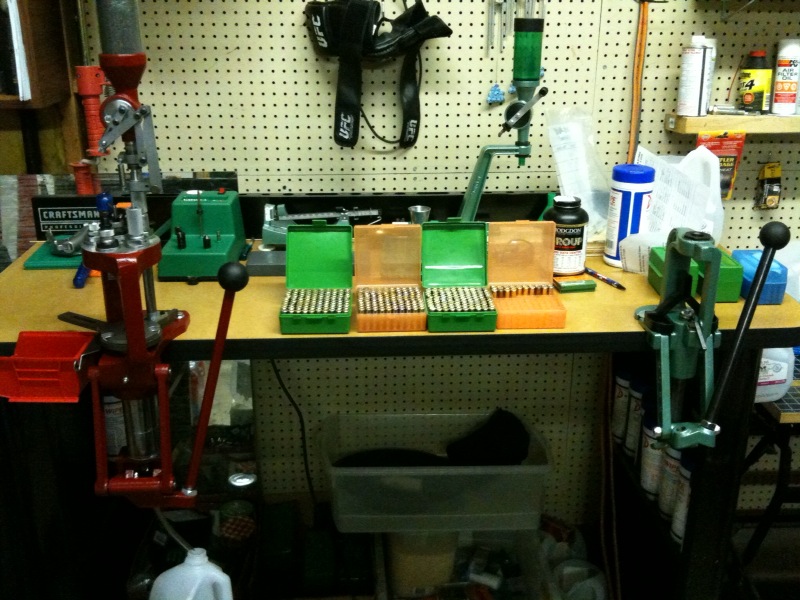
Primer Investigation – Part 3, Results
Hornady’s YouTube Channel
Hornady Manufacturing has their own YouTube Channel.
My Lock-n-Load AP is here and I’m hoping to get it set up some time this week…. just waiting for some final things to be delivered. It came with an instructional DVD that shows how to install and use it, and you can find all of those same videos on their YouTube channel. Nice touch, especially since it shows complete disassembly and assembly of parts.
Primer Investigation – Part 2, 43 Loaded
Link back to part 1, links forward to part 3 and part 4.
43 .223 Remington rounds loaded.
Each one has:
Bullet — Winchester .22 caliber 55 grain FMJ BT
Primer — CCI #41
C.O.L. — 2.215″ (came from the Speer #14 manual for a .223 Rem 55gr FMJ BT)
All are using TAC powder, but varying in amount. As well, the cases vary.
9 cases are new Remington left over from the first batch of .223. These were taken out of the bag, resized, and loaded. 3 cases have 25.0 gr of TAC, 3 have 25.5, 3 have 26.0.
25 cases are new Remington, but have received more prep. They were resized, flash hole deburred, primer pocket uniformed. 5 cases have 24.0 grains of TAC. 5 with 24.5. 5 with 25.0. 5 with 25.5. 5 with 26.0. I loaded a lot because if in fact there’s a new brass vs. used brass issue, I wanted to ensure I had enough “once fired” brass to work with.
9 cases are each loaded with 25.0 grains of TAC. 3 cases are used Winchester. 3 cases are used Federal. 3 cases are used WCC (NATO + stamp). All cases were trimmed to 1.75″-ish in length (about 1.753″, but could be 1.751″ or 1.752″). All of this brass is of unknown life (i.e. once fired? twice fired?) but inspection didn’t turn up any problems.
All rounds received a light Lee Factory crimp.
The main purpose of all of this is to shoot and look at primer pockets. I’ll also see if there’s any difference across the brass. I’ll also be taking a set of calipers with me to see how much things change.
I’ll also be shooting some Georgia Arms Canned Heat 55gr FMJ as a comparison/control.
Planning to go to the range first thing in the morning.
How to start working up a load
I recently stumbled across this bit of information on how to work up a load. It came from nodakoutdoors.com, posted by “Woodser”:
Probably the best advice that can be given to someone just starting to reload for accuracy is KISS. Keep it simple. Do not go out and buy several different bullets, several cans of different powders, and a couple different primers to start with. Start with one bullet, one powder, and one primer type and work on that combo with your choice of cases until you find a load that meets your specs. Start with the published COAL, the recommended minimum powder charge and work up 1/2 grain at a time until you find a combo that produces a circular grouping, no matter what the group diameter is. Then refine that load by changing the COAL, and incrementally vary the powder charge by 0.20 grains to tighten that grouping. Change only ONE variable at at time. Changing more, or using too many different components, can prove very frustrating.
If you find a combo that appears to have tightened the group as much as it will go, then change a component. THE FIRST thing I change is the primer. Many times I have found combos that yielded 1-1.5″ groups, and changing the primer reduced that by 1/2 or more.
When working up a new load for a new rifle, I start firing 3 shot groups, and when I have found a load combo to refine, switch to 5 shots, even with a light sporting barrel.
Then in a follow-up posting Woodser adds:
I forgot to add: When changing COAL from the published, always go longer by 10-15 thou. at a step. I am assuming the reloader does not have a throat gauge, or does not wish to take the time to measure the throat by other means. I do not on either count, I just shoot until I find the optimum COAL.
Gives me more reloading, shooting and range time, don’t ya know.
Since I enjoy the whole process, it is not a problem.
Those who measure the throat, and start at 5-15 thou. off the rifling, and do not vary it much during the whole load work-up cycle, may miss the sweet spot OAL for his rifle. Said sweet spot might well be 10 thou. off the lands, but it might also be 50-80.
I wish I had that advice when I started reloading. Granted, the only reason I can view that as really good advice is because of hindsight. But it’s something I’m going to take to heart as I go along.
The key would be to start with the known. So you have a good book, like the Speer #14 manual, or other solid sources of complete reloading data. Pick components (bullet, primer, powder, cases) based upon what’s established in the book. Of course these days it’s kinda hard to get exactly what you want due to supply and demand issues, but still pick something that’s in the book and as close as you can get… or at least, just pick one thing and stick with it. Work with that one thing. Vary powder and seek accuracy, working powder charges until you find what works best in your rifle. Then once you’ve exhausted powder (i.e. changing that one component), move to another component and see what happens.
And keep good records of everything.
Ladder Testing
An article on the ladder test technique for developing a load.
The article is geared towards long distance rifle shooting (e.g. out to 1000 yards), but the technique is sound for any distance where top accurary is the main goal for the load you’re developing.
Primer investigation – Part 1
Sometimes the day doesn’t give you what you want, but does give you what you need.
I wanted to spend the day in the garage reloading.
Instead, I spent a good portion of the day 1. cleaning the house, 2. playing Horse-opoly with Daughter, 3. napping. I got what I needed.
However, I did get some things done today, so here’s part 1.
Off to the garage
Now that the house has been cleaned up, it’s time to go to the garage to work on my next phase of the .223 reloading. Specifically working on trying to figure out the primer backing out issue.
More later.
Streamlight NightFighter Review
This is a quickie review of the Streamlight NightFighter.
I received this flashlight as a Christmas gift from my brother-in-law.

It’s my first Streamlight. My other “serious” flashlights are a SureFire E2L (which I always carry) and a SureFire 6P LED Defender.
 Stuff From Hsoi