2017-01-05 training log

Today was good!

First and foremost, benching with almost no arm pain is a win. 🙂 There was a little ache in my right biceps at the elbow, but that was there before the session and the session didn’t seem to change it. I think all those body work sessions with Howard really paid off. Plus taking all of last week off, stretching, etc..

That said, working up to 210 actually felt heavy. If I was going for rep PRs I’m sure I still would have hit my 10-rep threshold just fine, but again it FELT heavy. Why? don’t know. Could be that on the cutting diet here yesterday was an off day and I didn’t have much for carbs. Could be benching later in the week now I’m not as fresh. Could just be a random thing. Dunno. But worth noting.

The AMRAP set tho, again I went for 60% and hit 15 reps easily. So I am thinking I MIGHT try changing the AMRAP set to a true first-set-last. But I don’t know — feels like then on 1+ weeks I’d risk only getting 5-8 reps and I’d rather be sure to hit up to 15 reps because volume. But we’ll see. I’ll play around because nothing says I can’t try first-set-last and if it’s not enough reps I go back to straight-weight.

Assistance work is of course what it is. I continue to focus on getting a “3-0-1-0”-ish tempo. I say “ish” because I found if I really want to get that tempo I focus too much on counting and not on what’s important. So I’m more trying to just ensure the concentric is “fast and explosive” yet still the muscle moving the weight (no heaving, no momentum, etc.). Then make sure the eccentric is slower than the concentric was. One thing that came out of today is I may need to actually have a 1-second or so pause at the top/peak. Not because I want that squeeze or anything (tho I’ll take that), but more to stop momentum. As I was doing the lat pulldowns, I found that I’d lose about 1/2 the eccentric to just slowing down the momentum — not really what I want. So if I pulled down, held for a second, then all that energy was lost and the eccentric became nice and slow all the way down.

Still, today kept things “light” to help me find the placement for things and where to work, because again that slower tempo works things harder. 🙂

On the 100 rep work, I’m following that version of “100-rep protocol” where you start with about 40-70 reps, then rep as much as you can. When you hit failure, rest for as many seconds as you have reps remaining (to 100). Then keep going, get more, rest as much as there is left, etc.. I didn’t keep track of where things stopped — not really important. I’ll know over time if it’s time to move up (e.g. if first “set” hits 60-70 reps, up the weight and keep going).

Based upon 5/3/1 for Powerlifting, off-season for mass

  • Bench Press (superset with lat pulldowns)
    • bar x whatever
    • 100 x 5
    • 120 x 5
    • 145 x 3
    • 160 x 5
    • 185 x 5
    • 210 x 5
    • 145 x 15
  • DB Bench Press
    • 55e x 10
    • 55e x 10
    • 55e x 10
    • 55e x 10
    • 55e x 10
  • Chest-Supported DB Row
    • 45e x 12
    • 45e x 12
    • 45e x 12
    • 45e x 12
    • 45e x 10
  • Pushdowns
    • 35 x 100
  • Face Pulls
    • 50 x 100

How many rounds to carry?

Data is good, and I always appreciate Claude’s collection and analysis of it.

tacticalprofessor's avatartacticalprofessor

That question came up on a Facebook group I’m a member of recently. In response, I referenced my Armed Citizen database. The question was asked about my methodology, which is a fair question. I’ll address it my forthcoming eBook about the Armed Citizen but I want to first post the Introduction, which addresses the journey I have made about the Armed Citizen and my analyses thereof.

Introduction

This book is the result of the overlap of several very widely different topics and experiences. As is often the case, as more information comes to light over time, perceptions can change.

During my time in the Army, I held several different intelligence (S2) positions. These largely involved information collection and analysis duties, not ‘spyguy’ stuff. The purpose of Intelligence in the military and government is always to facilitate decision-making. Having to provide and defend a cogent analysis of not only the information…

View original post 1,342 more words

2016-10-03 training log

That was satisfying.

5/3/1 week. And yeah, maybe I should have stopped at 3 reps, but things just felt good so I kept going. Managed to get 5 reps at 290 — which is a 5RM PR for me. Rep 5 did have a slight pause at the sticking point, so I did rack it. And of course 3 reps would have been the proper thing to do on this adjusted program but geez… things did feel good, moving well, depth, all that. I saw no reason to NOT forge ahead. 🙂

I think in part I’m excited on two counts.

First, 230 is an interesting number for me. Way back when I started lifting again, I started with “Starting Strength” and got to 230 on my squat before stalling out pretty hard. I know it was a sloppy 230 as well. I struggled for a long time to get through this barrier. So it always stands out to me when I do 230, especially when now it’s just some warm-up weight.

Second, I’m closing in on 300, which is a great milestone. And when I break 300, that means I’m close to my all-time PR and breaking that. Soon. Soon.

For sure it energized me too, because I banged through the stiff-legs fast and easy, done before I knew it.

Hypers and crunches get bumped up a bit – instead of arms crossed on chest, now interlaced fingers behind the head.

But whatever. In the end, a pretty good day.

My own massing template, based upon 5/3/1 SST and some Paul Carter principles

  • Squats
    • bar x whatever
    • 120 x 5
    • 155 x 5
    • 185 x 3
    • 230 x 5
    • 260 x 3
    • 290 x 5
  • Straight-leg Deadlift
    • 185 x 10
    • 185 x 10
    • 185 x 10
    • 185 x 10
    • 185 x 10
  • Leg Curls
    • 35 x 12
    • 35 x 12
    • 35 x 10
    • 35 x 10
  • Hyperextensions, fingers interlaced behind head (superset with crunches)
    • BW x 10
    • BW x 10
    • BW x 10
    • BW x 10
  • Crunches, fingers interlaced behind head
    • BW x 15
    • BW x 13
    • BW x 10
    • BW x 10
  • Standing Calf Raises
    • 55 x 12
    • 55 x 12
    • 55 x 12
    • 55 x 12

Mindset and Decision Making

Once again, excellent insights from Claude Werner.

tacticalprofessor's avatartacticalprofessor

Then I guess it will just be time for him and me to be with Jesus.

Caleb Causey of Lone Star Medics related a mind-boggling story recently about one form of mindset. He posed questions to some friends in the context of encountering two burglars in their home. The concept of giving scenarios and asking people questions about their anticipated reactions is often far more effective than pontificating about what they ‘need’ to do.

The friends are a couple who have a 10 year old son. The wife is a petite woman who is a practitioner of boxing; good for her. What Caleb did was to posit a scenario of initial violence and asked her what she would do. She replied she would fight them. Since the scenario was two burglars whose combined weight was three to four times hers, he continued escalating the scenario in his questions. In the event…

View original post 762 more words

BACK AT IT AGAIN WITH THE ACCURACY DRILLS!  The Secrets of Highly Successful Gunfighters, and the Tactical Professor’s Baseline Establishment

An excellent drill from Claude Werner, by way of Dr. Sherman House.

This isn’t about how badass you can be. It’s about how good you can be. The beauty of this drill is there is no time-pressure, and thus really no pressure overall. Can you do this? It’s not necessarily hard, but it will show you where you need work. I haven’t shot this yet, but I am pretty sure my work will come at 25 yards (and perhaps 15).

I also like the approach of using different guns for this. You might just see where X gun really isn’t that good, or perhaps it means you need more practice with that specific gun. While this drill wasn’t involved, it was in shooting the same drills with my M&P9 vs. my S&W 442 vs. my M&P Shield that basically told me it was time to give up the snub as my BUG and take the Shield a little more closely. When I get my NAA Guardian back from the factory, it’ll be curious to try all of this out with it.

Really, this is a good diagnostic drill to help you understand where you are, and where you need more work. It helps you vet your gear too. Challenge yourself — it’s how you get better.

Sherman A. House DDS's avatarCIVILIAN DEFENDER

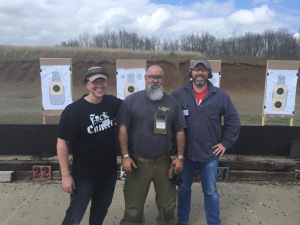
img_2379Mark Luell of, “Growing Up Guns,” (left) Darryl Bolke (middle) and myself (right), at the 2016 RANGEMASTER Polite Society Tactical Conference.

As I’ve already written about in the past few posts, I recently attended the RANGEMASTER Polite Society Tactical Conference.  One class I attended there was presented by Darryl Bolke of Hardwired Tactical Shooting, from Dallas TX.  The lecture was entitled, “The Secrets of Highly Successful Gunfighters.”

Darryl talked about the legendary lawmen, of both the distant and recent past.  Some of these men had been his mentors, and he made careful notes  of the skills he observed these men to have in common.  A common thread through all of these men was their capability to deliver extremely accurate fire, under the threat and pressure of tense situations AND/OR incoming gunfire!  Having the ability to deliver, on demand, gunshots to either the fist-sized vital zone of the upper chest, or…

View original post 2,006 more words

WHERE YOU BEEN?

Ever wonder why I blog so much about lifting weights, diet, exercise, and so on? Sure, guns are fun, self-defense is important — but if self-defense is all about preserving your life, then probably a more important thing to do is take care of yourself.

Dr. Sherman House (never met the guy, but we’ve exchanged some chatter and he’s friends with many people I know and respect) just came back from the ether. He’s been on a hell of a ride and well… you’d do well to learn from his experience.

Click through, read on. And then, do something tangible with the learnings.

Sherman A. House DDS's avatarCIVILIAN DEFENDER

Well, it’s a long story.  Indulge me here for a few…there is a personal defense message near the terminus.  As some of you know, I am a dentist by trade.  I have worn other hats in a fairly exciting life.  I had the distinct displeasure of contracting tuberculosis WAY back in 1999 whilst working as a fireman/EMT in Western Washington State.  I had to take a handful of HUGE pills, everyday, for six months.  The pills (Pyrazinamide and Rifampin) made me itch, feel nauseous, and made my food taste metallic and not good.  I was exhausted, and spent most of that six months feeling like a sweaty, miserable, mess.  After the six months had passed, I still didn’t feel great, and it took some time until I was able to, “feel,” right again.

Fast Forward to 2012…it was an ugly year.  My dear friend, “Uncle,” Paul Gomez died suddenly, on…

View original post 1,570 more words

“My gun kept you safe” – no it didn’t

Over the past few days, a letter to the editors of the Boston Globe has been going around.

TO THE man I sat next to on my way in to Boston:

When I boarded the commuter rail, you were already in the midst of a spirited phone conversation and didn’t seem to care about how loud you were talking. You were talking with someone about the Paris train attack and the growing epidemic of gun violence in America.

You spoke about the “murderous NRA” and “bloodthirsty gun nuts” who were causing our schools to “run red with blood.” You spoke profanely of the Republicans who opposed President Obama’s call for “sensible gun control,” and you lamented the number of “inbred redneck politicians” who have “infiltrated Capitol Hill.”

I found myself amazed at the irony of the situation. While you were spewing your venom, I sat quietly next to you with my National Rifle Association membership card in my wallet and my 9mm pistol in its holster.

I see where this letter is going, and frankly I do understand and agree with the general tone and sentiment of the letter.

However, there’s one thing I strongly disagree with. The letter poetically ended with (emphasis added):

Your liberal self-righteousness and ignorance may have made you feel superior and comfortable, but during that 40-minute train ride to Boston, my gun kept you safe.

No it didn’t.

Your gun didn’t keep you safe. It didn’t keep the other guy safe either.

“Our side” likes to parrot how “guns don’t kill people, people kill people”. That guns are inanimate objects and they (alone, in and of themselves) can’t kill.

Well then, by the same token, guns can’t keep people safe. It’s the same inanimate object.

But then by the same token, what keeps people safe are people willing to keep people safe, be that keeping yourself safe, or keeping others safe.

The author of the Globe piece does tacitly admit this, and I grant the prose is constructed and presented for artistic impact. However, let us not blindly parrot the phrase lest we suffer from the sting of our own words used against us.

When I first sat down to write this piece, this second part was to go in one direction. However a couple days after I started writing, respected firearms trainer Grant Cunningham wrote an article Do you carry religiously? You may not be as safe as you believe which actually dovetails perfectly.

The firearm is a very limited-application device in the totality of self defense situations and, being a reactive tool of restricted application, doesn’t keep you safe because it doesn’t prevent an incident from unfolding. It simply gives you a tool to defend yourself once a very specific type of event has occurred.

This is apparently a new concept for a lot of people, even (maybe especially) for those who have been in this field for a while! With such limited application there is no way the gun can really keep you safe — it’s all the other stuff you do that keeps you safe; the gun simply gives you a way out when things go horrendously bad. The gun has often been compared to a fire extinguisher: does a fire extinguisher prevent fires? Of course not. It’s just a tool to allow immediate response in case one breaks out.

Grant’s article was nourishing food for thought, and so I opted to change the rest of my article because of what he wrote.

Grant asserts:

I submit that if you find yourself acting differently, more cautious or fearful, when you can’t carry a gun you have a problem that results in you not being truly prepared for violence. The gun has blinded you to both its proper use and what actually keeps violence from being visited upon you.

And he’s right.

And I know a lot of people believe they are tuned in and “get it”, but this is NOT a place for ego. If any life-context requires humility, it’s the context of personal safety. You need to be humble, you need to be honest, even if it bruises or destroys your ego. Put it in check, step back and truly examine yourself within the context of Grant’s assertion; you probably suffer from it to some degree. Better to be hurt now and have a chance to correct the problem, than to be hurt later and forever denied the chance to correct.

Grant suggests “an unorthodox drill”. I think it’s a good one. I get some degree of practice in it when I do things like go to concerts. But I tend to only do this when I’m put into such specific contexts. Why not other contexts? So I’m going to do that from time to time. I know learning will occur, and I know I’ll be overall better for it.

Put it this way:

If, however, you feel completely confident and change nothing about your routine or your habits, then you probably have a good understanding of your concealed gun’s real place in your personal security planning. That’s how you know you’re at a point of balance, which means you’re safer overall than someone who isn’t.

Strive for balance.

If we can say anyone is a master of balance, it’d be an Olympic gymnast. Even an Olympic gymnast stumbles, even an Olympic gymnast can improve – that awareness of self is part of what brought them to the Olympic level. Have that awareness about yourself. Work to improve.

Slow Is Not Fast

Some wisdom from my mentor, Karl Rehn.

John Buol's avatarFirearm User Network / American Gunsmith

You’ve probably heard the advice “slow is smooth and smooth is fast.”

This tip from Karl Rehn

Slow Is Not Fast

USPSA Production GM and multi-time national champion Ben Stoeger talks about this issue a lot in his books and in his podcasts. His approach – which I used to finally earn the GM card I started pursuing in 1988 – uses intensive dry fire practice with aggressively challenging par times, combined with slower paced drills that focus on correct technique.

Techniques that work OK for a 2.5 sec reload may be too sloppy and inefficient to allow a 1.5 sec load.

One drill that was a breakthrough drill for me was a simple draw, shoot 2, reload, shoot 2 drill. His (total) par time for the drill was 2.6 seconds, shot at 7 yards with all A’s.

The standard advice given to someone that can’t hit the par (points…

View original post 78 more words

2015-12-21 training log

Mostly good today.

I like that weights are starting to go up, things are getting a little tougher, but still not too tough. The progression feels right so far.

My knees and other joints tho just were not feeling it today; had a few unsteady times due to my unhappy knee. But once things got warm and in the groove, it was better.

Oh, the calf raises. I opted to keep firming that up. It’s hard to do the 4×20 with 5-seconds pause between each rep — harder on your counting skills. 😉 Past couple weeks I crank the sets and reps but may not always get the pause in full. But today I really focused on following that strongly and geez! I can’t recall my calves ever feeling that way. It’s nuts! Furthermore, when I then rolled my knee sleeves down, it felt different — calf pump. Crazy stuff. Let’s hear it for pausing. Hopefully I won’t have serious DOMS tomorrow and Wednesday and be unable to walk. 😉

Based upon Paul Carter’s Inception program

Week X

  • Squats
    • bar x 6
    • 95 x 6
    • 115 x 6
    • 135 x 6
    • 155 x 6
    • 175 x 6
    • 195 x 6
    • 205 x 6
  • Leg Curls
    • 50 x 8
    • 50 x 8
    • 50 x 8
    • 50 x 8
  • Leg Extensions
    • 60 x 12
    • 65 x 12
    • 70 x 12
    • 75 x 12
    • 80 x 20
  • Seated Calf Raises
    • 25 x 20
    • 25 x 20
    • 25 x 20
    • 25 x 20

2015-12-10 training log

Gah… a little good, a little crazy. 🙂

It felt really… stupid to be squatting only 125 5×5. But that’s the program. First week, very very light. That said, it was actually kinda good because I really got to feel and find a good groove and technique. So, good thing.

The split squats… they were a little funny. My knees complained in the bad way, thus only 10 reps (program calls for 4×15). It got better as I kept doing the movement, so I think my body just needs to get into the groove. Still, kept it conservative today. I’ll increase reps over the coming weeks.

Leg press was what it was. Start light, work up.

The calf raises tho… that was crazy. Had to drop the weight a LOT so you can get the work in per Paul’s methodology. The 4×20, the 5 second pause, the stretch… yeah, that makes it a LOT harder. When the reps started to really burn, it was crazy. My knees wanted to unlock to relieve the tension, and I found that I couldn’t go down as far — not sure if it was just elasticity or my body was like “hell no”. So I’d push my knees back and push down to get the stretch, and oh… this pain would shoot up the back of my leg. Not a horrible pain, like “bad pain”… hard to tell if it was bad pain, or just massive burn or what. But it was crazy. Only got so many reps.

When the reps get really tough, I keep trying to think like John Meadows and really really push through it. But eventually, you gotta stop. Still, I try to push a little further, try to increase that pain threshold — again, not bad pain, just the good burn pain, y’know?

So today was a “light” day.. .ha ha ha. I can see this day becoming certainly less “work” than day 1, but still a good day of work. Will be very curious to see how this program pans out over the weeks.

Based upon Paul Carter’s Inception program

Week 1

  • Squats
    • bar x 5
    • 95 x 5
    • 115 x 3
    • 125 x 1
    • 125 x 5
    • 125 x 5
    • 125 x 5
    • 125 x 5
    • 125 x 5
  • Pause Split Squats (rear leg on bench)
    • BW x 10 (each leg)
    • BW x 10 (each leg)
    • BW x 10 (each leg)
    • BW x 10 (each leg)
  • Leg Press
    • Sled x 20
    • 135 x 20
    • 185 x 20
    • 225 x 20
  • Standing Calf Raises
    • 40 x 20
    • 40 x 18
    • 40 x 14
    • 40 x 14