Wildfire help from Hank Fleming

Were you or someone you know directly affected by the recent Texas wildfires (Bastrop, Cedar Creek, Spicewood, Steiner Ranch, etc.)?

Hank Fleming, one of Austin’s finest gunsmiths, posted the following to the TXIPSC mailing list. I asked Hank if I could repost to spread the word, and he said yes. So, here I repost:

Hank Fleming, Gunsmith, Austin TX offers to the fire victims of the Bastrop
fires

New guns @ my cost plus 5% (the 5% will pay my expenses, not a profit)

Internet transfers…$10.00 per transfer.

Please allow me to help in this way.

Having a house burn when I was a teen ager, I understand your loss.

Regards,

Hank Fleming

Very kind of him, to help in the way that he can.

Please help spread the word.

A little rifle work

Slipped away to the gun range this morning.

Hunting season is upon us. Whitetail deer season starts in November (gun), but with the weather cooling down if I wanted to go on a quick hog run I could do that too. Need to get things in order.

The Rifle

My rifle of choice is again my Wilson Combat 6.8 SPC. That’s actually just the upper, the lower is a RRA with their sweet 2-stage trigger; a few other odds and ends on the rifle too. But the key here really is that RRA trigger and the WC upper.

In the past I had shot Silver State Armory‘s 6.8 SPC, 85 grain Barnes TSX, “tac load” and had reasonable success with it. Then I started to hear about Barnes Bullets making a 95 grain TTSX, purpose-built for the 6.8 SPC (i.e. not just another .277″ bullet). Unfortunately, it was only available as a hand-load component, but the handloaders were having great success with it. I fully intended to hand-load for it, but life got in the way and I have been unable to sit at the reloading bench. Since I don’t expect life to let up any time soon, I was hoping someone would make factory loads of the 95 TTSX. Silver State tried it but results weren’t that great.

Then Wilson Combat made one. And the results were excellent.

I was finally able to put in an order for some, had to wait for the backorder to be filled, but a couple of weeks ago 4 boxes arrived. Huzzah! It’s my hope this will be THE round that I can use for all my hunting needs (deer, hog, etc.).

On top of that, the old Burris Fulfield II 3-9×40 I had well… I’ve long been suspecting the scope is broken. I’m no Marine Sniper with my rifle, but I can shoot and hit things, but any time I’d shoot with this scope I’d have problems, but not consistent problems. I loosely poked at it a few times to see, but results were always inconclusive. Still, being convinced that it’s broken I bought a new scope: a Leupold VX-R 3-9×50, and mounted it with a LaRue QD LT-104. While this gun doesn’t (yet) have iron sights on it, I want to get some because well… while it’s still just a hunting rifle, it would suck to have my weekend go kaput because of a failed scope.

I’ve been itching to get her zeroed in and finally was able to do so this morning.

The Performance

Since it’s my hope for the 95 to be my go-to round, but I still had a bunch of 85 around, I figured to start off with the 85 to get the scope roughly dialed in. I was happy to see that windage was centered and elevation wasn’t off by much. A few clicks of the knobs, recheck it at 100 yards and it was good enough to switch to the 95.

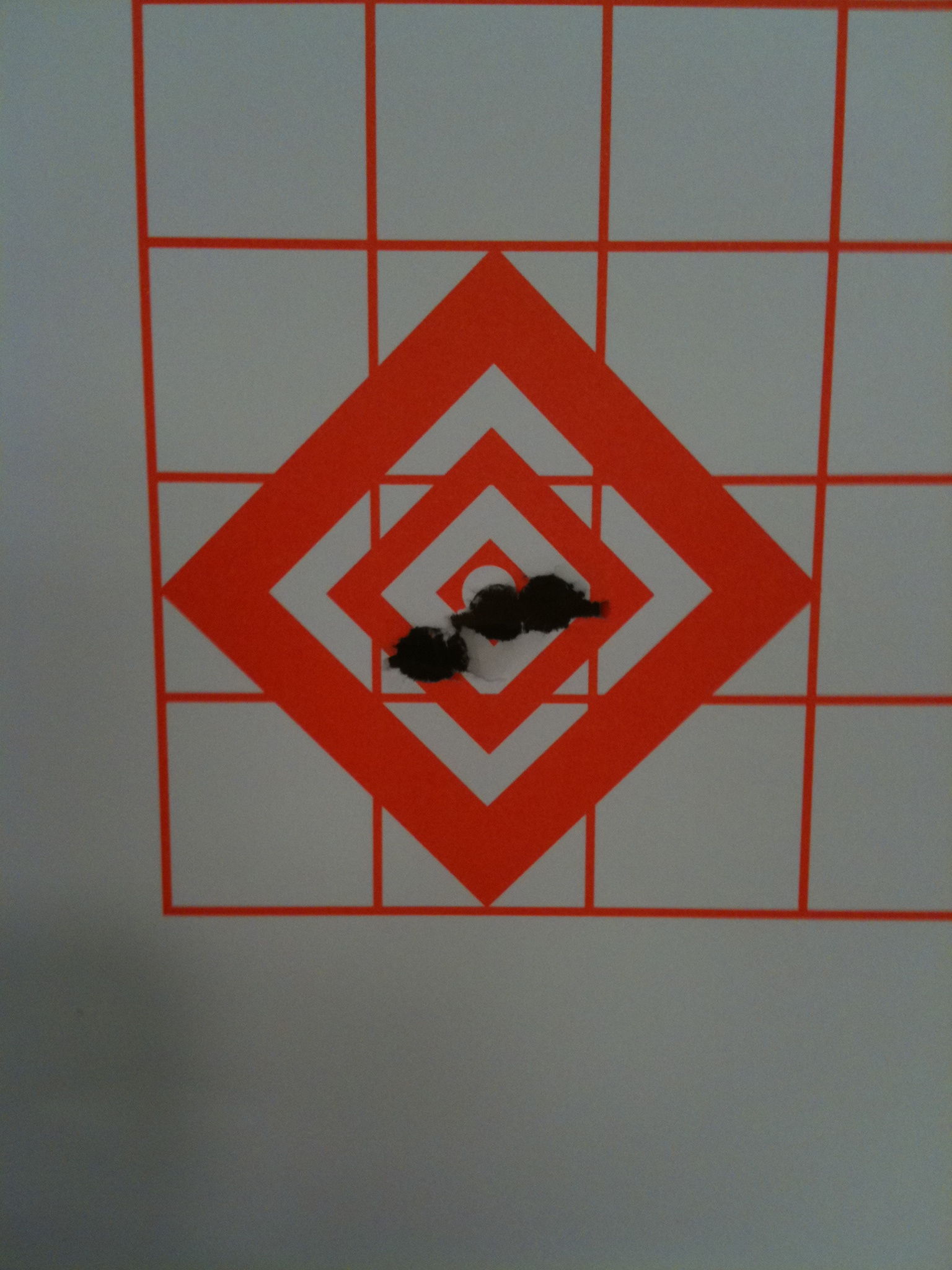
Here’s a sample of the Wilson Combat 6.8 SPC 95 grain Barnes TTSX ammo. 3 shots, 100 yards, out of my Wilson upper:

And I’m sure a better rifleman could do better. I’ll take that tho. 3 shots, under an inch at 100 yards. And technically these Barnes bullets aren’t “match” bullets, they are hunting rounds. So, good enough.

I did a little more shooting with the Wilson ammo to check point of impact at 25 and 50 yards, and they were about the places expected. All seems good. AND, everything shot consistently and as expected.

But then….

The Other Scope

I put the Burris onto a 5.56 upper. My feeling was I could at least use that for some plinking… to help the kiddos get used to the form factor of the rifle, the trigger, and so on, with just a simple upper swap.

The ammo was just some Georgia Arms .223 55 grain plinking stuff, so not the best, but it’s not unreasonable.

However, everything was all over the map.

I started at 25 yards for a rough zero, was a couple of inches off zero, so I dialed it to zero and it seemed good. In fact, I figured I should crank it about an inch low at 25 yards to try to have more of a zero impact at 100 yards. Whatever I adjusted it to tho, the point was that I adjusted the elevation so the point of impact would go down.

When I shot at 100 yards? The point of impact was about 4-5 inches high! Eh? And rather a wide spread too. I cranked the elevation down more and shot, and it seemed spot on. I then tried shooting the bottom-right diamond and was shooting a little low right. Then I cranked the magnification up to 9x (from 5x) and shot the bottom-left diamond… and those shots were about 2″ low and made a nice horizontal “line” about 4-5″ wide along the bottom of the target.

WTF?

Now sure, this isn’t match grade ammo, but it shouldn’t perform like that. And this barrel is a nice stainless 1:8 Wylde barrel that every other time I’ve shot it, even with this ammo, has performed excellent. So this?? This makes no sense to me, but it’s continuing to reinforce my feeling that the scope is fubar. I’d really need to sit down and do more scientific-like testing to be sure, but I’m getting more convinced it’s screwed up.

I’m not going to blame Burris or swear off their products because I have no solid knowledge yet if it is a messed up scope and then if it is, what caused it to get messed up. But I am going to go back and look at their warranty again….

And so…

Anyways, I feel the 6.8 is in shape and ready for action. Next up, taking the Kiddos to the range to let them try it out.

And yes… I’d love to see about a quick little harvest/hunt to see how she does in the field. 🙂

Addendum

I posted, then I realized I didn’t mention a few things I wanted to say.

The Leupold scope. The more I look through it, the more I love it. Compared to the Burris? No question, the Leupold is better. Crisper picture, brighter picture. Sure the Burris isn’t bad in this areas, but the Leupold was obviously a step up. Very happy there.

The Wilson ammo… I still need to do some work with it, like I’d love to run it over a chronograph. Wilson reports 2850 fps out of a 16″ barrel. Well, I have a 16″ barrel, and it just so happens I have a Wilson barrel so… I would expect to get 2850 fps, but it’d be nice to know what was really happening. I will say, shooting the SSA 85 grain tac load then shooting the Wilson load? The Wilson load felt like there was a little more oomph at the beginning… I certainly recall hearing more rattle in the buffer spring. It’d also be cool to see some gel performance of this particular load, but I don’t expect to do that myself nor see it any time soon.
What to expect at your first action shooting match

Local action pistol shooter, Nathan Taylor, made a 2 part video series for folks interested in getting involved in action pistol shooting but aren’t quite sure what to expect.


on zeroing

In this past weekend’s Defensive Long Gun class, the first thing done in the class was discussion of zeroing. Students were lined up at 5 yards, 15 yards, 25 yards, and 50 yards. A white 6″ paper plate was put up, and the students were told to aim at the center of the plate. We didn’t want students to adjust their shooting, we didn’t want them to try to put the holes in the center of the plate. Aim in the same spot every time as we vary distance so one can see the effects of their zero, the effects of distance upon their zero, the effects of distance as it pertains to point-of-aim vs. point-of-impact and so on.

Remember, the point of KR Training’s Defensive Long Gun is to look at long gun use in a civilian defensive context. So what does that likely mean? Something goes bump in the middle of the night. Strictly speaking that’s not the only scenario, but it helps to frame the context for the class. This isn’t military tactics, this isn’t shooting out to 300 yards. In fact, most of the shooting inside a typical home or office isn’t going to go above 25 yards. That frames the class.

Students came to class with a wide variety of zeros. Some had the traditional hunting “zeroed at 100 yards”, some had 25 yard zeros, some had 50 yards, some … well, we don’t know. 🙂   I’ve got a cool iOS app called Ballistic, and I wanted to run a bunch of numbers through it so you could see what the effects of different zeros are.

Settings

Ballistic comes with a large library of projectile characteristics. Since most students came with AR’s chambered in .223/5.56, I picked Hornady TAP .223 Rem 75 grain HP, because that’s a reasonable choice for a home defense load. As well, I chose a sight height of 2.5″, which isn’t strictly correct but is good enough to talk some numbers. But whatever the specifics, I kept all those variables the same, only changing the zero point since that’s the intent of the discussion.

Continue reading

Defensive Long Gun

Just got home from assisting with the Defensive Long Gun class at KR Training.

Great day. Overall things went well and it’s obvious the students learned a lot. Some learned lessons about shooting, some learned lessons of tactics, and a lot of people learned lessons about equipment and gear.

Yes, things break. Doesn’t matter how fancy and cool your gun is… if it breaks, if things aren’t Loctite’d down, it doesn’t matter. But it’s good to learn that in the safety and security of a classroom setting than when it really matters.

I’ve said it numerous times: find gear that works for you. Don’t be attached to your gear because it’s just “stuff”. If it doesn’t work, make changes be it modifications to what you have or maybe a full-on change and buy something else. You have to find things that work for you and work well. Your life and the life of those you love may depend on it.

A few things to comment on:

There was one AK, 2 pump shotguns, 1 Saiga (which the student was having a dog of a time getting to run well), and I believe the rest were some flavor of AR. I was surprised to see the great number of EOTech’s, but probably because I’m an Aimpoint fan. 😉  But consider the context of the class: civilian defensive situations, which is mostly home-defense. In a case like that, and since things can happen VERY quickly (as many learned in the role-play scenario) well… do you have time to turn your optic on? One reason I love Aimpoint is the battery life, so I can just turn the optic on and leave it on. Reminder to change the battery once a year, and even if I forget I’m not going to sweat it.

Whatever you have, but especially if you have an AR, you need to lube it. No, you don’t have enough oil on it. No, really, you don’t.

Since in a home defense situation you won’t be running around with the gun mounted but instead in a low or high ready position, it’s important that you can snap the gun into position and be in that same position every time. Cheek weld should be repeatable. If this means you have to lower the optic, you do. If this means you need to do something to raise up your stock, then do it. You should be able to snap the gun to your cheek bone and hit the same spot every time without having fiddle and adjust.

For you shotgun guys, look into shorter stocks to shorten your length-of-pull. Even 1″ off the back end makes a huge difference in your ability to mount the gun. For you guys running collapsible stocks, try going in one notch and see how that works. There will be a point where it’s too short, but work to find that point because it’s well likely you can go a little shorter and gain a lot of manuverability.

And don’t forget about holdover… especially if there’s something in front of you, like a barrier to shoot over or around. Very important the higher your scope is over the bore.

Due to all of that, there was discussion about zeroing distances. I’ll talk about that in another post because I think it’s worth it. I’ll get to it soon. Stay tuned. 🙂

On that Saiga… there was a time I was interested in getting one. I’m pretty well cured of that desire now. My pump shotgun runs.

Oh.. .the real treat for the day? Seeing Schnookiemuffin, Rog, and… Exodus. Welcome home, man. 🙂

What would you do?

Mob violence is on the rise.

Watch this video of mob attack at a Dallas convenience store. This happened just a couple of days ago.

So what would you do if you were caught up in this? If you were in the store buying a soda… if you were at the pump filling gas… if you just happened to be at the wrong place at the wrong time.

What would you do?

And consider not just the mob itself, but consider this store clerk getting attacked. Would you intervene to try to save him?

Consider as well… even if you carry a gun, consider the sheer number of people involved. Consider as well that some of these choir boys are likely packing a gun too.

It’s ugly all around.

What would you do?

Another 2 years

Today’s mail contained an envelope from the Texas Department of Public Safety.

It was my Concealed Handgun Instructor Certificate certifying me to teach the Texas CHL course through the end of 2013.

As noted before, there’ve been some recent program changes for the instructors. I had my paperwork in order, so once DPS got their stuff together, it was no problem on my end.

DPS has had a lot of bumps as they’ve worked to modernize their process for applications, renewals, and other such administrative tasks. It’s still not perfect, but I’ll give them credit for working on it and working in what appears to be the right direction.


Why I Trust Aimpoint

My friend Charles, over at TacticalGunReview.com, recounts an experience with his Aimpoint red dot scope that only serves to further his trust in that product. I’m with him: I’m Aimpoint all the way.

Go read. It’s a good testimonial for their product.

A fine day for shooting

Just returned from a morning at KR Training. Today was just a Basic Pistol 1 class; there was another class in the afternoon but I guess between the heat and the Labor Day weekend, enrollment was small enough that Karl could handle it solo.

While the heat is starting to decline, it’s still hot out. Because of this, the past some BP1 classes have been slightly modified. Instead of 2 hours of lecture then about an hour on the range, we’ve been doing an hour inside to cover safety and basics of shooting, then we go to the range, then come back in to cover things like types of guns, actions, parts, nomenclature, and so on. It gets us onto the range sooner, while it’s cooler. It’s slightly awkward because when you’re on the range you find yourself wanting to talk about certain things that won’t be introduced until we get back inside. But I think the switch actually works better. It forces a little better time management, it ensures enough time on the range, and the best part is it helps the students understand things more when we come back in to talk about things. It actually works out well, and helps to generate better questions and better understanding. We may keep the format, thank you Mother Nature. 🙂

I think the biggest thing that came out of the class was discussion of gun fit. If you search my blog you’ll find many previous discussions of the topic, but if you just want to click on something, click here; that article refers to a good guide as well as some writings by the TXGunGeek (a fellow KR Training instructor). I ran a station with 3 different 1911’s all in different calibers, different options, and with the variety of students we had (women with small hands, men with small hands, men with large hands, men with really huge hands) it was useful to show them how guns can vary in fit and how simple modifications can be made to help guns fit better. When a gun fits better, you’ll shoot better, you’ll enjoy it more, you’ll be more apt to practice. All good things.