Range Observations

Let’s try “Range Observations” as a title for these things. And since there’ll be a bunch of them, how to delinate them? Well, I’ll figure it out.

I spent the morning at KR Training helping with Defensive Pistol Skills 2. But, I left after that. The plan was to be there all day helping with all 3 classes but I was able to leave early because 1. some students dropped at the last minute so headcount was down 2. we had some additional helpers show up that I didn’t originally expect to see, so 3. that made the ratios a little better and things able to be handled so… I was able to come home early and tend to other important family matters. So, thank you to Karl, John, Tom, Brian, and Steve for letting me bail early.

Anyways….

So what did I see in DPS2?

First, I’m still pleased as punch to see a few more women showing up for more advanced training, especially gunfighting-type training. Saw some come in for the Force-on-Force scenarios as well, which is great!

Second, to all the students in class? Of course, practice the things we taught in class, like malfunction clearing, reloads, scanning, use of cover/concealment… all that good stuff. But more than that? Continue to work on your fundamentals: trigger control, sight alignment (and remembering to USE the sights, don’t just throw the gun out there and spray and pray), presentation, all that good and fundamental stuff. Slow down, work to get good hits. Remember: unacceptable hits are just that: unacceptable. I’d rather you be a half second slower and get acceptable hits, because in the long run you’ll be faster.

The fundamentals will always be where it’s at. Work on the new stuff, it’s important, but always focus on the fundamentals and devote time to constant improvement of those.

And don’t forget…. SCAN! SCAN! SCAN!

Why can’t he be a jackass?

Apparently there’s a CHL instructor here in Texas that doesn’t want everyone’s business:

“If you are a socialist liberal and or voted for the current campaigner in chief, please do not take this class. You have already proven that you cannot make a knowledgeable and prudent decision as under the law.”

The ad continues, going on to say,”If you are a non-Christian Arab or Muslim, I will not teach you the class with no shame; I am Crockett Keller, thank you and God bless America.”

Of course, a lot of people have their panties in a bunch over this.

What I’m wanting to understand is… why is this a problem?

Why can’t this man conduct himself as he wishes? Why can’t this man conduct his business as he wishes?

He’s not hurting anyone, he’s not depriving anyone of anything. There are lots of CHL Instructors in Texas (I’m one), so take your business elsewhere. That’s one of those wonderful little things we like to call “freedom” in this country. He’s free to act as he wishes, so long as it doesn’t hurt anyone. You’re free to not associate with him if you don’t like him and what he’s doing.

The thing is folks, if someone wishes to behave like a jackass, why should we stop them? They will reap what they sow; karma is real; how ever you want to look at it. You know the saying… “Better to remain silent and be thought a fool than open your mouth and remove all doubt”? Well… when they open their mouth, at least then we know who the fools are and can (re)act accordingly.

As for DPS well… one can argue that being a DPS-certified Instructor, he reflects upon all CHL Instructors and DPS and the Texas CHL program. As the article notes, DPS is going to look into this. DPS has every right, authority, and responsibility to maintain the CHL program, and if revoking his instructor license is deemed proper, then so be it. Mr. Keller can still run his private business as he sees fit, but the state doesn’t have to associate nor condone it.

I don’t share Mr. Keller’s line of reasoning; I understand where he’s coming from, but I do not agree with him. Note, there are NRA/TSRA A-rated Democrats. As well, someone hell-bent on killing you isn’t going to seek a CHL. However, if we truly believe in freedom then yes, you need to let the man conduct himself as he is. He’s not hurting anyone, depriving anyone, abridging anyone (except perhaps himself). All he has is what some might call an unpopular opinion, and he’s willing to stand up for his beliefs. You “Freedom of Speech” lovers must remember that 1A is about protecting unpopular speech. As Evelyn Hall said, “I disapprove of what you say, but I will defend to the death your right to say it.”

Do you believe in freedom? Or don’t you?

I need a better title for these things

I spend about 2 weekends a month at KR Training and like to write up something about the experience. What I saw from students, lessons we can learn, maybe some things to share with those students towards furthering their study and improvement. Whatever ends up striking me as relevant from the class(s). But for whatever reason I can’t think of a good way to title the postings… it’s not really an after-action-report (AAR) tho I guess it is. Oh well, I’ll figure out a good title eventually. 🙂

This past Saturday was Basic Pistol 2 and Defensive Pistol Skills 1. Both classes sold out, weather was awesome, things were looking good. More than half the folks in BP2 were women, and many of them repeats. Looks like a lot of these ladies are going through the program together, which is awesome. I hope to see the same groups back for future classes like Defensive Pistol Skills 1 or Beyond the Basics: Pistol. What was very cool to me was seeing 20% of the DPS1 class was women. For whatever reason, I just don’t see many women taking higher levels of training, which is a shame. Our culture and society puts a lot of emphasis on woman empowerment, on women’s self-defense. Many women desire to have a handgun for personal defense, and they’ll come to get basic training, but that basic training is just that — basic. The realities of gunfighting, of actually using a gun to defend your life, I’m not sure why more women don’t pursue that level of training. So to slowly see more women doing so is wonderful to me. You ladies need to preach the word. 🙂   As for other demographics, men and women, young and old, various ethnic backgrounds, various social strata… folks, you just can’t pigeonhole what a “gun owner” is, no matter how much your prejudice wants to.

For the students of both BP2 and DPS1, I have the same bit of advice: practice putting the gun on target. We may have referred to it as the press-out, the present, presenting the gun, presentation, going from step 3 to step 4 of the draw, it’s known by numerous names. But it’s all the same. It’s going from that (high-compressed) ready position with the gun pointed at the target, finger off the trigger, your eyes looking at the target (that string connecting your eyeball to the target), then on the “go” you simultaneously press the gun out towards the target (and up into your eye-target line) and press the trigger in with the shot breaking when you reach extension. Eyes don’t break the eye-target line, but focus will shift from the target to the front sight as the front sight comes into view.

THAT skill is the one skill that students from both classes should focus on. Sure there were other things to focus as well, and I’ll talk about a few of those below, but if there was only one thing to practice, it would be this.

This skill is used in so many areas of pistol handling, it’s so vital to do and to get right — you use it more than you’re aware. As well, doing this will help with some of those other areas, like trigger control. Practice this skill in dry fire. When the gun goes *click* the front sight shouldn’t move — it shouldn’t dip down. If it dips, you’re smashing the dickens out of the trigger, don’t do that. Lighter press. Remember, when first working on this skill work to get it right, work to get it correct. Take your time, let it be slow. Speed will come.

Dry fire is your friend. It will help you more than blasting away at the range. Use dry fire to develop your skills. Use time at the range to confirm them.

As for some other things…

Defensive Pistol Skills is about that — skills needed to help you defend your life with a pistol. That implies that somehow your life is in the line, that you are in danger. You have to put your training in such perspective, that your life matters and you need to move — now!  Things move fast, you must move faster. This isn’t a casual day at the range. Granted, DPS1 is the first exposure to a lot of people so I don’t expect you to walk in with that mentality, but I hope you walk out with that mentality and keep it when you practice these skills and when you come back for future classes like DPS2 and DPS3. You will fight like you train, so train like you’re fighting.

About speed. Don’t worry about it right now. Yes, we will put you under pressure to make a point, because within a 3 hour class we want you to get information and introduction to the skills — it’s up to you to go home and practice those things to retain and get better at them. But don’t try to go at those fast, pressured speeds in your practice. Slow down. Memorization, Precision, Smoothness. For instance, we teach that 4-step draw with each step being discrete. Then we have you go fast and those 4 steps suddenly become this smear from holster to extension… the steps disappeared. Don’t do that. Keep the draw with 4 discrete steps; they will eventually smooth into one motion, but all 4 steps are identifiable and there. So, work on things like the draw, keep all 4 steps in there, be correct, and speed will come.

Finally… hardware. Seeing a growing number of XD’s, especially the XD(M). There were 3 H&K’s in the DPS1 class, which was unusual. I know at least one of those H&K owners considered shopping for a new gun — that long double-action trigger is just way too much trouble to shoot well. Too many fiddly bits (if it’s got a decocker, just say no). If you find yourself at the gun range only wanting to shoot such guns after first manually cocking the hammer? Then you know it’s no fun to shoot it in DA mode, so why bother with the gun at all? We also had 2 students with Kahr’s, which I thought was awesome. First, they ran well. Second, they were the guns these people chose to carry, and they chose to learn with them. Too many people desire to have X gun for carry, but they grant all the issues about X gun and won’t use it in class instead opting for some big easier to shoot gun. Well folks, when the fur flies, it’s going to be pretty hard to perform… if X gun is so undesirable to use when there’s no pressure, how desirable will that gun be under pressure? If you’re going to fight with X, you better know how to fight with X. So train with it. These folks chose the Kahr for carry, and they chose to train with the gun they’ll fight with. Good for them.


Another episode of “What can we learn from this”

A grandfather accidentally negligently shoots his grandson. (h/t Unc)

A man unloading a rifle from his SUV accidentally shot his grandson in the head today in the parking lot at Cabela’s sporting goods store in Kansas City, Kan.

[…]

Police spokesman Capt. Ronald Kaminski said the man was bringing an antique .22-caliber rifle to the store to get it appraised. As he was unloading it the gun discharged. The bullet went through the vehicle and struck the boy, who was standing outside.

The boy is in the hospital but expected to survive.

Let us learn from this so we do not repeat the mistakes.

  • Why was the gun’s state (i.e. loaded/unloaded) not verified when it was taken out of storage? I am making the assumption that the state was not checked at that time, but I figure it’s a reasonable one because it’s unlikely he desired to haul around a loaded gun since he was bringing it in for appraisal.
  • On the same token, why was the gun’s state not verified when it was originally put into storage? Unless, gremlins got into the gun safe (or closet or wherever it was stored)?
  • Why was the gun’s state not verified when it was taken out of the car? Now I will say, you shouldn’t check the state in the parking lot because where is a safe direction? But a greater point is, every time you pick up a firearm, verify it’s state to ensure it’s in the state you expect it to be.
  • How was it the gun was able to fire? It may be possible the gun itself is mechanically faulty, but more likely something came in contact with the trigger and the trigger was pressed. It could have been his hand/finger when he took the rifle out of the car. It could have been as he was pulling the rifle out the trigger snagged on something in the car. Was the rifle in a case? Was there anything covering/protecting the trigger to prevent undesirable things from coming in contact with the trigger?
  • Note that it was “a little .22″… but the bullet still penetrated the vehicle. You know… steel and other materials. .22’s are still worthy of respect.

Those NRA Safety Rules exist for a reason. All 3 appear to have been violated.

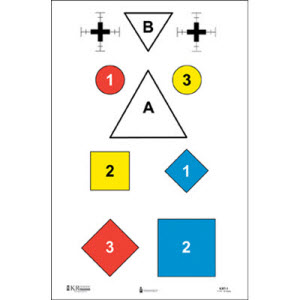
The KRT-1 Target is now available

Finally, we can reveal it to the world!

The KRT-1 target.

The KR Training instructor crew spent quite a while hashing this out, designing, revising, arguing, testing. But finally it’s here, available from Law Enforcement Targets.

If you go to LE Target’s website you’ll see tons of targets already in existence. Why in the world create another one?

The main reason? it fits on 18″ target frames, the same frames used for IPSC and IDPA targets. These are the frames we use at KR Training.

With few exceptions, most targets are designed to fit on 24″ frames. There are lots of useful targets, but when you put a 24″ target on an 18″ frame, the uprights won’t last long, nor will your training session (and it doesn’t help towards keeping cost and maintenance issues down either).

We designed a target that could be used for the KR Training curriculum, from defensive pistol training, to competition, command work, group shooting, you name it. It’s rather versatile. It has A and B zones that map to head and chest areas; and the numbered, colored shapes can be used for many drills. It includes two sight in areas with 1″ grid marks.

Of course, we hope this will be useful to shooters around the world, especially those similarly frustrated by using 24″ targets on 18″ stands. 🙂

Glock, the book

Paul Barrett wrote a book, Glock: The Rise of America’s Gun. I was offered a preview copy of the book but had to decline — I don’t have the spare cycles to read it, and am rather behind in my own reading list anyways. *sigh*

Nevertheless, it seems an interesting book and now has a new web home.


You’ve got a hammer, but everything isn’t a nail

Michael Bane and Michael Janich discuss an important construct in self-defense: that one solution isn’t always the appropriate answer.

Can’t embed the 5 minute video… you just have to click the above to watch it.

I like Janich and he speaks a lot of truth here. I’ve dealt with two realms of “self-defense” training: guns, and empty hand martial arts. In the past and even today, people tend to choose one or the other. As well, many schools tend to only teach one or the other, tho thankfully that’s improving in recent years.

The reality is, like Janich points out, if you have a gun that’s great but that is not the appropriate nor possible response in all possible situations. It doesn’t mean you need to become a black belt in some deadly art, but having more responses programmed in, from simple verbal commands, to escapes, to perhaps basic empty-hand strikes can be a useful thing to allow you to respond appropriately to what’s presented. Insights Training Center is a good place for this sort of integrated methodology. If you want to go a more traditional route, consider Filipino arts, like Pekiti Tirsia Kali (in Austin, check out Leslie Buck).

On the other side, a lot of people take empty hand training but won’t progress to the level of firearms. Well, many traditional martial arts will teach weaponry, but it’s interesting how much of that ends up being demonstration and never application. Granted, it’s difficult to apply sword or nunchaku in a modern context, but what’s the point in learning a weapon if you do not know how to actually fight with it? However, I’d argue to move beyond those weapons because technology has evolved (else we’d all be using clay tablets and not iPad’s) and firearms are the modern sword. Empty hand skills can take you far, but not far enough because I’m sorry… a 5’4″ 95# woman no matter how skilled is just going to have a tough time against a 6’6″ 275# strong man hell-bent on raping her. A gun is a force equalizer.

I know some argue against the notion of “another tool in the toolbox” because then you start to collect a zillion tools and won’t know how to deploy anything. This is true. But there’s a balance point, and it starts by having to acquire more tools. Let’s be literal with the notion of toolbox. If the only thing you have in your toolbox is a hammer, yes everything looks like a nail. You’ll pound screws, if you need a hole in something you’ll just have to whack the hammer through it, if you need to measure something it will be “3 hammers long”, and so on. Well sure that might work, but it’s not very efficient and could cause collateral damage. That’s why you have to acquire more tools for your toolbox: to have a screwdriver, to have a drill, to have a tape measure. There are enough basic tools that one needs in order to have a complete toolbox. The problem starts to arise when you start to acquire too many tape measures… how many rulers does one need? For me, a simple 25′ tape measure is fine and covers all my needs. But a professional carpenter might want a carpenters ruler. Most people only need a claw hammer, but the handyman might also have a drywall hammer, and the roofer a roofing hammer.

So most people don’t need a taser and handcuffs, but a police officer does. A bouncer at a nightclub needs a lot of empty hand arrest and control techniques, as well as good verbal skills. So you can see, toolbox contents, literal or figurative, can vary from person to person and situation to situation. What matters in this self-defense context is that you can go too far. Bragging about having 3608 techniques means… what? Consider Bruce Lee: “Take what is useful and discard the rest”. Or Antoine de Saint-Exupéry, “Perfection is achieved, not when there is nothing more to add, but when there is nothing left to take away.”  Whether you listen to the martial artist or the writer, they are both saying that it’s about stripping away, but first you must have something to strip away. If all you have is a hammer, you have nothing to strip away. If you have 3608 techniques, you have a lot you can strip away. In the journey of life, we start with nothing and acquire as we go along. This is the way it has to be, because how else can we find what is useful? How else can we discover what we need? How else can we know what to discard if we’ve never acquired it in the first place? The key, however, is to not just collect, but ensure you periodically review and discard the useless so your collection is meaningful. So, “another tool in the toolbox” is good, but only if it’s useful to you. If all you have is a hammer, it should be because you had an entire hardware store and were able to discard everything else.

I’ve been blacklisted

I guess I’ve made it to the big time now, because I’ve been made part of The Gun Blog Blacklist.

(if you don’t get it, don’t worry about it… it’s a bunch of silly drama llama stuff, but Google “gun blog blacklist” if you really care).

I didn’t ask to be listed, because I couldn’t care less about the drama. But hey, it’s nice to be recognized as part of the s00p3r s3c43t conspiracy. 🙂

What is a safe direction?

When it comes to the rules of gun safety, most people recite something similar to Col. Cooper’s 4 rules. I used to do the same, but over time came to prefer the NRA’s gun safety rules.

  1. ALWAYS keep the gun pointed in a safe direction.
  2. ALWAYS keep your finger off the trigger until ready to shoot.
  3. ALWAYS keep the gun unloaded until ready to use.

Why I believe that’s a better rule set is another discussion for another time (Karl Rehn of KR Training does write about it). What I want to focus on here is the notion of “safe direction”.

We are to ALWAYS keep guns pointed in a safe direction. Thus, we need to know what a safe direction is. Here’s how the NRA elaborates on rule 1:

This is the primary rule of gun safety. A safe direction means that the gun is pointed so that even if it were to go off it would not cause injury or damage. The key to this rule is to control where the muzzle or front end of the barrel is pointed at all times. Common sense dictates the safest direction, depending on different circumstances.

Emphasis added. I think that’s pretty plain and clear.

The reality is, while the definition is clear and simple, putting it into practice isn’t always so easy. The reason is, “safe direction” can change. What you may need to think about is “the safest possible direction, right now”.

Let’s say you’re at the gun range. You’re at the established firing line. Given that, it’s reasonable to say that pointing your gun downrange is a safe direction: if you pointed a gun downrange and the gun discharged, the bullet would eventually be stopped by the big dirt wall or whatever it is the range has as a backstop/bullet trap. The only thing that might be damaged between the gun and the backstop is the target you were shooting at, but of course that’s acceptable. Thus, downrange is a safe direction.

Right?

Well, generally speaking yes. But what if a person walked downrange because they wanted to put up a target? Now is downrange a safe direction? I would say no. This is why gun range rules have it that no one goes downrange if there are people/guns on the firing line, and that if people are going to go down that all guns are rendered safe (e.g. benched, unloaded, action open; holstered; etc.) and everyone steps off the firing line with no gun handling permitted while folks are downrange.

So when handling a gun, if your safe direction no longer is the safe direction, what do you do? You have to find what the safest possible direction is now.

Could that be up in the air? Maybe, but remember that gravity is always in effect: if a bullet goes up, it’s going to come down. Do you know where it’s going to come down? Can you guarantee it will not cause damage, injury, or death?

Could that be down at the ground? Maybe. I wouldn’t say directly down at your feet, given you probably don’t want to destroy your feet. Perhaps then angled down pointed just a few feet in front of you? Perhaps. Consider the ground surface. If it’s dirt, that’s one thing. If it’s a hard surface like concrete or tile, that bullet will splatter.

How about at that wall? Maybe. Could that wall stop a bullet? If it’s drywall, like most homes and buildings use for walls? No, that won’t stop a bullet at all (even birdshot will go through drywall). Cinderblocks and bricks? Better chance of stopping, but that could depend (e.g. a 9mm handgun round should stop; some rifle rounds could go right through). Consider that where the bullet comes to rest doesn’t stop where your eyes stop. My eyes cannot see through the wall, but I know that while the wall stops my eyesight, it does not stop a bullet. So, I must continue to consider beyond my eyesight to the point where the bullet would come to rest. If you want to see what bullets can go through, check out The Box O’ Truth for much information, experiments, and pictures.

What if you were in a personal defense situation? Let’s say you’re at a crowded shopping mall and hear shots fired. There are innocent/uninvolved people all around you. Where is the safe direction now? Of course, if the bad guy is in front of you, you could argue the safest possible direction at that moment is pointing the gun at him!

I’d like to think it should “go without saying” that pointing a gun at yourself is not a safe direction, no sir, not even a little bit safe. Alas, there are more than enough stories of people pointing guns at themselves, “relax, it’s unloaded”, press trigger, and tragedy ensues. Lots of rules violated, but that’s the one thing about safe direction: if you follow it ALWAYS the worst you might end up with is manageable damage to property, and injury to your pride.

This is also why there are multiple safety rules, because they provide layers of protection: there must be violation of multiple rules for truly bad things to happen. Point the gun in a safe direction but fiddle with the trigger? That can be OK. Point the gun in an unsafe direction and the trigger is never touched? That can be OK. Point the gun in an unsafe direction and press the trigger? That’s going to be a problem. This doesn’t permit you license to knowingly violate one rule while following the others; all the rules begin with ALWAYS and that means always.

Going back to the gun range situation, do not allow yourself to be lulled into thinking safe direction but violating it. I see it all too often where a line of people are on the firing line. Someone in the middle of the line goes to work the slide on their semi-automatic handgun. They want or need a little more strength, leverage, and comfort in working the slide so the gun comes in and gets turned sideways — much more ergonomic and better leverage for the person working the gun — but now where is the muzzle pointed? At the person next to them! If you point a gun at someone, that can be considered aggravated assault. Not to mention, it’s impolite, inconsiderate, and unsafe range behavior. Safe direction is an ALWAYS proposition.

The reality is, safe direction is fluid and dynamic. As well, sometimes the safest direction may not be an ideal safe direction: it may be the best you can do is point at the floor and risk some lead splatter in your shins because that’s the least risk of damage and injury of all possible choices. You must consider where the bullet will come to rest (a place you may be unable to see), what there is between the muzzle and that point of rest, if between those points there’s potential for damage or injury, and if that damage or injury is acceptable or not. You must ALWAYS point the gun in a safe direction. You must ALWAYS (re)evaluate if that safe direction is still a safe direction, and if not find the new safe direction and point it that way.

I wrote this article because I often mention safe direction, but can only give it lip service because I don’t want to distract from the larger point of whatever else I’m writing about. Now, I’ve got an article that elaborates on the topic and it’s simple to link to for further discussion. Feel free to link to this article to help in your discussions of gun safety and “safe direction” (please give proper credit). Shoot safe.
And your data is where?

Via Unc, Herschel Smith has an excellent examination of Heller vs. DC and how that pertains to “assault weapons”.

It’s a good read and pretty much stands on its own. I just wanted to make a couple of comments.

On page 35, the judges jump into bed with Siebel when they parrot his own words.

The Siebel testimony moreover supports the District’s claim that high-capacity magazines are dangerous in self-defense situations because “the tendency is for defenders to keep firing until all bullets have been expended, which poses grave risks to others in the household, passersby, and bystanders.” Moreover, the Chief of Police testified the “2 or 3 second pause” during which a criminal reloads his firearm “can be of critical benefit to law enforcement.” Overall the evidence demonstrates that large-capacity magazines tend to pose a danger to innocent people and particularly to police officers, which supports the District’s claim that a ban on such magazines is likely to promote its important governmental interests.

A few things.

Tendency is for defenders to keep firing until all the bullets have been expended. Upon what factual basis is that statement made? I’d like to provide you with some hard data. It’s slightly old data, from 2009 (go to page 3, “Shooting Incidents, Common Factors”), and while there have been additions to this data set, overall I doubt the core numbers have changed much. As of that 2009 data, Tom Givens of Rangemaster had 48 students involved in self-defense shootings. The average number of shots fired? 3.8 (lowest was 1, highest was 11).

3.8.

Shooting until all bullets have been expended? Well, since we’re talking in the realm of “high capacity assault clips”, those all hold a LOT more bullets than 3.8. And even if we talk some really low capacity assault clips, like say the 7 rounds of a 1911 or maybe the 5, 6, 7 rounds that get held by a lot of pocket semi-autos, that’s still rather different from the average. So where are they getting that defenders have a tendency to keep firing until all bullets have been expended? Please, back up your assertions with data.

As for this “2 or 3 second pause”. Why might that time be critical to law enforcement in an active shooter situation? It means the gun is out of commission, so law enforcement can act, such as rushing in to take the bad guy down or just being able to pop out from behind cover and return fire.

Let’s step back from things. Let’s remove the notion of good guy and bad guy here, let’s just look at the people involved and the roles they’re playing. You have someone with a gun that was shooting but now needs to reload. Then you have someone being shot at that can now act freely because the shooter is out of commission. That means having to reload is a bad thing for the person doing the shooting, right?

Let’s step forward, but to the right a little bit… let’s swap the labels and make the shooter the good guy. If the time it takes to reload is bad for the shooter, that means if a good guy is doing the shooting, the less he has to reload the better, right? I think we can agree upon that, because police seem to always be exempted from “large capacity assault clip” bans… we want police to have lots of bullets and be able to fire them, right? If not, why not give police single-shot guns? No, we seem to understand that the good guys being able to keep shooting with minimal (or delayed) downtime is good.

So why deny this from law-abiding citizens?

Why do we want to put good people at a disadvantage?

You can ban all the large capacity assault clips that you want. By definition, criminals will not obey the law and will have access to all the guns and ammo they can get their hands on. The only people abridge, hurt, and otherwise crippled by such bans and laws are those willing to obey the law — you know, us good citizens.

So now through force of law the state has put the citizens at the mercy of criminals.

Is that right?

It’s not, in my book. But you know… insert snarky comment about how a lot of politicians are scummy corrupt criminals themselves, and perhaps we could see why they might think this way. But I don’t think that’s necessarily the case: I think it’s just done out of ignorance. I used to be similarly ignorant, but I was enlightened.

It can be argued that not only is the 5.56 mm round and the AR style weapons a legitimate home defense weapon, it is in some circumstances the optimal one to use.  The District of Columbia and the judges find themselves in the uncomfortable position of saying that it is acceptable for citizens to possess a long gun shooting the 7.62 mm round, as long as it doesn’t have a collapsible stock, forend grip, or rails for lasers or lights (after all, we wouldn’t want individuals to be precise in their self defense, or perhaps we do because of the safety of others around them).  Or, substitute here a shotgun, even shooting slugs for self defense.  Yet one feature of the 5.56 mm round shot from any AR is that brick (and in fact multiple layers of drywall) shatter the round, turning it into shrapnel due to its tendency to yaw upon impact (and even during flight).  Thus, people in adjacent homes are at least as safe with the AR as they are with any shotgun, and they may be more safe.  The same holds true for rounds fired from pistols (from 9 mm and above in caliber).  Pistol rounds penetrate more layers of drywall than 5.56 mm rounds.

For proof and data to back that up, see here (part’s 1 and 3 are especially relevant).

So again… where’s your data to back up your assertions? Facts are useful things in persuasion. If you want me to see your side of it, present me facts, not hyperbole and emotion… or worst of all, ignorance.