Home Depot kid workshops

If you have kids and there’s a Home Depot near you, then the first Saturday of each month you can have some free fun with your kids by attending the Kids Workshop.

It’s a free workshop for kids ages 5-12. You get to assemble some sort of a kit, which varies from month to month… but think “birdhouse” sorts of things. A simple wood kit, a few nails, maybe some screws, and off you go. It’s free, it’s some fun with your kid(s), and yes… they might actually learn something (but don’t tell them that). The kits are not that difficult to put together, and you really won’t learn a lot of carpentry skills (so parents, don’t feel intimidated by the prospects of this activity). But you do have to learn to read directions, including matching all the kit parts to the instruction’s lists/pictures to ensure you have everything and have properly identified all the parts. Plus, you want to read all of the directions before starting, which is a good lesson to learn for successful projects. You learn how to hammer, maybe how to use a screwdriver, perhaps some sanding or gluing. It’s all simple and basic, but still some good things to learn.

And again, it’s fun. And most of all, it’s free. šŸ™‚

Disney copy-paste

I’ve seen these Disney movies many times (I have kids!), and I noticed some of the similar/rehash stuff back when I was watching these over and over and over and over with my kids. This video did a great job of really showcasing it. While watching this video, what got me was the video’s juxtapositionĀ really brings to light just how far they went with the copy/paste, down to the last detail.

(h/t to Fark)

Note, I don’t consider this a horrible thing, just interesting. I would like to know the story behind it because this was back in the days of traditional cell animation where you still had to draw… not like they could just re-render some CGI scene. How did they do it? What motivated them to do it (budget? stock actor films? homage to past films?).

Fanny Packs

Call them what you want: fanny packs, man purses, I’ve heard almost every possible name for them.Ā 

I think they’re great.

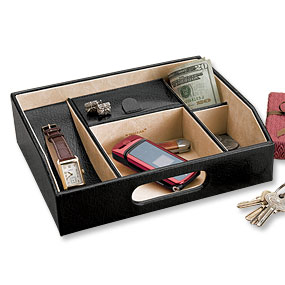
When I was a small child I watched my Dad’s daily ritual of going to his dresser in the morning, going to this special multi-compartment tray, and from each compartment loading up his clothing: money in this pocket, wallet in that pocket, checkbook here, put on the watch, keys, and whatever other things he kept in his pocket. Then in the evening he’d return home and empty everything back into the tray. Just one of those things a man did. So of course, as I was growing up and started carrying things in my pockets, I did a similar sort of ritual, but no cool tray. However as I got older, I also got lazier and would often just leave everything in the pockets of my jeans, so when I woke up the next morning I could just pull the jeans back on (provided they were still clean enough) and ta da… dressed and prepped all in one shot!Ā EfficiencyĀ is intelligent laziness.

Still, I didn’t always care for this because often I’d want to carry more things and didn’t have a place for them. Or I might want to carry things that I didn’t want to crush (e.g.,Ā in my younger days I smoked cigarettes and wouldn’t want the pack to get crushed). Or just the simple fact that sometimes it’s annoying to carry heavy and/or sharp objects in your pockets (e.g.,keys). What to do? I think it was on a trip to New York City during my years in undergrad. I was seeing a bunch of bands and noticed all the crew guys and band members all wore these bags around their waists. One of the guys expounded upon how convenient it was to use them, so I tried it myself. Sure enough, it was a great thing. The main reason? Convenience. You can carry all of your stuff. All of your stuff is in one place, so when you’re in a hurry to get out the door, you just grab the bag and go.

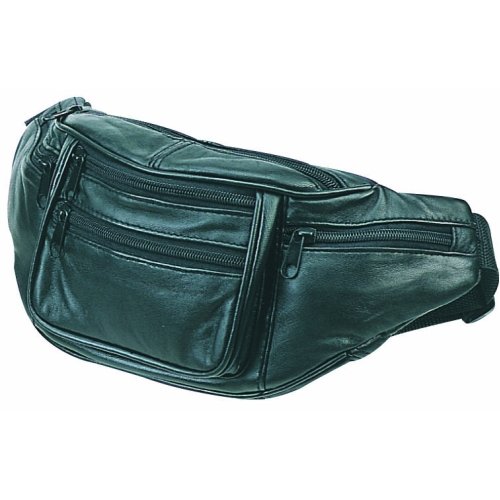
For many years I wore a fanny pack. I could keep my keys, wallet, Leatherman, mobile phone, loose change, lip balm, and whatever else maybe needed carrying at the time. Just grab and go. My children even became conditioned to the sound of the “click” of the joining of the clasps of my bag to mean “Dad’s leaving”. The only problem with most fanny packs is they are cheap, so I wore out many of them, often having to replace them every year. This was always tough because I had a few rules about the bags:
  1. It must be leather. Nylon? Sorry, but no. I don’t care much about fashion, but nylon… no.
  2. It must be black.
  3. When wearing it, you do not wear it over your untucked shirt.Ā 

And it’s difficult to find a well-made fanny pack that fits at least the first two criteria, and has enough space and utility to be of worth. Basically, it’s tough to be cool wearing one of these, but you can work to minimize how dorky you look. šŸ˜‰

Ā 

Then I entered into the world of guns, and you discover that fanny packs can be useful for carrying a concealed handgun. Unfortunately, most purpose-built holster-fanny-packs, IMHO, suck. First, most are nylon (violates rule 1), but at least most are black (hey… it’s not tacti-cool if it’s not black, right?). Second, most don’t look like fanny packs. Most look like some sort of odd-shaped compartment strapped to your waist. Third, they can be huge. They have to be large enough to hold a handgun, and so they often end up being larger than a lot of traditional packs. This isĀ exacerbated if you wish to have your pack hold more than just the gun (e.g.,Ā hold keys, wallet, etc.)… now the pack will be even larger, even heavier. Furthermore, they may have to do odd things to be able to support the weight of a handgun (and perhaps anything extra you carry), such as reinforcement (most fanny packs are not stiff), or maybe a strap on the back of the pack that can loop around your belt, but how many “social” fanny packs do this? I have just not been impressed with the holster-packs on the market.

That said, I don’t think a fanny pack holster is without merit. It does allow you a way to carry, especially if there isn’t any other way. For example, to go jogging, to go to the gym (i.e.,Ā a place where you may be changing clothing). Riding a motorcycle, you can keep it in a handy location that isn’t obscured by a riding jacket and is still somewhat on your person. Women can have a difficult time finding a concealed carry solution because their bodies are just built differently than men (IWB carry usually just isn’t possible); a fanny pack can provide a solution. Another nice part about a fanny pack vs. other methods of off-body carry (e.g.,Ā daytimer, handbag, etc.) is the fanny pack is and should remain strapped to your body, thus you are less likely to forget it or leave it somewhere. Perhaps most importantly, a fanny pack can provide urbanĀ camouflage.

If you carry concealed, you want to do your best to blend in. I live in Austin, Texas, and due to the hippie scene, fanny packs are fairly common. In fact, this is perhaps an argument to violate the “leather/nylon” rule because you can go to REI and pick up some fanny packs for other purposes and may be able to carry a small gun with you on a back-country hike, where carrying in a IWB holster may be possible but may be uncomfortable. I still think a purpose-built holster fanny pack has advantages (e.g.,Ā many have a means to hold the gun secure, they provide fast and “correct” draw access), but your situation may dictate differently. You have to choose what is right to serve your needs.

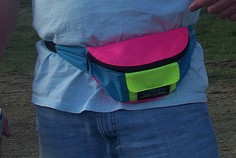
Some argue that wearing a fanny pack screams that you have a gun. Well, maybe to other gun folk, but apparently not to the majority of the public. Again, in a place like Austin, no one blinks at a fanny pack. Or if you’re in a location heavy with tourists, maybe that rainbow nylon pack is just right. Key thing is, blend in with your surroundings.

In the end, a fanny pack is not a bad thing. Yes, some people hate them with a vengeance, but I’m a practical person and fanny packs provide a practical solution. They carry whatever gear you deem important to carry and keep it handy.

Texas 30.06

If you live in Texas and have a concealed handgun license, you know that 30.06 not only refers to a rifle caliber, but it also refers to a particular section of the Texas Penal code.

texas3006.com is an informal but helpful website for keeping track of places that post 30.06 signs.

Windy day

I wanted to go for a nice long motorcycle ride this morning. But again, we’re having heavy sustained winds and some wicked gusts. Just doesn’t make for the most enjoyable riding, so I’m opting to skip it.

In the spirit of making lemonade, I’ll see about going and flying a kite with the kids. I’m curious how the kite we bought at the Kite Festival can fly at higher altitudes… just couldn’t fly too much at the festival since it was so crowded.

In related windy day news, that momma duck and her ducklings are still coming around, however the day after my blog entry there were only 4 ducklings. 😦 Ā Who knows. Hit by a car, taken by one of the many neighborhood cats, I’ve seen turtles in the pond take a duckling under. Such is life.

Sunday Metal – Monster Magnet

I was working at WXJM as the Metal Director. An album comes in from the band “Monster Magnet” called “Spine of God”. The CD sleeve was rather sparse but had one standout line printed within: “It’s a Satanic drug thing, you wouldn’t understand.” Ā And thus describes Monster Magnet’s music and how they helped to bring the so-called genre of “stoner rock” to the masses.

Monster Magnet takes a nostalgic drug-fueled journey back to the 70’s. Overdriven fuzz-box guitars,Ā psychedelia, and lyrical content that I guess would make a lot more sense if you took drugs by the truckload but yet still had an amazing poeticness even to the sober. Dave Wyndorf is the mainman and visionary force behind Monster Magnet, and over the years of his drug consumption, sexual overindulgence, and music writing, you can see how his life experiences become reflected in the trippy space rock outlet that is Monster Magnet.

Lyrical gems include: “Life is good, a rocket-sled utopia, a self-imposed myopia, you gotta love this pace. Life is fast, a million winners everyday; you tell me is this work or play? I’m never really sure.”. Ā “Some people go to bed with Lucifer, then cry when they don’t great the day with God.”. Ā “You’ll never find your pleasure if you worry about your pain.” Ā and my favorite: “I’m suckin’ up more karma than I need, so have a supernova on me.” That last line comes from the song “Facedown” from the album “Superjudge”, which is my favorite album from Monster Magnet.

When the record company was pushing “Spine of God” they offered me a chance to do a phone interview with Dave. I took up the offer and they gave me his home phone number and said to call him at this time on this date. I grabbed the nearest piece of scrap paper and scribbled down his phone number and the information. When it came time to do the interview, I called Dave and we spoke on the air for about 5 minutes. I spun some tracks off the album, and proceeded to continue to speak with Dave off-air… for about an hour. It was years ago and I don’t recall all that we spoke of, but I just remember at the time he was very cool and down to earth… he was talking with a complete stranger for an hour, so there had to be some level of friendly there. The other weekend when was I was overhauling my closet, I came across some of my mementos from my radio daze… one of which was that scrap of paper with Dave’s number on it. While lots of things got thrown out, I kept that scrap of paper.

Dry fire, do you do it?

So everyone goes on about the rising cost of ammo, the reluctance to shoot what little ammo you have, the difficulty in getting to the range, and whatever excuse possible. I don’t disagree… I don’t get to the range nearly as much as I want to either, and even shooting a .22 is getting expensive! However, that’s OK. Dry fire is a fantastic way to keep your chops up.

One great thing about dry fire is you can practice skills that you just can’t practice at the gun range. For instance, does your range let you draw from a holster? If not, that’s ok, you can do it as a part of your dry fire practice at home. Can you do movement drills at the range? If not, you can do it at home with dry fire.

Really, there’s no excuse not to dry fire.

When (not if) you dry fire, you must do it safely. Kathy Jackson has a great article on safety practice for dry fire. The biggest thing is to ensure a clear cut distinction between your dry fire session and the time before and after the session. That when you start, you verify the gun is unloaded and ensure a safe environment. While you practice, you practice uninterrupted and if for some reason you are interrupted you ensure when you pick up the gun again that you start practice all over again (i.e. verify the state of the gun). When practice is over, it’s over. Yes it might seem silly to recite aloud that the gun is unloaded, but there’s nothing silly about a negligent discharge. Frame your practice time appropriately.

I forget who said this, but one of the top shooters said something to the effect of for every live round you wish to fire at the range, you should do 10 dry fires. So if you want to go through 200 rounds at the range, you better dry fire 2000 “rounds” at home beforehand. You will be much better off, and the time and ammo you spend at the range will be time and ammo much better spent. Don’t believe me? Try it.

You can find lots of great dry fire training aids online. Some of my favorites:

Just about any shooting drill can be adapted for dry fire. Remember: slow is smooth, smooth is fast. Strive to be correct, perfect, and smooth. Once you can do that at a given (slow) speed, speed it up by 10%. Practice the things you like, practice more the things you hate. Don’t focus on your mistakes and failures, envision your success.

If you carry a concealed handgun, you owe it to yourself to be the best you can be. Handgun skills areĀ perishable, so you have to keep your chops up. Even if it’s nothing more than doing 10 draws and presentation from concealment, you can find the 5 minutes a day to do it. Someday, your life may depend on it.

On Dan Bong

Kuk Sool claims a wide array of weaponry. I personally don’t care for much of the weaponry taught because I find them impractical. These days one just doesn’t fight much with a trident or spear orĀ halberd, and they’re a bit hard to conceal when you walk down the street. That said, one of given intents of Kuk Sool is to be a preservation of Korean martial traditions, so including such weaponry makes sense. Still, I have only so much time in a day to practice things, so I prefer to practice things that are practical and that I can use. Weaponry such as cane, rope, fan, staff, and what I want to speak about here: dan bong.

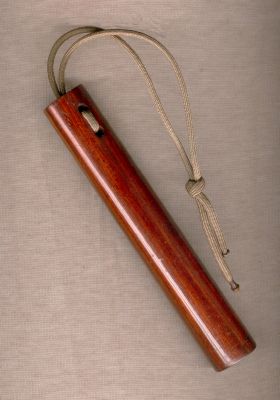
A dan bong is a short staff, 1.0″ – 1.25″ in diameter, 8″ – 14″ long, made from a hard wood such as oak. Some dan bong’s have a thong attached to one end, but that tends to be more from Hapkido than Kuk Sool. In fact, it’s useful to bring up now that dan bong tends to be a weapon of Korean flavor, and seen in the “Hapkido family of martial arts” (for lack of a better term) such as Hapkido, Kuk Sool and Hwa Rang Do. However, Kuk Sool takes a slightly different approach, which I’ll discuss later. Note as well that fighting with sticks is not unique to any one art. I am discussing a particular approach, but as you research you’ll discover how other approaches to stick fighting can complement one’s study and use of dan bong.

The intent of the dan bong is as a close-range fighting weapon. Due to it’s small size you cannot gain much distance from it (although you do gain some and when in close inches can matter), but you can gain a harder striking surface as well as a tool for leverage and locking. Furthermore, due to its small size, it can easily be concealed in a handbag or up a sleeve. In fact, due to this, some recommend that the ideal length of a dan bong should be (no greater than) the length of your forearm. Where the dan bong came from isn’t certain, but the story goes that it could have been drum sticks, or from wandering monks carrying bamboo flutes with the flute serving double duty. However it came about, it does show how dan bong techniques can be applied from non-standard objects such as a hairbrush, wooden spoon, or my favorite, the Vaughan Superbar! 😈

The primary attack mechanism of the dan bong is striking. You can strike sideways with the dan bong, you can thrust with the tip, thrust with the butt, even perform lateral strikes. A couple examples:

Dan bong tip thrust to the throat.

Dan bong block, then striking downward with the butt.

Notice how the dan bong is being held in the middle of the staff? This is the primary differentiatorĀ of Kuk Sool dan bong. In Kuk Sool, the basic dan bong technique emphasis is placed on holding the dan bong in the middle and performing a “double strike” where you strike first with one end (usually the lower) then snap your fingers/wrist to strike a second time with the other end (usually the upper). Other arts that study dan bong may mention this sort of grip and striking, but it is not the key emphasis. I personally don’t care for this “double strike” because I find it impractical in the heat of a fight. If you try it yourself, you’ll often find on the first strike that the dan bong will hang up on whatever you are striking, or if you try to compensate to not hang up then you miss. This sort of strike may work fine in forms and other controlled practice, but in the aliveness and gross motor skills of combat I just don’t see it happening. Typical grip puts the hand about 1/3 of the way up from the butt-end of the dan bong, striking primarily with the tip-end. This allows a great deal of surface for striking, provides improved reach, provides space for locks and leverage application, yet still allows some butt-end to be exposed for use.

So how do you strike? A dan bong is not a club. A club is just a basic motion of the (stiff) armĀ strikingĀ a surface. With dan bong, the difference is involving more of your arm – especially the wrist — to increaseĀ accelerationĀ and “snap” and thus increase the force of impact. As a result, ideal striking points are pressure points and/or other sensitive areas of the human body. In the above pictures you see two such examples: the throat, the top of the foot. This article provides a nice overview of the 18 points that Kuk Sool teaches as dan bong striking points, as well as additional information on Kuk Sool dan bong.

Dan bong can also be used as a locking and grappling tool. Think of it as an extension of your hand, that can apply greater force and leverage. While the following video isn’t Kuk Sool (it’s Hwa Rang Do), it provides a good illustration of how dan bong can be applied.

As I mentioned before, fighting with sticks is not limited to Korean martial arts. Japanese arts have stick fighting, but I would say the Filipino martial arts are probably best known for their use of sticks. Consider the 12 attacks of Modern Arnis. These attack points apply just as well to any sort of fighting, and I’ve found study of Arnis theory and technique useful in my study of dan bong.

If you’ve spent any time reading my blog, you’ll see that I favor a different sort of weapon. However, I find dan bong to be a useful tool. It can be used for striking, blocking, locking, throwing, and adding to their impact. It’s small, practical, and the techniques can be applied to a wide variety of common objects. The only weapon I find more practical is a cane, but that’s a topic for another time. Explore dan bong.

Updated:Ā Forgot to talk about practice and application drills.

I can has more 10/22’s?

I have a Ruger 10/22. It’s the basic carbine model, hardwood stock, nothing fancy. Threw an inexpensive 4x32mm scope on top of it, and off we go. It’s a fun little plinking rifle, and what the kids are cutting their teeth on. Still, after having the one, I’ve been dreaming about getting a few more. With the rising cost of ammo, shooting .22 gets more and more appealing every day.

Survival Rifle

It was an episode of Survivorman,Ā I believe season 2 episode 3, Labrador. Les carries a .22 rifle with him as a survival tool. This is a useful tool as can hunt small game with it. What was nifty was how Les utilized the rifle itself to make a bit of a survival kit. For instance, he drilled some holes in the stock and inserted extra ammo. He also stored some cotton tinder and aĀ magnesiumĀ striker, both for starting a fire. Basic, but useful.

I then came across this. I liked the wrapping of the 550 cord, which serves to not only protect the rifle but then provides you with rope, which is always a welcome thing. Furthermore, he hung a pouch off the side of the buttstock, into which you can store whatever, like small first aid kit.

So I’ve been thinking about making a survival rifle like this and what else I’d put into it. Some thoughts:

  • Compass. A map too, but that’d be case-by-case dependent.
  • Sun protection
  • Some means of insulating yourself, e.g. those emergency blankets
  • Knife/multitool
  • Flashlight, like a small LED and/or lithium-powered thing
  • First aid kit: bandages, tweezers, basic medicines
  • Whistle
  • Matches and/or striker, cotton tinder
  • Needle and thread, zip ties
  • Water and/or water purification
  • Nutrition? e.g. bouillon cubes, hard candy
  • Orange trash bag

These are just some thoughts. I haven’t sat down to seriously flesh this out yet, and even think if a Ruger 10/22 would be best. For instance, Chuck Hawks has an article on purpose-built survival rifles. Something like an AR-7 or Springfield M6. I don’t have much of a need for such a rifle, but I just find it an interesting exercise that I’ll probably do one of these days for the heck of it.

Target Shooter

As you look online for things about the 10/22, you’ll find rather a large aftermarket for it, which is one of the great things about this rifle. One thing you’ll quickly find is you can deck her out and spend far more money aftermarket than you ever spent on the base rifle in the first place. I’d like to try this. šŸ™‚

Take for instance this Pittsburgh Steelers model. Or this special edition made for the USA Shooting team.Ā 

I’d like to try taking a 10/22 as far as you could take it. Customize it, deck it out, spending a lot of time reading and researching on the RimfireCentral forums. Make it an awesome target shooting gun, highly accurate, the whole 11 yards.

Oldest would really like this too. He loves the look of the Boyds SS Evolution stocks.

Of course, this is going to be the hardest one to justify to the Wife. šŸ˜‰

Trainer

Ever since I first bought the 10/22 and saw the wide variety of aftermarket parts you could get, plus going along with the wisdom of Appleseed (which I have yet to do), I wanted to make a trainer.

I could do the simple thing and keep the basic 10/22, slap on a sling, some TechSights, and off I go. But I figure if I’m really going to make a trainer, I might as well go for the gusto! For instance, make an AR-22.

This has an added advantage of not just being a trainer for me, but it’s a teacher for others.

Ā 

So, the Ruger 10/22. Quite a versatile little rifle. I may never do these ideas (matter of time and money), but hopefully someday I will.

Motorcycle maintenance

Just motorcycle maintenance… no Zen. šŸ™‚ Ā Still, there’s something peaceful and relaxing about wrenching on your bike.

I gave my motorcycle its annual maintenance: oil change, oil filter change, gear oil change, lube cables, lube other moving parts, check and adjust valve clearance, clean and reoil the air filters, sync the carbs, adjust the idle, etc. etc. etc..

It’s a wonderful thing about living in Texas… there is no off-season for riding, but still, gotta take care of her. Didn’t get to ride as much the past year as I wanted to, but I’ll do my best to make up for it in the coming months.

Still got a few details to tend to, like figuring out what’s up with the passing lamps, and I’ll probably have them take care of repacking the steering bearings since I just don’t feel like dealing with it.

Hopefully I can go for a nice long ride on Sunday morning.