So everyone goes on about the rising cost of ammo, the reluctance to shoot what little ammo you have, the difficulty in getting to the range, and whatever excuse possible. I don’t disagree… I don’t get to the range nearly as much as I want to either, and even shooting a .22 is getting expensive! However, that’s OK. Dry fire is a fantastic way to keep your chops up.
One great thing about dry fire is you can practice skills that you just can’t practice at the gun range. For instance, does your range let you draw from a holster? If not, that’s ok, you can do it as a part of your dry fire practice at home. Can you do movement drills at the range? If not, you can do it at home with dry fire.
Really, there’s no excuse not to dry fire.
When (not if) you dry fire, you must do it safely. Kathy Jackson has a great article on safety practice for dry fire. The biggest thing is to ensure a clear cut distinction between your dry fire session and the time before and after the session. That when you start, you verify the gun is unloaded and ensure a safe environment. While you practice, you practice uninterrupted and if for some reason you are interrupted you ensure when you pick up the gun again that you start practice all over again (i.e. verify the state of the gun). When practice is over, it’s over. Yes it might seem silly to recite aloud that the gun is unloaded, but there’s nothing silly about a negligent discharge. Frame your practice time appropriately.
I forget who said this, but one of the top shooters said something to the effect of for every live round you wish to fire at the range, you should do 10 dry fires. So if you want to go through 200 rounds at the range, you better dry fire 2000 “rounds” at home beforehand. You will be much better off, and the time and ammo you spend at the range will be time and ammo much better spent. Don’t believe me? Try it.
You can find lots of great dry fire training aids online. Some of my favorites:
Just about any shooting drill can be adapted for dry fire. Remember: slow is smooth, smooth is fast. Strive to be correct, perfect, and smooth. Once you can do that at a given (slow) speed, speed it up by 10%. Practice the things you like, practice more the things you hate. Don’t focus on your mistakes and failures, envision your success.
If you carry a concealed handgun, you owe it to yourself to be the best you can be. Handgun skills are perishable, so you have to keep your chops up. Even if it’s nothing more than doing 10 draws and presentation from concealment, you can find the 5 minutes a day to do it. Someday, your life may depend on it.
Kuk Sool claims a wide array of weaponry. I personally don’t care for much of the weaponry taught because I find them impractical. These days one just doesn’t fight much with a trident or spear or halberd, and they’re a bit hard to conceal when you walk down the street. That said, one of given intents of Kuk Sool is to be a preservation of Korean martial traditions, so including such weaponry makes sense. Still, I have only so much time in a day to practice things, so I prefer to practice things that are practical and that I can use. Weaponry such as cane, rope, fan, staff, and what I want to speak about here: dan bong.
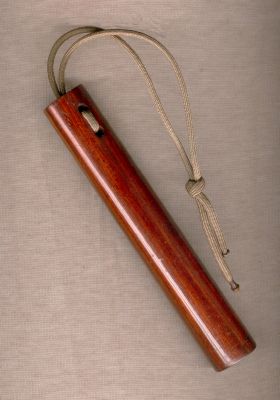
A dan bong is a short staff, 1.0″ – 1.25″ in diameter, 8″ – 14″ long, made from a hard wood such as oak. Some dan bong’s have a thong attached to one end, but that tends to be more from Hapkido than Kuk Sool. In fact, it’s useful to bring up now that dan bong tends to be a weapon of Korean flavor, and seen in the “Hapkido family of martial arts” (for lack of a better term) such as Hapkido, Kuk Sool and Hwa Rang Do. However, Kuk Sool takes a slightly different approach, which I’ll discuss later. Note as well that fighting with sticks is not unique to any one art. I am discussing a particular approach, but as you research you’ll discover how other approaches to stick fighting can complement one’s study and use of dan bong.
The intent of the dan bong is as a close-range fighting weapon. Due to it’s small size you cannot gain much distance from it (although you do gain some and when in close inches can matter), but you can gain a harder striking surface as well as a tool for leverage and locking. Furthermore, due to its small size, it can easily be concealed in a handbag or up a sleeve. In fact, due to this, some recommend that the ideal length of a dan bong should be (no greater than) the length of your forearm. Where the dan bong came from isn’t certain, but the story goes that it could have been drum sticks, or from wandering monks carrying bamboo flutes with the flute serving double duty. However it came about, it does show how dan bong techniques can be applied from non-standard objects such as a hairbrush, wooden spoon, or my favorite, the Vaughan Superbar! 😈
The primary attack mechanism of the dan bong is striking. You can strike sideways with the dan bong, you can thrust with the tip, thrust with the butt, even perform lateral strikes. A couple examples:
Dan bong tip thrust to the throat.
Dan bong block, then striking downward with the butt.
Notice how the dan bong is being held in the middle of the staff? This is the primary differentiator of Kuk Sool dan bong. In Kuk Sool, the basic dan bong technique emphasis is placed on holding the dan bong in the middle and performing a “double strike” where you strike first with one end (usually the lower) then snap your fingers/wrist to strike a second time with the other end (usually the upper). Other arts that study dan bong may mention this sort of grip and striking, but it is not the key emphasis. I personally don’t care for this “double strike” because I find it impractical in the heat of a fight. If you try it yourself, you’ll often find on the first strike that the dan bong will hang up on whatever you are striking, or if you try to compensate to not hang up then you miss. This sort of strike may work fine in forms and other controlled practice, but in the aliveness and gross motor skills of combat I just don’t see it happening. Typical grip puts the hand about 1/3 of the way up from the butt-end of the dan bong, striking primarily with the tip-end. This allows a great deal of surface for striking, provides improved reach, provides space for locks and leverage application, yet still allows some butt-end to be exposed for use.
So how do you strike? A dan bong is not a club. A club is just a basic motion of the (stiff) arm striking a surface. With dan bong, the difference is involving more of your arm – especially the wrist — to increase acceleration and “snap” and thus increase the force of impact. As a result, ideal striking points are pressure points and/or other sensitive areas of the human body. In the above pictures you see two such examples: the throat, the top of the foot. This article provides a nice overview of the 18 points that Kuk Sool teaches as dan bong striking points, as well as additional information on Kuk Sool dan bong.
Dan bong can also be used as a locking and grappling tool. Think of it as an extension of your hand, that can apply greater force and leverage. While the following video isn’t Kuk Sool (it’s Hwa Rang Do), it provides a good illustration of how dan bong can be applied.
As I mentioned before, fighting with sticks is not limited to Korean martial arts. Japanese arts have stick fighting, but I would say the Filipino martial arts are probably best known for their use of sticks. Consider the 12 attacks of Modern Arnis. These attack points apply just as well to any sort of fighting, and I’ve found study of Arnis theory and technique useful in my study of dan bong.
If you’ve spent any time reading my blog, you’ll see that I favor a different sort of weapon. However, I find dan bong to be a useful tool. It can be used for striking, blocking, locking, throwing, and adding to their impact. It’s small, practical, and the techniques can be applied to a wide variety of common objects. The only weapon I find more practical is a cane, but that’s a topic for another time. Explore dan bong.
I have a Ruger 10/22. It’s the basic carbine model, hardwood stock, nothing fancy. Threw an inexpensive 4x32mm scope on top of it, and off we go. It’s a fun little plinking rifle, and what the kids are cutting their teeth on. Still, after having the one, I’ve been dreaming about getting a few more. With the rising cost of ammo, shooting .22 gets more and more appealing every day.
Survival Rifle
It was an episode of Survivorman, I believe season 2 episode 3, Labrador. Les carries a .22 rifle with him as a survival tool. This is a useful tool as can hunt small game with it. What was nifty was how Les utilized the rifle itself to make a bit of a survival kit. For instance, he drilled some holes in the stock and inserted extra ammo. He also stored some cotton tinder and a magnesium striker, both for starting a fire. Basic, but useful.
I then came across this. I liked the wrapping of the 550 cord, which serves to not only protect the rifle but then provides you with rope, which is always a welcome thing. Furthermore, he hung a pouch off the side of the buttstock, into which you can store whatever, like small first aid kit.
So I’ve been thinking about making a survival rifle like this and what else I’d put into it. Some thoughts:
Compass. A map too, but that’d be case-by-case dependent.
Sun protection
Some means of insulating yourself, e.g. those emergency blankets
Knife/multitool
Flashlight, like a small LED and/or lithium-powered thing
First aid kit: bandages, tweezers, basic medicines
Whistle
Matches and/or striker, cotton tinder
Needle and thread, zip ties
Water and/or water purification
Nutrition? e.g. bouillon cubes, hard candy
Orange trash bag
These are just some thoughts. I haven’t sat down to seriously flesh this out yet, and even think if a Ruger 10/22 would be best. For instance, Chuck Hawks has an article on purpose-built survival rifles. Something like an AR-7 or Springfield M6. I don’t have much of a need for such a rifle, but I just find it an interesting exercise that I’ll probably do one of these days for the heck of it.
Target Shooter
As you look online for things about the 10/22, you’ll find rather a large aftermarket for it, which is one of the great things about this rifle. One thing you’ll quickly find is you can deck her out and spend far more money aftermarket than you ever spent on the base rifle in the first place. I’d like to try this. 🙂
I’d like to try taking a 10/22 as far as you could take it. Customize it, deck it out, spending a lot of time reading and researching on the RimfireCentral forums. Make it an awesome target shooting gun, highly accurate, the whole 11 yards.
Of course, this is going to be the hardest one to justify to the Wife. 😉
Trainer
Ever since I first bought the 10/22 and saw the wide variety of aftermarket parts you could get, plus going along with the wisdom of Appleseed (which I have yet to do), I wanted to make a trainer.
I could do the simple thing and keep the basic 10/22, slap on a sling, some TechSights, and off I go. But I figure if I’m really going to make a trainer, I might as well go for the gusto! For instance, make an AR-22.
Just motorcycle maintenance… no Zen. 🙂 Still, there’s something peaceful and relaxing about wrenching on your bike.
I gave my motorcycle its annual maintenance: oil change, oil filter change, gear oil change, lube cables, lube other moving parts, check and adjust valve clearance, clean and reoil the air filters, sync the carbs, adjust the idle, etc. etc. etc..
It’s a wonderful thing about living in Texas… there is no off-season for riding, but still, gotta take care of her. Didn’t get to ride as much the past year as I wanted to, but I’ll do my best to make up for it in the coming months.
Still got a few details to tend to, like figuring out what’s up with the passing lamps, and I’ll probably have them take care of repacking the steering bearings since I just don’t feel like dealing with it.
Hopefully I can go for a nice long ride on Sunday morning.
From the NYT, an editorial on …. well… I guess how to spout (the same old) lies?
Gosh, I don’t even know where to begin. The whole thing is just full of misinformation.
This was a choice piece tho:
States routinely grant concealed carry licenses without proper background checks or training. Indeed, among the evidence Bush officials ignored in their haste to relax national park gun limits was the long list of violent crimes committed by dangerous people with state concealed carry licenses. Contrary to gun lobby claims, the evidence suggests that permitting concealed weapons drives up crime rather than decreasing it.
And your evidence is where?
Actual empirical evidence (to the contrary) can be found here and here and here and here and here and here and if you really need more I can find it.
Furthermore, who wrote this editorial? If you’re going to open your yap at least have the guts to identify yourself and stand behind what you say.
If I remember correctly, the grade scale in my public government school was:
A	100 - 94
B+	93 - 90
B	89 - 84
C+	83 - 80
C	79 - 74
D+	73 - 70
D	69 - 64
F	63 - 0
So the students referred to in the article have to maintain at least a 70 to participate in other activities, but parents are complaining it’s too high and want to go to a 60.
To me, that’s a big fat fail no matter how you cut it.
Just read this piece about some Nebraska state legislation regarding their concealed carry laws. This is a good sign, and I hope it goes through. Slowly but surely Nebraska’s laws will improve.
It wasn’t bad. It wasn’t incredible, but it was enjoyable… I didn’t feel like I wasted my money when I walked out, but I didn’t feel like the Earth was moved. It was fun. A cookie-cutter predictable plot, only so much character development and thus attachment (at least Susan developed and you had some sort of bonding to her). The animation was good, the 3-D was pretty well done. I did find myself laughing out loud at some things, and was into the suspense when called for. Some memorable lines that the kids and I quoted on the drive home.
So, not bad. A fun flick, and good time with the kiddos.
What I really liked was some previews. I’m looking forward to the next Pixar movie, Up, and seeing the preview for 9… oh yes, I want to see that movie. I’m a sucker for Tim Burton.
Updated: I forgot to say. There were some uh… “negligent discharges” in the movie. Violation of rule number 3 (booger hook on the bang switch), violation of rule number 2 but in a way #2 was OK since it was technically pointed at something worth destroying. What does it say about me when while watching those parts of the movie the rule violations were the first things that went through my head? Then I used it as a “teachable moment” with the kids on the drive home? 🙂


 Stuff From Hsoi