Finally.
The lawn mower died.
Hallelujah!
I wrote my piece On Dan Bong and completely forgot to mention something, so I’ll mention it now. 🙂
I have found dan bong to be a versatile weapon. Apart from some striking drills, e.g., the 12 angle drill I mentioned from Modern Arnis, what else can you do to explore dan bong?
Take whatever you know, put a dan bong in your hand, and see what you can do with what you already know. That’s a good place to start.
So what do I mean by that? Easiest way for me to explain is within the context and nomenclature of Kuk Sool.
Let’s take Maek Chi Ki. First, perform Maek Chi Ki as the empty-hand set that it is. Now, pick up your dan bong and perform Maek Chi Ki but instead of using your empty hand to strike, use the dan bong. Maek Chi Ki 1-3 would involve a normal “whipping strike” with the side of the tip. Maek Chi Ki 4 would involve a tip thrust into the armpit. Maek Chi Ki 6 could be a butt-end strike to the temple or an inverted tip strike to the temple. And so on. Ki Bohn Soo is a good place to start for locking and leverage applications.
Will every technique work exactly the same? Probably not. Some techniques may require a small modification, some techniques could have multiple approaches/interpretations, some may require you to invert the technique (e.g. performing it “other side/mirror image”), and some techniques may just flat out not work. But the point is to use existing knowledge as a foundation for exploring what you can do with a dan bong. Explore.
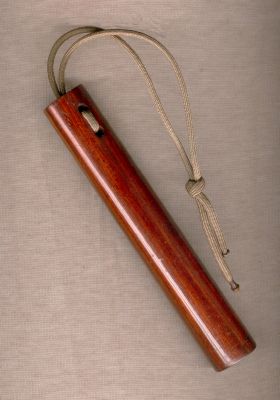 Kuk Sool claims a wide array of weaponry. I personally don’t care for much of the weaponry taught because I find them impractical. These days one just doesn’t fight much with a trident or spear or halberd, and they’re a bit hard to conceal when you walk down the street. That said, one of given intents of Kuk Sool is to be a preservation of Korean martial traditions, so including such weaponry makes sense. Still, I have only so much time in a day to practice things, so I prefer to practice things that are practical and that I can use. Weaponry such as cane, rope, fan, staff, and what I want to speak about here: dan bong.
A dan bong is a short staff, 1.0″ – 1.25″ in diameter, 8″ – 14″ long, made from a hard wood such as oak. Some dan bong’s have a thong attached to one end, but that tends to be more from Hapkido than Kuk Sool. In fact, it’s useful to bring up now that dan bong tends to be a weapon of Korean flavor, and seen in the “Hapkido family of martial arts” (for lack of a better term) such as Hapkido, Kuk Sool and Hwa Rang Do. However, Kuk Sool takes a slightly different approach, which I’ll discuss later. Note as well that fighting with sticks is not unique to any one art. I am discussing a particular approach, but as you research you’ll discover how other approaches to stick fighting can complement one’s study and use of dan bong.
The intent of the dan bong is as a close-range fighting weapon. Due to it’s small size you cannot gain much distance from it (although you do gain some and when in close inches can matter), but you can gain a harder striking surface as well as a tool for leverage and locking. Furthermore, due to its small size, it can easily be concealed in a handbag or up a sleeve. In fact, due to this, some recommend that the ideal length of a dan bong should be (no greater than) the length of your forearm. Where the dan bong came from isn’t certain, but the story goes that it could have been drum sticks, or from wandering monks carrying bamboo flutes with the flute serving double duty. However it came about, it does show how dan bong techniques can be applied from non-standard objects such as a hairbrush, wooden spoon, or my favorite, the Vaughan Superbar! 😈
The primary attack mechanism of the dan bong is striking. You can strike sideways with the dan bong, you can thrust with the tip, thrust with the butt, even perform lateral strikes. A couple examples:

Dan bong tip thrust to the throat.

Dan bong block, then striking downward with the butt.
Notice how the dan bong is being held in the middle of the staff? This is the primary differentiator of Kuk Sool dan bong. In Kuk Sool, the basic dan bong technique emphasis is placed on holding the dan bong in the middle and performing a “double strike” where you strike first with one end (usually the lower) then snap your fingers/wrist to strike a second time with the other end (usually the upper). Other arts that study dan bong may mention this sort of grip and striking, but it is not the key emphasis. I personally don’t care for this “double strike” because I find it impractical in the heat of a fight. If you try it yourself, you’ll often find on the first strike that the dan bong will hang up on whatever you are striking, or if you try to compensate to not hang up then you miss. This sort of strike may work fine in forms and other controlled practice, but in the aliveness and gross motor skills of combat I just don’t see it happening. Typical grip puts the hand about 1/3 of the way up from the butt-end of the dan bong, striking primarily with the tip-end. This allows a great deal of surface for striking, provides improved reach, provides space for locks and leverage application, yet still allows some butt-end to be exposed for use.
So how do you strike? A dan bong is not a club. A club is just a basic motion of the (stiff) arm striking a surface. With dan bong, the difference is involving more of your arm – especially the wrist — to increase acceleration and “snap” and thus increase the force of impact. As a result, ideal striking points are pressure points and/or other sensitive areas of the human body. In the above pictures you see two such examples: the throat, the top of the foot. This article provides a nice overview of the 18 points that Kuk Sool teaches as dan bong striking points, as well as additional information on Kuk Sool dan bong.
Dan bong can also be used as a locking and grappling tool. Think of it as an extension of your hand, that can apply greater force and leverage. While the following video isn’t Kuk Sool (it’s Hwa Rang Do), it provides a good illustration of how dan bong can be applied.
As I mentioned before, fighting with sticks is not limited to Korean martial arts. Japanese arts have stick fighting, but I would say the Filipino martial arts are probably best known for their use of sticks. Consider the 12 attacks of Modern Arnis. These attack points apply just as well to any sort of fighting, and I’ve found study of Arnis theory and technique useful in my study of dan bong.
If you’ve spent any time reading my blog, you’ll see that I favor a different sort of weapon. However, I find dan bong to be a useful tool. It can be used for striking, blocking, locking, throwing, and adding to their impact. It’s small, practical, and the techniques can be applied to a wide variety of common objects. The only weapon I find more practical is a cane, but that’s a topic for another time. Explore dan bong.
Updated: Forgot to talk about practice and application drills.
Was out all day today, thus the lack of blog entries.
One thing I did today was “beta test” some handgun drills/tests. For an idea of what I’m talking about, check here (and the PDF files linked to on that page); those aren’t what I shot today, but it gives you an idea. It’s handgun shooting drills, timed, to assess knowledge and skills.
I have to admit, when I was told I was going to be beta testing the drills I got nervous. I was going to be watched, judged, my performance evaluated. *gulp* Furthermore, I would be shooting with two other gentlemen whose experience and skills are far more vast than mine, so I was just hit with this feeling of pressure and nerves. But a few seconds after that all washed over me I said to myself: “Don’t worry about it. This isn’t a contest. This isn’t to compare you against them or anyone but yourself. Just shoot the best that you can shoot. Take your time and get hits. Be accurate. Don’t rush and try to shoot fast, even if the other guys can and do shoot faster than you, else you will mess up and shoot poorly. So, just stop being anxious and just shoot your best.” Just had to let the wave of nerves and apprehension wash over me, then be washed off me. 🙂
We went out to shoot. I kept my mind calm and didn’t worry about anything. I’d shoot however I’d shoot, and as long as I didn’t work myself up I’d shoot fine. Just focus on that front sight, good trigger press, and that’s all you can do.
We shot the tests. If I remember correctly, I scored a 97%. Was I surprised? A little. I didn’t think I’d shoot that well. What surprised me was that I held my own with the other guys. Not that this was a competition or a need of an ego stroke, but that I’m my own worst critic. I will be hard on myself in assessing my skills, abilities, and knowledge in anything. These guys have always told me I shoot well, and while I never thought they were blowing smoke up my skirt, I didn’t think I was good enough. They might say “You shot that well”, but I knew what mistakes I made, I knew I could do better. But now to see me shoot and hold my own with these guys, it did show me my skills aren’t as bad as I think they are. These guys gave me a neutral measuring stick, so to speak, that I could measure myself against instead of just always telling myself “no not good enough”. Note: I do believe these gentlemen could still outshoot me in competition, don’t get me wrong.
I also know that I did shoot well on my own accord. I just kept to the fundamentals, e.g. “cleardistinctfrontsight-press-cleardistinctfrontsight”. I did NOT look at the target at all while shooting (it’s a habit I’m working to break); I kept my eyes focused on that front sight. Good trigger presses. Stayed relaxed and calm, focused on nothing but myself and my shooting. I was aware of all of this as I was going through the drills, and that made me most pleased. I was especially pleased in that I did not care about how I was performing. All too often I get caught up in how I’m performing and that causes me to screw up the performance. I just shot and didn’t care what happened, at least until well after the shot was over. So that’s what surprised and pleased me most. It was me performing as I should perform, and it paid off. So I was happy. It wasn’t an ego stroke, but it was certainly a good gain of confidence.
In the end, I realized I’m not as bad as I thought I was. Sure I’m still going to be hard on myself, sure I’m still going to work to improve myself. But it was nice to have something that gave me a bit of a reality check, to put things in some sort of perspective.
In related news, I am very pleased with the modifications done by Springer Precision. The improved trigger certainly helped, but what helped most were the sights. There’s no question in my mind regarding today’s drills/tests that I would not have shot as well as I did if I still had those XS Sights on (that may be (part of) my problem… having those XS sights on as long as I did and my shooting sucking as much as it did, that may have brought my confidence and “belief in myself/skills” down). The bright red fiber optic just draws my eye to the front sight. The rear sight is clear and unobtrusive. The sight picture is just great. I do believe having better tools helped me.
I’ve also been working on my grip, especially my left hand. I’m placing my left palm heel a bit higher on the grip/frame, which gets more of my left palm in contact with the frame and allows my left hand to have as far forward a cant as possible. I’m finding a “sweet spot” for where to place my left hand in terms of how it wraps around my right. And I am working with the Todd Jarrett “grip 20% harder” rule. I believe it’s making a difference in recoil management and thus ability to reacquire my sight picture. Heck, I shot some quasi-Bill drills (6 shot rapid fire strings) today and had no loss of left grip, no need to reset my grip, and good sight picture reacquisition and control.
Bottom line for the day: I got a nice idea where my skills are, and that my practice and work is paying off. So with that, off to practice more.
And the sun was shining. The weather was great. I got about 120 miles of motorcycle riding in. A good day.
My day job entails working as a software engineer writing Mac software. I just went through an ugly experience dealing with a particular 3rd party API, so it was a welcome experience to deal with a well-written bit of 3rd party code.
Jay Tuley’s CocoaScriptMenu is a terrific piece of reusable software. It does one thing: allows you to add a Scripts menu to your application, and it does it very well. I obtained the code, made a few small modifications to fit it into our build environment, dropped it into my application, and viola… it just works. Furthermore, it has just about every bit of functionality and customization that one could want. I mean, as I was thinking about how to implement this feature on my own I came up with a list of functionality, and CocoaScriptMenu satisfies every single one of them and a little bit more. Plus the licensing terms are reasonable.
Thank you, Jay Tuley, for creating this and releasing it. Good work indeed!
 What can I say. I like tools. I especially like useful tools.
One of my favorite useful tools? My Leatherman Wave.
Sure I had a pocket knife when I was a kid; in fact, I had a bunch of different pocket knives. You’re a young boy. You’re in Scouts. You get your Whittlin’ Chip. You get your Tote N’ Chip. You have knives (and work with other things too like axes and saws). You learn how to be responsible in the use of these tools and how to use them correctly and effectively. It’s just what you do as a kid. 🙂
I’ve also had various other knives, and sure they’re great and fun, but they’re just not always useful and handy. Tools are really most useful when they’re available to you at the point in time you need them. So you need to cut something? If you can’t get at your knife, what good is it?
 So when I finally was able to get a good knife, the first thing I looked for was the ability to get the knife into my hand and the blade in a position where I can cut. Even better is if I can do this one-handed, and even better, if I don’t have to look to do it.. There are certainly lots of knives out there that do this (I like Spyderco Delica‘s too). This is one great thing about the Wave. When it was introduced, most Leatherman tools had the blades on the inside, meaning you had to open up the whole tool just to get at the blade, then close everything up to be able to use the blade. This was not handy at all. Leatherman realized this and created the Wave with the blades on the outside of the tool (seen at right). Now you can pull out the Leatherman from your pocket or sheath, and the blades are right there. You can place your thumb in the hole on the blade and with one hand open and lock the blade and off you can use it. One subtle but important thing Leatherman did was understand the importance of the sense of touch. There are 4 blades on the Wave, 2 blades are within easy deployment by a right-handed person. But when the Wave is in your hand and you can’t see what you’re doing, you can feel! There’s a small bumpy ridge on the back of the serrated blade (bumps, serrated, get it?), so you can feel for this with your thumb… if you feel the bumps, you’re in position to deploy the serrated blade; feel smooth, the straight blade. So this was a key reason in my choice of the Wave back when I bought it. These days it seems most of Leatherman’s full-sized multitools offer the blades on the outside, so that’s good to see.
The other reason for choosing this over a traditional pocket knife? More tools! Well, that and locking blades (most traditional pocket knives don’t have locking blades… something you appreciate the first time something slides and a blade closes or nearly closes on your fingers). It’s nice to have tools. There are countless times I have used the pliers, wire cutters, screwdrivers, bottle opener, can opener, ruler, scissors… yes, I’ve used just about all of it. But this is me and what’s right for me. What’s cool is there are many different combinations and variations out there. For instance, check out the Leatherman Crunch and it’s different pliers. The pliers have probably been one of the best things… you don’t realize how much you can actually enjoy having them handy until well… you’ve got a set always handy. Another thing that was novel about the Wave when it was introduced was that when the pliers were in use, the handles were smooth and rounded, which made it very comfortable on your palms, especially if you have to grip hard; Leatherman’s with pliers at that time didn’t have this and it wasn’t enjoyable to use the pliers.
 There is only one problem with the Wave. It lacks tweezers. The first Leatherman I actually owned was a Micra. I received it as a Father’s Day present long ago because it was small and had a good pair of scissors. Why scissors? Well, my children were very small at the time, but able to sit up and drink from beverages with straws… which were always too long… which would always cause drinking problems…. so I wished I could just trim the straws down to size for the kids. And lo, I was given the gift of the Micra. I will say, the scissors are better than the Wave’s, but the Wave’s are sufficient for most needs. The real bonus with the Micra, again, is the tweezers. And I still carry my Micra, on my keychain. No reason not to. Splinters happen and need to be removed.
Keep your Leatherman handy. In your pocket, on your belt, in your bag, whatever works for you. Useful tools, on hand when needed. Leatherman ranks high on my must-have list.
 Stuff From Hsoi