Women, firearms, and self-defense

Funny how some things come together.

Today I made a post and then I receive a comment from Kellene Bishop from Women Of Caliber. Never heard of her or her group before, but I’m starting to read her blog and she presents some good food for thought. She is of course geared towards women and self-defense issues.

Then I’m reading over at Joe Huffman’s blog and he links to the brief of amicae curiae 126 women state legislators and academics in support of respondant.

Kellene, looks like some good stuff for your cause.

Home Defense Shotgunning

While I’ve chimed in before with my take on a home defense firearm, Carteach0 has a nice piece on home-defense shotgunning (h/t Xavier). I will say I don’t like the buttstock shell holder because if you have to switch shooting to your “other hand/shoulder” (something we did in the KR Training Defensive Long Gun class), now you’ve got shells in your cheek and it’s going to be tough to aim. However, you may not have a choice and it’s certainly better than nothing. As InSights Training Chief Instructor Greg Hamilton says:

Chances are, if you’re ever going to be involved in a home defense situation with a shotgun, you’ll be in your birthday-suit. So unless you’ve got ammunition Velcro’d to your ass, all the extra ammunition you’ll have will be on the gun.

And while I’m apparently now biased towards an AR/M4-gery as my home-defense tool, there’s still some good reading in my take on a home defense firearm regarding use of a shotgun. Take a look at the section with links to The Box O’ Truth. Very good reading.

One thing I really liked was Carteach0’s additional piece on practice drills for shotgun home-defense. Look at the first reload drill. Notice the muzzle is kept between you and the threat (previously discussed here, firearm may be different, concepts are the same). Notice the shotgun runs dry, he then ensures the first load is dropped in and made ready… he doesn’t reload the whole gun then ready it, he gets one load ready to go then reloads the rest. This is important because you did the minimal necessary to get the gun back in a reusable state in case you have to start using it again before being fully replenished. Good technique. He’s very smooth in the video. I’m going to have to give his particular technique a try. Someone in the comments mentioned reaching under to pop the shell into the port instead of over, and gave a nice reason why. Have to try both approaches.

In terms of movement, one of the best things you can do is move in a natural way — like he said, it’s tough, tougher if you try to think about it. Try to let your legs and feet move in a natural way. Let your hips point in the direction you want to move, keep a slight bend in your knees, and walk. You should pivot your torso at your hips, like a turret on a tank, to take aim at whatever you’re shooting at.

Carteach0, thanx for the pieces. Good stuff!

(Re)loading from empty

Another nice video from Clint Smith of Thunder Ranch. This time talking about (re)loading an empty semi-automatic handgun (from slide-lock, because you’ve run the gun dry).

There are some subtitles of his technique to pay attention to:

  • Leave the muzzle between you and the threat. This keeps your eyes on the threat, the gun will be in your peripheral vision which is all you need. If you bring the gun in to your face to reload your eyes will focus on the gun and who knows what that threat is going to be doing and how fast they can do it in (see Tueller Drill). 
  • When he pulls out the new magazine, note it’s already positioned properly for the reload… no need to flip it around to get it positioned right. Ensure your spare magazines are stowed in such a manner. This then allows that index finger to index the first round of the magazine which will facilitate your brain and gross motor skills to guide the magazine into the magazine well.
  • When he racks the slide, he grabs the slide with an overhand grip. I’ll discuss this more in a moment.
  • Clint emphasizes being smooth, not fast. This is important! Yes you need to be fast, but not so fast that you fail to reload on the first attempt — that will ultimately lead to a slower reload. You must be smooth: slow is smooth, smooth is fast. When you practice these reloads, focus on being correct and smooth first, then gradually add speed but never go so fast as to let your smoothness and correctness degrade.

I wanted to talk a little more about the rack technique. Generally you see two techniques: the over the top grip like Clint used, or the “slingshot”  method. In the slingshot method you use your thumb and index finger (or maybe index and middle, or the side of the 2nd knuckle of the index finger) to “pinch” the rear of the slide and rack it like you would if you were pulling back a loaded slingshot. I prefer the over the top method because it provides a few advantages:

  • It’s a gross motor skill. If adrenaline is pumping, fine motor skills degrade.
  • It involves more muscles, thus is easier to rack the slide. If you’re not that strong (e.g. women, elderly), you’ll have more success, maintain a better grip on the slide, and be able to successfully rack the slide. Furthermore, if you’re using a gun you’re unfamiliar with, who knows… maybe the recoil spring on this one is a lot stronger than you’re used to; sure on the range you’d get to try racking again, but in a fight for your life you might only get one chance to rack it: give yourself every advantage to ensure your success.
  • On that same token, some of us might have one hand’s grip stronger than the other. What if you have to use your weak hand to rack because your strong hand is disabled? Over the top works with any hand.
  • And on that token, what if you lose use of your thumb? You can still rack over the top, even if some digits are disabled.

To perform the over-the-top technique, do it just like Clint demonstrates in the video, with the meat/palm-heel of your hand resting on one side of the rear of the slide and your fingers coming over the top and the pads of your fingers gripping the other side of the rear of the slide. Grip firmly, ensuring your hand/fingers do not cover the ejection port. Then pull the slide back in one smooth and fast motion (it’s easier if you move fast than slow). Your hand should travel all the way back to your shoulder, which means, when the slide reaches the end of its travel it should come out of your hand and the recoil springs slam it forward and your hand comes off and continues back towards your shoulder. Do not ride the slide forward, let the recoil springs slam it forward.

As well, as Clint said, don’t just drop the slide. Rack it, always rack it. Let your muscle memory work to always rack it. The gun that saves your life may be unfamiliar to you, so learn and practice techniques that work regardless of the hardware in your hands.

The screams just echo…

I’m sure you’ve heard the recent news story about the chimpanzee attack.

If you haven’t heard the 911 call, listen to it.

It’s sobering. It’s frightening. And some may think it’s harsh to use such a sad event to make a point, but David Codrea makes a good one.

Guns in your car vs. employer property rights

In a 3-0 decision, the US Tenth Circuit Court of Appeals ruled in support of allowing employees to store legally owned firearms in locked, private motor vehicles while parked in employer parking lots. I wonder how this will affect efforts here in Texas, such as HB 1301 and SB 730

I’m torn on this issue, because it’s a mix of personal rights to self-protection and property rights.  Here’s some debate on the matter:

And if you spend a little time with Google, you can find a lot more on the debate.

Lawmakers defend the right to bear arms at work

News 8 Austin (Time-Warner Cable’s 24-hour Austin news channel) has a piece about how the Texas State Lawmakers are allowed to carry concealed weapons on the Capitol grounds and onto the House and Senate floors, but your average citizen doesn’t have that same ability.

“A citizen carrying a concealed weapon with a permit can come in to the Capitol and walk around and visit legislators at their offices,” Sen. Juan Hinojosa (D-McAllen) said.

Citizens may be allowed to carry guns on to Capitol grounds, but their privileges are not the same as legislators. Members can and do carry guns on to the House and Senate floors, without restrictions. Citizens who visit those areas by way of the gallery have to pass through a metal detector and cannot enter with a gun.

“I don’t think that people who have a permit to carry a concealed weapon should be restricted from bringing a gun in to the gallery,” Hinojosa said.

Note: a Democrat legislator said that. 

What confuses me tho is a later comment by another lawmaker. Actually, let me splice this with her former comments:

It’s a known fact among state lawmakers that some of their colleagues carry guns at the Capitol.

Rep. Debbie Riddle (R-Tomball) supports the concept and also supports an open-carry law.

“It’s a matter of safety for the members of the House,” Riddle said.

… [insert above comments from Sen. Hinojosa] …

Riddle disagrees and said it’s because the Department of Public Safety guards know the lawmakers but typically don’t know the public.

“The difference is pretty elementary…we are well known,” Riddle said.

I’m a little confused. First, I thought Rep. Riddle was in process of drafting open carry legislation. Maybe it’s just a rumor because until we see it, it’s vaporware.  But it does seem to conflict with her above statements.

But what I really don’t get is the reasoning that “we’re known” so that’s ok. Remember in 2006 when US Congresswoman Cynthia McKinney wasn’t recognized by US Capitol Police? The guards may not always know you, and just because you might be a lawmaker doesn’t somehow automatically make you a person that won’t do something stupid or act in a rash manner.

Maybe the DPS guards and lawmakers don’t know all of the public, but I can tell you something they can know: what a Concealed Handgun License tells you about a person. If a Texas citizen holds a Texas Concealed Handgun license that means:

  • You have a clean criminal history, including military service and recent juvenile records
  • Not be under a protective order
  • Not be chemically dependent
  • Not be of unsound mind
  • Not be delinquent in paying fines, fees, child support, student loans, etc.
  • Have 2 sets of fingerprints taken, one sent to the FBI for checking
  • Multiple background checks, including with the FBI
  • Complete required training
  • Must be able to possess and/or purchase a firearm, which on the BAFTE 4473 form states
    • You cannot be under indictment in or convicted of any court for a felony or any crime where you could be imprisoned for more than one year
    • Cannot be a fugitive from justice
    • Cannot be an unlawful user of or addicted to any sort of controlled substance
    • Cannot be adjudicated mentally defective
    • Cannot have been dishonorably discharged from the US Armed Forces
    • Cannot be subject to a restraining order
    • Cannot have been convicted of domestic violence
    • Cannot have renounced your US Citizenship, and must be a US Citizen
    • Then of course go through yet another background check before you can purchase the firearm

So as you can see, if you hold a Texas CHL, you’ve got to live a pretty clean life: not just a clean life up until now to get the license, but if you want to keep it you have to continue to live a clean life. So if someone possesses a Texas CHL, you may not know much about them but the police don’t refer to them as the “I’m a Good Guy” card for nothing. A CHL holder has been vetted by the system as a good citizen, and they have to remain a good citizen to retain that CHL. This doesn’t mean CHL-holders are angels — they’re human and make mistakes like anyone else can. But take a look at the crime statistics of Texas CHL holders vs. the general public: here, here, and directly from TxDPS. Nothing is perfect, but the crime rates by CHL holders are vastly lower than the general populace.

To me, this difference is pretty elementary: you’re a Texas resident CHL holder, you’re one of the good guys.
Texas Legislation Alert: HB 1301

In the Texas Legislature, SB 730 has already been introduced. Now HB 1301, the House companion bill, has been introduced.

If you live in Texas, contact your State Representative (and your State Senator too, if you haven’t chimed in on SB 730).

Defensive Long Gun

A few weeks ago I was a student of KR Training’s Defensive Long Gun course.

The intent of the course is to lay the foundation for the use of a long gun in a defensive manner. While many such courses are about “defensive shotgunning” or “defensive carbine”, this course is unique in that it’s about the use of any long gun: rifle, shotgun, or pistol caliber carbine. The basic principles are the same regardless of the particular firearm: presentation, rapid acquisition of sight picture (cleardistinctfrontsightpost-press-cleardistinctfrontsightpost), shooting from standing, shooting from kneeling, shooting around barriers, shooting distances of 3-25 yards, cover, movement. Another nice thing about having any sort of long gun in the class is that you get to see the effects of other long guns. For instance, shotguns are wicked things but as the distance to the target increases it becomes difficult to control where every pellet lands (e.g. at 25 yards, maybe you’ll need to use a slug). Or as well, using an AR, where the sights are very high above the bore, when shooting at close ranges you really have to compensate with holdover. The class gives you an opportunity to not only pick up skills with your choice of long gun, but it also gives you a chance to see how other long guns fare in the same contexts, learn the strengths and weaknesses of each. The class does teach some specifics about particular long guns (e.g. good techniques for shotgun reloading), but for the most part you realize that the principles are the same.

The “defensive” aspect is using the long gun for self-defense (i.e. this isn’t a gunfighting course, this isn’t military training). The course is aimed for situations such as home-defense, or maybe you’ve got a lot of land and need to be mindful as you’re out working on your property (people in Texas can have vast acreage). There’s time taken in the course to talk about tactics, situations, mindset, law and legal implications.

One other thing that I appreciate about KR Training’s classes (mostly in the more advanced courses) is the use of FoF — Force On Force. This is using things like AirSoft guns with safety gear, which allows us to actually shoot each other. The purpose is to role play, to be in scenarios. It’s realistic training, and any martial artist can tell you that training “alive” is the best way to train. What I like about such training is it’s open-ended: you get put into a situation, you have to figure how to get out — and the answer often doesn’t involve shooting anyone. It enables you to be in as close to a real situation as possible, but no one gets hurt; in fact, usually what gets hurt is your ego (that’s fine). This is the time and place to make mistakes and learn from them, in a forgiving learning environment. I find these situations to be the most humbling and best ways to learn. It’s a shame I cannot take KR’s AT-2 Class on Feb. 28. If you can, you should.

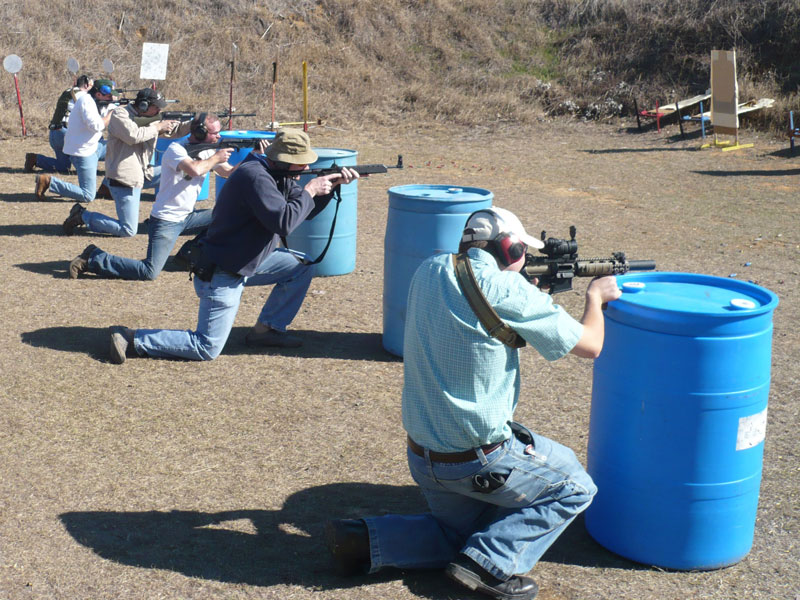
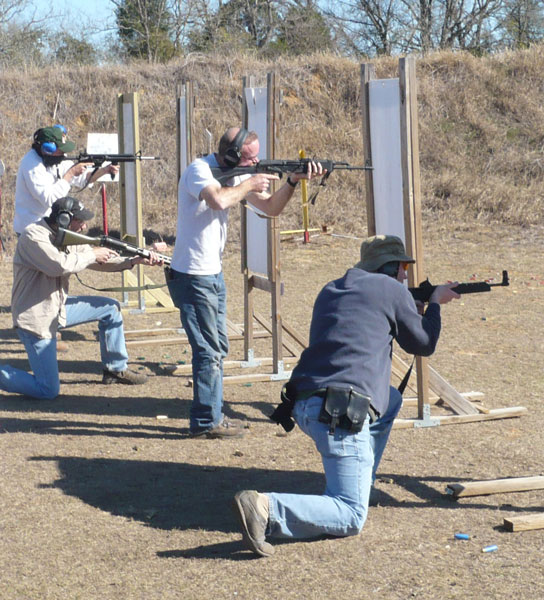
Anyways, some pictures from the Defensive Long Gun Class were just posted. Here’s a couple with me in them:

KR Training Defensive Long Gun 2009 Class - Students shooting from kneeling

KR Training Defensive Long Gun 2009 Class - Students shooting from kneeling

KR Training Defensive Long Gun 2009 Class - Students shooting around cover

KR Training Defensive Long Gun 2009 Class - Students shooting around cover

I have to say, all of this has entered into changing my choice of home defensive firearm.

Situational Awareness

I was reading this article and one line in there reminded me of something I saw the other day.

Out with the family, finishing up dinner. I’m waiting for my kiddos to finish up, so I’m doing a bit of people watching in the restaurant. Our table was situated by the main route to the exit doors, so of course I get to watch lots of the people going in and out of the restaurant. One group that struck me was a family, Mom & Dad leading the way, then the kids following up behind… each with their iPod ear buds in, their noses buried down in the iPod’s watching some video, and the kids playing bumper cars with the tables and chairs as they make their way to the door.

I had a Sony Walkman when I was kid. It was a great companion during my morning paper route deliveries, blasting ZZ Top’s Eliminator and throwing the papers up on the porches with an arm circle like Rev. Billy and Dusty Hill did in their videos. Do my kids have iPod’s? Nope. Not just a matter of hearing damage (which I suffer from due to years of loud music and early years of neglecting things like ear plugs), but a matter of being unaware of your surroundings.

I’ve experienced it many times. People walking around with their eyes pointed at the ground or just oblivious to what’s going on around them. Couple that with things that either deaden or overtake your senses (e.g. your vision distracted by a book or a video, your hearing dominated by the music that comes out of the iPod). Furthermore, if you’re listening to music or watching/reading something, you’re mentally engaged in that and not other things. So you can see, there are many layers that add up to a rather unaware state of being.

I realize it’s your business if you choose to tune out the world. But if you do choose to do so, don’t be surprised if you’re viewed as a ripe target for someone willing to take advantage of you… and your first post-situation thought is “they caught me by surprise… I wasn’t aware of them until they were on top of me”. Be pro-active, don’t let it happen to you, stay aware of your situation. And teach your kids the same.