The second set of techniques one learns in Kuk Sool (at yellow belt level) is Sohn Mohk Soo — wrist techniques.
Many people put down defenses against wrist grabs, and I can understand why. It’s complicated, and in a “real fight” situation a lot of it is unlikely to work unless you’ve had a lot of training, practice, and know how to set it up. There’s merit to learning how to escape from wrist grabs because they do happen, but you just don’t always need a lot of fancy flowery moves. If what you want is to just break their grip on your wrist so you can get away, there’s really nothing special: work against their thumb (weakest point of the grip), use your fully body (weight):
Other simple movements can work too, e.g. stomp on their instep.
Back to Sohn Mohk Soo.
What has to be considered here isn’t so much that you are learning “defense against wrist grabs” but that you are also learning body mechanics. Sohn Mohk Soo teaches more about how the body works: how the wrist, arm, shoulder work, or perhaps more importantly how they don’t work. It also teaches ways for you to move your body: methods of grabbing, methods of entry, body positioning. Furthermore, just because these techniques are set up from a same-side wrist grab position, that doesn’t mean they are only applicable in that instance: an arm bar is an arm bar no matter how you enter into it. When viewing and learning these techniques, don’t stop at the surface, look deeper. There is a lot taught and much to learn.
The more I read about Blauer’s approach to combat, the more I like it. It’s modern in approach, it builds upon natural body reactions and movements, but he also doesn’t totally dismiss more traditional arts. If there’s anything he dismisses it’s martial arts bullshit, which I appreciate.
For instance, Blauer understands the value of “forms” practice (kata, hyung, poomse). Many modern martial artists poo-poo the notion of it, but in the end any sort of repetitive practicing of movements is forms practice. IMHO there’s a lot of good in forms practice, so long as it’s a meaningful form and meaningful practice. If you’re just flailing and dancing, there’s no point to that other than perhaps some physical exercise and ego feeding. If however you are practicing actual martial movements to ingrain them as natural actions, if you train with the proper mindset, that has utility. Some forms practice is like moving meditation, and there’s utility in that as well (Kuk Sool’s Baek Pahl Ki Hyung is that for me). In the above-linked article, Blauer presents a “Close Quarter ‘Muscle Memory’ Form”. You must first obtain the correct mindset: visualizing where the strikes are landing, visualizing the reactions so you properly flow with their movement. Then imagine that you’re in a situation, you tried to avoid physical confrontation but the attacker/bully presses the issue and you must physically react.
Start from a “Submissive Posture” Legend: YOUR ACTION ‑ opponent’s reaction
SHORT LEAD FACE SLAP ‑ opponent flinches and closes his eyes.
PALM STRIKE UNDER CHIN ‑ opponent steps back, growls and rushes in to nail you with a “big Haymaker.”
Intercept with the S.P.E.A.R. ‑ opponent is jammed and hesitates.
VERTICAL ELBOW ‑ catches opponent under the chin, snapping his head back.
DOWNWARD RAKE (flows from same elbow #3) ‑ scratching attacker’s face, he flinches forward.
HORIZONTAL ELBOW (opposite arm) ‑ hits opponent in the nose.
REVERSE RAKE (same arm #5) ‑ causes opponent to clutch his face and turn away.
DIAGONAL ELBOW (opposite arm/up and downward, slashing motion) ‑ hits attacker in the temple (clavicle, ear, etc.) region causing him to buckle.
HAIR GRAB & KNEE ‑ grabbing the opponent’s hair, you drive a knee solidly into his face. He clutches his face and starts to stand up.
LEAD FRONT KICK ‑ seizing the opportunity to attack the groin, you step in and snap a hard, quick kick to the groin. Your opponent doubles over, clutching his groin.
REAR LEG FRONT KICK ‑ With the opponent doubled over, drive a powerful front kick, and use the shin as a striking surface, into his hands. Turn and run.
Is that a form? Sure is. Is it useless to practice? I don’t think so.
Blauer’s got an interesting approach. Well worth the read.
Updated: Found a video demonstrating the form. Tony himself made the video, narrates it.
Many of the techniques in Kuk Sool (and many other martial arts that involve more than striking) involve grabbing, trapping, locking… basically that you’re grabbing your opponent and then manipulating them in some way. There’s no denying that some degree of strength is involved in these actions. You hear the stories claiming a 90# woman can disable a 300# man… well, maybe. Let’s be honest, there’s certainly a size and strength disparity here that is difficult to overcome; difficult, but not impossible. It’s a matter of knowing how to use what strength and size you have to its maximum advantage. I’m not going to say it will allow that little woman to out-muscle the big man, but at least perhaps she can use what she has to its fullest.
One key aspect to this is to use your center. Bring things to your center, as this is where you are strongest. The best analogy is the pickle jar. When you have to open a jar (pickles or otherwise) and the lid is stuck and tough to get off, what do you do? Most people bring that jar into their center, somewhere around their belly button. You’re able to apply more strength to the lid by holding and working the jar in this location as opposed to say holding the jar at arms length and working on it there. So when you apply physical techniques to people, bring them to your center. If you cannot bring the person/joint/lock to your center, move yourself in a manner that places your center closer to the point at which you are trying to work. So you move yourself or you move them, either way it’s putting what you’re working on closer to your center. Your center is where you can best apply your strength.
Related to this, don’t forget to keep yourself towards your center. Try this experiment. Have a friend hold their forearms vertically in front of their chest, forearms pressed together, hands clenched in fists, fists in front of their chin, elbows in front of their belly button. Now you come up to your friend and place your hands atop their fists and press down as hard as you can; your friend should resist, not so much as to throw you off but just enough to counter your force. When you press down, first try pressing down holding your elbows out to the side (your forearms parallel to the ground). Then try pressing again, this time with your elbows pointing down (perpendicular to the ground). If I described this correctly and all goes well, you ought to be able to exert more force when your elbows are in. You’ve kept your elbows in, towards your center. This isn’t saying there’s magic about the center, but it’s about how our body physiology is set up and how much more effective we can work when we angle ourselves in a manner that allows our body to work to its maximum potential.
Of course, there’s a lot of philosophical implications of “finding strength from your center” as well, but that’s perhaps a discussion topic for another time. 🙂
So as you work, consider your center and keeping to it. This is where you can find much strength.
Self-defense bottle caps. Um… OK. It’s certainly novel.
Now, let’s ignore the whole issue of bottled water, and the fact that a gun or a knife trumps a lump of knobby plastic atop your water or soda bottle (both you being attacked by, and that they’d be better tool choices for yourself).
Could this thing be a reasonable self-defense tool?
Actually, maybe it could. Maybe.
I think about dan bong (short stick) techniques, seen in Korean martial arts such as Kuk Sool, Hapkido, and Hwa Rang Do (and their variants). Not that I think this bottle cap actually could work dan bong style, but it’s something I’m familiar with and as soon as I saw the bottle cap and thought a bit about it, dan bong techniques came to mind. One premise of dan bong techniques is directing hits to sensitive/vital areas, pressure point targets, and so on. This article describes some of the points, but lacks visuals. So instead, here I have a visual taken from Kali, and I have seen a similar illustration from a Modern Arnis book I have by Remy Presas. You can click on the picture for more details (it’s discussing the Presas approach), and you can see the basic striking points and angles of attack. Dan bong is similar. While with this bottle cap you may not take a true Kali/Arnis/Eskrima or Korean dan bong type of strikes, thinking about those weaponologies… take strikes with the butt-end of the stick, apply them to these vital target areas. And so yeah, maybe a knobby lump of plastic might do something. I would think the cap would be more effective applied to bony areas, bare skin (clothing pads and would diminish the effects)… striking, grinding it in.
But on that token, I think that’s where the cap has limited application. Someone attacks you middle of winter, they’ll be rather covered up… where are you going to strike them? Or even if it’s in the summer and lots of flesh is exposed, the striking/grinding application of the cap is only going to be effective in certain places. I guess go for the head and hope. Which brings up another point… this is a contact weapon. You’re going to have to be close in to use it, and that’s probably too close for comfort. This is where tools that utilize projectiles are useful.
I also wonder about the structural integrity of the bottle. Many bottles now are being made out of very skimpy and flimsy plastic, so bottles collapse and crush pretty easily. Can those bottles withstand such a use? And would you trust your life to that? Maybe these will screw on top of the steel (reusable) water bottles. Most of the steel ones I’ve seen have a female top with a male cap, and this Bottle Bezel is a female cap for the male disposable bottle tops… so unlikely to work unless you can find a steel one set up the right way. But steel would be better than plastic bottles. Then perhaps you could use other striking techniques with the bottle itself, but even that’s a bit unwieldy.
I’ll say this. While I applaud their efforts to create a “less lethal” self-defense tool, one key part of self-defense is to stop the attack so you can escape. Is this bottle cap going to stop an attack? By look alone? I highly doubt it. I mean, flash a gun or a knife and attackers typically stop… flash a bottle cap? Then by effective application? Well, perhaps, but it seems so limited and difficult to trust.
I don’t know. Maybe. I haven’t actually seen or played with one so I can’t make a complete assessment. But just looking at the logic of it all, I can’t see it. If they really want to market it as a self-defense tool, they ought to show how it can be used. Give us some honest material and ways to view this as anything other than a gimmick or talisman. Maybe they can create their own martial art and call it “H2-Do” (sorry, the pun was there). At this point, it’s not something I’d put my faith in. I have more effective and proven tools, and I’ll stick with those.
Here’s an advanced kicking routine that we used to do at my martial arts school. I don’t know if this is some greater Kuk Sool kicking drill or was just something local to our school. But it’s a challenge, and fun. Note as well that I’m using what ought to be typical Kuk Sool verbage, both in kicks (e.g. a “spin kick” is what others might call a 360º kick) and and specification (e.g. inside kick implies using the back leg, pop-up implies front leg).
Start in defensive stance
Inside kick (now in offensive stance)
High spin kick
Low spin kick
Jump spin kick (ending in offensive stance)
Switch stance (now in defensive stance)
Pop-up outside kick
Roundhouse kick (now in offensive stance)
Spin kick (ending in offensive stance)
Inside kick
Jump spin inside kick (ending in defensive stance… and no right had soo doh 🙂 )
There aren’t many blogs out there that talk about one’s journey through the same martial art that I study, but I found one and he’s fairly active with it.
(Sorry…. I had to turn the music off while watching, but the content is still good.)
This is Master SUH Sung Jin; 8th degree black belt; oldest son of SUH In Hyuk, founder of Kuk Sool Won. This video shows him demonstrating various Kuk Sool forms (hyung):
Oon Hak Hyung, “Crane Over Cloud”. Learned at 5th degree black belt. I’ve seen many perform this form, but the way Master Sung Jin has been performing this the past few years is simply amazing. Beautiful.
Kyuk Pah Hyung, “Power Breaking Form”. Learned at the 2nd degree black belt level. Watch the form and you can see the breaks, the power. I’ve seen many perform this form, but few perform it as well as this.
Ki Cho Hyung, “Fundamental Form”. Learned at the white belt level. This is not an easy form, but is the foundational form upon which all Kuk Sool is built. Master Sung Jin has been performing it recently in demonstrations in this “stylized” manner to help promote improved execution and technique in and of the form.
Gum Moo Hyung, “Sword Dance Form”. Learned at the brown-black level. The speed at which Master Sung Jin’s hands are moving during the middle portion of the form’s execution is amazing. Great relaxation.
Dae Geup Hyung, “Advanced Level Form”. Learned at the brown belt level.
The video is nice in that it is a compilation of various forms demonstrations. But moreso, what I like about this is seeing “other” forms demonstrated. Many times in demonstration what gets demonstrated is the highest-level form the person knows. While that’s nice, us lower-level folk like to see our stuff demonstrated too, but performed at a higher level. It helps you see what the form can look like in an ideal state, or at least give you a more tangible ideal towards which to model and strive your own execution of the form.
At the dojang today, all I did was sword training.
I don’t care for sword.
I know some people are totally enamoured with swords. There’s a Romantic notion about it. There’s great fantasy in it. But for me? I couldn’t care less. I’m practical. A sword is not practical. Sure it’s better than nothing, but it’s just not a practical weapon for the 21st century urban dweller. In my traditional martial arts training I prefer more practical weapons, such as a staff (especially short staff called “dan bong”); I’m looking forward to studying cane.
But for today. Sword.
So I look at it this way: it’s training, it’s discipline. I have a heavy (relatively-speaking) steel sword. Most people don’t like to use my sword because, while a gorgeous and well-balanced sword, it’s long and heavy: arms tire out. That’s why I like it, because it works out my shoulders, my arms, and most of all — my grip. It’s not just strength, it’s endurance.
Updated: I should clarify. I only have so much time and energy in a day to study and practice something. So with limited time and energy, I’d prefer to spend my finite resources on the things I find most productive and useful. Thus why I prefer to study things like staff or cane or firearms. But if I must study sword, and to progress in my martial art yes I must from time to time, then I might as well utilize that time towards productive ends. Maybe I’ll never be a master at wielding a sword, but if it’ll strengthen my grip, well, I found something useful to focus on.
Some time ago in my training I made a point to always keep my hands up. That is, I see all too often when people are doing kicking drills that they focus only on the kicking and their feet/legs… the rest of the body tends to be ignored, and this is most evident to observe in how they hold their hands or more typically how they aren’t holding their hands at all. I resolved to not do this, that even if I was focusing on something else that my hands must remain up in a proper defensive/blocking position: hands more or less guarding the sides of the face, forearms more or less vertical, elbows pulled in close so you’re not leaving your gut unprotected. Of course going with this, doing things like shrugging the shoulders, chin tucked, but that’s not the focus of my discussion today. The point of ensuring I always kept my hands up was to turn that positioning into my habit, that that’s just the place my hands naturally go — and stay. The stay is an important part. I see people might start with their hands up, but eventually the hands migrate somewhere else. Maybe their arms are getting tired (keep them up there, they’ll get stronger). Maybe they just forget (keep doing it, be aware of it, make it habit). Or many times they’re doing something dynamic and their arms leave their center so they can keep their balance. To that I say, you have to fight to keep your hands in. First, if with every kick your hands fly out so you can keep your balance that tells me (fighting/sparring you) that you’re not very balanced and I’ll either take advantage of that aspect or take advantage of the fact you’re not guarding yourself and attack those areas. Second, when you flail your arms you’re creating more movement, which will lead to further balance disruption, not to mention you’re wasting energy working all those muscles that don’t need to be worked. Keep your hands in, force yourself to do this. You’ll find that your balance will come along just fine.
One thing about keeping your hands up is what to do with your hands themselves. Should you make tight fists? Should you have a fist but just not clenched? Hands in a natural and relaxed but curved but not a full fist looseness? Or maybe have the hands fully straight, fingers extended, palm flat? I have been taking the relaxed approach, a semi-fist, if you will. A few days ago I started to play with keeping my hands flat. I’m going to experiment with this for a while and see where it goes. Here’s my thoughts.
With my hands flat there is now more stuff guarding me. Measure from the tip of my elbow up the forearm to the end of my closed fist, then measure from the elbow to the tip of my extended fingers and you’ll find a few more inches there. That’s a few more inches of protection for myself. Granted it’s fingers, not someting that can absorb a lot of damage (nor do you want them to), plus having the fingers out there leaves them open to finger grabs/locks. Still, I’d like to play with this to see if it really does add any more guarding effectiveness.
It’s good to use natural weapons, parts of our body that are naturally tougher, such as the palm heel. While fists are your traditional “fightin’ man’s” weapon, punching someone in the head with your bare fist is more likely to hurt you than them. Which would you rather do? punch a brick wall with your fist? or punch a brick wall with your palm heel? I’ll take the palm heel. The further implication is you’ll be more willing to put more power behind the palm strike because you’re not as worried about getting hurt. Keeping your fingers functioning is important, be you looking to further trap or manipulate your opponent, or perhaps transitioning to say a sidearm. So by keeping my hands open when up in the guard, I’m more apt and open to use palm strikes than closed fist attacks.
One technique in KukSool is the Sa Ma Gui Mak–Gi (사마귀막기) or Praying Mantis Block. This is a trapping and control technique, one that I’ve dabbled with a bit in the past, but I think I’d like to take the time to more seriously study and experiment with practical application. Starting from my hands-up guarding position, with open palms, a block can lead directly into a mantis block and trap.
I think my desire to explore the mantis block/trap more actually started in earnest about a month ago. I was flipping through my copy of Dr. YANG, Jwing-Ming’s Analysis of Shaolin Chin Na book because he has a lot of exercises for wrist strength and I’ve been looking to improve my wrist/grip strength for other activities. I was reading over his exercises for trapping, twisting, gripping, but especially the coiling training. So it got me thinking about mantis blocking/trapping again.
As I was preparing to write this blog entry, I Googled around for more information on Chinese praying mantis kungfu. I found a video that was most interesting.
I admit, I don’t have a lot of direct exposure to any flavor of Chinese Praying Mantis KungFu, and most of what I do see is the performance of forms. But this video is the sort of thing I wanted to see: 2 man fighting techniques/drills, application. Here’s what stood out to me.
Notice the attacker/defender (person performing the techniques) has their hands up, in the guard position. That’s the position they fight from, which is efficient and deceptive.
I like how both arms are always doing something. One arm blocks the other attacks, then they switch roles. Watch the exchange that starts at 0:30 to really see this.
Notice the use of natural weapons: palm heels, elbows, hammer-fists. Big strong meat of the forearms provides the block, the palm and the elbows provide the attack.
Very cool stuff. Something for me to focus my study on for a while.
Updated: All of yesterday I was involved in helping teach a different sort of combative art. One of the movements done is that you start out with your hands put up in front of you, open palms, palms facing out, hands more or less in front of your face. It’s not hands above your head in an “I surrender” position. It’s not hands pulled back so your arms are fully bent, elbows down by your hipbones and hands up at your shoulders, which isn’t quite “I surrender” but is a very submissive position. It’s not hands pushed out in front of you, arms fully or almost fully extended, as if to push a person in front of you back; this is a very aggressive position. No, it’s more that your hands are just out in front of you, just enough, palms open and facing forward, which is an assertive stance that could say “Hey man, I don’t want any trouble. Just stay cool. This is a very reasonable position to start from, especially in a self-defense situation. If you do some things like avert your eyes just slightly, it provides a little more submissiveness to the position, which can be good towards helping diffuse a situation (but that doesn’t mean you are being submissive, perhaps just manipulative of the situation).
When you look at this posture, what is it? It’s the same posture I’m describing above. That guarding stance, hands open, arms up. Look at the non-verbal message it sends to an attacker. It’s not taking an aggressive and obvious fighting stance (clench your fists or even loosely ball them). It’s not putting you in a negative position such hands above your head, or at your side, out of position to attack or defend. It leaves you guarded, defended, but sending a good message to an attacker. You can combine it with verbal commands “STOP, DON’T MOVE!” “BACK OFF NOW!” or perhaps just less assertive spoken words such as “Hey man, I don’t want any trouble.” or whatever is clear and appropriate for the situation. From this posture you can then transition to whatever may be necessary. You’ve got your hands in close, you can shoot your body inside his for takedowns. You can defend against strikes. You can do as I’m exploring above and be able to perform mantis-based traps and locks. You could transition to your sidearm. You could just transition to other non-verbals as needed, e.g. maybe you have to push your hands out further to be more aggressive and sending a stronger message.
The more I consider this sort of open handed guard position, the more potential I see within it.
This morning I went into the backyard for some training and practice and wanted to share with you something I did during my session.
In Kuk Sool, there is something called “hyung bup” — principles of forms. They are basically:
eyes bright
mind clear
hands fast
feet slow
body low
Now for the outsider looking in, you have to realize there’s more to these principles than the 10 words. For example, “eyes bright” isn’t that your eyes are shining like beacons, it’s about awareness. For now I’ll assume the reader understands these 5 principles and save a discussion of them for another time.
I started my practice slowly, working with Ki Cho Hyung. Ideally when you perform hyung it should be smooth, without stopping, and fast. Stopping is essential in learning the form, but as you progress things should be smooth, without any stops. One thing I picked up from my gun work (e.g. drawing from holster) is: slow is smooth, smooth is fast. All too often we train fast or at least at a moderate pace, but how smooth are we? And then if we aren’t stopping, are we also being sloppy? So this morning I opted to train with “slow is smooth, smooth is fast” in mind. The ideal is fast and smooth, no stopping, no sloppiness. So, start off by taking it slow.
When taking it slow, this also gives you a chance to really work on principles like “body low”. But more so, it really allows you the time to focus and be aware of your application of hyung bup throughout your execution of the form. You’re able to mind little details of your body position and correct them. You’re able to feel all the muscles contracting, including the muscles that shouldn’t be and therefore need to be relaxed. This isn’t to say you should move so slowly, like an exaggerated turtle, but that you should go at a slower pace than normal, smooth it out, and really allow yourself to be aware of your body and your application of hyung bup. It makes a difference.
After working on being slow and smooth for a while, I changed my practice slightly in how I applied hyung bup. I worked to exaggerate the principles (tho really, it tends to work best for hands fast, feet slow, body low). So I really pushed out my stances, not too stupid low levels, but certainly pushing them beyond where I normally go… to a level where yes my legs will shake and tremble as the muscles are tired, but not so much that by the end of the form my stance is nothing. It’s picking something just over my normal state so that I push myself a bit beyond my threshold so that my body grows stronger. Push yourself but pace yourself (train smart). Then I work at the feet slow, ensuring grounded stances, ensuring my head is level, my back is straight, my hips squared, my balance centered. Working on moving my hands as fast as possible, which seems even faster in contrast to the speed everything else is moving, but never letting it be sloppy. If things are getting sloppy, back off the speed a bit and work to make it correct and smooth; speed will eventually come. The key here is to take the principles and not push it to ridiculous extremes but to push it beyond your normal bounds so that you have to be just a bit more than before… it may not be comfortable, but eventually your body will adapt and strengthen, and that’s the point.
I like to perform this exaggeration of multiple principles at the same time, but if it’s too much for you at first, just pick one principle and focus on it. And really focus on it… do that form 10 times, 20 times, 50 times, all focusing on that one thing. Be aware of what you’re doing, how you’re progressing, and always striving to push yourself to be better, closer to ideal, nearer to perfect. Always check your personal feedback, never getting angry at yourself if you mess up but instead discovering something about yourself from that experience and do better on the next repetition. Then once you’re working well at the one, try exaggerating two principles during the same execution. And so on.
Hyung practice shouldn’t be mindless and repetitive movement, just you dancing about the floor. There should be thought and purpose in every movement. Hyung execution should be meaningful and productive.
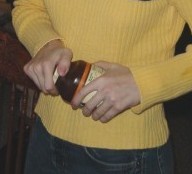 One key aspect to this is to use your center. Bring things to your center, as this is where you are strongest. The best analogy is the pickle jar. When you have to open a jar (pickles or otherwise) and the lid is stuck and tough to get off, what do you do? Most people bring that jar into their center, somewhere around their belly button. You’re able to apply more strength to the lid by holding and working the jar in this location as opposed to say holding the jar at arms length and working on it there. So when you apply physical techniques to people, bring them to your center. If you cannot bring the person/joint/lock to your center, move yourself in a manner that places your center closer to the point at which you are trying to work. So you move yourself or you move them, either way it’s putting what you’re working on closer to your center. Your center is where you can best apply your strength.
 Stuff From Hsoi