In light of my cane making, this morning I found myself going around YouTube in search of cane videos. Man, I remember when I used to search for martial arts videos and would find nothing. Now there’s just too much to list. 8) From my searching, I wanted to highlight some of what I found.
Kuk Sool
Raising cane
My martial arts school had an informal gathering this afternoon. Why?
Is Hand Placement Important?
Just finished a workout (Kuk Sool-based) in the front yard. I want to cool down before I hit the shower, so that gives me some time to write up something I observed during the workout.
Hand placement. Does it matter?
Kuk Sool Won Seminar 2009
The annual Kuk Sool Won seminar rolled through my school tonight.
Topic: dan bong.
Dan bong is one of my favorite weapons, so I was looking forward to this seminar. I can’t cover everything, because there’s just no way to type it all up. But I did want to give an overview of the event and what I took from it.
Slacking, sorta
The past couple weeks have been… full? distracting? having other things taking priority? been what they’ve been is all I can say. Some of it documented here, some not. As a result tho, I haven’t been at the dojang as much as I’ve wanted to be. So to my Kuk Sool folk reading this, sorry I haven’t been there… but it’s not from lack of want. 🙂 I did sign up for seminar tho. Dan bong! Looking forward to it.
Thing is, a while ago I made a commitment to practice martial arts every day. Doesn’t matter what it is, just as long as it’s something and done every day. It could be going to the dojang. It could be going to the garage and working on the heavy bag. It could be going on the yard and doing forms. It could be dry fire. It could be just draw practice. It might just be working out some techniques in my head, thinking through self-defense scenarios. Mentally going through all my Kuk Sool curriculum. Freeform development of mixed concepts (e.g. empty hand transition to handguns). Whatever. Doesn’t always have to be intensely physical, could be mental, could be just meditating on some concepts. So long as every day I do something. Going to the dojang is actually a fair part of that, but not going is really bugging me…. such is just life right now. Ebb and flow.
Shooting, relaxing, and having no mind
I was scheduled to participate in a handgun class today, AT-4 Extreme Pistol. However due to the heavy rains and flooding issues the class has been postponed until tomorrow. Heavy rains, shooting on the move, paper targets… just doesn’t mix well for a safe and productive class. Tomorrow should be better.
Some weeks ago when I was assisting with a class I mentioned to one of the instructors that I was signed up to take AT-4 as a student. He gave me a puzzled look and wondered why I would take the class, saying something to the effect of I shoot better than that and don’t really need the class. While I appreciated the complement, I’m still taking the class. I signed up for it a long time ago, back when I was still unsure of my skills. While I apparently underestimated myself, I know I can still learn a lot by taking the class. Plus it’s good to just take it as a “résumé” builder — the more formal training the better.
I’ve been thinking about how to approach the class. What do I want to get out of it, what do I want to focus on for myself apart from the class curriculum. I think I’m coming back to something I’ve spent a long time trying to improve about myself:
Being relaxed.
Some years ago I injured myself in some way and so I wasn’t sure how I could keep up my empty-hand martial arts training while I healed from the injury. My teacher at the time suggested to me to work on forms and utter relaxation. To use only those muscles that had to be used and nothing more. For instance, if you’re in a horse stance, your leg muscles certainly need to be at work… but all of them? Your quadriceps sure, but your hamstrings not so much so ensure they’re not tight. Certainly in a horse stance your shoulders aren’t involved so why should there be any tension in them? You’d be surprised how much we involve muscles that have no true reason to be involved, and all that does is consume energy and tire us out quicker. The more I worked on being relaxed, while that in and of itself was difficult, the end result was making things a lot easier. Endurance went up merely because I wasn’t wasting energy.
I still have to work on the physical aspects of this. I guess it’s in my genes to be a tense “type A” person, so it’s an effort to relax (ironic eh?). It’s even in little things, like noticing during a workout or even just sitting here right now at the computer as I type this and I furrow my brow. There’s no need. If the brow is furrowed, I’m not relaxed. The more relaxed I am, the better I move, the better I work. Plus, it telegraphs. Can’t have a relaxed poker-face.
So back to the handgun class. I think the key thing I want to focus on is being relaxed. The class is about pushing your skills further, so if I really want to shoot well the more relaxed I am the better I will perform, the faster I can perform. But that’s just the physical side of it. I need to be mentally (and emotionally) relaxed as well.
No Mind. The Japanese would call it mushin. Chinese, wu-hsin. In Kuk Sool’s hyung bup, “mind clear”. I don’t want to have a gazillion things racing through my head. Maybe “front sight front sight front sight” but I don’t even want that. I want my mind to just be. Just let things flow. Be one with the gun, the target, myself, everything. Harmony.
This will be my personal goal for the class. We’ll see how I do. 🙂
Notes from my workout
Went into the garage this morning and worked out with the heavy bag (Wavemaster XXL… I’d prefer a real hanging bag but don’t have the infrastructure to handle the abuse). Worked on various things. Some random notes:
- If you want to “get off the X”, you cannot open with a kick…. feet gotta be used for moving, not attacking.
- Continuing to work on “eyes level“. Eyes need to be in a middle ground between focused and uninvolved. Aware, I guess is about the best term I can come up with. Helps spin kicks and spin back/side kicks too. Even just turning for moving.
- Continuing to work on hand positioning. The more I work with this, the more I like it. I find more and more how it fits the combatives approach/road I’m going down.
- I want to hang a tennis ball (or something) from the garage ceiling to help work on bobbing, weaving, dodging.
I also finally circumscribed my bag. I’ve got an older Wavemaster XXL with logos and words running vertically up the length of the bag, so I knew about where the “S” was was about the level of the solar plexus, and other relative locations to body parts. Trouble was, if you weren’t facing that side of the bag, you could only guess. So I finally got a magic marker out and drew circles around the bag about where things are. I opted to draw lines at the level of the waist, solar plexus, nipples, and chin. This helps when looking for areas to target, with whatever you’re using.
Dan Bong drills
I wrote my piece On Dan Bong and completely forgot to mention something, so I’ll mention it now. 🙂
I have found dan bong to be a versatile weapon. Apart from some striking drills, e.g., the 12 angle drill I mentioned from Modern Arnis, what else can you do to explore dan bong?
Take whatever you know, put a dan bong in your hand, and see what you can do with what you already know. That’s a good place to start.
So what do I mean by that? Easiest way for me to explain is within the context and nomenclature of Kuk Sool.
Let’s take Maek Chi Ki. First, perform Maek Chi Ki as the empty-hand set that it is. Now, pick up your dan bong and perform Maek Chi Ki but instead of using your empty hand to strike, use the dan bong. Maek Chi Ki 1-3 would involve a normal “whipping strike” with the side of the tip. Maek Chi Ki 4 would involve a tip thrust into the armpit. Maek Chi Ki 6 could be a butt-end strike to the temple or an inverted tip strike to the temple. And so on. Ki Bohn Soo is a good place to start for locking and leverage applications.
Will every technique work exactly the same? Probably not. Some techniques may require a small modification, some techniques could have multiple approaches/interpretations, some may require you to invert the technique (e.g. performing it “other side/mirror image”), and some techniques may just flat out not work. But the point is to use existing knowledge as a foundation for exploring what you can do with a dan bong. Explore.
On Dan Bong
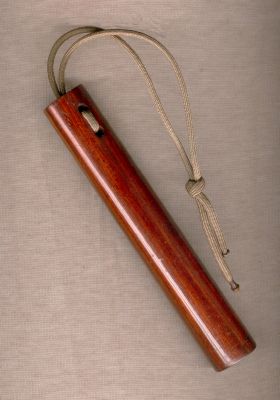 Kuk Sool claims a wide array of weaponry. I personally don’t care for much of the weaponry taught because I find them impractical. These days one just doesn’t fight much with a trident or spear or halberd, and they’re a bit hard to conceal when you walk down the street. That said, one of given intents of Kuk Sool is to be a preservation of Korean martial traditions, so including such weaponry makes sense. Still, I have only so much time in a day to practice things, so I prefer to practice things that are practical and that I can use. Weaponry such as cane, rope, fan, staff, and what I want to speak about here: dan bong.
A dan bong is a short staff, 1.0″ – 1.25″ in diameter, 8″ – 14″ long, made from a hard wood such as oak. Some dan bong’s have a thong attached to one end, but that tends to be more from Hapkido than Kuk Sool. In fact, it’s useful to bring up now that dan bong tends to be a weapon of Korean flavor, and seen in the “Hapkido family of martial arts” (for lack of a better term) such as Hapkido, Kuk Sool and Hwa Rang Do. However, Kuk Sool takes a slightly different approach, which I’ll discuss later. Note as well that fighting with sticks is not unique to any one art. I am discussing a particular approach, but as you research you’ll discover how other approaches to stick fighting can complement one’s study and use of dan bong.
The intent of the dan bong is as a close-range fighting weapon. Due to it’s small size you cannot gain much distance from it (although you do gain some and when in close inches can matter), but you can gain a harder striking surface as well as a tool for leverage and locking. Furthermore, due to its small size, it can easily be concealed in a handbag or up a sleeve. In fact, due to this, some recommend that the ideal length of a dan bong should be (no greater than) the length of your forearm. Where the dan bong came from isn’t certain, but the story goes that it could have been drum sticks, or from wandering monks carrying bamboo flutes with the flute serving double duty. However it came about, it does show how dan bong techniques can be applied from non-standard objects such as a hairbrush, wooden spoon, or my favorite, the Vaughan Superbar! 😈
The primary attack mechanism of the dan bong is striking. You can strike sideways with the dan bong, you can thrust with the tip, thrust with the butt, even perform lateral strikes. A couple examples:

Dan bong tip thrust to the throat.

Dan bong block, then striking downward with the butt.
Notice how the dan bong is being held in the middle of the staff? This is the primary differentiator of Kuk Sool dan bong. In Kuk Sool, the basic dan bong technique emphasis is placed on holding the dan bong in the middle and performing a “double strike” where you strike first with one end (usually the lower) then snap your fingers/wrist to strike a second time with the other end (usually the upper). Other arts that study dan bong may mention this sort of grip and striking, but it is not the key emphasis. I personally don’t care for this “double strike” because I find it impractical in the heat of a fight. If you try it yourself, you’ll often find on the first strike that the dan bong will hang up on whatever you are striking, or if you try to compensate to not hang up then you miss. This sort of strike may work fine in forms and other controlled practice, but in the aliveness and gross motor skills of combat I just don’t see it happening. Typical grip puts the hand about 1/3 of the way up from the butt-end of the dan bong, striking primarily with the tip-end. This allows a great deal of surface for striking, provides improved reach, provides space for locks and leverage application, yet still allows some butt-end to be exposed for use.
So how do you strike? A dan bong is not a club. A club is just a basic motion of the (stiff) arm striking a surface. With dan bong, the difference is involving more of your arm – especially the wrist — to increase acceleration and “snap” and thus increase the force of impact. As a result, ideal striking points are pressure points and/or other sensitive areas of the human body. In the above pictures you see two such examples: the throat, the top of the foot. This article provides a nice overview of the 18 points that Kuk Sool teaches as dan bong striking points, as well as additional information on Kuk Sool dan bong.
Dan bong can also be used as a locking and grappling tool. Think of it as an extension of your hand, that can apply greater force and leverage. While the following video isn’t Kuk Sool (it’s Hwa Rang Do), it provides a good illustration of how dan bong can be applied.
As I mentioned before, fighting with sticks is not limited to Korean martial arts. Japanese arts have stick fighting, but I would say the Filipino martial arts are probably best known for their use of sticks. Consider the 12 attacks of Modern Arnis. These attack points apply just as well to any sort of fighting, and I’ve found study of Arnis theory and technique useful in my study of dan bong.
If you’ve spent any time reading my blog, you’ll see that I favor a different sort of weapon. However, I find dan bong to be a useful tool. It can be used for striking, blocking, locking, throwing, and adding to their impact. It’s small, practical, and the techniques can be applied to a wide variety of common objects. The only weapon I find more practical is a cane, but that’s a topic for another time. Explore dan bong.
Updated: Forgot to talk about practice and application drills.
Keeping your eyes involved and on the level
I was at the dojang today and because we only had a few people and thus space to do so, we spent time working with staff. One thing I did was work on a staff form, Joong Bong Il Hyung (middle staff, 1st form). You can see a portion of the form here:
Notice at the beginning of that clip how the gentleman is doing 360º turns? I spent a lot of time on that today because I always have problems with that movement. I know the theory of what to do, like a figure skater that you need to turn your head all the way and focus your eyes on some point, keeping your head level, and so on, yet still it gives me trouble. However something hit me today that worked like a dream.
I took a cue from my motorcycle riding. On a motorcycle you look where you want to go. Where you look, that’s where you will go. So if you look down, you will go down. If you look through the turn, you’ll glide gracefully through the turn. Looking is very important to motorcycle riding. I noticed when I was turning that while I looked, I was only looking at the end points… that I start facing north (if you will) and look north, then I perform the 360º pivot and work to lock my eyes 360º around at the end point. But what am I doing with my eyes during the turn? Well, I wasn’t looking at much of anything… my eyes just went, wherever, I couldn’t tell you.
What I did was ensured that as I turned, my eyes stayed involved. No I didn’t still focus on any points during the turn, but your eyes still have to do something… they will still be looking, they will still be taking in whatever whirrs past them. So what I did was kept my eyes level the whole time. My eyes were semi-actively scanning and taking in everything on a plane parallel to the ground… kept it all level, kept my eyes involved. And lo… I was steady. I could pivot and rotate without any problem.
This has other implications too. Not just for empty hand martial arts skills (e.g. helping with 360º spin kicks, turning back kicks, etc.), but even for other tactical matters. I did notice while I was turning, while I wasn’t actively looking at anything, I was certain that I was taking in a great deal of visual information… I was far more aware of what was going on around me (duh!). Just goes to show that we’re not always aware of what we’re doing, and these little things can matter.
 Stuff From Hsoi