ProArms Podcast – Episode 099 – John Daub

In early April 2017, Massad Ayoob came to KR Training to teach his MAG-40 class.

Mas had asked me if I would be willing to speak to the class about my January 2015 incident. Gail Peppin asked me if I would be willing to be interviewed for The ProArms Podcast. Of course I was happy to do both. In the end, we settled on Gail recording my talk to the class, as the podcast content.

Episode 099 of The ProArms Podcast contains my talk to the class.

photo credit: Gail Peppin

I want to reiterate why I share this story.

First, in a way it helps me cope and deal with the incident. It’s a part of my life history, I will never escape it, so I own it. Sometimes when I talk about the incident, because of listener reactions or questions I find something new or different to think about. It helps me deepen my perspective on the event, on myself.

Second, and more importantly, I share it because I want something good to come from this incident. It is a tragic incident, and I hope through sharing my experience somehow good can come from it. Since the day of the incident, I’ve maintained this stance, and will always proceed with this goal. When I made my first public comment about the story I said:

I never wanted such a thing to happen, but it did and I can’t undo it – my actions, the actions of the others involved that lead up to and enabled this situation to happen. The best I can do is try to find something positive from it. To try to find some way to make the world better from it. One hope is that it brought the problems with the group home into the public eye; perhaps the lives of others will be improved because of this event, if it means bringing better protections, better oversight, better living conditions. Time will tell. But I will not sit by and just let time pass; I fully intend to be active in making good come from this event.

Sharing my story is part of my effort to make good come from this event.

And if this is your first time hearing this story then I ask you – and if this is not the first time, I ask you again – please pray for the repose of the soul of Jared James, and please pray for his family, that they will be able to find peace.

Thank you.

Which matters more? Capacity or…

My esteemed colleague, Claude Werner, penned an excellent analysis: Revolvers will get you killed – Or will they?

You see, Claude likes data. He likes to collect it, analyze it, interpret results, and in presenting his data he often rocks the boat. It’s one thing I love about Claude.

In this particular article, Claude discusses a recent article that posited armed citizen encounters rarely need more ammunition than what’s in a concealed-carry revolver (5-6 rounds).

Of course, in today’s world where increased magazine capacity is a huge marketing/selling point, only carrying 5-6 rounds tends to be scoffed at. So of course, Claude presents data.

Claude’s data shows the number of shots fired ranging from 0 to 2.

We can also look at Tom Givens’ student incident data, where the average was 3-4 rounds.

Thus, it’s reasonable to conclude that “seldom” does one need more than 5.

In my own incident, I fired 5 rounds.

But here’s where perhaps Claude and I differ.

Because you see, statistics are of little comfort when you are the anomaly.

Looking at the Givens data set, the range of shots fired ranges from 1 to 12 (last I saw the data summary it was 11, but I think recently it went up to 12). That 5-shot snub ran empty long ago. I think about my own incident, and while it was unfolding I was expecting there to be “friends”; if I had only a 5-shot revolver and if my situation was different, I’m not sure how things might have gone.

So this isn’t to say that there isn’t a place and a role for smaller, lower-capacity guns. I have them, and sometimes I carry them because they are what’s contextually appropriate. But for me, if I’m in a situation where I can carry something bigger with greater capacity, I will. Because why not? If all other things are equal, why choose 5 when I can choose 15? Because one thing I can NOT choose is how my self-defense incident is going to be and what I’m going to face.

But I didn’t come here to beat the dead horse of “capacity”.

Because if you read Claude’s article (and I can tell by my website analytics that you haven’t clicked through to read it… which is a shame, and your loss), you’ll come to see what matters MUCH MUCH more in terms of a self-defense incident.

For you see, while the hard-skills of shooting are certainly important, there are skills involved in private citizen self-defense incidents that matter so much more.

You’re just going to have to read Claude’s article to learn.

KR Training 2017-04-22 – BP2/DPS1 Quick Hits

Saturday April 22, 2017 was another fantastic day at KR Training. On tap: Basic Pistol 2 (our Defensive Pistol Skills Essentials) and Defensive Pistol Skills 1. These are two of the core – and arguably most important – classes we teach. It’s here that students go from casual plinking at the range to starting to acquire the skills and understand the realities involved in using a handgun for self-defense.

We had a good turnout, with over a dozen students in the morning, and over half staying for the afternoon class. For those all-day students it’s a long day, but one packed with learning and growth.

A bit of an interesting day too, as the weather took a “pleasant” turn. Instead of the warm weather we’ve been having, a cold front blew through just as class was starting. Sure 60º–ish all day isn’t that cold, but the wind was strong and bitterly cold; not all students were prepared for it. I can’t totally blame folks, but now instead of my usual “wear sunscreen” I’m going to have to start suggesting to people to ensure to always bring clothing/gear to mind the weather – even if it doesn’t make logical sense, because days like today apparently do happen. 😉

As well, I was the Lead Instructor for this day. Karl was off at the annual A Girl and A Gun Conference, so I held down the fort. I had capable assistants in Larry, Brett, and Justin. We had a mix of students: young and old, male and female – we ran the gamut. Again, I always like to point out demographics because there are people who think they know who and what gun owners are, but really have no clue.

John Daub, instructing students on the range during KR Training’s Basic Pistol 2 class.

As for some quick take-homes:

  • Trigger press. Remember? Prreeeeeeeeeeeeeeeesssss. Apply smooth pressure. Yes the pressure will and must increase, but keep it smooth (not sudden).
  • Grip should be strong (“Homer choking Bart”), and consistent. When you are holding the gun in the ready position, be gripping HARD – don’t tighten up when you get the gun out and in response to pressing the trigger.
  • Going fast is important, but not at the expense of accuracy. At this stage I’d rather you work on good mechanics, establishing good technique, and working to get acceptable hits. Speed will come.

One other thing.

For some, it can be a hard day. Not even so much on the skills and direct learning aspects, but what you go through, what you put yourself through. There can be a lot of emotions, a lot of discomfort. These two classes are filled with novel experiences, and sometimes uncomfortable experiences.

But guess what?

You made it through.

You are more aware.

You are stronger.

You are more capable.

And that smile on your face tells me, it was a good day.

Thank you for coming out and training with us. Thank you for putting your faith and trust in us, to help you learn and grow in such an important aspect of your life.

Practice well. Train hard. We’ll see you out on the range.

“But he was unarmed!” – Maybe so, but he could still kill you

It’s a widely held misconception that an “unarmed” person – someone with only their hands, without tools (gun, knife, baseball bat, hammer, 2×4, etc.) – is not dangerous, is not harmful.

Robert A. Margulies, MD, MPH, FACEP speaks with the ACLDN about blunt force trauma lethality.

A blow to the temple area where the skull is relatively thin can actually cause a fracture in that area and tear the underlying artery. This can produce permanent disability, and can cause death.

A blow to the back of the neck can dislocate the spine and cause paralysis or death. These are things that one does not really have to be a trained martial artist to do. Blows to the nose, to the back of the neck, to the throat are examples of “empty hands” that can produce disability or death.

Head and face trauma has an interesting aspect to it. It is not just that somebody has been hit in the face, but bleeding and swelling of tissues can also lead to airway blockages. Bleeding in the mouth can lead to swallowed blood, which is very irritating and can cause vomiting which puts somebody at a disadvantage, but also leads to the risk of aspiration. That is, the vomit is trying to come up and out, and you’re trying to breath in, and you suck some of this stuff down into your lungs. All of these things can become fatal, even though this was just a broken jaw and a little bleeding.

A blow to the ribs can cause injury to the liver or the spleen, both of which, in the vernacular, bleed like stink. Surgery is extremely difficult because the liver and the spleen are not like muscle where you can isolate a blood vessel and get control, they’re spongy and trying to suture is like trying to sew gelatin—it is difficult! It requires a highly trained team to be able to salvage somebody who has a shattered liver or spleen. Spleens can be removed and the patient can survive. Humans do not do well without a liver.

Dr. Margulies continues:

Unequivocally not. I consider hands and feet, knees, elbows and shoulders, to be deadly weapons. Once that first blow is delivered and once you go to the ground, the kick to the head, the knees in the chest, may produce permanent injuries and fatalities. I’m going to give you a reference to an article in the Journal of Head and Face Medicine, published in October 2005 (see http://www.head-face-med.com/content/1/1/7 – B10). One of the comments in it is that as of 2005, we in developed countries have a level of facial injuries caused by interpersonal violence exceeding those from motor vehicle crashes. This is not a new concept or a new problem.

I won’t question the fact that tools enable us to do things more efficiently, more effectively – that’s why we humans are tool creators and tool users. However, the lack of tools does not preclude a human from inflicting deadly harm upon another.

Please understand this.

Beyond the 1% – ProArms Podcast

My bossman, Karl Rehn of KR Training, was interviewed for Episode 98 of the ProArms Podcast.

It was about his presentation, “Beyond the One Percent” (8 part series starts here).

Give it a listen!


Being reluctant to shoot, but eager to know

On April 1, 2017, KR Training ran it’s Defensive Pistol Skills 1 and Defensive Pistol Skills 2 classes. It may have been April Fools Day, but what I want to talk about is no joke.

These particular classes are about gunfighting. These are classes were we work to impress upon students the reality of self-defense with a handgun. It’s fast, it’s ugly, it’s full of pressure. You have to perform at a high-level, usually starting from a deficit, and you must make split-second decisions (these classes are often a sobering reality and wake-up to students).

It’s that last part – split-second decisions – I want to talk about.

Context

Let me explain the context of class.

In DPS-2, we run each student through a shoot house scenario. The intent of the exercise is to introduce students to the notions of moving through structures, use of cover and concealment, and target discernment.

Target discernment.

You see, upon our hip we have a hammer – but we must realize that the world contains more than nails. What complicates matters is some things may appear to be nails, but really are not. Furthermore, we are “good guys”; which means we operate within the constraints of the law, both the laws of men and the laws of morality.

In terms of a curriculum progression, certainly it makes sense to first teach people general marksmanship as well as basic default response to a threat; you have to teach foundational and fundamental skills first. Once people begin to understand the fundamentals, you progress to more complex, complicated, and advanced concepts. One of those is target discernment.

Setting

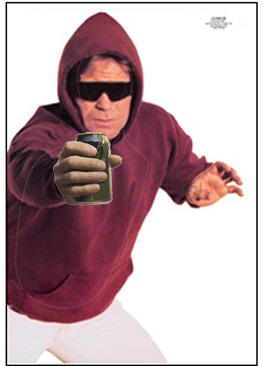
In this particular run of the shoot house, the situation was framed that you have pulled up to your home in your car and parked in the driveway. You get out of your car and you see… this. The “this” starts out with 2 targets across from you: one is a reactive target (i.e. if you shoot it properly it will fall down) with a threat indicator (a gun), the other is a reactive target with a not-threat indicator (hands up). The student begins by analyzing what they see and responding accordingly.

The student is then to move “into the house”. As they approach the opening, they see way down the hallway – about 15-20 yards away – this target:

When you look at this picture from the comfort of your office or living room, with no pressure, no need to make a decision, as you casually read this article, you can probably figure out what it is that you are seeing.

But when it’s 15-20 yards away, when you have a split second to make a decision, when you are under pressure, it’s not so clear.

Discernment – is this a threat or not – is difficult. Just because it is difficult, doesn’t mean it isn’t important; in fact, it means we need to work harder at it.

Reactions

With about a dozen students in class, responses were wide and varied.

Some people immediately extended their gun and shot.

Some people started to extend their gun, but realized they weren’t sure what they were looking at. (some thought “a grenade?”)

Some people stepped aside (out of line of sight, behind cover/concealment).

Some immediately questioned what they saw.

Some where not sure what they saw and what to do.

From there, responses continued typically with my interaction (i.e. me playing the part of either a “narrator” or role-playing the target).

Of those who wondered or weren’t sure what they were seeing, I asked them what they thought they should do. The basic idea? If you don’t know what it is, work to gain more information so you can become more certain about what it is. Some people wanted to get closer, and while that’s an understandable reaction, it’s not necessarily the safest tactics. What else could they do? They could shout commands, like “DROP IT!” If they did this, I roled-played the target and he dropped it. Of course, another solid response is “don’t go in the house at all; back out and call the police” (that’s really the best general response, but for purposes of the exercise we continue forward).

Of those that were quick to go to guns, I asked them why they did so. Some said “he was in my house”. One gentleman didn’t have his contacts in and wasn’t totally sure what he was looking at, but the general appearance and context was enough for him to perceive a threat. Generally afterwards, showing them what the target actually was caused a bit of reconsideration.

What’s key here is how people perceived the (total) situation, how they assessed threat, and how they chose to respond.

Response

I’m not going to fault any student for whatever their response was. This is class. This is the place to come to make mistakes, to learn, to become better. One of the hallmarks of training is how it provides a forgiving learning ground to learn what to do and what not to do, so when you actually have to do something in the unforgiving real-world, you can do it better and minimize chances of doing it wrong (and risk making things worse).

There’s a few take-homes here.

First, realize how situations can unfold. This scenario started with a context of “trouble”, so human nature is going to expect trouble to continue. When you see something else that’s abnormal – in this case, a strange person supposedly within your home thrusting an object towards you – when a split-second decision needs to be made, we process the situation based upon what information we have.

Take for example a recently released dashcam of an Opelika, Alabama police officer shooting a man on the side of the road in 2014. Every police officer knows that road-side stops are one of the most dangerous events in police work. It’s dark. Pull up on scene, man goes to exit his vehicle. As he exits, he turns towards the officer, something dark in his hands, and he clasps his hands together.

As the situation is unfolding, what might that officer be thinking?

Here’s a freeze-frame from 0:23 into the video. What does that look like?
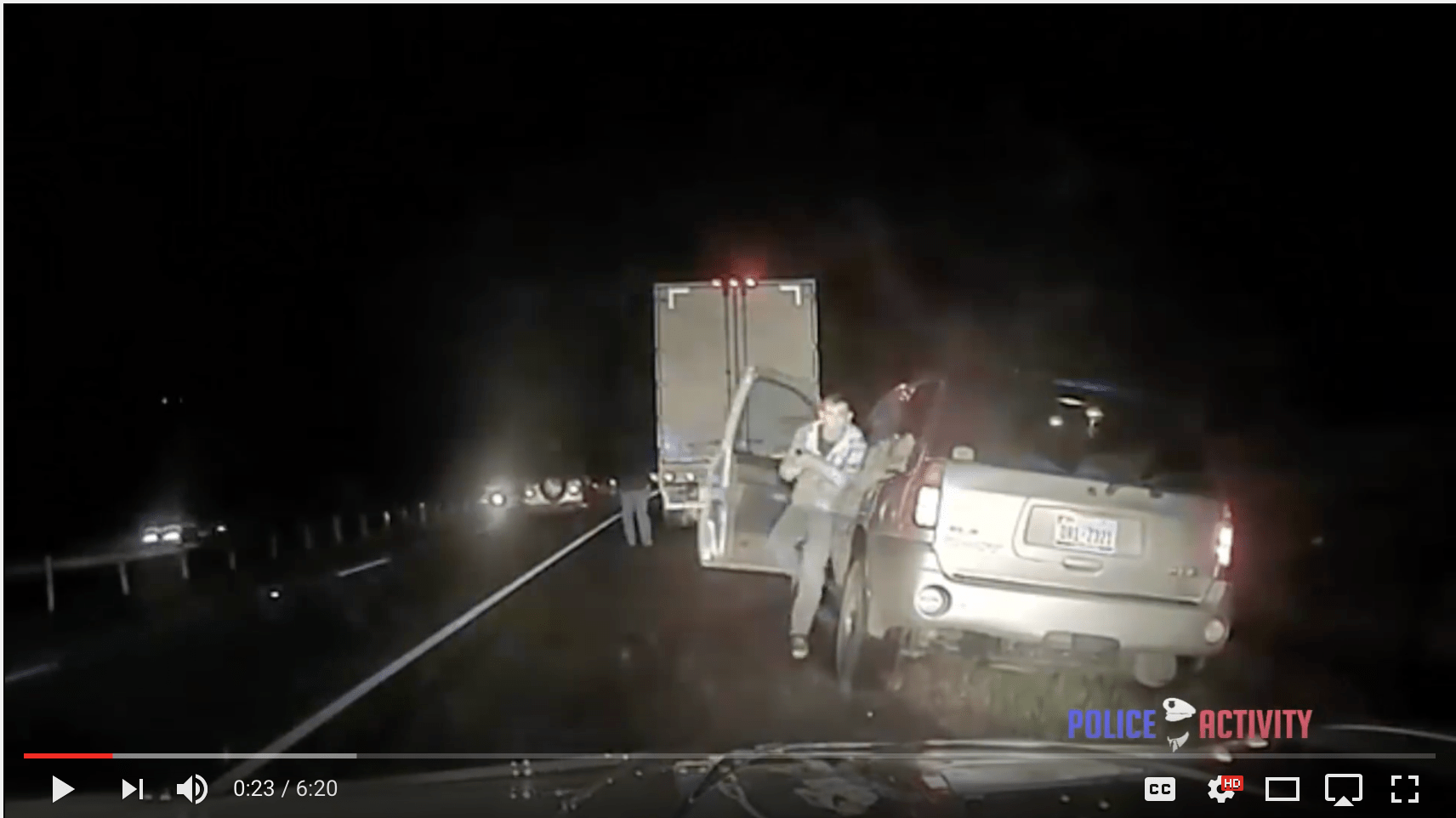
If you are someone educated in violent behavior (as police tend to be), that certainly looks like someone holding a gun, preparing to extend their arms to shoot. And not just shoot, but shoot at me.

It’s only in hindsight, it’s only with the benefit of sitting in our armchairs, that we can speak otherwise about this event. You can watch the full dashcam here.

I’m making no commentary on that specific event. What I am trying to point out is how there is reality in situations, how they frame events in our minds, and then how it affects our perceptions, especially in the seconds as events unfold. As well, simple objects that aren’t a weapon may not be so obviously-not-a-weapon as situations are unfolding.

We must work to be certain, or as certain as we can be.

Second, rid yourself of absolute mindsets. By that I mean mindsets like “if they’re in my house, they’re getting shot”. I hear this expressed far too often, with people proudly exclaiming how any unknown person in their house is getting shot, no questions, no discerement, no nothing. This is a recipe for trouble.

Claude Werner speaks of Negative Outcomes.  For example:

Deputies found a 32-year-old man who said that he and his wife were sleeping when they heard a noise in the kitchen.

The husband took his handgun and walked in the kitchen area, where he shot the victim.

After the shooting the husband recognized the victim as his younger teenage brother.

Full story, and Claude’s analysis can be found here.

Something as simple as shouting “Who’s there?” could have prevented tragedy.

(Aside: I highly recommend reading anything and everything Claude writes; if you need a place to start, start with his series on Negative Outcomes).

Think

There’s a time to go to guns, and there’s a lot of times not to. Even if we don’t shoot, pointing a gun at someone is aggravated assault. I’m not saying not to point guns at people when that needs to happen, but we need to be as certain as we can that it actually needs to happen. Because whatever happens, it’s likely it will become necessary for you to articulate why you did what you did. To be able to validly express the ability, the opportunity, the jeopardy of the situation.

At this point in one’s training, one must learn discernment. One needs to move beyond the simple physical skills of “point and click” and work to first engage the brain. In a sense, we should be reluctant to go to guns, but we should be eager to acquire the knowledge necessary to know if we should go to guns – or not.

Because in an instant, what will happen will happen and you cannot take it back.

You never have a problem – until you do

It’s the mantra of “the gear investor”:

“Works great for me!”

“Used it for years; never had a problem.”

Or whatever justification that their chosen gear is right, good, and infallible. The defense of the product is even stronger when the gear is demonstrably worse and the ego-investment in it even higher. What’s often implied by these statements is a belief that it hasn’t failed – and it won’t.

Here’s the thing.

All gear will fail. It’s not a question of “if” but “when”.

Gear has parts, and parts wear out and break.

Gear is made by humans, and the fallible creatures we are, we will make mistakes in the manufacture and assembly of that gear.

Of course, good, quality gear strives to be reliable and minimize chances of failure, but it still will happen.

Case in point.

This past weekend I reached into my pants pocket to get my keys. Withdrawing the keys felt different and I quickly learned why. My ASP Street Defender (pepper spray) had become detached from my keys. The tail-cap? It somehow managed to  completely unscrew itself while in my pocket. I have no idea how that happened, but it happened.

My gear failed me.

I’ve carried it every day for over a year. It worked great for me. I’ve never had a problem.

Until I did.

To remedy this, I put a drop of blue Loctite on the cap’s threads, which should minimize the chances of it happening again.

But think about it. Honestly assess how “stuff” has failed you. You may not have thought much about it because the failure came at a “safe” time. Maybe you were on the range just plinking and your gun went “click” instead of “bang”. You probably didn’t think much of it, remedied the situation, and moved on. But that was a failure.

Failure can and will happen, even to that precious piece of gear that hasn’t failed you… yet.

Because of course your gear never has a problem… until it does.

Why NOT SERPA

Ah, the SERPA holster.

Is there any piece of equipment that rustles more jimmies?

Here’s a fun video, from Craig “Southnarc” Douglas and the late Paul Gomez. (h/t Seth Anderson Bailey)

In case the video disappears, here’s a rundown.

  • Southnarc is running evolutions (I believe ECQC class).
  • They are in Arizona, so lots of dirt, sand.
  • Student is running a SERPA.
  • Student is unable to activate the release mechanism and cannot draw his gun.
  • Paul Gomez is holding onto the SERPA while the student pulls – despite 2 strong men pulling, the gun does not come out of the holster.
  • Paul then tries again, using both hands to try to depress the button and hold the holster, another person comes in to play tug-o-war to try to draw the gun.
  • The result of the tug-o-war is the SERPA breaks off at the belt screws.
  • As the video ends, the gun is still in the holster.

And all this, because a little bit of dirt got into the release mechanism.

Of course, there’s going to be the countless defenders of the SERPA. Just a couple days ago, Active Self Protection posted about (against) the SERPA. And the comments were typical:

“Never had a problem”

“the holster instills good habits from the start”

“videos like this are an example of operator error”

“don’t be stupid”

“it’s not the holster’s fault you can’t control your finger”

and the list goes on.

Here’s the thing.

What Southnarc and Gomez encountered? The only “user error” here is choosing to use the SERPA in the first place. Having the release mechanism totally seize up and become inoperable, the fact the holster can so easily detach from the belt and you completely lose control of your gun – these are design problems.

And there are countless individuals, either well-trained or not, that have experienced undesired discharges through the use of this holster.

Here’s the rub.

There are thousands of holsters on the market. Never have there been so many choices available to you. Yes, there are a wide range from the crappy (e.g. Alien Gear, Uncle Mike’s) to the excellent (e.g. Keepers Concealment, JM Custom Kydex, Raven ConcealmentDale Fricke, PHLSter). And because of that, because there are so many good holsters available and they just do not have the problems SERPA does – why use a SERPA?

Ever buy a shitty product that generally worked OK but when you needed it the most, when you were really counting on it, it failed you? Holsters are life-safety equipment. Don’t bet your life on inferior products, when there are countless better products available to you.


Moving up

For some time, Karl Rehn been pushing me to get my USPSA classification. I finally did last summer, landing in “B” class in Production.

I’ve made the decision I want to get to “A” class.

Why? Because once I get there I’ll be a better shooter than I am now. Of course, it’s the process of getting there that matters more than actually getting there, but aiming for “A” class gives a guidepost.

I told this to Karl, and have asked his help via private lessons. Show me where I suck, and help me start to unsuck.

Had my first lesson. Shot from my USPSA Production gear, and used my M&P9 M2.0 (Dawson sights, Apex DCAEK trigger). So it’s not a gamer gun, but I’m OK with that for my purposes and goal.

Karl had me shoot the Central Texas Standards. We didn’t focus too much on the 50 yard and 35 yard portions, but we did shoot them. The goal was to assess where I was and find what I need to work on.

I don’t need to work on my draw, as that’s pretty fast (tho I should move my left hand faster). However, working on a “precision” draw (e.g. draw to a head-shot, and remember this is IPSC targets with the 2″ x 4″ A-zone) is something I should work on.. Remember, it’ll be Minor scoring, so A’s matter. Drawing to small targets at longer distances as well (e.g. draw to head at 15 yards).

My reloads are probably my weakest point, taking way too much time. Karl gave me some homework here.

Weak-hand. Longer distances. And at shorter distances, really pushing the speed.

So yes, much to work on. “A” class is not out of my grasp, it just needs work.

Beyond the One Percent

My bossman, Karl Rehn of KR Training presented at the 2017 Rangemaster Tactical Conference.

His presentation was: Beyond the One Percent. The presentation looks at firearms ownership vs. firearms training. How many (or rather, how few) people actually participate in training. Why people participate in training, and why they do not. And what we as trainers can do to increase participation.

The presentation was well-received and I know of at least one high-profile group already putting Karl’s teachings into practice.

Even if you’re not a firearms trainer, there’s a lot of fascinating data about firearms ownership and training in his presentation. Well worth the read.

He’ll be publishing his presentation in parts. Here’s part 1.