Training variations for hyung

This morning I went into the backyard for some training and practice and wanted to share with you something I did during my session.

In Kuk Sool, there is something called “hyung bup” — principles of forms. They are basically:

  1. eyes bright
  2. mind clear
  3. hands fast
  4. feet slow
  5. body low

Now for the outsider looking in, you have to realize there’s more to these principles than the 10 words. For example, “eyes bright” isn’t that your eyes are shining like beacons, it’s about awareness. For now I’ll assume the reader understands these 5 principles and save a discussion of them for another time.

I started my practice slowly, working with Ki Cho Hyung. Ideally when you perform hyung it should be smooth, without stopping, and fast. Stopping is essential in learning the form, but as you progress things should be smooth, without any stops. One thing I picked up from my gun work (e.g. drawing from holster) is: slow is smooth, smooth is fast. All too often we train fast or at least at a moderate pace, but how smooth are we? And then if we aren’t stopping, are we also being sloppy? So this morning I opted to train with “slow is smooth, smooth is fast” in mind. The ideal is fast and smooth, no stopping, no sloppiness. So, start off by taking it slow.

When taking it slow, this also gives you a chance to really work on principles like “body low”. But more so, it really allows you the time to focus and be aware of your application of hyung bup throughout your execution of the form. You’re able to mind little details of your body position and correct them. You’re able to feel all the muscles contracting, including the muscles that shouldn’t be and therefore need to be relaxed. This isn’t to say you should move so slowly, like an exaggerated turtle, but that you should go at a slower pace than normal, smooth it out, and really allow yourself to be aware of your body and your application of hyung bup. It makes a difference.

After working on being slow and smooth for a while, I changed my practice slightly in how I applied hyung bup. I worked to exaggerate the principles (tho really, it tends to work best for hands fast, feet slow, body low). So I really pushed out my stances, not too stupid low levels, but certainly pushing them beyond where I normally go… to a level where yes my legs will shake and tremble as the muscles are tired, but not so much that by the end of the form my stance is nothing. It’s picking something just over my normal state so that I push myself a bit beyond my threshold so that my body grows stronger. Push yourself but pace yourself (train smart). Then I work at the feet slow, ensuring grounded stances, ensuring my head is level, my back is straight, my hips squared, my balance centered. Working on moving my hands as fast as possible, which seems even faster in contrast to the speed everything else is moving, but never letting it be sloppy. If things are getting sloppy, back off the speed a bit and work to make it correct and smooth; speed will eventually come. The key here is to take the principles and not push it to ridiculous extremes but to push it beyond your normal bounds so that you have to be just a bit more than before… it may not be comfortable, but eventually your body will adapt and strengthen, and that’s the point.

I like to perform this exaggeration of multiple principles at the same time, but if it’s too much for you at first, just pick one principle and focus on it. And really focus on it… do that form 10 times, 20 times, 50 times, all focusing on that one thing. Be aware of what you’re doing, how you’re progressing, and always striving to push yourself to be better, closer to ideal, nearer to perfect. Always check your personal feedback, never getting angry at yourself if you mess up but instead discovering something about yourself from that experience and do better on the next repetition. Then once you’re working well at the one, try exaggerating two principles during the same execution. And so on.

Hyung practice shouldn’t be mindless and repetitive movement, just you dancing about the floor. There should be thought and purpose in every movement. Hyung execution should be meaningful and productive.
On Wrists and Recoil

Ahab has a piece on grip and recoil management. This has been one of the things I’ve been focusing on heavily in my practice. I can tell you without question it makes a huge difference. You go around enough and you find various suggestions on just how tightly to grip, and you should certainly try them all. I have, and I’ve found that nothing gives me greater recoil management and faster follow-up shots than griping hard.

I wanted to add a few things on wrists and grip.

  1. Whenever you grab your gun, always grip it hard. The biggest place to work on this is during dry-fire practice. We might slack on the grip because in dry-fire there is no recoil to manage. But by always gripping hard every time you grip your gun you 1. build up the grip strength, 2. get your body in the habit of “grip gun, grip hard” so that it’s just natural to grip hard. If you get in the habit of gripping weak, you may grip weak when you least want to.
  2. Make sure you engage all of your fingers, especially your pinky. How do we hold something delicate, like a champagne flute? with pinky extended. How do we hold something we need to keep a hold of, like swinging a hammer? with our full hand and all our fingers. Try it right now. Ball your fingers in a fist and clench. Now really concentrate on adding your pinky into that clench and you’ll likely find yourself gripping just a bit harder.
  3. On that notion, an interesting concept from my empty-hand martial arts study is the notion of “ki finger” (or maybe also called “ki grip” or “ki finger grip”). Watch the video embedded in that post. How that looks like your strong/shooting hand, eh? Believe it or not, you can actually exercise a great deal of your grip strength from your last 3 fingers and can almost ignore your index finger freeing it to do other things, such as work a trigger. The upshot here, when you’re thinking about your grip, experiment with focusing your grip on just your last 3 fingers (middle, ring, pinky) and grip hard with just them. It may or may not work for you, but it’s worth experimenting with.
  4. Always work to improve your grip. This doesn’t mean just when you grip the gun but any time you grip anything. This may not be gripping something hard, but at least ensuring a good grip. For instance, if you carry your groceries in sacks with handles, don’t let the handles droop to the end of your fingertrips — have a fully closed grip. If your grip is starting to fail, of course don’t sacrifice your groceries, but try to hold onto things as long as you can. Your muscles will work long after your brain says to stop, so hang on a bit longer to increase the muscle strength and endurance. If you want, throw in some wrist curls with the groceries too. 🙂
  5. Use it or lose it. If you want to develop the wrist strength, you must continually do so. To perhaps work on it today then not again for weeks isn’t going to develop anything except a poor work ethic. If you work on it for a while then give it up, you will likely lose some of the developed strength and endurance because now your muscles lack that increased workload. Our bodies like to maintain a state of “only what it needs” (efficency), so if it doesn’t need phonebook tearing wrist strength it won’t maintain that on its own. You must work to maintain it.
  6. As for specific exercises, there are many things you can do. Google is your friend.

The S.P.E.A.R. Tactic

While my primary martial arts studies may be in the realm of a traditional empty-hand martial art, I certainly study and regard a wild body of fighting skills. Modern combatives are especially interesting to me, and one system I’m working to learn more about is Tony Blauer’s S.P.E.A.R. System™.

Mr. Blauer’s got a reprint of a nice introductory article to the S.P.E.A.R. concept on his website. Give it a read.

Block, Cover, Punch

One of the first movements you learn in Kuk Sool is “block, cover, punch” (others may call it something else, but that’s what we call it around our school). This isn’t some formalized technique, per se, but it is one of the first movements you learn. The white belt form, Ki Cho Hyung (translated: “Foundational/Fundamental Form”) makes this the first real movement you do with your  hands. Watch the following video:

He starts in a right-facing “offensive” stance. Turns to a long stance, performs a front kick and sets his leg down. Then at about 0:06 into the video you’ll see him use his right arm to block, left arm to cover, then right hand to punch. That’s the movement I’m talking about. Let’s break it down.

The motion starts with a block. The block itself guards your centerline, from your head/face down as long as your forearm is (perhaps mid-chest). This provides reasonable protection to your front and center. The block is also a sweeping inward movement, able to deflect, meet, or redirect an incoming attack.

The motion continues with a cover. The left arm is coming up horizontal to have left fingertips meet right elbow. This provides further cover to the lower portion of your body, perhaps guarding from uppercuts, or the left hand is in position to swing down to block attacks to even lower portions of the body. The combination of the block and cover puts you in a position of reasonable defense to your vital center. I’ll come back to talk about the movement portion of the cover in a moment.

The motion then ends with a punch. This is your (counter)attack. 

That’s the basics of the motion: block, cover, punch. Of course, what you see in the form is idealized/stylized, but the act of performing the movement over and over in forms practice helps to beat a well-worth neural pathway to create that so-called “muscle memory”. In fact, if you examine Kuk Sool’s forms, you’ll see this exact movement or slight variations are in every Kuk Sool form. I reckon there’s some merit to the movement if it’s worth doing so often. Let’s look at how this basic movement can be utilized.

One of the most common forms of attack is a haymaker, and for ease of discussion let’s assume you (the defender) are right handed and the attacker (throwing the haymaker) is throwing with the right hand. So visualize yourself standing, you and the attacker are facing each other, the attacker throws the haymaker. You can block. This receives the haymaker (to a point other than your head), intercepts the attack. You cover; while the initiation of the cover may not do anything, what it is doing is bringing your left hand/arm up from under the attacker’s arm. As you move the covering arm upwards (go back and watch the video and see how the covering arm moves upward ending with the left hand in front of the forehead), this works to move the attacker’s arm out of the way, opening him up and now giving the opening for your punch to hit home (e.g. his chin). That’s a very basic illustration, but it shows what this movement can do.

However, the movement doesn’t have to remain so stylized. For instance, as you cover, instead of the left arm just moving the attacker’s arm out of the way, the left arm could move up and left hand grab the attacker’s arm/hand. From there, you now have control over one of the attacker’s limbs and you could apply various joint locks or throws (I find Ki Bohn Soo #9 a nice follow-up). The punch could be a palm strike to the nose, or consider any of the Maek Chi Ki strikes. Instead of pulling the punch all the way back to the hip, just fire off the punch from where your right arm/hand came to rest after the block.  As well, this doesn’t just work against the right-handed haymaker; try working it from a right jab or cross. Try working it with a left-handed attack; in this case the cover and perhaps grab will close the attacker off (even better to prevent their further attack now that their back will be towards you), you can punch over their shoulder, or move to a lock such as an arm bar (think Ki Bohn Soo #6). Of course, you as well should practice this “left-handed”.

This basic movement of “block, cover, punch” is nothing fancy; in fact, it’s rather simple. It is one of the first movements introduced to a student of Kuk Sool, and given the timing and where/how it’s introduced it’s evident how fundamental it is… a foundation upon which to build. We often practice our forms as movements detatched from everything else we do many times not extracting the movements for practice in combat situations, but here’s a perfect example of a movement to break out and practice. Try it next time you’ve got a partner to work with. Experiment and see just what you can do with this simple movement. Start with the basic haymaker vs. stylized movement. Progress to other attacks vs. stylized movement, then haymaker vs. expanded/experimental movement (variations on the theme). Then progress to any sort of attack vs. any sort of defense (i.e. get dynamic, spontaneous), tho of course keeping within the basics of the block, cover, punch theme. 

We all like doing really advanced and fancy things, but when it gets down to it, there’s nothing like the fundamentals. Block, cover, punch is about as fundamental as you can get, but can be an effective dynamic response.

Testing – Post Mortem

So the blog’s been quiet because I’ve been away from the computer. As I noted before, I spent most of today down in Houston taking the first (of many) tests towards my 2nd degree black belt. So, here’s the post mortem on the day’s events.

I drove down by myself (many people carpool) because I wanted to get a gauge on the drive. I’m hoping in May and August to ride my motorcycle down there (about 150 miles one-way), so I wanted to get a handle on location, issues, and how long it took traveling at a reasonable speed (e.g. on my bike I like to take it slow and easy… enjoy the ride, not be in a rush). I’m looking forward to the ride. Couldn’t ride today because the weather was threatening some ugly rain and while if I’m caught in the rain on my bike that’s one thing, I’m not going to knowingly ride into an unsafe situation.

When I first walked into the facility, it felt weird. The vast majority of people there are brown-black belts working towards their 1st degree black belt, so they are all unfamiliar faces… a vast sea of them. But I saw the other black belts there and some of those faces are familiar (apart from the other folks from my school that were also testing). It’s somewhat like a family reunion and kinda cool that way, to see your distant relatives again and to meet some new ones, so to speak.  You go through a lot with these people, and shared experiences can bring people together.

The testing itself was very curriculum oriented today. My test was run by Kwahn Jahng Nim Alex Suh (7th degree) and he ran through our entire curriculum at a very intense pace. The test wasn’t necessarily that physically taxing (due in part to a lot of people and limited space, so you’re crowded), but it was mentally taxing and you really had to stay on your toes and move fast. I actually liked that because it’s different; sure the physical stuff is good, but it’s nice to get a good brain workout now and again… it shows if you really know your stuff and can call it up on demand, because someone on the street coming to stomp your head in isn’t going to pause to let you remember how to defend yourself.

I was worried about my performance due to my ankle. Well, the ankle held up, but in part because I just didn’t let it get abused. I didn’t do a lot of the jump spin inside crescent kicks because those kill the ankle (the impact from landing, the torque from the twist/spin). But I did come out of there with a matched set of blood blisters on the pad of each big toe.

So how did I I feel I did? I did ok. It’s not where I want to be… I usually perform better than this, but I know why I wasn’t on top of my game: other pressures and stress in life, some inner-turmoil about my future in Kuk Sool Won (which has been resolved but caused me to not train as much as I should have the past few months). Here’s what I need to work on:

  • Simple memorization of curriculum. The stuff at the beginning, the stuff at the end, they get lots of focus. The stuff in the middle often gets ignored and so without regular practice it fades. I forgot and fumbled on a few techniques today (I prefer to forget and fumble nothing), so I need to just get things back in my head and under my fingers.
  • I need to practice sword with my proper sword. The wood practice sword is ok but it’s not as heavy as my nice steel sword. I used steel today and my arm and shoulder muscles tired faster than I liked.
  • I ought to do staff spinning and work at least once a week. I need to justify it to myself that the more I do things that improve my wrist strength, that’ll help my handgun shooting too (that Todd Jarrett “grip 20% harder” thing). 😉
  • Gotta bring up my overall muscular endurance. I think my reduction in training the past few months coupled with the new smaller dojang (i.e. I can’t really stretch out and get my low long stances.. .I’ve got long legs and when space is tight I just can’t get long and low) led to this. 
  • It’d be great to be able to do Baek Pahl Ki Hyung 108 times in a row, each time performed better than the previous. A long-term goal perhaps.

Some good things:

  • My relaxation was good. I wasn’t too tense and things flowed ok. 
  • Breathing was well managed too. Relaxation and breath control go a long ways towards your endurance.
  • My ankle held up
  • I can perform under pressure
  • I’m almost done with my curriculum, which I’d love to complete a.s.a.p.. Then I can spend the next year-plus doing nothing but refining it. I look forward to that.

The relaxation and breath control stuff is big for me. It’s about efficiency. If you’re tense and using more muscles than needed you’re going to wear yourself out faster. You’ll use up your energy supply, you’ll need more oxygen, and just be overall harder on your system. The more relaxed, the deeper your breath (i.e. abdomen, and very deeply), the better you fare. I’m getting quite good at managing this.

Some random things:

  • Skunks seem to be today’s roadkill of choice. The air was so pleasant on both the drive down and drive back.
  • 8-ish hours travelling for 2 hours of testing (and an hour or so for promotions and demos). I do sometimes wonder if the drive is the bigger test. 🙂
  • In the promotions today, we actually had a promotion to 6th degree, sorta. He was actually promoted back in October but wasn’t able to make it out at that time. He made it out this weekend, so received his official promotion and such. That was nice.
  • The reason he was in town was because this weekend a big seminar is being held at HQ for all school owners and Master-ranks and such. It was really cool to see many of the high-ranking masters from around the nation at the testing. Don’t get to see or visit with these people that often.

All in all, not a bad day. During my drive down I decided that this test, being my first of the cycle, is going to be my baseline. It’s going to set the tone of my training and how my testing will go from here. I will only go up. And I’ve got homework to do to get me there. 🙂

Testing

Tomorrow I head to Houston for the day. I’ll be participating in my first test towards my 2nd degree black belt.

In Kuk Sool, testing for black belt ranks is a lengthy process. It is comprised of multiple tests, each test taken once every 3 months. I will probably undergo 6-8 tests before promotion, but promotion isn’t based soley upon number of tests taken as there are other factors (e.g. instructor recommendation/approval). But I went ahead and marked my calender for the next 2 years as there’s no reason not to.

My biggest hope for tomorrow is my ankle making it through. My left ankle has been injured a couple times and doesn’t always cooperate. I’ve been on a diet of Aleve all week to ensure the inflammation is minimized. Depending how my ankle feels it can hamper my ability to kick, both kicking with that foot (and the impact it receives) but moreso using that foot as the planted foot and rotating (e.g. 360º spin kicks). Things that torque the ankle aggravate it the most (yes, I have an expensive brace that I’ll be wearing, but it only does so much good). What makes it worse is the association rents out a volleyball facility for such mass testing, and so the floor is some sort of urethane-coated wood, which doesn’t always play well with bare feet. Granted I don’t want to be slipping everywhere but I also don’t need loads of friction keeping my foot planted and dragging while I try to move. If my ankle can make it through tomorrow, I’ll be alright.

More later….

Kuk Sool Demo – Dewain Perry

I started my study of Kuk Sool under Dewain Perry. Dewain’s a spectacular martial artist: very physically capable, understands both the art and the science, and really had a higher standard of excellence: his school was always well-regarded. He knew how to throw down and get physical, and I appreciated that. One thing that Dewain was good at was putting on demonstrations that were both action-packed and entertaining. Here’s a video of one of his most entertaining demos:

Another thing done in the past was “The Curse of Chubbs

Defensive Long Gun

A few weeks ago I was a student of KR Training’s Defensive Long Gun course.

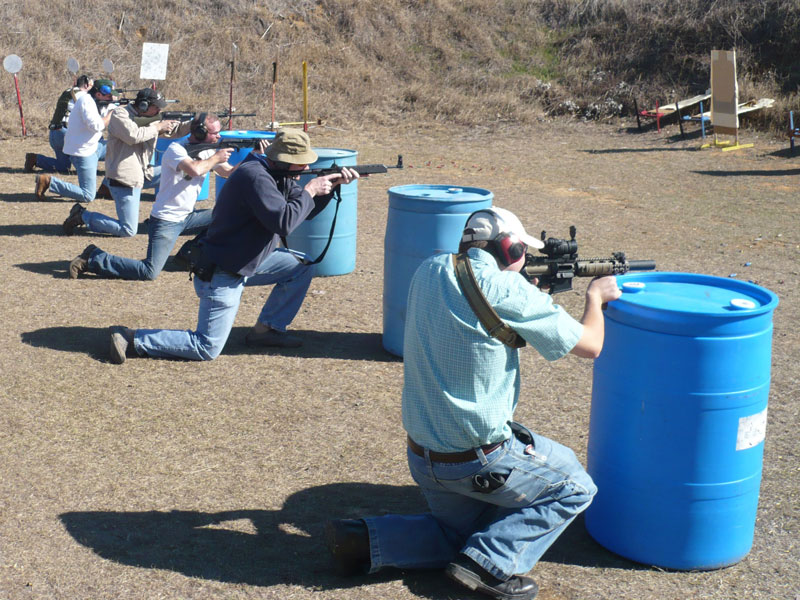
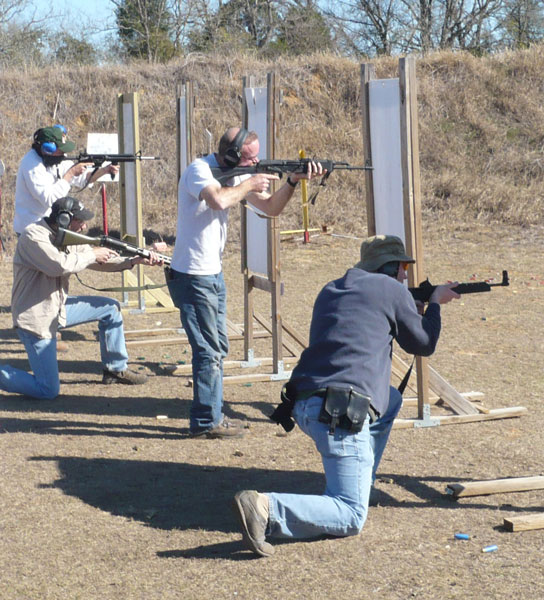
The intent of the course is to lay the foundation for the use of a long gun in a defensive manner. While many such courses are about “defensive shotgunning” or “defensive carbine”, this course is unique in that it’s about the use of any long gun: rifle, shotgun, or pistol caliber carbine. The basic principles are the same regardless of the particular firearm: presentation, rapid acquisition of sight picture (cleardistinctfrontsightpost-press-cleardistinctfrontsightpost), shooting from standing, shooting from kneeling, shooting around barriers, shooting distances of 3-25 yards, cover, movement. Another nice thing about having any sort of long gun in the class is that you get to see the effects of other long guns. For instance, shotguns are wicked things but as the distance to the target increases it becomes difficult to control where every pellet lands (e.g. at 25 yards, maybe you’ll need to use a slug). Or as well, using an AR, where the sights are very high above the bore, when shooting at close ranges you really have to compensate with holdover. The class gives you an opportunity to not only pick up skills with your choice of long gun, but it also gives you a chance to see how other long guns fare in the same contexts, learn the strengths and weaknesses of each. The class does teach some specifics about particular long guns (e.g. good techniques for shotgun reloading), but for the most part you realize that the principles are the same.

The “defensive” aspect is using the long gun for self-defense (i.e. this isn’t a gunfighting course, this isn’t military training). The course is aimed for situations such as home-defense, or maybe you’ve got a lot of land and need to be mindful as you’re out working on your property (people in Texas can have vast acreage). There’s time taken in the course to talk about tactics, situations, mindset, law and legal implications.

One other thing that I appreciate about KR Training’s classes (mostly in the more advanced courses) is the use of FoF — Force On Force. This is using things like AirSoft guns with safety gear, which allows us to actually shoot each other. The purpose is to role play, to be in scenarios. It’s realistic training, and any martial artist can tell you that training “alive” is the best way to train. What I like about such training is it’s open-ended: you get put into a situation, you have to figure how to get out — and the answer often doesn’t involve shooting anyone. It enables you to be in as close to a real situation as possible, but no one gets hurt; in fact, usually what gets hurt is your ego (that’s fine). This is the time and place to make mistakes and learn from them, in a forgiving learning environment. I find these situations to be the most humbling and best ways to learn. It’s a shame I cannot take KR’s AT-2 Class on Feb. 28. If you can, you should.

Anyways, some pictures from the Defensive Long Gun Class were just posted. Here’s a couple with me in them:

KR Training Defensive Long Gun 2009 Class - Students shooting from kneeling

KR Training Defensive Long Gun 2009 Class - Students shooting from kneeling

KR Training Defensive Long Gun 2009 Class - Students shooting around cover

KR Training Defensive Long Gun 2009 Class - Students shooting around cover

I have to say, all of this has entered into changing my choice of home defensive firearm.

Maek Chi Ki

The first “dynamic” technique you learn in Kuk Sool is called Maek Chi Ki:

The set is about hand strikes to particular points. Some are pressure points, some are not; the intent is to hit places on the body where you can do the most damage. For instance, strikes to the temple, strikes to the side of the neck (jugular vein), soft cavities. When people say “hit him in the face”, that’s not specific enough. Side of the jaw? chin? to the nose (and then upwards, into, downwards?), temple, crown, ears. Learn to go for specific places, increasing your chance of hitting them and doing maximum damage.

Now, no one attacks this way (with a kick and punch), but as a teaching tool it strives to help teach distance, timing, footwork, movement, blocking, avoiding. While the set seems very simple, it’s one well worth practicing over and over, working to get as fast as possible while staying highly accurate.

One interesting thing about this particular presentation of the set is the contents of the set. As Maek Chi Ki is taught today, the set differs in about half of the strikes/techniques. What the video shows is an old version of the set, and if you have a copy of Dr. He-Young Kimm’s Kuk Sool book, you’ll see his version is the same as what’s shown in the video. I don’t know when or why the set changed, but it did. IMHO, there’s merit in both. Take a look around the 1:41 point in the video (after the 4-knuckle strike to the windpipe). The two techniques at that point in the video are single-hand techniques: same hand blocks then strikes. I’m unaware of any modern technique in Kuk Sool that formally teaches that.

Self-Defense Acronyms

Hecate ponders about betting your life. She makes many valid points about self-defense and personal responsibility, the biggest of which is that self-defense is your own responsibility.

Like anything we must learn, ways and tricks to help us learn and retain the information is useful. One learning technique is using acronyms. Hecate’s article points out a couple and I wanted to add a couple more.

Continue reading