This should not be a surprise

A survey conducted by researchers from Duke University and the University of Chicago found that Chicago criminals obtained their firearms almost exclusively from friends and family.

Wait. I thought they got them all through the “gun show loophole”? Or that they got them through proper legal commerce (including 4473 form and background check) down at the sporting goods store.

The study found that due to fears of encountering undercover police officers attempting sting operations, a large majority of the criminals surveyed would only make illegal gun purchases from people they knew. “In discussing the underground gun market in their neighborhoods, most respondents emphasized the importance of connections—prior relationships that could create sufficient trust to reassure the seller that the transaction would not create an unacceptable legal risk,” the survey says. “A majority of the primary guns (40 of the 48 for which we have detailed information on the source) were obtained from family, fellow gang members, or other social connections; the fraction is still higher for secondary guns.”

Wait. This goes against everything I’ve been told about how criminals acquire guns.

But surely then they must be acquiring “assault weapons”.

The survey also found that criminals preferred handguns by a wide margin.

Um…. but….

Well, this has to be somewhere like Texas.

Chicago criminals are finicky about how they get their guns, according to a new study by the University of Chicago Crime Lab.

But Chicago has some of the toughest gun control legislation. Are you saying criminals don’t obey the law?

Well, it doesn’t matter. We still need to make things more illegaller, because (somehow) that will stop criminals from getting guns.

“Some of the pathways people are concerned about don’t seem so dominant,” [Harold Pollack, co-director of University of Chicago Crime Lab] said.

But… but…

Look folks, most any reasonable person in our society wants to see reduction in (negative) violence. What some of us have a problem with is the means by which to achieve that end. When you work to make legal pathways for obtaining guns more difficult to traverse, you are only harming law-abiding citizens – you are NOT preventing criminals from obtaining guns, you are not stopping criminals from partaking in illegal and/or violent activity.

The only people you are harming are good people.

Why are you doing that?

Either you don’t know any better and haven’t truly considered the consequences of your action, or your blindly following irrational thoughts or emotions… or harming good people is precisely what you want to do. And that, good people will not stand for.

But I prefer to think most of my fellow citizens are also good people. So folks, consider the hard data these researchers are providing. “Illegal guns” don’t come from where you think, and trotting out the same tired and failed “solutions” to “the problems of illegal guns, and ‘gun violence'” just doesn’t hold in the face of such evidence. Let’s use facts and data to help us find real solutions, shall we?

(first article, second article)

Updated 2015-09-05 – Here’s a link to the University of Chicago Crime Lab’s press release about the article.  And here’s a link to the full paper.

6 signs you’re getting bad advice

Oh ye Internet, how you are full of information both good and bad. And how much more difficult is it to sort the wheat from the chaff when groups you’d hope would know better perpetuate bad information. Yeah maybe it’s all well-intended, but remember what the road to Hell is paved with.

So this article: 6 Signs You’re Using The Wrong CCW Handgun is more like 6 signs you’re getting bad advice.

1. Size

Yes, you should be comfortable with the size of your handgun in terms of hold, grip, shoot, proper trigger finger placement. It’s called proper gun fit. That much is true.

But bigger pistols have more accuracy because of their fit and reduced recoil? Um, no. Bigger pistols can be more accurate because they can have a longer sight radius. The article gives a nod to the longer sight radius, but incorrectly attributes how things work.

Yes a smaller gun can be more handy with regards to carry itself: less weight, smaller is easier to conceal. But why are you carrying a gun? So you can have a little lead and steel weight dangling off your body at all times? Or because you feel you may need to draw and shoot to preserve your life? Smaller guns are harder to shoot. Size matters, but ability to perform and handle the critical task matters more.

2. Caliber

Smaller calibers mean less recoil, faster and more accuracy. Larger calibers will inflict more energy and damage.

Say what? Smaller calibers are more accurate? Can someone explain to me how bullet diameter enables greater accuracy?

Larger calibers inflict more energy and damage. Really? I mean, 9mm and .45 ACP suck about the same. And .223 Remington and .308 Winchester are smaller calibers than .45 ACP, but they sure inflict more damage.

If you’re looking for fast follow-up shots and more chances of accuracy, then perhaps starting off or switching to something small might help. If you need something with a lot of force and penetration, then definitely look into the larger calibers.

Well, sorta. Yeah, if there’s less recoil it will enable faster follow-up shots because there’s simply less time with the gun off target (off in recoil-land). But needs lots of force and penetration? um.. maybe you should spend a little time looking into ballistics data.

There’s so much wrong here.

3. Accuracy

your accuracy could suffer because of poor compatibility between you and your gun

True. We see this a lot in classes,  often because students have guns that do not fit them. Someone with small hands trying to shoot a Sig P226, and it doesn’t work. Give them something like an M&P with the small backstrap and suddenly they can hit everything.

But that’s not how the article goes.

if you notice that you are lacking either point shoot or sighted accuracy, maybe it is because the gun is too heavy, too big in size, too big in caliber, etc.

Maybe. But did you ever think that maybe the problem is you?

Why is there no discussion of maybe you just not having the skill? That maybe you should seek professional instruction? That the eyes of an experienced person can better diagnose the problems and guide you to an optimal solution.

4. Recoil

if after time, the recoil is still slowing you down and not allowing you to have quick, more accurate follow-up shots, then this could be a sign to find something different (maybe even something smaller than what you normally carry).

Maybe. But again this is rarely the case. Most often recoil problems are technique problems, not gun problems. Again, seek professional instruction.

5. Bullets & Accessories

Bullets play a big role on choosing the right firearm for yourself. There are no perfect bullet types and every sort of bullet will have its pros and cons. The question is whether or not the type of bullet gives you as the individual carrier more pros. Important things to consider with your bullets: weight, penetration, energy, shape, projection and distance, and more.

I have no idea how this relates to the topic of the article. I have no idea what the author is trying to convey here.

How does FMJ vs. HP or a round nose vs. a flat nose matter in this context? in choosing the right firearm for yourself? Granted, make sure the gun can feed the ammo, but apart from that, I’m confused.

6. Maintenance

I’ll grant, if your gun is so finicky that it needs to be cleaned after a few hundred rounds in order to operate right, then you need a different gun. Yes yes, some guns are this way and rightly so, but for the purposes of personal defense? Man, get a Glock or M&P and be done with it. This isn’t to say you can ignore and neglect things (your car won’t run very well if you don’t give it gas, change the oil, keep air in the tires, etc.), but there you go.

So ok… maybe it’s 5 signs of bad advice since I pretty much agree with #6.

Here’s the thing.

Equipment matters, but not for the reasons given in this article. What matters more and affects most the issues raised in this article more? The operator of the handgun. Get good instruction from good instructors. Put 10,000 rounds downrange in good classes. Put 100,000 reps of dry fire in. Put in a few good years of serious and dedicated study and practice. After that if you find your Glock 17/19 or M&P9 doesn’t fit your bill, then you’ll have the knowledge and experience to know how to tweak your equipment choices — and you’ll actually have the skill to back it up too.


The Handgun Sling? No. Just… no.

Just saw a promotional video for a new product called “The Handgun Sling”.

No, I’m not going to link to the product website as I don’t believe this product is a good idea; no point in driving traffic that way. You can Google/Bing/DuckDuckGo search for it if you’re curious enough.

But here’s the gist.

It’s a doubled-over length of cord. One end has a “coin tab”, the other has an 8mm tube. The instructional video shows the “holster” being placed in the small-of-the-back. You make a lark’s head knot around your belt (passing the tube end through the “loop” end of the coin-end). You then insert the tube into the muzzle of the gun and shove the gun into your pants at the small-of-your-back. You then loop the coin end around the back-end of the slide to hold it “firmly” in place. To draw, you have to reach around to the small of your back, attempt to locate this coin, lift it off and over the gun , then remove the gun from your pants.

Oh, and the video ends with this disclaimer:

The Handgun Sling is NOT a safety device nor does it claim to have any safety features. Failure to understand and comply with gun safety can result in property damage, bodily injury, or death.

So much facepalm.

Where to begin?

Small of the back is a horrible place to carry. I hope you don’t fall down or get knocked down, because your spine sure doesn’t think a lump of steel makes a good cushion. As well, it’s quite a difficult place to draw from. Not just issues of flexibility and mobility, but get into a clinch and try to draw. Or how about from under a coat?

Nothing to cover/protect the trigger.

When your heart is pumping and adrenaline dumping, you now need to find this little tab and lift it off and over the gun and THEN get a grip on the gun and THEN draw it? Yeah, good luck with that.

The gun is held in essentially a vertical position; that’s a difficult draw from that location. Due to how our body and arm physiology work (you know, angles), as things go around the body you want to have them angled in a position most natural for your hand to grip without having to bend your wrist into awkward positions. Try it. Grip a pen or pencil in your hand (to simulate gripping something, like a handgun) so you can see the relative angle of your grip as it runs perpendicular to your arm. Keep your wrist locked and orbit your arm around your body at your waist. Notice how that grip angle changes? at the small of your back that pencil is almost perpendicular to the ground (parallel to your spine). This “holster” positions the gun’s grip essentially opposite of that (parallel to the ground, perpendicular to your spine). Break your wrist position to make that sort of grip possible (you have to bend your wrist almost to its furthest extent). Sucks doesn’t it?

Also notice how this “small of the back” design runs counter to every other “small of the back” holster design. Not just the angle of the gun, but that the gun is “upside down”?  Why do you think all those other designs might be designed that way?

To holster the gun I have to put it out of my sight, fiddle fart with it, point the muzzle at my fingers and hand, shove things up the barrel… and then they want to display disclaimers about not following gun safety? You damn right it doesn’t have safety features; in fact, I dare say the features of this product require you to perform unsafe actions in order to use the product.

I could go on, but if the above isn’t enough to convince you this is a bad idea, well… do what you wish. It’s a free country, which includes the freedom to make bad choices.

I haven’t conferred with Karl on this, but I feel pretty safe in saying this sort of product won’t be allowed at KR Training. Certainly I won’t allow it in any class I’m a part of, as a teacher or a student.

Jerry Morris (inventor), this is nothing personal. If you read this, I know it may be hard to read this because it’s critical of your product, of your invention, of your baby. I do applaud your desire to innovate, to try new things, to be an entrepreneur. Certainly you have every right to sell your product. And I have every right to be critical of it. I also reserve the right to change my mind. Convince me your product isn’t a bad idea. Give some samples to Craig “SouthNarc” Douglas of Shivworks and see if this product holds up in ECQC classes. Give some samples to other notable trainers; heck, I’ll even be happy to try it myself in our Force-on-Force classes. Basically, if you believe this is truly useful and valuable life-safety equipment that offers greater advantage and less disadvantage to the private citizen that will lead towards a better ability for them to carry a gun on a daily basis and use it when their life depends on it, then put the product up to scrutiny and test it.

Here’s the thing. What problem is this product solving that is actually improving the world in some way? I’m just not seeing it. I see this product having greater potential for harm than good. Not just the fact you have to violate basic gun safety runs in order to use the product, but the fact it seem to complicate the single most important thing you need to do when you need your gun (draw and present it), I just don’t see how this product is a good thing.

I’m willing to be proven wrong tho.

NAA Guardian .32 ACP – first shots

It was a lucky find.

I’ve been intrigued by things like the Seecamp LWS32 and North American Arms Guardian for some time. Why? Just because. They’re so tiny, about the smallest “practical” semi-auto pistols you can buy and use for personal defense. But it’s not been a serious obsession or anything, just a passing interest.

But when I was out in Kerrville, TX last weekend with some extended family, one of them took me to a pawn shop. I don’t frequent pawn shops (just not my habit), but on this day I’m glad I did because right there in the case was a NAA Guardian .32 ACP.

I bought it on the spot.

Why?

My interest in guns started with personal defense, and that remains my primary motivator. Sure, my first purchase was a small gun, a Springfield XD-9 Subcompact. Well, it was a mistake purchase because small guns are hard to shoot and shoot well, which really works against someone learning how to shoot, build competence, and gain confidence. Shortly after I started, I ended up buying another gun, an XD-9 with the 5″ barrel, and things went much smoother. 🙂

While I prefer full-sized guns for a host of reasons, there’s no question small guns have their role. They are NOT a first choice, and probably not even a second or third choice, but sometimes they are the right tool for the job. I mean, I have a screwdriver that has a 24″ shaft, which I bought and used once because it was the needed tool for the job. You tend to be more successful when you use the right tool for the job, and being as a gun is merely a tool, you should use the right one for the job at hand. Sometimes, small is what you need.

For a while my small gun was a S&W 442 J-frame “snub-nose” revolver. There’s a lot of positive to such a choice, but after a few years of trying to make it work for me I came to accept that it just wasn’t the best choice for my needs. The S&W M&P Shield 9mm has worked out pretty well, but the Shield’s size is in an odd slot where it’s a little big for small jobs and a little small for big jobs. It does work and fills a fair role, but it’s still not always what’s needed.

I’ve considered Kahr’s for a long time, like a PM9/MK9 or maybe a CM9, and frankly during my shopping in Kerrville I did look for one of these Kahrs and may well have bought it if one was available. Alas, the only Kahrs they had at the couple places we went to were other calibers or larger sizes.

But then, the NAA Guardian came up, and I figured what the hey, why not?

It’s a (very) small gun for when you need that. I’ve had a few times in life where I’ve had to go somewhere and wanted the smallest possible gun I could legally carry. I made do with what I had, but still wished for something smaller. And now, perhaps I have it.

Plus why this particular gun? As an instructor, we get people asking all sorts of questions, and it’s often useful to give tangible answers. Being able to have such a gun on hand to let people handle, shoot, and see first-hand why we might answer as we do – it enables people to convince themselves, which is far more educational and persuasive than saying “just trust us”.

As well, it’s simple novelty, and “just because”. It’s the first time I’ve seen one for sale (tho maybe if I got out more I might have seen one sooner), so I figured I better buy while I can. 🙂

The Gun

The NAA Guardian was introduced in 1997. If you search around for those “mouse gun comparison charts” is one of the smallest around. This version, in .32 ACP (not .32 NAA), is all steel, DAO, holds 6+1, barrel 2.49″, OAL 4.4″, 3.3″ tall, 0.85″ wide, 13.6 oz empty and 16 oz full.

That’s small.
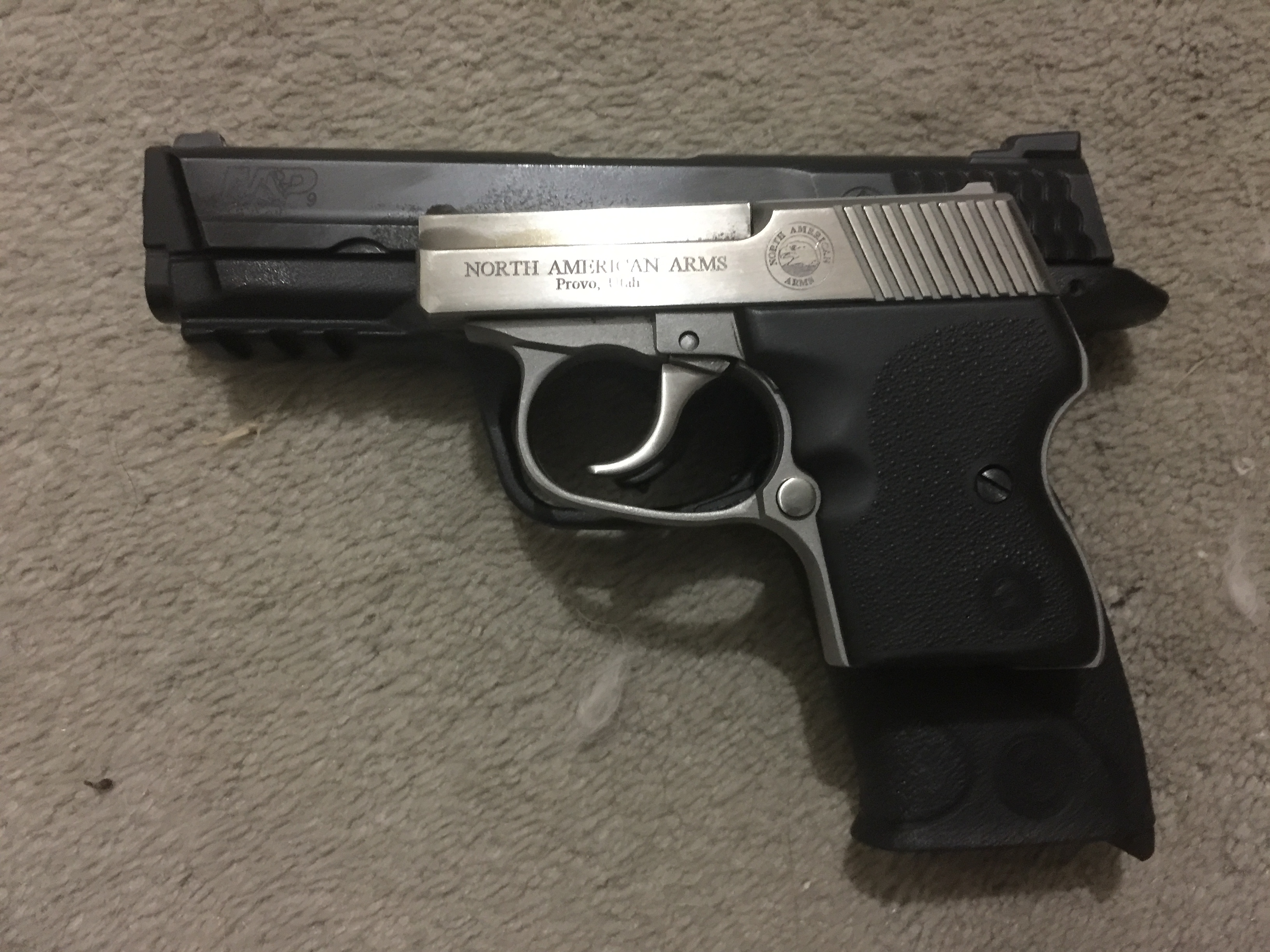
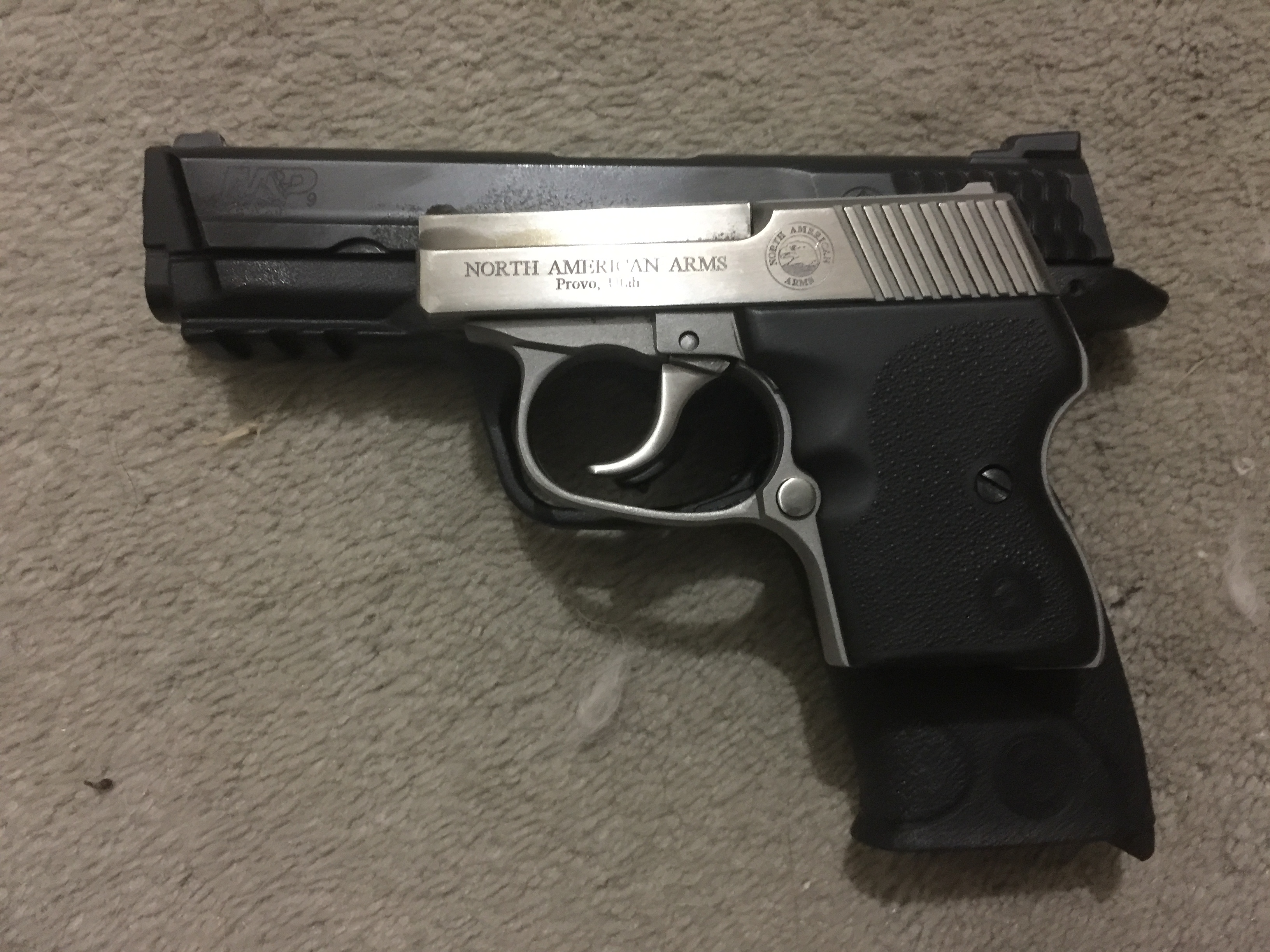
NAA Guardian .32 ACP vs. S&W M&P9

So small that most people can only get 1 finger on the grip, with your ring and pinky fingers dangling off. Yeah, that’s a bit of a problem. Good luck getting that 2-handed grip on it. 🙂

This particular gun seems to be on the older side. I’ve emailed NAA asking questions, but as of this writing I’ve yet to hear back. I’m curious about the gun because it does seem older. For example, the 2 magazines are all metal, whereas the new production magazines have plastic baseplates. Some other details make me wonder about the history here, but I’ll save that for another time.

Overall it seemed to be in good shape. Obviously fired, but reasonably maintained.

Then there’s .32 ACP. Yeah… it’s not the best cartridge. If you’re curious about .32 ACP, search around as there’s lots of information out there. But long-short made relevant here? It seems the best choice is loads with Hornady XTP bullets, as they will have reasonable penetration AND will expand. Is it still great performance? Nope; I still consider it sub-optimal. But it’s not the worst thing in the world, and it’s better than nothing.

You just have to remember that it’s all about trade-offs. This is not a gun of first choice, or even second or fifth choice – this is a gun of “no other choice”.

First Shots

Before I took it to the range I took it apart to clean and oil it. Yeah, it was dirty, and I could also tell… old. The recoil springs were old. Still, I cleaned what I could, oiled it up well, and put it back together. The fact it lacks any way to lock the slide back is a little annoying, but it’s what it is.

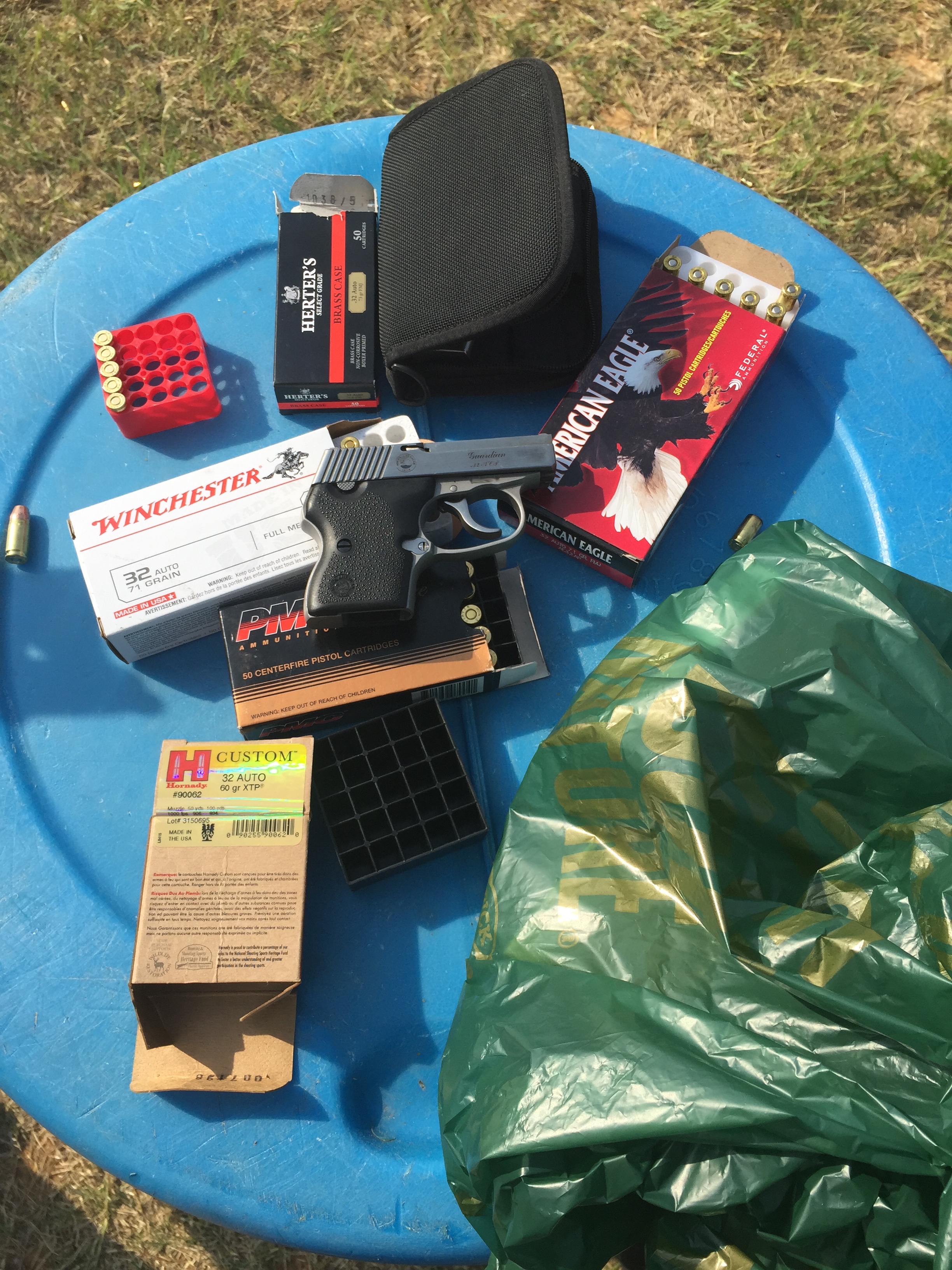
I purchased single boxes of a variety of ammo:

  • Federal American Eagle 71 grain FMJ
  • Herter’s 73 grain FMJ
  • Winchester “white box” 71 grain
  • PMC 71 grain FMJ
  • Hornady’s “Custom” 60 grain with the XTP bulet (2 boxes)

Ran through all 250 rounds between myself, a friend, and Oldest. Here’s how it went.

There were numerous malfunctions, mostly failures to feed. Sometimes the last round would stovepipe in the magazine, sometimes it might start feeding then the slide closed and things munged up. Considering how and when it would happen (many times the last round in the magazine), that it happened with all ammo types, under various shooting circumstances, best we can figure is old springs. The magazines are likely original springs, and given the gun uses the upward pressure of the magazine as the ejection mechanism, it’s likely that. So I’m going to purchase some new magazines (and new recoil springs) and try again. If it continues to malfunction after that, then it’s off to the gunsmith. If it continues to malfunction after that, then it becomes a conversation piece. Certainly at this point I do not trust the gun for personal protection.

The inability to lock the slide back? That’s a major hamper when it comes to clearing the malfunctions. I reckon any malfunctions or reload needs here will be better served by dropping this gun and drawing a second gun, which you’re unlikely to have if you’ve been pressed into having to carry this gun in the first place. :-\

Overall tho, all ammo performed fairly well. The Herter’s had noticeably more felt recoil than the others. But regardless of bullet shape – and they were all different – all either fed or malfunctioned the same. I could detect no pattern of success or failure, so likely in the future practice ammo purchases will be “whatever is cheapest”.

Felt recoil wasn’t as bad as I thought it would be. I expected some bite, but didn’t get it. Would I want to do a 1000 round weekend class with it? Probably not (and not just because felt recoil). But something like KR Training’s Defensive Pistol Skills – Back Up Gun (4 hours, 150-200 rounds) oh sure. I will say tho, a couple times we gripped the gun up higher than it should be gripped and the felt recoil was greater and hurt a little bit. Will have to see how that pans out in reality in terms of quick drawing.

We did no draw work, tho I did get lucky and found a DeSantis Nemesis at Cabela’s (hrm.. I wonder if I can get a Safariland ALS for it so I can open carry it come January 2016… that’s a joke, folks). Everything was from the ready position. At this point it was just trying to determine if the gun was reliable enough, if and what any issues were, what ammo would it consume, and just how it ran and felt.

Some stuff was slow fire. I was surprised at the accuracy. We were shooting a 8″ steel plate at probably 15 yards and had no problems when using the “sights”. Yes, “sights” in quotes because it does have some bumpy things up there, but I doubt you’ll ever use them in a fight because they are hard to find and use (tiny tiny, hard to find, hard to determine “equal height, equal light”). Shots did land slightly right, and it was easy to see why. The barrel and frame are 1 piece, with the front sight is on the barrel; the rear sight is on the slide. The slide locks up fine, but looking at the rib that runs the length of the top of the gun, you can see the slide isn’t perfectly square on lockup. Bug or feature? I don’t know, and maybe new recoil springs will help. But because of that the sights don’t line up mechanically, so when you visually line them up the muzzle points a little to the right. Still, the groupings were tight and consistent, and I was pleasantly surprised.

Still, what made it a bitch to shoot right and well was the fact it was a 1 lb. gun with long heavy trigger press. The manufacturer states it has a 10 lb. trigger press! I went looking for Karl’s digital gauge but couldn’t find it, just an old spring one. The spring one’s scale topped at 8 lb. but it looked like the gauge could go to 10 lb. before it bottomed out. Well, it’s at least that then, because it wasn’t until it bottomed out that I could get the trigger to break. Could be the gauge had weak/old springs, so I don’t know how accurate it all was, but it’s reasonable to say it’s got a damn heavy trigger.

So consider that: a very tiny gun which is hard enough to get a good grip on, to have good “gun fit” and a proper trigger press. Then you have a pull weight that’s 10x the weight of the gun. Yeah, it’s going to be DAMN hard to shoot well.

Of course we tried some fast stuff, because this isn’t a bullseye gun. This is a personal defense gun that’s likely going to be shot from 0-5 yards, quickly, multiple rounds. On the one hand, the lack of proper sights can be ok there because at that distance and speed an index off the slide is reasonable. Dumping magazines as quick as we could landed just fine on a 18″x24″ steel plate at 10 yards. But that’s still not awesome. Certainly we had times when we’d shoot and not hear the DING of the steel — it’s very easy to get unacceptable hits with this gun. I didn’t take any cardboard out to see how it’d perform, but that wasn’t the point of the day. Still, once I get the new magazines and springs, I’ll give it a full run through (like doing the DPS-BUG class drills, maybe just running “3 Seconds or Less“). Again, this day was about seeing if the gun would just run.

All in all tho, I was pleasantly surprised with the gun. It performed better than I thought it would, and was much more enjoyable to shoot than I expected it to be. The fact ammo is rather expensive (it’s more than 9mm) hurts, so I don’t think I’ll be shooting it all that often. But still, I think it’s going to find a place.

What’s Next?

Next up is buying magazines and springs, then another round of testing. That testing will be just to see if the gun runs and how it runs with new springs, and I plan to do more structured shooting. Some simple “just does it work?” shooting. Some slow accuracy, and certainly some proper and appropriate drills on paper (e.g. “3 Seconds or Less” drill).

Buying magazines and parts, seems I have to go to the manufacturer, which is fine. I just hope they’re more responsive with the sales than they seem to be so far with customer service questions.

When it comes to ammo, the only loads I can find with the XTP bullet are Hornady’s own load and the Buffalo Bore. I expect the BB would hurt like hell. 😉  But it does document 943 fps out of a 2″ Seecamp barrel and 1080 out of a 3″, so maye 1000 out of the 2.5″ Guardian, which would be quite good. Other .32 ACP loads where I can find info on tend to be 1000-ish out of a 4″ barrel so…. I’m going to pick up at least 1 box of the BB to see how it goes. Otherwise for practice ammo, whatever is cheapest. I see MidwayUSA has Fiocchi 73 grain FMJ for $15.49, cheapest stuff available so…

Anyways, time to do a little shopping. 🙂

KR Training August 2015 newsletter

The KR Training August 2015 newsletter is up.

To me, the high points are some upcoming classes, such as Tom Givens doing his Combative Pistol 2 — excellent class. But also? There’s a lot of stuff for 2016 already taking shape. You should check it out and get in on things before they sell out (because they do).

See you at the range!

Again, “unarmed” doesn’t equate to “not dangerous”

[Christy] Mack’s injuries included 10 broken bones, a broken nose, missing and broken teeth, a fractured rib and a severely ruptured liver from a kick to her side.

Typically when people use the term “unarmed”, they mean “doesn’t have a weapon” (knife, gun, baseball bat, screwdriver, hammer, crowbar, etc.). As if somehow that means the person couldn’t be dangerous, or couldn’t inflict severe bodily harm.

He allegedly forced her to strip naked and repeatedly punched and kicked her, breaking several of her teeth.

Look at her pictures:

That’s the sort of damage an “unarmed” person can inflict. And honestly, she’s lucky; I’ve seen worse damage at the hands of “unarmed” individuals.

So tell me again why you think “unarmed” means “not dangerous”?

(full story)

Sooner, not faster

I love it when I can refine and improve, especially when it enables me to become a better teacher since that enables others to refine and improve. Such a joyous cycle of betterment. 🙂

I often talk about how to “go faster without going faster“. It’s built upon concepts like performing simultaneous actions, being able to “change gears”, efficiency and economy of motion, and so on.

John Mosby (h/t Greg Ellifritz) makes a great refinement on the point of “going faster”:

The purpose of the snap drill is genuinely not about shooting “faster.” In the real world, shooting faster actually tends to have rather deleterious effects, like shooting the wrong fucking person, because you shot before you recognized that it was your 12-year old, and NOT a MS13 gunslinger.

Our goal is to shoot “sooner.” What’s the difference? Shooting sooner is about working the problem correctly, and only making legitimate shots, as soon as possible. That requires more than a fast target acquisition and a quick trigger finger though. It involves knowing and understanding what the parameters are that allow for a legitimate shot, in your circumstances, and then—and ONLY THEN—breaking a FAST, ACCURATE shot. Being able to recognize what is “precise enough,” and then delivering it “fast enough,” wil allow you to shoot sooner, AFTER the decision-making process has allowed you to positively identify your target as a legitimate target.

The time metric just forces you to accept “accurate enough,” instead of pushing for “precision.”

That’s an excellent distinction.

Granted, sometimes discussion has to be about “faster”, but “sooner” is a related concept with overlapping but also unique qualities.

Well-worth understanding the difference, and when each should be called for.

Data regarding U.S. concealed carry permit holders

John Lott, Jr., John Whitley, and Rebekah Riley just published a paper examining Concealed Carry Permit Holders Across the United States.

The abstract contains relevant statistics:

Since President Obama’s election the number of concealed handgun permits has soared, growing from 4.6 million in 2007 to over 12.8 million this year [2015]. Among the findings in our report:
— The number of concealed handgun permits is increasing at an ever- increasing rate. Over the past year, 1.7 million additional new permits have been issued – a 15.4% increase in just one single year. This is the largest ever single-year increase in the number of concealed handgun permits.
— 5.2% of the total adult population has a permit.
— Five states now have more than 10% of their adult population with concealed handgun permits.
— In ten states, a permit is no longer required to carry in all or virtually all of the state. This is a major reason why legal carrying handguns is growing so much faster than the number of permits.
— Since 2007, permits for women has increased by 270% and for men by 156%.
— Some evidence suggests that permit holding by minorities is increasing more than twice as fast as for whites.
— Between 2007 and 2014, murder rates have fallen from 5.6 to 4.2 (preliminary estimates) per 100,000. This represents a 25% drop in the murder rate at the same time that the percentage of the adult population with permits soared by 156%. Overall violent crime also fell by 25 percent over that period of time.
— States with the largest increase in permits have seen the largest relative drops in murder rates.
— Concealed handgun permit holders are extremely law-abiding. In Florida and Texas, permit holders are convicted of misdemeanors or felonies at one-sixth the rate that police officers are convicted.

One thing to note is the number of carriers is likely higher, because with no permit required to carry in 1/5 of our states, there’s no means of tracking and collecting such data. In a weird way, it’s one reason I like the permitting process, because data like this is useful.

Other things that jump out at me:

The largest growth is with “minorities”, that is, racial minorities and women. Just a few days ago I touched on the rapid growth of gun ownership and concealed carry amongst blacks in the US. Those who wish to see improvements in civil rights and equality for minorities must understand the vital role gun ownership has always played in that movement.

Permits go up, murder (and violent crime) rates go down. States with the largest increase in permits also see the largest drop in murder rates. I’m not saying correlation equals causation, but it’s sure something to think about.

As a permit holder in Texas, I’ve known that we permit holders are generally more law-abiding than the un-permitted citizenry. Since 1996, the Texas Department of Public Safety (who oversees the Texas Concealed Handgun Licensing process) has released reports of the number of CHL holders with convictions versus the entire Texas population with convictions. CHL holders are quite law-abiding. Which should be no surprise given the great lengths we have to go through to obtain and maintain not just a gun but the CHL itself.

But all this data probably doesn’t matter. These days data, logic, and reason aren’t as important as someone’s feelings.

Unconventional practice

What do you do when you practice?

Do you practice the good stuff? The easy stuff?

You may be wiser and realize the best thing to practice is the stuff you suck at; to address your weaknesses because that’s the only way to convert them into strengths.

But how much time do you put into the unconventional?

This hit me the other day.

I’ve been fairly regular with my dry fire practice, but my dry practice has been “conventional”. I practice Wall Drills. I practice the press-out. I practice drawing from my concealment holster. I practice reloads and malfunctions. I practice two-hands, strong-hand-only (SHO), and weak-hand-only (WHO). I do all the conventional stuff, especially what I suck at (WHO).

But then the other day I realized I haven’t been practicing the unconventional. I realized this because I found myself in an unconventional situation (nothing bad, but just enough of a situation to make light the bulb above my head).

For example, my concealment draw typically involves my left hand reaching around to my right side, yanking up my shirt, then my right hand goes to draw.

But what if I don’t have my left hand?

What if I have to use only my right hand to make everything go?

Or… what if I only have my left hand to make everything go?

Unconventional.

Now, this isn’t to say we need to make addressing the unconventional a staple of our practice. However, it’s worthwhile to consider and work on these things every so often, at least so that the first time you have to do it isn’t when you need it.

The changing face of gun ownership

Did you know African-American support for gun ownership and carrying firearms for self-defense is at an all-time high?

Members of Larry Cook’s church in Minnesota, an all-black congregation, carry guns and provide protection to the pastor and church members. They’ve had threats, and Charleston provides a reminder.

Detroit’s Chief of Police, James Craig (who is black) tells NPR:

Police chiefs usually don’t like the idea of citizens carrying concealed guns for self-defense, but Craig says he had to be realistic about the situation in his hometown.

“It was a well-known fact here in Detroit,” he says. “People didn’t have a lot of confidence that when they dialed 911, that the police were going to show up. In fact, we know they didn’t.”

So he endorsed a trend that was already well under way — the trend toward more people carrying legal guns.

The same NPR article reports:

According to a survey by the Pew Research Center, 54 percent of blacks now see gun ownership as a good thing, something more likely to protect than harm. That’s up from 29 percent just two years ago. In places like Detroit, more African-Americans are getting permits to carry concealed weapons.

And again, more pastors are encouraging carrying in vulnerable places like churches:

Detroiters are even taking their guns to church. When Rosedale Park Baptist had trouble with drug dealers and car thefts, Pastor Haman Cross Jr. told his congregants from the pulpit that they should consider getting concealed-carry permits.

“I love the Lord; I’m a Christian,” he says. “But like I told the congregation, let’s send a message right in front. I want the word out in the community, if you steal any of our cars, I’m coming after you.”

At another black church, Greater St. Matthew Baptist, Pastor David Bullock points out the pews that where his armed congregants usually sit.

“The chairman of my deacon board, he carries,” Bullock says. “And then on the west side, there’s a middle-aged woman who also carries.”

Self-defense is a basic human right.