On a home defense tool – part 3

If you have not read “On a home defense tool” (part 1) I suggest you go back and read that first. After reading that, you should then read part 2, then come back and read this part 3.


While some may discount The Box O’ Truth (e.g. exactly how scientific is it), there’s still some merit in what was presented — it’s still food for thought, especially regarding things like buckshot patterning. So on the topic of ammo, not only do we want something good enough to stop the bad guys, but we also want something that minimizes risk of over-penetration especially in a home-defense situation.

The reality is, if you want it to penetrate the bad guy enough to make them stop, it’s going to have some risk of over-penetration (e.g. ability to go through common household walls). But depending on your ammo choice you can have greater or reduced issues to deal with.

So let’s see what one of the top resources has to say about choice in .223 ammo. Or from Troy & Dr. Gary Roberts. Now granted, what they write there is .223/5.56x45mm specific, but based on part 1 and part 2 of this series you can see where my bias lies. Nevertheless, let’s look at what Dr. Gary Roberts, LCDR, USNR, Stanford University Medical Center. Dr. Roberts has performed much published research into this matter and is a well-respected man in this field.

Given the widespread availability of this information for over a decade, I am shockingly surprised to read about the “overpenetration” with “high powered assault rifles”. In this day and age anyone who is spouting this BS needs to be horsewhipped… Several respected organizations have done structural wall testing, including the FBI, CHP, and IWBA. In our IWBA and CHP testing, replicas of standard construction interior walls were fabricated using two pieces of 1/2″ thick dry wall cut in 12″ x 24″ segments and mounted four inches apart using 2 x 4″ fir studs and 1.5″ dry wall screws. Five rounds of each load were first fired into bare gelatin to serve as controls. Then 5 shots of each load were shot through interior wall segments into gelatin blocks placed a set distance behind the intermediate barriers–various distances have been tested, typically ranging from 1 to 10 feet.

Generally, common service caliber JHP bullets failed to expand and had very deep, excessive penetration after passing through the interior wall, due to plugging of the hollow point. With the hollow point plugged, the bullets performed nearly identically to FMJ pistol bullets. The terminal performance of the 12 ga. 00 buckshot and slugs was not altered by passing through interior wall replicas, with penetration and deformation nearly identical with their performance in bare gelatin. Likewise, .308 rounds were not usually effected by the presence of an interior wall intermediate barrier.

With one exception, the majority of the 5.56 mm/.223 loads, including M855 62 gr “green-tip” FMJ, which were fired through interior walls demonstrated either minimal changes in terminal performance compared with bare gelatin or reduced penetration. The major exception were 55 gr M193 style FMJ projectiles which exhibited minimal fragmentation and deformation after first passing through interior wall replicas and hence penetrated deeper than in bare gel. Since all of the 5.56 mm/.223 bullets fired through the interior wall had significantly less penetration than 9 mm, .40 S&W, .45 ACP, and 12 ga. shotgun projectiles which were fired through an interior wall, stray 5.56 mm/.223 bullets seem to offer a reduced risk of injuring innocent bystanders and an inherent reduced risk of civil litigation in situations where bullets miss their intended target and enter or exit structures. As such, 5.56mm/.223 caliber weapons may be safer to use in CQB situations and crowded urban environments than service caliber handguns or 12 ga. weapons.

Obviously, it is important to keep in mind that purpose built barrier blind 5.56 mm/.223 projectiles, such as the 55 & 62 gr Federal Tactical JSP’s and the Nosler 60 gr Partition, will offer deeper penetration than fragmenting designs and may exit.
 

So as you can see, there’s something to be said for 5.56/.223 loads in a home-defense situation. And what fires those loads? Generally, rifles. And what’s generally going to be a better rifle for a home-defense situation, with corners, narrow hallways, darkened rooms? Your AR-style platform, or perhaps an “M4-gery” because it’s a bit more compact.

While ammo selection is certainly important, while your choice of hardware is certainly important, I’d argue there’s something more important: a proper warrior mindset combined with proper training/instruction and practice.
 

Continue to Part 4.

On a home defense tool – part 2

If you have not read the first part of On a home defense tool, you should read that first so the following has context and makes more sense.

The following comes from John Holschen. The words and such are John’s, I’ve merely reformatted for HTML.

I’d like to share a few thoughts considering defensive long guns for your consideration.

I’ll start out by saying that a shotgun is my last choice to procure for employment as a defensive long gun. This is because:

  1. It is heavy.
  2. It’s manual of arms is relatively complex.
  3. It’s recoil is more difficult to manage for quick follow up shots (as might be required for multiple threats).
  4. It’s ammunition supply is relatively limited (this is not a critical factor in a typical home defense situation but it could become one in case of large scale civil disturbance).

Many people believe these drawbacks are offset due to various factors (which I believe are largely misconceptions), such as:

  1. “You don’t have to aim a shotgun just point it in the direction of the bad guy and pull the trigger.” (This is often an allusion to the fact that an untrained person will be using the shotgun.)
    • Reality – At the “across the room” distances likely to be found in most houses the shot column has not opened up significantly (especially with “Buck” sized shot.) Therefore you must aim.
    • Reality — Due to numbers 2 and 3 above, the shotgun actually requires more training for many/most people to shoot well when compared to a rifle.
    • Reality — The very people that would benefit most from additional training (those with small stature and/or less upper body strength) don’t want to train much with a shotgun because of the recoil and the weight.
  2. “Just the sound/appearance of a shotgun with dissuade attackers.”
    • Reality — In many situations it will not be tactically feasible to demonstrate either the sound or appearance of your weapon prior to using it.
    • Reality — Many/most bad guys aren’t switched-on enough for the type of gun you are using to even register with them.
    • And ultimately — I’m not willing to potentially decrease my effectiveness to potentially increase my bluffing power.
  3. “The shotgun is the most versatile defensive/survival weapon.”
    • Reality — Yes it is versatile; if by that you mean you could use it to hunt birds and up to deer sized game animals with the right loads. However, I suggest that people make an honest assessment of how likely it is that they will need to hunt birds with their primary defensive weapon. Also please keep in mind that versatility does have trade-offs as mentioned above. (I won’t even discuss gas rounds, bean-bag rounds, bird-bombs, Taser rounds, etc., other than to say that private citizens show not even consider these as factors in choosing their primary defensive weaponry).
  4. “The shotgun is less likely to over penetrate.”
    • Reality — A 5.56 mm rifle, with the proper ammunition, penetrates less through typical household construction than does 00 Buck.

I started by stating that the shotgun was my last choice to procure as a defensive weapon for my use. IT is even lower on my list of desired weapons for my wife and (adult) daughters to use. So what do I recommend for a defensive long gun? I suppose it will come as no surprise to most of you that my suggestions are:

  1. A semi-auto rifle (read AR)
  2. A semi-auto rifle (read AR)
  3. A semi-auto rifle (read AR)

If I absolutely could not have a semi-auto rifle I would rather have a pump-action rifle (or a lever action rifle) than a shotgun.

Just my (somewhat informed) opinions.

Again, let me state that these are merely opinions. However, they are informed opinions from people with solid backgrounds to shape those opinions. In the end, pick what is right for your situation and context, get training, practice, and be prepared.


Continue to Part 3.

The Real Story on So-Called “Assault Weapons”

You generally have more success to argue based on facts than emotion. So, let’s lay out the facts on these so-called “assault weapons.”

Brady Campaign, yes they are merely like hunting rifles. Go look at the actual mechanics of the action. Compare and contrast, look at actual firearms… we’ll wait.

And it’s not (just) about hunting. Maybe it’s about keeping my children safe.

(h/t to Ahab)

The S.P.E.A.R. Tactic

While my primary martial arts studies may be in the realm of a traditional empty-hand martial art, I certainly study and regard a wild body of fighting skills. Modern combatives are especially interesting to me, and one system I’m working to learn more about is Tony Blauer’s S.P.E.A.R. System™.

Mr. Blauer’s got a reprint of a nice introductory article to the S.P.E.A.R. concept on his website. Give it a read.

Keepin’ on

I’ve always found Xavier’s blog to be filled with good stuff… one of the better blogs overall out there.

Yesterday he writes about “On Keeping On Keeping On” and I have to agree with him. One reason I became an NRA Certified Instructor was to help people learn about firearms. I changed, I know others can too. It’s difficult to preach change to a large group and expect change to happen, but working one-on-one with folks you can speak directly to their needs, address their concerns. I won’t lie, I don’t bullshit; honesty is the only way to go about things. I’ll do my best to avoid politics, but there’s inheriently a political component to this. Still, by going one-on-one you can gauge the audience and tailor the message best (e.g. you can avoid politics unless asked; if they’re for sport, you can go that route; if they’re for self-defense you can go that route; etc.). If at the end of it all they’re not going to “see it my way” that’s ok… at least if they were willing to engage in the conversation, and that’s something. That they were willing to let a seed be sown, even if it doesn’t sprout today, maybe it will sometime later.

We cannot hold a grudge. We cannot let our anger be our driving force, especially if it closes us off. Not only does that make us look bad, but it won’t help bring new people into the fold. Think about it. If a sheep sees an angry dog bearing big teeth, it doesn’t matter if that angry dog is a wolf or a sheepdog — it’s still a big predator with teeth that the sheep is going to be afraid of and avoid. So you sheepdogs, think about how to win the trust of those sheep. How to better present yourself, how to better and honestly gain their trust and realize that we’re The Good Guys. And perhaps, just perhaps, be able to teach those sheep how to show some teeth as well.

Texas Concealed Carry on Campus bills introduced

Just read the word that SB 1164 and HB 1893 have been introduced to the Texas State Legislature.

If you live in Texas, contact your State Senator and State Representative and let them know your opinion on the matter.

Crime in downtown Austin

Overall, crime is low in Austin, but data is showing that crime is on the rise. Robbery, burglary, assault, rape… it’s all going up.

Austin Police Department of course believes the solution is more cops and surveillance cameras downtown. This isn’t going to stop crime, maybe only make it easier to clean up the mess and/or prosecute the crime after it’s been committed. 

Folks, the bottom line is simple: if you care about your safety, only you are responsible for it. While it’s nice if someone else can help you stay safe (additional layers), in the end only you can be guaranteed to be where you are when you need it.

Self-Defense for all

I’m in my mid-30’s. I’m a big guy (6’3″, 200#). I’m strong. I’m physically fit. I actively practice an empty-hand martial art.

One might argue that I’m able to take care of myself should someone attack me. Why should I need a gun to defend myself? Just knock ’em out with my fists or subdue them with a hold or something, right? Of course, that assumes that anyone would mess with big ugly me in the first place…. no one should mess with me, I don’t look like an easy target. Well, assumptions are fine, and I’m sure if I come across as food to some predator that I don’t come across as an easy target. But when there’s a pack of jackals about, they can take down a lion. Your biggest, baddest sport fighters lose a match now and again. No one is immune. But for the sake of argument, let’s say I am because of my state.

Is the world filled with people like me? No, not really. 

Look at Kellene. She admits to being 200 pounds, 5′ 2.5″, and out of shape. Does she not have a right to defend herself?

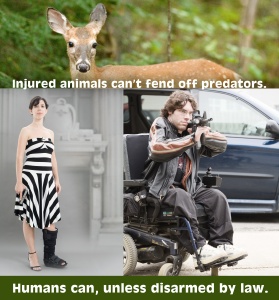
How about disabled folks? I see folks on motorized wheelchairs buzzing around town, but I always wonder what stops some degenerate from taking advantage of them?

How about the elderly? Is a big and fit 19 year old attacking a 75 year old man with a cane, hip replacement, and pacemaker really a fair fight?

Perhaps you could argue I don’t need a gun because I’m fairly equal or dominant by myself alone. I wouldn’t agree, because I know wolves travel in packs, because I am not so arrogant and blind as to think I’m invincible and “it could never happen to me”. What I would like you to explain to me how and why the above people, who don’t have the same advantages I do, should be denied an equalizer. Why should they be relegated to be weakened prey? Are their lives not important? They have every right to self-defense.

Block, Cover, Punch

One of the first movements you learn in Kuk Sool is “block, cover, punch” (others may call it something else, but that’s what we call it around our school). This isn’t some formalized technique, per se, but it is one of the first movements you learn. The white belt form, Ki Cho Hyung (translated: “Foundational/Fundamental Form”) makes this the first real movement you do with your  hands. Watch the following video:

He starts in a right-facing “offensive” stance. Turns to a long stance, performs a front kick and sets his leg down. Then at about 0:06 into the video you’ll see him use his right arm to block, left arm to cover, then right hand to punch. That’s the movement I’m talking about. Let’s break it down.

The motion starts with a block. The block itself guards your centerline, from your head/face down as long as your forearm is (perhaps mid-chest). This provides reasonable protection to your front and center. The block is also a sweeping inward movement, able to deflect, meet, or redirect an incoming attack.

The motion continues with a cover. The left arm is coming up horizontal to have left fingertips meet right elbow. This provides further cover to the lower portion of your body, perhaps guarding from uppercuts, or the left hand is in position to swing down to block attacks to even lower portions of the body. The combination of the block and cover puts you in a position of reasonable defense to your vital center. I’ll come back to talk about the movement portion of the cover in a moment.

The motion then ends with a punch. This is your (counter)attack. 

That’s the basics of the motion: block, cover, punch. Of course, what you see in the form is idealized/stylized, but the act of performing the movement over and over in forms practice helps to beat a well-worth neural pathway to create that so-called “muscle memory”. In fact, if you examine Kuk Sool’s forms, you’ll see this exact movement or slight variations are in every Kuk Sool form. I reckon there’s some merit to the movement if it’s worth doing so often. Let’s look at how this basic movement can be utilized.

One of the most common forms of attack is a haymaker, and for ease of discussion let’s assume you (the defender) are right handed and the attacker (throwing the haymaker) is throwing with the right hand. So visualize yourself standing, you and the attacker are facing each other, the attacker throws the haymaker. You can block. This receives the haymaker (to a point other than your head), intercepts the attack. You cover; while the initiation of the cover may not do anything, what it is doing is bringing your left hand/arm up from under the attacker’s arm. As you move the covering arm upwards (go back and watch the video and see how the covering arm moves upward ending with the left hand in front of the forehead), this works to move the attacker’s arm out of the way, opening him up and now giving the opening for your punch to hit home (e.g. his chin). That’s a very basic illustration, but it shows what this movement can do.

However, the movement doesn’t have to remain so stylized. For instance, as you cover, instead of the left arm just moving the attacker’s arm out of the way, the left arm could move up and left hand grab the attacker’s arm/hand. From there, you now have control over one of the attacker’s limbs and you could apply various joint locks or throws (I find Ki Bohn Soo #9 a nice follow-up). The punch could be a palm strike to the nose, or consider any of the Maek Chi Ki strikes. Instead of pulling the punch all the way back to the hip, just fire off the punch from where your right arm/hand came to rest after the block.  As well, this doesn’t just work against the right-handed haymaker; try working it from a right jab or cross. Try working it with a left-handed attack; in this case the cover and perhaps grab will close the attacker off (even better to prevent their further attack now that their back will be towards you), you can punch over their shoulder, or move to a lock such as an arm bar (think Ki Bohn Soo #6). Of course, you as well should practice this “left-handed”.

This basic movement of “block, cover, punch” is nothing fancy; in fact, it’s rather simple. It is one of the first movements introduced to a student of Kuk Sool, and given the timing and where/how it’s introduced it’s evident how fundamental it is… a foundation upon which to build. We often practice our forms as movements detatched from everything else we do many times not extracting the movements for practice in combat situations, but here’s a perfect example of a movement to break out and practice. Try it next time you’ve got a partner to work with. Experiment and see just what you can do with this simple movement. Start with the basic haymaker vs. stylized movement. Progress to other attacks vs. stylized movement, then haymaker vs. expanded/experimental movement (variations on the theme). Then progress to any sort of attack vs. any sort of defense (i.e. get dynamic, spontaneous), tho of course keeping within the basics of the block, cover, punch theme. 

We all like doing really advanced and fancy things, but when it gets down to it, there’s nothing like the fundamentals. Block, cover, punch is about as fundamental as you can get, but can be an effective dynamic response.

Old age and treachery overcome youth and skill.

A 75 year old man tackles and stops the 29 year old 6’1″ 230# “man” that just tried to steal his laptop. Lessons to learn:

  1. Keep an eye out, on your stuff, on your surroundings. Be aware.
  2. Who protects you and the things you care about? Only you. The police may eventually show up.
  3. Don’t mess with old people.