2012-07-20 Dry Fire Practice

Following the TLG 4-week sample dry fire routine.

Week 1, Day 5

Movement

  1. 10 reps of wall drill from press out 2H
  2. 10 draws stepping right, 3/4 speed, 2H
  3. 10 draws stepping left, 3/4 speed 2H
  4. 10 reloads stepping right (reload on the move), 3/4 speed 2H
  5. 10 reloads stepping left (reload on the move), 3/4/ speed 2H
  6. 10 reps wall drill from press out 2H

Karl responded to my question about the trigger, so that’s something for me to work on.

I also thought about something last night while standing on the back patio watching the dog frolic. And this is probably something that should have hit me a long time ago, but for whatever reason it opted to hit me now.

I work at 2 speeds. I work at dry fire speed. I work at live fire speed.

I find that in dry fire I work slower. Maybe it’s because I’m trying to trying to ensure everything is done right, or maybe it’s because I don’t feel the pressure and live feedback.

I find in live fire I work faster. There’s more pressure. There’s usually a timer and a set drill (whereas dry it’s just working some fundamental skill).

Yes sometimes I work with a timer dry and sometimes live is slow and no pressure. But it just hit me that I do this, and I think it may be causing me some leve of impasse.

I grant to some extent this is how things are and should be. That I should do some things slow in dry practice because that’s how you ingrain the right movements and motions. Slow is smooth, smooth is fast and all that stuff. But this should be a deliberate choice in practice. For example, how in steps 2-5 above they are done 3/4 speed, which TLG defines as “go at a pace you are doing things right and not fumbling”. So of course, that implies steps that don’t denote speed are done full speed.

But then I get to the range and I find I go faster, and it’s not always smoother or I find myself going “gee, I had no problems with this dry”. Well, it’s because I’m not doing it like I did in dry.

My challenge to myself. Work hard in dry to do it like I should do it live, but this means doing it more correct and 100% acceptable hits, not going faster than I can handle. But the bigger challenge? Next time I do it live, I need to do it exactly like I did it in dry… at least, as far as I can perceive and measure it to be the same pace. So it may feel slow, and if it does then it does. But I want to try striving to do it all the same (except where explicitly different, like 3/4 speed) and see how it goes.

Probably not articulated very well here, but I know what I mean. 🙂

2012-07-20 workout – sled drags

Second day trying out sled drags with my DIY tire drag sled.

Start out light, start out easy, ease into things.

The Andy Bolton program I’m modelling after said for the first week:

  • 6 trips
  • 75 yards
  • 45# on the sled
  • 45 seconds rest between trips

As noted in my first day, I didn’t quite do that then. But today I got closer. I added one more rock (maybe 5-8#) to the tire. That seems to be enough for now. I made the 6 trips, 75+ yards, 45 seconds of rest. Note that the first trip is on a slight downhill, but the return trip is a slight uphill and oh, that really made things hurt. I really focused not on just walking and stepping, but trying to pull my femur by the knee-end back… thus really trying to engage my glutes and hams. Shit… I was burning. 🙂

I’m also going to add dynamic stretching to my warmup. I used to do these all the time back in my martial arts days and I could easily kick above someone’s head. Not that I really need to do that any more, but I’ve certainly tightened up and I’d like to regain some of my range of motion.

Oye. This will be good. I’ll stick with this weight and start dropping the rest times by 5 seconds like Andy’s progression lays out.

2012-07-19 Dry Fire Practice

Following the TLG 4-week sample dry fire routine.

Week 1, Day 4

Basic routine

  1. 20 reps of Wall Drill, from extension 2H
  2. 5 reps of Wall Drill from extension, SHO
  3. 5 reps of Wall Drill from extension, WHO
  4. 20 reps of Wall Drill from press-out, 2H
  5. 5 reps of Wall Drill from press-out, SHO
  6. 5 reps of Wall Drill from press-out, WHO

I need to ask Karl about something with trigger work during dry fire. Because we don’t have reset and because I’m so conditioned to “the break” and then other artifacts of dry fire, like holding the trigger back, manually cycling the slide, then reset and fire again, I notice that I always hold the trigger back. I started instead pressing the trigger, click, then releasing the trigger to about where the reset point is. So basically, working the trigger like you really would, tho there’s no reset. I think that’s better and more correct, and creates less training artifacts. But could it have any other side-effects? Hrm.

Anyways, I did that through most of the practice, and I noticed my front sight moving less. I think when I hold the trigger back I end up holding the trigger back. Coupled with my grip, it basically forms a big tight squeeze and my brain is basically thinking to clench the hell out of the gun… which causes front sight to dip, which is no good. But when I just press and release, like a real trigger press should be, dip goes away. Hrm.

Maybe I’ve been doing my dry practice wrong all this time? *sigh*

2012-07-18 dry fire practice

Following TLG’s sample dry fire routine.

Week 1, Day 3, reloads

  1. 10 reps of wall drill from press-out 2H
  2. 20 reps reload from slidelock, slow, 2H
  3. 20 reps reload from slidelock, 3/4 speed, 2H
  4. 10 reps reload from slidelock, slow, 2H
  5. 10 reps of wall drill form press-out, 2H

I need to get another set of weighted practice magazines, but I wish I didn’t have to buy through RINGS given my prior poor experiences with them. Well, I don’t need, but it does help to have magazines of full weight and that can also allow the slide to be cycled without locking.


2012-07-17 dry fire practice

Following TLG’s sample dry fire routine.

Week 1, Day 2, draws.

  1. 10 reps of wall drill from press-out 2H
  2. 20 reps of wall drill from holster 2H
  3. 5 reps of wall drill from holster, SHO
  4. 5 reps of wall drill from holster, WHO
  5. 10 reps draw & fire at 3/4 speed, 2H
  6. 10 reps draw & fire slow 2H

All draws from concealment, but no extra stuff involved like moving on the draw. Just focus on the draw, the press-out, and the trigger press.

I noticed I reverted to closing one eye. It’s something I have to be conscious and “fight”. But I can tell my brain isn’t totally ready to see that sort of visual input “at speed” just yet. It’ll have to get there, and the only way is subjecting it. I do need to keep this in mind next time I do live fire, so my brain can take in that visual input.


2012-07-17 workout – sled drags

First day trying out sled drags with my DIY tire drag sled.

Start out light, start out easy, ease into things.

The Andy Bolton program I’m modelling after said for the first week:

  • 6 trips
  • 75 yards
  • 45# on the sled
  • 45 seconds rest between trips

So I based upon that. Andy’s program starts you on 45# figuring that’s enough for most people. It progresses by reducing the rest between sets, 5 seconds per week. Once you’re at 30 seconds of rest, it increases the number of trips one per week. At 8 trips, you can see about upping the weight and “starting over”.

The deck block made the whole sled about 80#, and the tire on concrete will give fair resistance. So I tried without the block, but the tire was too light, felt like there’d be no workout, and just bounced along the pavement. I found a 7-8# rock in the landscape border and put that into the tire. That was a good choice as it held the tire down and gave me just enough work.

I don’t recall if I did 6 or 8 trips… I lost count. And I only rested perhaps 30-ish seconds between sets, with almost no rest before the last set… just turned around and kept going. I walked, tho with a brisk pace. I faced forward and just held the ropes and dragged the tire behind me.

Oh, and before I dragged I walked a few hundred yards to warm up. While walking I did things like arm circles, neck circles, and so on… things to loosen my upper body up. After I dragged, I walked a few hundred yards again to cool down.

It was not the toughest workout… but I was sucking wind by the end. I felt it in my glutes and calves. So it was good for a first workout. Let my body adjust and adapt and I’ll slowly increase the workload.


My DIY Tire Drag Sled v1.0

I might be taking the week off from the gym, but I’m not taking the entire week off from working out.

Behold…

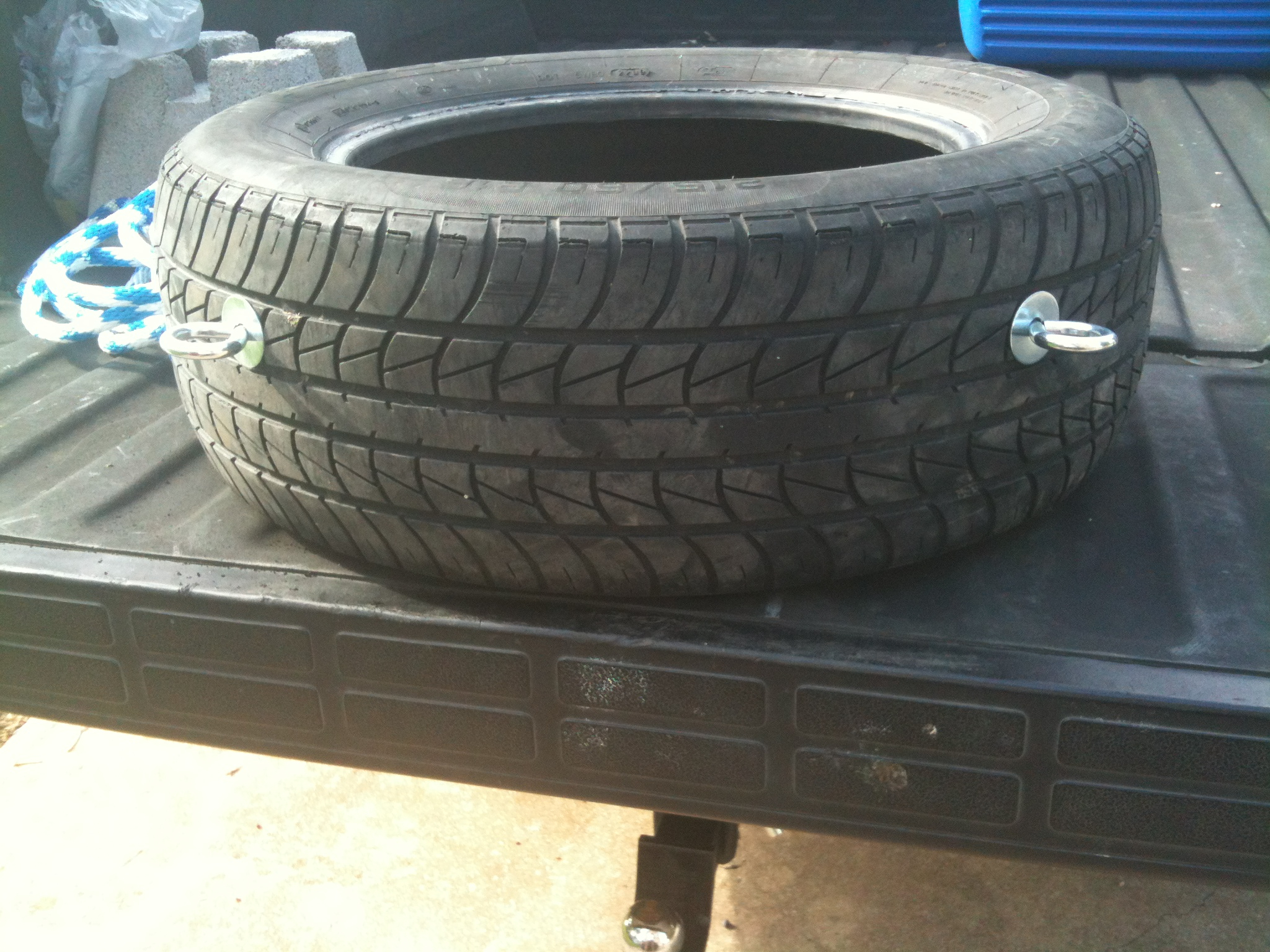
My tire drag sled!

I’ve been wanting to get back to doing conditioning. Sure I walk to/from the gym, but it’s not enough… makes for a good warm up and cool down, but doesn’t really do much for my conditioning levels. There was a short time where a guy brought his Prowler to the gym and that was awesome, but he stopped coming at that hour. I tried sprints, but it was hell on my knees and shins. Machines at the gym are boring as hell and don’t work me enough. I’d do hill sprints… if there were hills around here within easy distance (I’m not going to drive an hour just to sprint). I’d love my own Prowler, but they are costly and they’re going to make a LOT of noise. I’m trying to be somewhat considerate of my neighbors. A drag sled would be cheaper, but being a sheet of metal would still be loud. I read a lot about these tire drag sleds and figured why not give it a try.

My goal? Improve conditioning. If it helps me shed some fat? I certainly would like that end result. But I really do just want to bring up my conditioning levels because getting winded sucks.

I stopped into a small Mom & Pop auto repair shop on the drive home from the A-Zone range and asked if they had a tire I could have. They had a stack, gave me one. Awesome. Cost me nothing but a little time and trouble, and it was very kind of them to just give me a tire. Thinking about it tho, next time I might seek a truck tire instead of just any old tire, as a truck tire will be a bit bigger and heavier.

I’ve been researching ways to put this together. There are a zillion ways online, but here’s what I did.

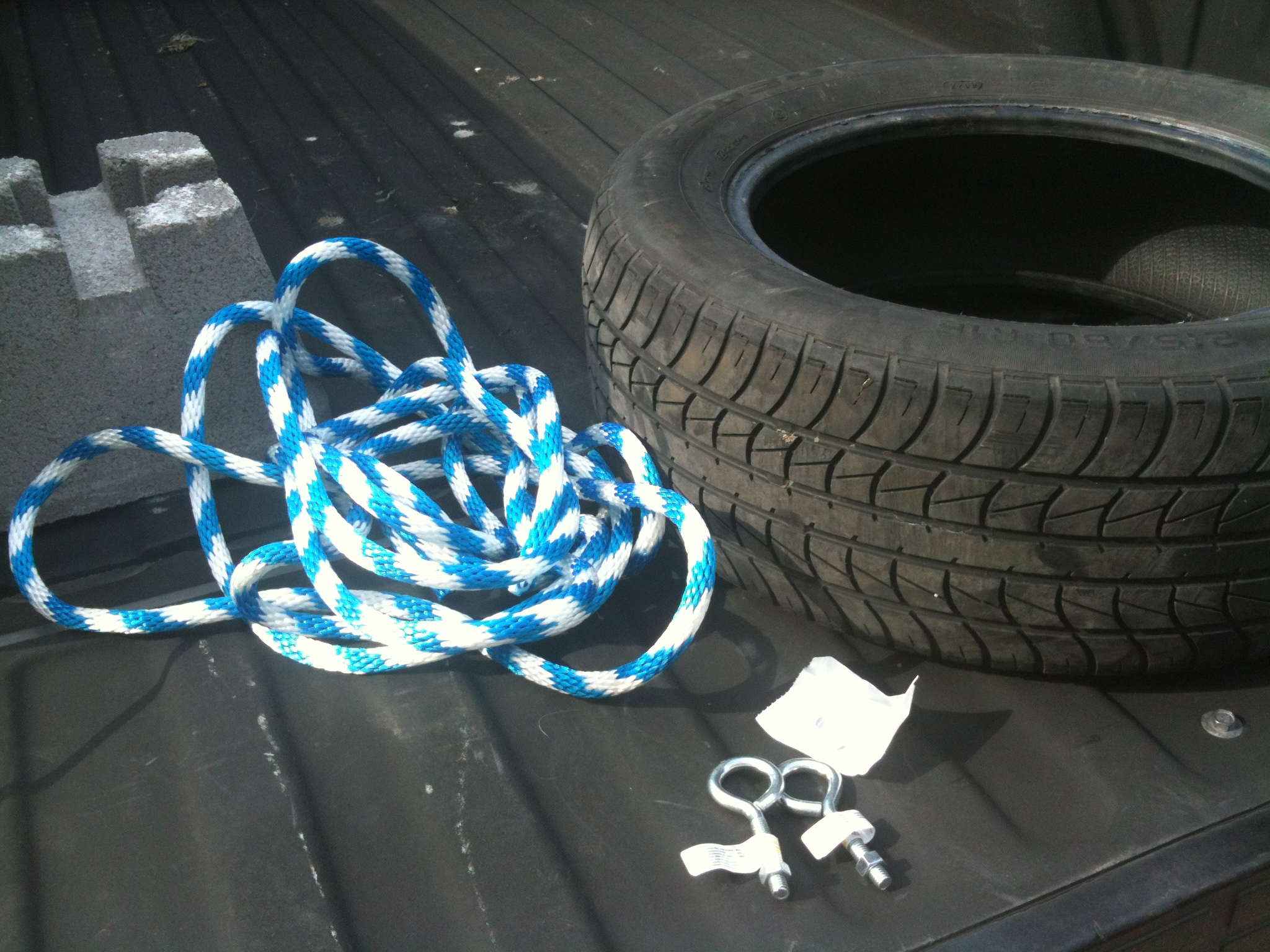
Materials:

  • tire
  • 25′ of 5/8″ nylon rope.
  • 2 3/8″ eye bolts, with nut
  • 4 3/8″ fender washers
  • some scrap wood
  • a patio deck block

I took my drill, inserted a 3/8″ bit, and drilled 2 holes in the tire.

I just picked a spot for the first hole, and opted to drill it just above the midline in hopes that will affect the balance of things and keep the tire flat on the ground (instead of putting it at midline or below it, or even too close to the edge). In terms of where to put the other eye bolt? I just held my hands out and measured that way — it’s basically “shoulder width” apart.

It’s a little tough getting the bolts in there, due to all the steel belting, but just keep working at it. I did opt to put a fender washer on each side, to ensure a good hold, but no need for anything like a lock washer since the tire will give enough and should put ample backpressure on the nut to keep things secure.

I took the rope and cut it in half. I tied large loops in one end using a double bowline knot. These will be the handles. I wanted thick rope to make it easier to grab, and large loops so it doesn’t compress my hands too much when pulling. The double bowline should remain secure. I must admit this is NOT the material I wanted to use… the rope doesn’t hold the knot very well, and I probably should have gotten 30′ instead of 25′ because I lost a lot more than I anticipated to the knots… it’s just thick and doesn’t hold very well, tho you can pull VERY hard and get the knots to tighten up better. I would have loved chains, but that would be very costly. I did look at tiedown straps, but they all would come with a ratchet and I don’t need it and the price was just getting too costly.

The other end of the rope was tied in a sliding knot. I forget what it is… it’s not a two-half hitches nor a taught-line hitch, but a similar variant. I figured a sliding knot would be necessary so I could fine tune the rope lengths to ensure they were the same size after all this knot tying. I opted to go for 2 separate rope handles because I felt that might be a little more secure and might give me some more options in pulling… but I could be wrong… it could become hampering if I try to do things like sideways pulls. But we’ll see. There are so many options out there on how to make a sled.

I had some scrap wood that happened to be just the right size to fit in and fill the tire. I did have to use my circular saw to cut it in half so it would go in, but that’s all I did.. just cut, put it into the tire, and let it be. No securing it down, nothing. It should be fine.

And then finally there’s the patio block to provide some weight. I weighed the whole contraption and it’s about 80#. My understanding is, for my goals, that’s potentially a lot of weight…. maybe too much to start with. I might start with just the tire itself to break myself into it. Start light, even too light.

In the end it cost me about $25, most of that for the rope. The eye bolts and nuts were $0.85 each, the 4 fender washers $127, the patio block was like $6, and the rope made up the rest of it. Of course, the more you use junk you have lying around the house, the cheaper this project can be.

I paced off 75 yards up and down the street outside my house. My goal? Lift Mon/Thu, drag the tire Tue/Fri. I have some simple routines from Andy Bolton and I’ll start with those and see how I do. It won’t be just a pure drag. I’ll probably do some light stretching, basic calesthenics to get my body warmed up, then drag, and a little cooldown and stretching. I doubt it’ll take me more than 30 minutes.

We’ll see how it goes. 🙂

2012-07-16 Dry Fire Practice

Following the TLG 4-week sample dry fire routine.

Week 1, Day 1

Basic routine

  1. 20 reps of Wall Drill, from extension 2H
  2. 5 reps of Wall Drill from extension, SHO
  3. 5 reps of Wall Drill from extension, WHO
  4. 20 reps of Wall Drill from press-out, 2H
  5. 5 reps of Wall Drill from press-out, SHO
  6. 5 reps of Wall Drill from press-out, WHO

Simple enough.

I’ve mentioned in the past that I’ve finally hit a breakthrough with my eyes and am able to shoot both eyes open — I still see “double” but my brain is able to cut the path and know the right visual input. I shot the dry routine this way, and will keep shooting all my dry routines this way, because obviously shooting this way is NOT ingrained in me because as far as I can recall my life-fire is still closing one eye.

Shot with my full-sized M&P9, racking the slide for a proper trigger break every time. Of course, couldn’t practice reset. If someone can make a trainer in the M&P form factor that can simulate reset with a good ApexTactical-like trigger, oh, I would buy that in a heartbeat. I will generally practice this way, unless noted otherwise.

Also noticed a strong desire to firm up my grip, especially the ring and pinky fingers on both hands… which causes a lot of “pull” and tension in the wrist flexors. But that really helps me prevent any movement in the front sight as I work the trigger. Tight tight tight… and if you think you’re tight, you probably aren’t.


Dry Fire routine

I document my weightlifting because if you want to know progress, you need to measure it, and to measure it you need to record it.

I also think that the fact I post here somehow keeps me accountable.

So… I’m going to see about doing that with dry fire practice.

And like my lifting, it’s good to start with an established program. It gets you off the ground, it gets you working on things, and it can then help you see where you are strong and where you need more work. I know of some places I could use more work:

  • snub in general, but especially on the press-out ensuring I can get the timing for taking up all that long, heavy trigger press
  • longer-distance shooting, like 15-25 yards. Group shooting, shooting against the clock.
  • WHO
  • shooting more standards, more classifiers and qualifiers. Pushing myself and again, measuring myself.

and the list could go on, but I need to write writing and get to my point. 🙂

So I’m going to try embarking on a more regular and established dry fire routine, and document it here.

Where to start? I’m going to start with Todd Louis Green’s blog post that presents a 4-week dry fire routine. I think that’s a reasonable place for me to start. It keeps the individual practice sessions short, but the frequency is high and in many regards that’s more important. The routine focuses on all the fundamental skills, including one-handed shooting. I think it will make a good starting point.

I’ve been wanting to do this for a while now, but there’d always be some reason to not do it. Well, that shit stops now, and this shit starts now. 🙂

And so with that, off I go.

Taking a break

Not going to the gym this week.

Last week I woke up questioning the need to roll to the gym. The last workout only got me through 2 sets of assistance work. Not that assistance is something to live and die by, but it’s evident I need a break.

2x/week is a nice template, and by design it doesn’t have a deload week. I don’t think I need to add in a formal deload week, but every so often I probably need one. Now is one of those times. When I start back up again next week, I’ll just start cycle 12 over.

That said tho, I did pick up something over the weekend, and if I can get to the store today to buy a few parts, I hope to start working with that this week. More later.