Quote of the day

From Tam:

People generally worry way too much about guns and not enough about shooting.

My heart says to buy more guns (we all like new shiny things). In my head, it says use that same money to buy more ammo, take more classes, do more dry fire, and get to the range. I try to let my head win.

Fellow reloaders – your help is requested

If you reload/handload your own ammunition, could you do me a favor and reply/comment on this for me?

If you keep logs of your loads, what data do you record and how do you record it, especially over time?

For instance, I might start out writing down the original recipe (e.g. Precision Delta 9mm 115 grain FMJ; 4.5 grains Titegroup powder; COAL 1.135″; mixed used cases; Remington small pistol primers) along with any other data I might feel is relevant about it (e.g. “half crimp” with a Lee taper crimp). Then I’ll go out and chronograph the load, do some accuracy tests with it, or whatever. I’d record things like the temperature, altitude, any other notes about the weather and range conditions. I’ll record what gun I used. And of course, I’ll record all the FPS that I get. If the chrono does the statistics for me I’ll record those else crunch those numbers later.

So, that’s “one entry”.

But then how about over time? For instance, do you ever chronograph it again? perhaps you check a hunting load in the heat of the summer but then again in the cold of winter to see how it varies and performs. Would you log this as a separate entry entirely in your log book? or just another entry under that load’s data?

So I guess what I’m wanting is, what data do you record? and how do you organize your data?

Please feel free to comment a length. The more detail the better.

Thank you!

Back from the range

30% chance of rain be damned. I’m going to the gun range!

Well, I’m actually back from the gun range.

Chronographing

A couple weeks ago I loaded up variants of my 9mm plinking load. In short, coming to the end of my Remington small pistol primers, and the rule is if you change something in the recipe you need to re-test to ensure all is good. So, I finally was able to get to the range to chronograph it all.

I will have detailed results later (lots of numbers to crunch). But at least a cursory glance over the numbers leads me to believe I’ll be just fine switching to the Federal or Wolf primers… small difference, remains to be seen just how statistically relevant the difference is. More eventually.

Updated: data now posted.

My Work

On the last range trip I left knowing a few things to work on. Karl was kind enough to provide some suggestions. So I did a combination of that.

Started by running the 1 target strings of those same drills. How funny… while at the range I thought that I hadn’t improved any (I was still not pleased with the numbers I saw). Getting home here and writing up this posting, I’m comparing my numbers from last time against now. I did improve! Yea! Across the board I was about a half second faster. For instance, 1 target, 3  yards, 6 shots. Last time I did it in 3.02 seconds with the first shot at 1.54. This time I did it in 2.59 seconds with the first shot at 1.46.

On the whole, my first shot times improved maybe a quarter second… not sure if I’m getting out of the holster faster or onto the trigger sooner. I know I felt like I was really slow on my draw, but generally doing a 1.5 second draw from concealment (IWB holster @ 3 o’clock) isn’t horrible. And certainly, my splits are improved.

So that’s the other thing Karl suggested I do. Just buckle down and shoot fast and put 5 rounds in the target. Just watch the sights and see what they do. The point is to get my brain to learn what that sight picture should look like. Splits in all my shooting (not just this drill) were coming in the 0.18 to 0.22 range, so that’s certainly improved, and I started to burn it into my brain what that sight picture should look like. Will still need a lot of range time to really ingrain it, but I’m starting to rewire my brain.

All in all, I’m pleased to see some improvement. I do still need to work on all of these things, including those fundamentals of reacting quicker to the timer beep, getting the gun out and first shot off (getting my eyes switched from target to front sight sooner, finger working the trigger sooner). A 1 second concealment draw (beep, rip shirt, draw, first shot) would be a great goal to achieve (and not a “gaming” IDPA concealment draw… I’m talking real-world, how I carry every day).

All good. Still much work to do. But, I didn’t want to spend hours there working on me because…..

Daughter’s Fun

Daughter came with me today. She’s been helping me almost every time I’m at the reloading bench, so she wanted to go with to see how all this chronographing stuff worked. And of course, get some trigger time herself.

Main thing we did was work with the Buck Mark .22. I set my cardboard at 10 yards and stapled 3 6″ paper plates in a “stop light” column on the cardboard. We started out just working on sight picture, then trigger control, tweaking her grip and stance along the way. She understands the notion of a “high grip” but a couple of times she got a little too high with her thumbs and the slide bit her. 🙂

After she reestablished her fundamentals, I had her try moving from plate to plate. Then a round of going a little faster (about 1 shot a second). Then a round of trying to put everything through the same hole. I tell you… when she did that? Her first 2/3rds of the magazine went great, but then I could tell her arms were peeding out so the last few shots dropped. Still, little girl is a pretty decent shot.

Take a look:

Ignore the middle target, the 9mm holes, and the .22 caliber holes not in the paper plate (the 9 holes are from me, the other .22 ones are from another gun which we learned has messed up sights… more on this later). The middle plate was full of a lot of me blazing away. So really, the 2 plates to focus on are the top and the bottom. That’s a 6″ paper plate, but that “inner circle” is 4″, and she was shooting at 10 yards.  The combination of all the shooting she did, from the slow at each plate, to moving from plate to plate, to the tight groups. I know you can’t see how each string fared, but little girl did good. She’s not yet Julie Golob, but so long as she’s improving and having fun, all that matters.

Anyway, twas a good morning at the range. I’ll have more numbers later.

Splits and transitions

Watching Matt Burkett’s DVD Volume 4 How to Shoot Faster.

It’s a segment on cadence. The drill they’re using is 3 targets at however many yards (probably 7 to 10), 2 shots on each. Matt is stressing the importance of a steady cadence. That is, it shouldn’t sound like: bangbang–pausetransition–bangbang–pausetransition–bangbang. It should sound like bang-bang-bang-bang-bang-bang. It’s a combination of both slowing down your splits (time between shots on target) and speeding up your transitions (time between shots on different targets), but the point of the drill is getting people to speed up their transitions because we tend to focus so much on improving our splits and not our transitions.

But what hit me was hearing Matt do the math on how important transition time is when it comes to match competition. What follows is a rough transcription:

The US Nationals… let’s rough it out with like 400 rounds, so it would be 200 targets, 2 rounds on each.Well there’s 100 splits and 100 target transitions then. Big chunks of time there. If you have a tenth of a second or two-tenths of a second per target transition, at the end of the match you’re 10 seconds behind somebody else right off the bat. You’re really behind.

Matt was talking off the top of his head, so you can see the math is a little loose, but the point remains.

Karl’s pointed this out to me before. It’s hearing the math that stood out to me.

Spare me

Yesterday I was at McBride’s Gun Store to meet someone. I arrived early so I looked around and picked up a few things. Of course, I had to look in the gun cases. I wanted to look for a revolver in .44 Magnum.

I saw a S&W 629 with a 4″ barrel. I would prefer at least a 5″, 6″ maybe…. so I asked the guy at the counter about that and he said he might have a 6″ elsewhere. I then asked “do you have any models without the internal lock?” and boy that set him off. He went on about how that’s the way things are now, get used to it, it’s no big deal, I’ve read all the stuff on the Internet but *I* have never experienced it and with so many guns sold and in circulation blah blah blah… and started talking down to me.

All I wanted to hear was “yes” or “no” the have it in stock or not. I didn’t ask for his opinion. To my fault, I engaged the conversation a bit, but he wouldn’t hear anything of it… I was obviously a moron.

You know, Michael Bane is no dummy and he’s personally experienced revolver lock-up. Read that thread and see that others have experienced it too, like Massad Ayoob. The point is simple to me: you have added something that isn’t necessary for the gun to function (it’s only there because of the gun grabbers and lawyers). You have now made the machine unnecessarily more complex, which just means with more parts there’s more ways for the thing to fail. And sooner or later it will. Given the nature of this mechanism, any failure with it could be fatal. It’s the engineer in me, what can I say. If the gun is a safe queen, who cares. If I’m betting my life on it? It’s a different story.

It may be a million in one chance of it happening and happening when your life depends upon it, but that’s little comfort when you’re that one.

Two O’Clock

I’ve been looking to improve the carry options for my snub nose revolver.

Pocket holsters are certainly good, but have limits, such as the pocket itself (positioning, drawing, etc.). The Werner Carry system is good, but just wasn’t working for me. However, the Werner system had me carrying at the 2 o’clock position — appendix carry. So why not look further into that. The issue there with the Werner system was that if I made it comfortable to wear it was difficult to draw; if I made it good for draw, it was uncomfortable to wear (and not just a discomfort, but digging into major femoral nerves). So why not try a proper appendix holster?

Appendix carry is gaining popularity, especially amongst trainers like Gabe Suarez and Todd Louis Green. I also recall that with SouthNarc’s ECQC, they find drawing snubs from appendix to work out best. So let’s give it a shot. I like Comp-Tac so much, let’s try out their Two O’Clock holster, made just for this purpose.

Initial impressions

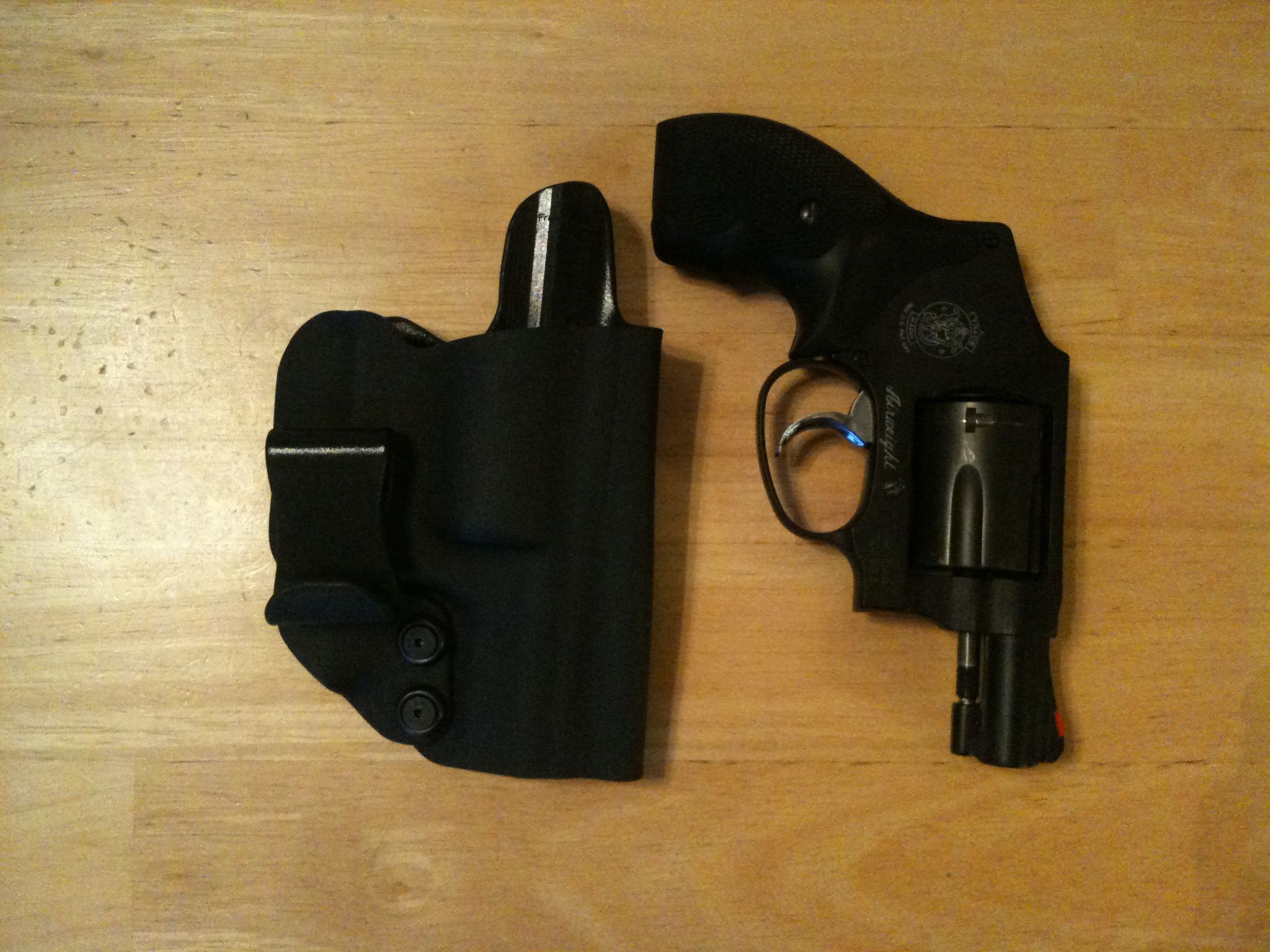
Wow. Looks like a lot of Kydex for such a small gun, but it’s really not much more than the gun itself. Let’s see how it looks inserted:

Not really all that bad. Let’s put it into the pants to see how it rides:

Gosh, that rides really high, or at least, it feels that way. But once you work with it a bit you realize this is good. It’s high enough that you can get a good grip for the draw and also keeps the muzzle from digging into your thigh so you can sit with this. You’ll notice I’m not wearing it at true 2 o’clock position. That’s due in part to the primary gun that I’m wearing at about 3 o’clock, but also the belt-loop on the pants (Tru-Spec 24/7 shorts). But I actually like it a little more up front like that in terms of accessibility. I did some dry fire draw practice and it goes pretty well. I am a little mixed on the sweat shield… there’s some, but I wish a bit more, but if there was more it might interfere with your thumb on the draw.

Holster completely covers the trigger.

I got the J-hook clip because I figured if I had to tuck this in I’d like things to be as unobtrusive as possible, especially given it’s facing front. Seems to work well enough. Yes it’s not as stable as full clips, but between the clip and just pressure from being IWB, it holds well enough.

Bending over? Forget it. 🙂  If you weren’t in the habit of squatting to pick things up, you’ll have to get into that habit.

Sitting isn’t bad.

So, those are my initial impressions. I actually wrote the above when I first got the holster. I’ve had the holster about a week now.

Further Impressions

So now that I’ve used the holster a bit, here’s what I think.

Ouch. 😦

It’s not comfortable for me to wear for more than a few hours. The main problem is the gun and holster end up angling slightly outward at the top (i.e. butt of the gun angles away from my body) which then pushes the muzzle end of the gun/holster into my body… think around the bladder area. It’s not pressing on my bladder and giving me discomfort in that way, but rather that it’s just pushing into that soft area of the body and doing so constantly. After a while it just gets painful… I remove the holster and touch that area of my body and it’s tender, no visible bruising but it feels that way.

So this holster just isn’t working out for me. I cannot say if it’s indicative of AIWB in general or this holster or my body or how my body and this holster combine. For now I’m going to say it’s a matter of me.

I will say I like the access the holster gives. It’s right there, it’s fast. Yes, I was wearing it closer to say a 12:30 position than a 2:00, and that’s an interesting thing to consider. First, I couldn’t wear it at true 2 because of logistics. But at true 2 the gun and holster didn’t wrap into my body as much and thus the butt-end sticks out and makes printing rather obvious as well as bumping into my right arm. Moving it more towards my centerline keeps everything pressed up against my body and printing is reduced tho not eliminated. If the holster was located more towards the center but I canted the holster with the grip slightly towards my right arm, that actually made things even more comfortable for sitting plus made the gun more accessable on the draw, but at the cost of risking more printing due to the gun butt not being totally against the curve of the torso. I’m curious to try out a standard-clip because I know the canting was allowed due to using the J-hook… curious which I’d like better, perhaps the J-hook.

In the car, a thing of beauty. I’d say only cross draw or maybe a shoulder holster would be more accessible.

To be continued…

I think the Comp-Tac 2 o’clock holster is a fine and quality holster, like all of Comp-Tac’s products. At this point I’m going to chalk things up to “it doesn’t work for me“. I contemplated returning the holster, but I don’t want to. I’ll keep it and see how things go. I’m going to continue searching for a holster that could work. I’m really liking what AIWB offers.

One guy suggested to me to use a DeSantis Nemesis pocket holster. I actually use that very one for my pocket carry. He said to use that, slip it inside your waistband, the friction would hold it there. I was skeptical but tried it. I don’t like it. Sure it holds it and holds it better than no holster at all, but it shifts around, the holster can come out with the gun on the draw… it’s just not ideal, but an interesting option.

I read some people using a Bianchi 100. I may be able to find one in town and if so I’ll try it. I’m wanting to try something leather and not Kydex, to see about “give” and the pressure on my body.

If you have suggestions of other AIWB holsters, especially leather ones or ones that could alleviate the problems I encountered, please comment!

To get involved, or not

When you’re of the sheepdog ilk, when you carry a gun, when you make a decision to defend right and stop wrong, one question that comes up — and that you must ask yourself — is, do I get involved?

If someone is striving to harm myself or my family members, yes I get involved. But if you’re just out in the world and you see something ugly going down, should you get involved? It depends.

Gabe Suarez wrote what I think is a pretty good piece on the matter. It’s still not going to give any clear-cut answers, because how you answer is a personal matter. It also goes back to the Insights “beer & TV” maxim.

Random 6.8 SPC ramblings

Presently in my 6.8 SPC rifle I’m shooting Silver State Armory’s 6.8 SPC 85 grain Barnes TSX tactical load. Pretty accurate stuff, and has enough oomph behind it to deal with Texas critters be it hogs or deer or whatever.

As it is, I have the rifle zeroed to be dead-on at 100 yards. Some folks (foo.c especially) have been encouraging me to use 1″ high at 100 yards instead. With my .308 rifle that just didn’t look right, at least looking at ballistics calculations and trajectories on paper. As well, when I did my .223/5.56 AR’s I’d want them more in a RIBZ configuration. Well, I’ve been playing with a lot of ballistics and trajectory calculators (and just picked up Ballistic for the iPhone, wicked awesome) and well… at least on paper I can see that for this 6.8 85 grain load that going 1″ high at 100 yards is going to give me the best setup. That I’ll be able to just put the crosshairs on what I want to hit from 0 to 200 yards and that ought to work out just fine for me.

Of course, I start thinking towards handloading for the 6.8, because Barnes’ new 95 grain TTSX was made specifically for 6.8 SPC rifles and the performance data so far on that bullet is highly encouraging (check out the 68forums for details). I’m not ready to handload for this yet, but it will be where I end up. And even here, 1″ high at 100 yards will be a good zero point.

I guess I was so discouraged after that one hunt… it just had me down. But since I took the 6.8 back out, I’ve really found myself with renewed interest and vigor in exploring 6.8 more and more.

THAT is turnaround time

Wow.

I just put in an order with Silver State Armory. Within 20 minutes after the order was submitted, I received the email saying it was shipped.

20 minutes.

That is awesome.

Updated: Well, it’s balanced out by the fact that it’s going ground, there’s a long holiday weekend ahead, and so it won’t be here until well into next week. Heh. No biggie, I’m in no rush for it.