Julie Golob – Wyoming State Steel Challenge 2010

This is a great video of Julie Golob from the 2010 Wyoming State Steel Challenge

I like how it shows a diagram of the stage, then shows her shooting it. You can see how one of the best shooters in the world preps, plans, and shoots the stages.

Is she fast? Yes. But notice, she’s not too fast. She’s not shooting faster than she can get good hits. In fact, some of the shooting seems downright slow, but you have to remember she’s shooting at small targets a long ways away (refer to the stage diagrams in the video). The take-home is shooting fast doesn’t necessarily mean emptying your magazine in 2 seconds, but going only as fast as you can that allows you to still get the hit. Speed is important, but accuracy is king. I still have to remind myself of this… probably why I posted this. 🙂

Dove hunting

It’s dove hunting season here in Central Texas.

I know some people dedicated to it. Me? It’s just not my thing.

First, I’m not really a shotgunner. I just don’t shoot them much, thus I don’t get much practice shooting flying things (be it clays or birds). The times I’ve shot skeet I really enjoyed it, but I just don’t seek it out (handguns are my focus). Second, shooting doves seems like a lot of work for little gain. All the feather plucking, cleaning, prep, and so on… just for a little nugget of meat? I guess that’s why if I’m going hunting I tend to prefer bigger animals (e.g. I am dreaming of elk hunting one of these days). The cost-benefit ratio just seems slightly better there. So the dove thing just hasn’t appealed to me.

However….

A guy I know from Scouts and church is an avid dove hunter. Last year we were talking about it and he made comments to me that I should go out with him; I passed. This year he started on me again and I said “why not?”. So I pulled the 18.5″ barrel off my Mossberg 500 (it’s a field version, wood furniture) and put the field barrel back on with a modified choke. I went out and bought some 7.5 shot shells. Got my hunting license with the migratory bird stamp. And… I’m ready. 🙂

Haven’t gone out yet. I’ll be talking with my friend tonight to figure things out, but it looks like maybe this weekend.

I figure why not? Try it. If I get something, great. If I don’t, it should just be fun to get out and try. Lord knows doves are not in short supply around here…. I’ve seen 2 dozen in my yard at times, and I must admit when I see that I have thought about how tasty that could be, if only I didn’t live in the city. 😉

We’ll see how it goes. If any of you are dove (or bird) hunters and have tips for me, please share in the comments.

KR Training September 2010 Newsletter – Training by Request!

The KR Training September 2010 Newsletter is up.

Have you wanted to take one of KRT’s half-day live fire courses (DPS1, DPS2, Competition Pistol, AT-3, AT-4, AT-6) but haven’t been able to because of your schedule or the KR schedule? Well, what are you doing Saturday September 18?

Between now and September 13 you can email KR Training and vote for what class you’d like to take! The class with the most votes will win and be offered on that date.  Winner will be announced on the KR Training website and the KR Training Facebook page.

Vote now!

“We just want to know where they are.”

Queensland lawmakers don’t get it, but it’s not about getting it.

ANY ITEM that looks like a gun will have to be licensed under several changes to the Weapons Act being considered by the Queensland State Government.

Even guns made out of materials as unlikely as soap or plastic may have to be kept under lock and key if they could “reasonably be taken to be a weapon”.

The draft act says an imitation is a “reasonable copy” of a weapon that is not capable of causing death or injury.

“If it looks like a gun and feels like a gun, it will have to be licensed,” said a government source.

“We just want to know where they are.”

Emphasis added.

Registration leads to confiscation… and if you want to confiscate, you need to know where they are.

Train like you’ll fight

Tam returns from carbine class. Makes comments about gear, the best of which is:

For what it’s worth, my tactical pants in the class were by Wrangler, and they come with two single 30-rd mag pouches, one right over each butt cheek. I can about guarantee that, should the balloon ever go up for real, those will be the pants in which I’ll be fighting, so I reckoned I might as well practice fighting in them…

It doesn’t matter what you’re doing, be it gun training, empty hand training, or taking the training seminar on how to use the company’s new phone system. Your training should be as close as you can get to the realm of application for what you’re training for. So UFC guys train for their sport and train as close as they can get to that. If you’re taking a training class on how to write iPhone apps, it’ll probably help to have an iPhone and a Mac. And if you’re training for self-defense shooting, you should be as close to your normal situational dress and carry as you can be.

I’ll grant, to help make classes run smoothly for everyone you make some compromise. For instance, wearing a Camelback (especially in the Texas summer heat) is good, because dehydration will make class miserable for you and slow things down for everyone else while the instructor has to stop class to tend to you. I may normally only carry one spare magazine, but if the constraints of the class allow me to wear my Comp-Tac Beltfeed (4 mags), I will because that will make life flow smoother for everyone on the line. We have to realize, class is class — it’s artificial by it’s very nature. What’s important is to ensure you can learn and that you put yourself in the best position to be able to learn without distraction (gear problems are distraction). Then after class when you practice, you should try to go further. So for instance, if during class I carried the gun OWB and used the Beltfeed because that allowed class to run smoother, outside of class when I practice the class skills I should go back to my normal carry setup of IWB and a single mag pouch. Allow class to be an environment for learning, then reinforce those afterwards in practice.

The main thing is to not continue carrying on in an artificial way. If your goal is private citizen self-defense, getting all tacti-cooled out for class may be one thing, just don’t always do that in practice. Same with empty hand martial arts… we don’t wear our dobok/gi out on the street, so practice in your normal street clothing once in a while to see just how constraining those jeans really are.

Feral Hog Anatomy

Via TacticalGunReview.com I found this TexasBoars.com forum thread. Because of that and some other things I’ve had well… I wanted to make one good posting about feral hog anatomy and kill zones, so I could have a good “one-stop” reference on the topic. So whenever I need a refresh on the topic, I can just pull up this article and have all resources in one spot.

I’ve spoken about feral hog anatomy before. That article included one of the better hog anatomy pictures I’ve seen:

Feral hog anatomy

TexasBoars.com has a great article on feral hog anatomy. They provide a nice shot placement picture:

Feral hog kill zone (from TexasBoars.com)

Feral hog kill zone (from TexasBoars.com)

Speaking of shot placement, the California Hog Blog talks about shot placement. They have great graphics showing the neck shot:
Feral hog kill zone - neck shot (from California Hunting Today's Hog Blog)

Feral hog kill zone - neck shot (from California Hunting Today's Hog Blog)

and the more traditional kill zone:

Feral hog kill zone - traditional zone (from California Hunting Today's Hog Blog)

Feral hog kill zone - traditional zone (from California Hunting Today's Hog Blog)

But while all of these are good, the TexasBoars.com forum thread has something that brings it home better than any other thing I’ve seen.

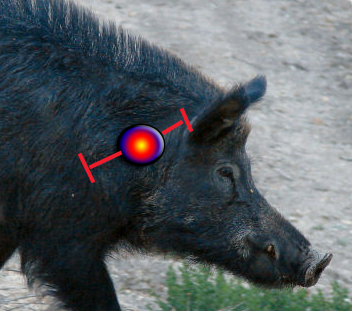
Is it this picture and description of the kill zone?

Feral hog - spine highlight (from TexasBoars.com)

Feral hog - spine highlight (from TexasBoars.com)

Here it is. A simple highlight of the “drop a hog in its tracks zone” DRT.
Don’t make the shot any further FORWARD or by NO MEANS any further BACK into the rib cage.

If the head is NOT DOWN the line would be horizontal.
The IMPORTANT FACTOR is don’t shoot high! If you shoot high the hog will likely hit the ground,, and then get back up once the “stinger” in the spine subsides as addressed in the video. If you hit a little low, thats OK.
A sign that a shot is HIGH is a SQUEAL. If the pig hits the ground and SQUEALS you should shoot it again to be safe. If the lungs or trachia are damaged and completely bruised the hog will not be able to squeal generally speaking.

No… it’s something else in the thread:

This video.

While the topic of the thread and video is more about bullet construction and performance, Kevin Ryer (TexasBoars.com’s admin) takes a freshly killed feral hog and dissects it. While doing so, it becomes very obvious where the kill zone is and why that’s the important kill zone.

Why does this matter? Because for people used to hunting deer or other such animals, the kill zone on a feral hog is slightly different. The chest cavity is a small target. It’s very low and forward. While the animal presents a large side to you, if you divide the animal in half horizontally, the lower half is really all you have to work with because of how the spine slopes as it approaches the head.

Here are a screen shots from the video that show what I’m talking about.

First, here’s where the 250# hog was shot in the shoulder. Entry wound. The knives are pointing to the hole, square in the shoulder.

Feral hog dissection - entry wound, square in the shoulder.

Feral hog dissection - entry wound, square in the shoulder.

He then cuts through the shield, removes the front leg, then gets into the chest cavity.

Feral hog dissection - location of spine

Feral hog dissection - location of spine

Kevin is holding the knife blade along the spine, and his left index finger is also pointing to it. Notice how the spine is about half-way through the animal… that is, about half their body is above it and half below it. This is lower than on a lot of other animals. Notice the bullet wound is below the spine. You have to aim lower than you may be used to.

And while the screen shots are nice, you really need to watch the entire video. There are a lot of comments Kevin makes, a lot of things he goes through. And again, while he’s focused on discussing the use of a fragmenting bullet, there’s a lot of importance placed on understanding anatomy and ensuring you get the bullet into the proper kill zone. It’s a well done video, and Kevin deserves much credit and thanks for making it.

The key thing is you have to shoot a little lower and a little more forward on a feral hog than you would on a deer. Think midline or a little below midline, and forward since the chest cavity isn’t that big. The target area is small, and, as Kevin points out in the thread discussion (read it!), depending what firearm you’re using it may be smaller. Shots have to be good and you have to know the anatomy clearly so you can ensure a good shot.

Thank you, Kevin, for all your work. It dispels a lot of myths and helps out a lot of hunters.

I don’t think it was an improvement

*sigh*

WENATCHEE, Wash. (AP) — A hiker on Blewett Pass shot himself in the butt when he put a handgun in his back pocket. The Chelan County sheriff’s office said the 52-year-old Snohomish man had moved his .40-caliber handgun from its holster to his back pocket Saturday to see if that position would be more comfortable.

So no…. I reckon it wasn’t more comfortable back there.

Let’s see here….

  • Proper holsters are the better way to carry your gun.
  • If you need to experiment with fit and feel, unload the gun first.
  • When figuring out a holster’s comfort, you should work with an unloaded gun… and figure it out before you go into the field.
  • Once your (loaded) gun is in the holster, LEAVE IT ALONE.

Equipment only goes so far

I like tools.

The purpose of tools is to help you do a job. Perhaps it enables you do the job, perhaps it helps you do the job better. And many times, better tools enable you to do a better job than if you had worse tools or no tools at all. Consequently, we rely upon tools and always seek to have better tools because yes, in some ways tools can compensate for skill.

But in the end, how much do tools matter? Steve Vai could pick up a crappy guitar and still sound awesome. I could pick up an Ibenez Jem, but it won’t make me play like Steve Vai. Does that mean you should use any old tool? No, because you probably will play and sound better through a Jem than through some flimsy piece of junk guitar. But even that piece of junk will be better than no guitar at all.

The key is that tools can certainly improve your game, but in the end it’s always going to be about the person using/operating the tool that makes the difference.

In shooting sports we certainly get caught up in gear. But I just saw this posted to Smith & Wesson’s Facebook page:

In the Limited Division, Team Captain Julie Golob showed that you don’t have to spend thousands of dollars on highly specialized equipment to win. Using an M&P Pro Series 9mm and a production rig, Julie captured the Women’s Limited World Title & placed an impressive 14th Overall in the Limited Division. Julie also placed 4th in the Overall Women’s Category against optic race guns. PHENOMENAL!

The Pro Series is a little better than the normal M&P (better trigger, better sights… shows you what really matters in terms of equipment modifications), but still… production gun and look how Julie did. BJ Norris won the 2009 US Steel Challenge Nationals Limited Division using a Pro Series with only a minor modification to the trigger.

Buy a good, solid, reliable gun. Glocks, XD’s, M&P’s and the like. Tune a few things on it (trigger, sights). Then spend money on ammo and training, and time on practice. That’s really what makes the difference. Sure you could buy a $2000 gun, but you’ll probably go further if you buy a $500 gun and spend $1500 on ammo, training, and practice. Equipment matters, but only so much.

Rep. Lloyd Doggett’s response

So that EPA lead ban thing came about.

I emailed my Congresscritters.

Today I received a response from my US Congressman, Rep. Lloyd Doggett (D, 25th district of Texas).

August 30, 2010

Dear John:

Despite its many benefits, the Internet allows misinformation to travel swiftly. You have been provided such misinformation regarding the claim that the Environmental Protection Agency (EPA) is planning to ban all traditional ammunition. The EPA did receive a petition from an outside group, exercising its right to petition — a right available to you or any other citizen.  But this petition to ban lead in hunting ammunition was denied by EPA as not even being an issue within its jurisdiction.

Rest assured, as someone who grew up around guns and hunting here in Central Texas, I respect the right of gun ownership, though I frequently question the propaganda of groups like the one that promoted this misinformation.

Please keep me advised of any federal matter with which I may be of assistance.

Sincerely,

Lloyd Doggett

I love the snide overtones. I reckon if we changed the context of this to something he favored, like Obamacare, he’d respond saying we had no right to petition and object. Certainly he’s behaved in the past like he’s above us mere commoners.

I love the “I respect the right of gun ownership”. Bullshit. Explain your “F” grade from the NRA then. And I replied to him as such (well, I didn’t say “bullshit”).