Penne with Braised (Water Buffalo) Short Ribs

Working from home has advantages (and disadvantages too, but that’s not the topic). One thing I often do is when I go down to have lunch, I’ll eat my lunch in front of the TV. A typical thing I like to watch? Food Network.

I like watching Giada De Laurentiis for more than her uh… “buxom personality”. The lady can cook and she makes some delicious dishes. I bought one of her cookbooks for Wife, and some fantastic stuff has come out of it. In one recent episode, Giada made this Penne with Braised Short Ribs. I’m reprinting the recipe in full at the end, just in case it ever disappears from Food Network’s website. Wife caught the episode too and opted to try it out.

Folks, it’s fantastic.

The only modification I’d make to the recipe? Cutting up a few katamala olives and adding them in (as a topping at the end, not cooked in); only a few, as they are strong and you just want them to accent the meat, not become the dominant flavor. But the recipe is fine without them.

Now, we’ve had it a few times with beef short ribs and it’s been great. So…. why not try it out with the water buffalo?

Defrosted a set of ribs, and cooked according to the recipe. I know Wife likes to make multiple changes at one time, and when it comes to cooking she’s got a good instinct for it. But she humored me and made only one change: water buffalo ribs instead of beef ribs. This is the engineer in me: if you change something, make one change at a time so you can isolate and know what that change did. If you change multiple things at once, how can you fully assess the impact of the individual changes? Wife’s thinking was, we know water buffalo needs “low and slow” cooking, so we should also change up the cooking time. But my thinking was, this was as different way of cooking the meat: it’s braising, lots of liquid, in a covered pan, and that’s going to do a lot to help break down the meat fibers. So let’s just see; the water buffalo is a new experience for us, so we need to experiment slowly and learn. Cook it exactly like the recipe says, and if it needs more time, we’ll leave it in longer. If it works out, it does, if it doesn’t it doesn’t; either way, we’ll learn from it.

A couple other small modifications happened. We didn’t have any Cabernet so a Gnarly Head Old Vine Zin was used instead. Also no fresh tomatoes so some canned were used, which added a little bit of liquid.

After 2.5 hours at 350º, we knew beef ribs were “fall apart”. We poked at the water buffalo rib meat with forks… it didn’t budge. So we put it back in for another 30 minutes. After 3 hours total, the meat started to come apart, but not “fall apart”. So another 30 minutes (3.5 hours total) and then it started to fall apart.

And, it was delicious. 🙂

If we try it again, I’m curious to fiddle with the cooking time a bit more. Should we try 350º for maybe 4 hours? Or perhaps go 300º for something like 5-6 hours? We do have to mind the liquid evaporation, so too much time isn’t ideal. But, this will certainly be the next variable to play with. My thought is 350º for 4 hours.

So far so good. I’m liking this!

Penne with Braised Short Ribs
Recipe courtesy Giada De Laurentiis

Prep Time:20 min
Cook Time:2 hr 40 min
Level: Easy
Serves: 4 to 6 servings
Ingredients
4 pounds beef short ribs
Kosher salt and freshly ground black pepper
1/4 cup olive oil
1 large onion, diced
3 cloves garlic, coarsely chopped
5 Roma tomatoes, cut into eighths
1 cup red wine, such as Cabernet Sauvignon
3 tablespoons Dijon mustard
2 cups low-sodium beef broth
1 pound penne pasta
1/4 cup freshly grated Parmesan
1/4 cup chopped fresh flat-leaf parsley
Directions
Place an oven rack in the lower 1/3 of the oven. Preheat the oven to 350 degrees F.

Season the ribs with salt and pepper. In a large heavy-bottomed Dutch oven or ovenproof stock pot, heat the oil over medium-high heat. In batches, add the ribs and brown on all sides, about 8 to 10 minutes. Remove the ribs and set aside. Add the onion and garlic and cook, stirring frequently, for 2 minutes. Add the tomatoes, wine and mustard. Bring the mixture to a boil and scrape up the brown bits that cling to the bottom of the pan with a wooden spoon. Return the ribs to the pan. Add the beef broth, cover the pan and place in the oven for 2 1/2 hours until the meat is fork-tender and falls easily from the bone.

Remove the ribs from the cooking liquid. Using a large spoon, remove any excess fat from the surface of the cooking liquid. Using a ladle, transfer the cooking liquid in the bowl of a food processor. Process until the mixture is smooth. Pour the sauce into a saucepan and keep warm over low heat. Remove the meat from the bones. Discard the bones. Using 2 forks, shred the meat into small pieces. Stir the shredded meat into the sauce. Season with salt and pepper, to taste.

Bring a large pot of salted water to a boil over high heat. Add the pasta and cook until tender but still firm to the bite, stirring occasionally, about 8 to 10 minutes. Drain the pasta and place in a large serving bowl. Using a slotted spoon, remove the meat from the sauce and add to the pasta. Pour 1 cup of the sauce over the pasta. Toss well and thin out the pasta with more sauce, if needed. Sprinkle the pasta with Parmesan cheese and chopped parsley before serving.
On Steak

The WSJ on steak, and why our steak has become what it’s become. In short, back in 1926 the USDA introduce “grading” to beef. And how is it graded? Fat.

How did the USDA separate the good beef from the bad? There was one thing everyone from ranchers and cowboys to butchers and USDA graders could agree on: fatter cattle tasted better than lean ones, so long as they weren’t too old. So that’s what they looked for: plump, well-fed cattle. They looked for fat on the ribs called feathering, and fat on the flank called frosting. If there was a great deal of that fat, the beef achieved the highest grade, Prime.

So, like any business, you look for ways to maximize your product and minimize your costs.

It’s the cattle industry that has changed. In the 1950s, cattlemen began sending their cattle to feedlots to get fat. A feedlot is a vast sprawl of fenced-in pens where tens of thousands of cattle eat grain—usually corn—out of concrete troughs. Soon after, cattlemen started using growth promotants—hormones and steroids, basically—to get cattle fat faster, and fed them antibiotics so they could eat corn in amounts that, under normal conditions, could kill them.

By the turn of the century, a new drug entered the scene: the beta2-adrenergic agonist, a muscle relaxant used in humans to treat heart and respiratory disease that makes cattle gain more muscle. And the corn cattle now eat, not surprisingly, has also taken great strides in efficiency, having been hybridized and genetically engineered to pack more fat-producing starch. More recently, we’ve been feeding cattle something called dried distillers grains, which is the muck that’s left over after corn is distilled into ethanol.

The result has been astonishing. In the 1950s, a cow was about two years old by the time it got fat. Today, it can be as young as one year old. An average carcass now yields 40% more beef than it did just 30 years ago. In short, the beef industry has experienced a tectonic supply-side shift. Production has become vastly more efficient. In 2009, beef cost 30% less than in 1974. Yet the average American is eating 20 pounds less of it per year.

But does more fat equal more flavor? Not necessarily. The article makes a good point: consider your wild game, which is amazingly lean but amazingly flavorful (and perhaps too flavorful for some). Yes, fat matters to some extent, but like all things there’s a limit and you can have too much of a good thing.

So what does the article say is best? Grass-fed beef, instead of corn-feedlot-based beef. But trying to find such a critter can be tough and expensive, and even then it’s no blanket guarantee for awesome beef. That’s one reason I’ve been enjoying doing my meat shopping away from the local grocer. At the local grocery store, who knows where or what the meat is. But if I go to a local butcher, I have more control. Furthermore, I can talk with local ranchers, or even kids selling their 4-H cattle at auction and get just what I want.  The article gives some guidelines:

The most important question to ask is age at slaughter. For flavor reasons, be wary of steak from a cow younger than 20 months. Ask how much the cow weighed when it was slaughtered, because any cow weighing less than 1,000 pounds is almost always too lean to be delicious. Ask about the breed. Be wary of “Continental” breeds, such as Charolais or Limousin, which do very well in feedlots and terribly on grass. Look for British breeds like Hereford, Galloway and Angus. And if you should find grass-fed Wagyu, buy it.

First tries in water buffalo cooking

So the water buffalo is back from the butcher. It was aged for about a week, then processed into the usual parts and cuts that you’d get out of wild game processing: roasts, ham steaks, backstraps, stew meat, hamburger, link/smoked sausage, breakfast sausage, ribs. Stuff like that.

Since water buffalo is close to beef, we figured to go with beef-based recipes.

First thing we did was a roast. Took a 3# bone-in roast and put it into the crock pot for about 8 hours (on low). The recipe was a basic beef style recipe, with carrots and potatoes and the like. Wife has the full recipe written down, not available to me at the time of this writing. It turned out great. Very tender, flavorful. Quite nice.

Second thing was pan sausage. I had the butcher make some breakfast/pan sausage. So it was 50% ground up water buffalo with 50% pork, then the butcher’s spice blend. Even with the added pork (thus fat), it cooked up very lean… little fat in the pan, but since we cooked it on a non-stick surface there was no need to add any fat/oil to keep it from sticking. Tasted very good. Oddly, the kids didn’t like it as much, seemed to be the smoother texture vs. the feral hog pan sausage we get. Personally, I liked the flavor a lot more than the hog sausage, and so did Wife.

Third thing we did was backstraps. The backstraps on this guy were huge, so all they were done for processing was to just clean them up and cut them into a manageable sized piece… probably a pound in weight, certainly not more than two pounds, and probably about 2 inches thick at the thickest part. I let them marinate in Stubb’s Beef Marinade for about 24 hours. I like that marinade because it’s got a good spice, a little heat, soy sauce based, very delicious. I put them on the grill. Now the trouble is my Weber grill is dying so I can’t do much for heat control *sigh* and have to do it via amount of coals. I put charcoal in both side baskets and let it burn down. Temperature was probably 400º… a little too hot, but I couldn’t do much about it. Threw a few small chunks of mesquite wood on the coals as well. Let it sit for about 90 minutes, temperature eventually dropped to 325º or so. Internal temperature on the meat got to about 150º, which is “medium”.  Took it off, let it sit for about 15 minutes, then slice it against the grain. The flavor was good, certainly a “medium” meat. The marinade didn’t do much; we thought it would have seeped deeper, but I guess the meat is too tight. Certainly the meat didn’t dry out, even after 90 minutes… hopefully that marinade helped in that regard. The meat tho was kinda tough… it’s that “chew” that I was talking about. Still, it was good enough to eat and fill your belly.

“Low and slow” has to be the way. The crock pot was low and slow, worked out great. The BBQ wasn’t low and slow (tho slicing against the grain is a must). I figure next time maybe 250º-ish, 6-8 hours. Certainly tho the meat will have to be wrapped in foil. My thinking is a good dry rub for 24 hours. Put it in foil but leave the foil a little open the first hour. After the first hour, baste in something like apple cider vinegar with some sliced white onion and other spices if desired. Then close up the foil… gotta keep in the moisture. Try to not poke at it too much, but ensure moisture stays in the foil. Keep it low and slow for 6-8 hours. Will it work? Don’t know, but it’s certainly the next way to go.

Anyway, it does taste good. The kids certainly love it. The leanness is awesome, but given the different muscle fibers and grain it’s certainly needing some experimentation for how to cook it.

What to cook… what to cook?

While out camping I got the call from the butcher that the water buffalo meat was ready to be picked up.

I got home from camping, unpacked, and figured that as long as I had the momentum, might as well get out and pick up the meat.

The chest freezer is full. I mean, all the way. It was probably 1/3 full of assorted beef, venison, and feral hog.

It’s a blessing for sure.

So… what to do first? 🙂  Wife took out a roast. We’ll crock-pot it tomorrow and see how it goes.

Anyway… now that I’m home, I’ll slowly be catching up on things. Bear with me.

KFC Double Down

Tried a KFC Double Down on a whim last night.

Win.

Tasty, delicious, original recipie, win.

I’d like to give thanks to all the people that are pitching a fit about it. You gave KFC tons of free press and “buzz generation”. I’m sure their PR department thanks you as well.

A little more about buffalo meat

Yesterday I did a quick little sampling of the water buffalo meat.

It paid off.

For dinner, Wife sliced the loin meat into maybe 1/4″ or at most 1/3″ slices against the grain. That is key — going against the grain. She then also pounded the meat with one of those tenderizing hammers, and sprinkled some meat tenderizer (the salty stuff) on it. Let it sit for a couple hours.

That made a difference for sure. Eating that meat for dinner and the meat was far “softer”. It’s still got a little bit of chew to it, that’s just gotta be the characteristic of the meat. But it made for a positive difference.

So that seems key in preparation: do things to help tenderness.

Again don’t get me wrong, it’s not a tough meat, but there is more “chew” than beef. Once I get the rest of the meat back from the butcher, we’ll see how that goes. That meat is aging at least a week. And then we’ll see how other preparation techniques work out on other cuts.

Water Buffalo is TASTY

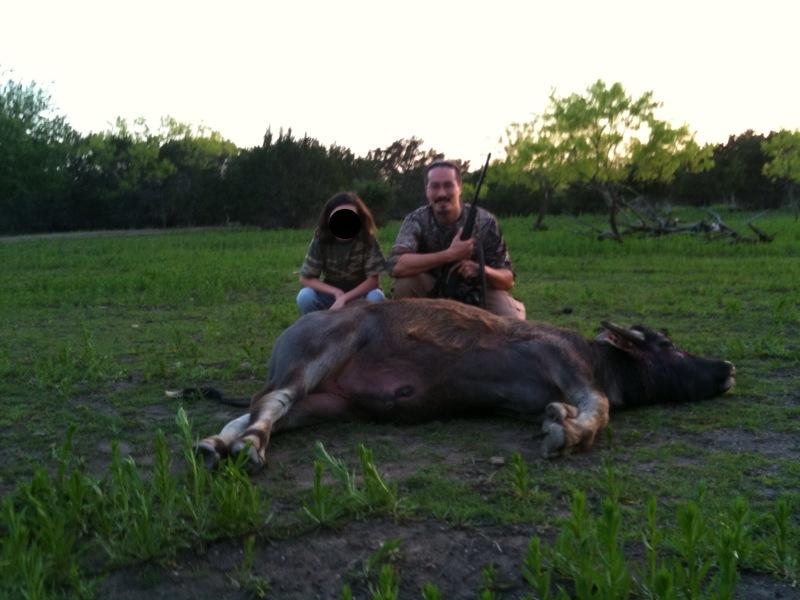
So a couple days ago I harvested a water buffalo.

I took the bulk of the meat to the butcher to be processed, but I kept a couple smaller pieces for myself to try out. I assume these are the tenderloins. You know the backstraps? They’re on the back of the spine. These cuts came from the front of the spine, down by the hips. Not very big.

I left them sitting in a pan in the fridge for about a day. The meat is red, very akin to beef. But there’s almost NO fat, no marbling. Maybe saw a dot of white here and there, but it’s mostly all just red meat.

I took the loins (I’m going to assume that’s what they are), cleaned them up, then cut off a couple small pieces (maybe 1/3″ thick?) and threw them into the frying pan. Totally plain. All I wanted to do was taste the pure meat with nothing to season it: no salt, no pepper, no smoke, no nothing. I want to know what this meat tastes like pure and simple, then we have a baseline and can figure from there what to do with it.

Oh Lord. It’s delicious. 🙂

It’s almost beef. I can’t put my finger on just what it is, because it isn’t cow beef. But it’s amazingly close in flavor. I figure if someone didn’t know what they were eating, they’d figure by the flavor they were eating cow beef. I want to say it’s a little richer tasting, a little stronger, but like strong in a good flavorful way… not like strong “gamey” or anything like that. Basically if you like beef, you’ll like this. Nothing to be afraid of.

Texture tho is different. I don’t want to say the meat is tougher than beef because I don’t think that conveys the right impression. It’s tender; sure cooking affects this and in my case it was in a medium heat pan for minute or two on one side then flip and another minute or two, just until you started to see the juices sweating through the flesh on the “up side”. But there’s certainly a little more chew to it than beef. Now, when we cut the loin to make these pieces we just cut. Looks like we ended up cutting with the grain. We made a few more slices against the grain and tried those. Made a fair improvement, but Wife pointed out something. Going against the grain helps on the initial chew, but after a little chewing it’s still the same sort of “chew” feeling in your mouth because the slicing only breaks it down so far… the rest of the breaking down that chewing does well, it’s the same in the end. But don’t let this deter you. It’s really not that bad, just different from beef.

Frankly, I’m stoked! 🙂

So, we’re about to commit heresy in the eyes of some. We’re chicken frying it. 🙂  Slicing up the loins against the grain, about 1/4″ to 1/3″ thick. A little flour, salt, and pepper (no heavy crust, just dusting), then into the pan they’ll go. Should be damn fine eating. Yeah it’s not high class, but I really don’t care. I’m about to wind up with a lot of it in the freezer… I’ll be able to be high-class and low-class and everywhere in between.

I’m certainly curious to see how the rest will turn out. For instance, how will steaks be? How will low and slow cooked roasts be? A beef roast in a crock pot could take 6 hours… would this need 8 or 10? A lot to figure out, but it’ll be fun.

BBQ Not Found

A few days ago I was in a business that had lots of old vehicle license plates decorating the walls. Some were just plain plates, others were vanity plates. One in particular caught my eye. Given it’s age (well before the Internet) I have to assume it the combination of letters and numbers was coincidence. I forgot to get a picture, but I can’t forget what the plate said:

BBQ 404

All I could think to myself was “BBQ not found? How sad.” 🙂

Perla’s

Had dinner at Perla’s Seafood and Oyster Bar last night.

Austin folk, if you like fresh seafood, especially raw oysters, you must check out Perla’s.

Atmosphere is relaxed, casual, but neat and trim. If you showed up in your summer shirt and shorts you’d be fine, or if you’re in a suit you wouldn’t be out of place. We dined inside, but they have an ample outdoor patio under the oak trees right on South Congress Avenue.

I had a half dozen oysters. I forget exactly which I had… they have about 20 different varieties. But they were quite good. I appreciated the freshly grated horseradish. Wife and I also shared their salt and jalapeño pepper fried calamari… quite good, not overdone at all (very easy to overdo it). For entrées, Wife had an angel-hair pasta with some Gulf prawns, watercress, capers, olives, and I forget what else was in the sauce… paired well with a pino grigio Manu Sauvignon Blanc (wife corrected me). I had a pan roasted grouper with morel mushrooms in a fantastic lemony buttery sauce; very delicate, well executed. We also shared a side of their lobster stock, cheddar & green onion grits — folks, you’ve never had grits taste so good. Finished off with a strawberry rhubarb tart, which on the plate looked like it was going to be a load of pastry but wound up being quite well balanced and not heavy at all.

Service was excellent. This isn’t a hoity-toity fine-dining establishment, but you can tell they care about service and providing not just quality food but a quality experience as well. I appreciated how the waiter knew what was going on, what the restaurant did and didn’t have. The waiter didn’t interfere too much in our meal, but you could tell he was always keeping tabs on things. Just very well executed.

Prices are on the expensive side, but I’ve come to expect that whenever you go to a seafood place that doesn’t consider seafood to be “catfish”. 🙂  I like catfish, but I hope you understand the differentiator here.

Thing is, as I look at the Yelp reviews, Perla’s seems to be a mixed-bag. We had no problems with service, but that seems to be their biggest problem. Maybe it was because we had a special night there (and making prior reservations sure helped). Maybe it was because we came on a Tuesday night a little earlier than later and they certainly were not full (not empty, but certainly no one was waiting for a table). Who knows. But the end result was we had a good experience. Maybe the lesson is to make reservations and go at off times?

Anyway, I’ll certainly go back. Hopefully it will be another home run when I do.