Bacon wrapped suppressors.
Bacon wrapped suppressors
Bacon wrapped suppressors.
Bacon wrapped suppressors.
Via TacticalGunReview.com I found this TexasBoars.com forum thread. Because of that and some other things I’ve had well… I wanted to make one good posting about feral hog anatomy and kill zones, so I could have a good “one-stop” reference on the topic. So whenever I need a refresh on the topic, I can just pull up this article and have all resources in one spot.
I’ve spoken about feral hog anatomy before. That article included one of the better hog anatomy pictures I’ve seen:

Feral hog anatomy
TexasBoars.com has a great article on feral hog anatomy. They provide a nice shot placement picture:

Feral hog kill zone (from TexasBoars.com)
Speaking of shot placement, the California Hog Blog talks about shot placement. They have great graphics showing the neck shot:
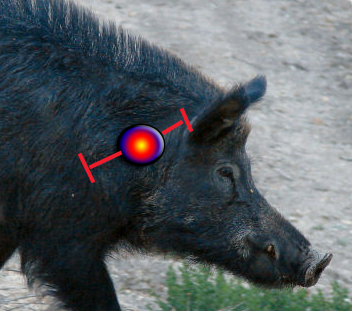
Feral hog kill zone - neck shot (from California Hunting Today's Hog Blog)
and the more traditional kill zone:

Feral hog kill zone - traditional zone (from California Hunting Today's Hog Blog)
But while all of these are good, the TexasBoars.com forum thread has something that brings it home better than any other thing I’ve seen.
Is it this picture and description of the kill zone?
Feral hog - spine highlight (from TexasBoars.com)
Here it is. A simple highlight of the “drop a hog in its tracks zone” DRT.
Don’t make the shot any further FORWARD or by NO MEANS any further BACK into the rib cage.If the head is NOT DOWN the line would be horizontal.
The IMPORTANT FACTOR is don’t shoot high! If you shoot high the hog will likely hit the ground,, and then get back up once the “stinger” in the spine subsides as addressed in the video. If you hit a little low, thats OK.
A sign that a shot is HIGH is a SQUEAL. If the pig hits the ground and SQUEALS you should shoot it again to be safe. If the lungs or trachia are damaged and completely bruised the hog will not be able to squeal generally speaking.
No… it’s something else in the thread:
While the topic of the thread and video is more about bullet construction and performance, Kevin Ryer (TexasBoars.com’s admin) takes a freshly killed feral hog and dissects it. While doing so, it becomes very obvious where the kill zone is and why that’s the important kill zone.
Why does this matter? Because for people used to hunting deer or other such animals, the kill zone on a feral hog is slightly different. The chest cavity is a small target. It’s very low and forward. While the animal presents a large side to you, if you divide the animal in half horizontally, the lower half is really all you have to work with because of how the spine slopes as it approaches the head.
Here are a screen shots from the video that show what I’m talking about.
First, here’s where the 250# hog was shot in the shoulder. Entry wound. The knives are pointing to the hole, square in the shoulder.

Feral hog dissection - entry wound, square in the shoulder.
He then cuts through the shield, removes the front leg, then gets into the chest cavity.

Feral hog dissection - location of spine
Kevin is holding the knife blade along the spine, and his left index finger is also pointing to it. Notice how the spine is about half-way through the animal… that is, about half their body is above it and half below it. This is lower than on a lot of other animals. Notice the bullet wound is below the spine. You have to aim lower than you may be used to.
And while the screen shots are nice, you really need to watch the entire video. There are a lot of comments Kevin makes, a lot of things he goes through. And again, while he’s focused on discussing the use of a fragmenting bullet, there’s a lot of importance placed on understanding anatomy and ensuring you get the bullet into the proper kill zone. It’s a well done video, and Kevin deserves much credit and thanks for making it.
The key thing is you have to shoot a little lower and a little more forward on a feral hog than you would on a deer. Think midline or a little below midline, and forward since the chest cavity isn’t that big. The target area is small, and, as Kevin points out in the thread discussion (read it!), depending what firearm you’re using it may be smaller. Shots have to be good and you have to know the anatomy clearly so you can ensure a good shot.
Thank you, Kevin, for all your work. It dispels a lot of myths and helps out a lot of hunters.
The trailer food scene is booming in Austin, and there are some really choice finds.
Since it’s my blog, I’m happy to plug The Flying Carpet, owned by two long-time friends of mine.
They just got a nice write-up.
Austin folks… give this place a try. There is NOTHING else like it in Austin (seriously: there’s no other Moroccan food place in Austin).
The food is simple, but ever so delicious. And it’s run by two of the warmest, kindest people I know. Support your local folk. 🙂
A friend of mine is in town.
He wanted to try the water buffalo.
I figured hey… I’ve got that new smoker. Why don’t we try smoking the water buffalo ribs?
And so we did.
Temperature was about 250º. Kept ’em in there about 8 hours. Used charcoal to get things started, but then it was all split oak wood logs from there. Just had the ribs with salt and black pepper overnight, then once I put them onto the smoker I rubbed them down with extra virgin olive oil. Closed the lid. Let it roll for 2-3 hours, then wrapped the ribs up in foil for the remainder of the cooking time.
The rule has been low and slow, thus the 250º and the longer cooking time. The meat is so lean, I figured the olive oil would help, plus wrapping them up in the foil for the bulk of the cooking time would help retain what moisture there was.
Thirty minutes before pulling them off the racks, I gave them a baste with some Stubb’s original BBQ sauce.
How did it turn out?
Well, a lot better than expected, but still not hot. Plus, I think we set our expectations kinda low to begin with.
They were a little dry, but what can you expect? This has been the biggest challenge with the meat. Due to the need to break down those muscle fibers, you have to cook for a long time over low and slow heat. But, that just leads to dryness, and given how lean the meat is there’s not a lot of moisture to go around for that long a time. I’m sure there’s a way to do it, but we just haven’t yet figured it out.
Flavor was good. And it was generally tender.
But the thing that we continue to struggle with is something that I don’t think there’s any way around: the texture. The muscle fibers are just thick and long (compared to beef). So it just makes for a different texture, and one that’s tough to deal with. My friend liked the flavor, but after trying to eat some more he just couldn’t… the texture just wasn’t doing it for him (and he admits, texture of food matters a lot to him). If I trimmed the meat off the bones and then cut it against the grain, it wasn’t so bad (the “chunks” of muscle fiber were made small). Even I found myself not rushing back for seconds because while the meat itself was about as tender as you could get it, the combination of that plus the fiber issue just makes for a less than pleasing mouth experience.
That’s been the general experience no matter how we try cooking this thing. Flavor isn’t bad, we can get it into the ballpark of tender, but the texture is always a problem… and while lean is good on paper, it’s not helping with these big-ass muscle fibers. It’s not the same as other game meat that’s lean, when it comes to cooking and preparing it.
It was suggested to me to try a marinade that includes papaya, since it contains an enzyme called papain. Apparently, papain cleaves the myosin (muscle) fibers at the fiber head which basically makes it impossible for the fibers to re-associate. Supposedly papaya-based marinades can turn chicken into mush in a few hours. So who knows. I think it’s worth a try.
Anyway… I must admit that the household is getting tired of the buffalo. Probably a little frustration, both at cooking and at eating. We’ve had the most success with ground (you really can’t tell the difference vs. ground beef) and with doing roasts in the crock pot (i.e. low, slow, and tons of moisture) but even the roasts in the crock pot still end up with you contending with big thick muscle fibers to chomp through.
We’ve still got a bunch in the freezer. We’re going to keep plowing through it as best we can. The experience is good for us all, and while Wife keeps saying “when we do this again, we’ll get it mostly ground and a few roasts”, I keep interrupting her and saying “if we do this again”. I won’t make up my mind until the freezer is empty, because while the experience has had frustrating moments, it’s still an interesting journey to take.
I’ve always wanted to eat at one of those Brazilian steakhouses.
I finally got to tonight.
It’s an endless parade of meat.
Bliss.
Took the family to Red Lobster last night.
Yeah, it was expensive… seafood generally is.
But watching Oldest having the time of his life as he ate his first whole lobster (shell-cracking and all)? Worth every penny. He even wore the bib. 🙂
So…. how did the brisket from the new smoker’s maiden voyage turn out?
Pretty good!
The meat itself was tender, juicy, good flavor. After 10 hours in the 200º-250º range, it did well.
There was a little bit more blackening on the exterior than I cared for, made things bitter, but avoid that and it was quite good. I admit I didn’t watch the actual meat as much as I normally did. See, with the Weber I had to take off the lid to add fuel thus I always checked the meat. When I was doing the initial burn in this new smoker I realized how the big lid was well… a big lid. If you open it, all that heat and smoke was quickly lost, so I did my best to NOT open the lid to look at the meat. Just trust the time (you know it’s going to be at least 6-8 hours), but by then it was too late.
A few things learned about the new smoker:
Anyway, the main thing here is the Hondo itself. No, it’s not perfect, but it seems to do the job just fine. I’m going to see what else I can do to tweak it.
When I bought my first house so many years ago, one of the first things I put in the backyard was a Weber kettle grill. Life was good. The way I grew up, that sort of “outdoor cooking over a fire” just meant grilling. To “BBQ” or to “grill” were interchangeable terms. And if you were smoking something, it typically involved something in rolling papers or a pipe. But you can’t live in Texas and not come to learn that grilling is one thing, BBQ-ing is another, and smoking is yet a third thing.
Some years ago I bought one of those upright bullet smokers. I hated it. I ended up keeping it for a number of years tho because it made for a good storage container to keep my wood chips dry.
I came to realize that most of my uses of the Weber grill were indirect grilling, so I thought why not make the best of what I’ve got and use it for BBQ’ing and smoking? I bought a proper thermometer, drilled a hole in the lid, and now that I could better control and monitor the heat, I actually made out for a good many years using the Weber grill for smoking. The main problem? The grill surface is small as it is, so when you smoke you lose a lot of what little grill space you have so you just can’t do a whole lot. I’d have to smoke smaller briskets or only one rack of ribs. But I pressed on because I couldn’t justify buying something new while the Weber was still kicking.
Well, the Weber is no longer kicking. It finally wore out enough that I cannot control the heat adequately, so it’s time for a replacement.
As I started to shop for a replacement I knew what I wanted to look for: a big, heavy, offset-side-box smoker. I wanted a lot of grill surface area so one could hold a lot of food or just larger food e.g. a whole feral hog hind quarter. It needed to focus on smoking, but some grilling ability would be useful. No need for an upright box as I won’t be doing much stuff that hangs. And I wanted something high quality, because I know if I got something good that it would last me for decades.
Then I saw the prices on these things. Cheapest ones might be $1000-$1500, and of course you could go up from there. Yikes! I just don’t have the ability to drop that kind of money right now.

New Smoker. Click to embiggen.
So I compromised and have a New Braunfels Hondo Smoker. New Braunfels Smokers went out of business I believe about 8 years ago, but Char-Broil bought their IP and still sells under their brand name. It would appear that Char-Broil’s American Gourmet Deluxe Offset Smoker is the same thing. And it cost me only $150.
Yes. It’s cheap Chinese crap. Yes, it’s somewhat thin sheet metal. Yes, it’s got cheap plastic wheels. Yes, I figure the firebox is going to burn out within a few years of heavy use. Yes it doesn’t seal tight enough. Yes I had to buy a couple proper thermometers and install them myself. But you know what? It only cost me $150 (and $20 for the 2 thermometers).

The smoker, lids open. Click to embiggen.
What convinced me to do it? The Internet. I started my general research into new smokers and in that general searching this smoker (or models just like it) kept coming up and getting pretty good reviews. Yes people admit it has limitations, it is what it is, you get what you pay for. But that for that money, it’s actually not too shabby. Furthermore, a guy wrote up an article about a few inexpensive modifications to make that really help the quality. I haven’t made the modifications because it looks like my version of the Hondo is “new and improved”, having a large tray within the body so you could use it as a big charcoal grill, plus there’s a warming rack in the lid. I’m going to try it out as it is and experiment with what I’ve got because the coal tray could work as the heat shield and deflector… don’t know, will need to experiment. And really, experimenting is half the fun.

Close-up of the interior (click to embiggen). Note the inner tray? That's for charcoal to use the thing as a grill. I'm going to play with it as a heat shield (yes, the slant is my intentional first experiment).
The way I see it? It’s training wheels. Yes, I know how to grill. Yes, I know how to BBQ and smoke. But I haven’t used this sort of setup before. So why not buy something inexpensive to help me learn about this specific cooking implement. It will also help me learn what I like and don’t like, what I want and don’t want. That way when I do go to plop down a big chunk of change for a custom smoker (new, or even a used one off craigslist) I can know exactly what I want and don’t want and be able to buy just the thing that will keep me happy for the rest of my life. I’ll feel better buying this way than shelling out a lot of money now for more expensive training wheels.
A few days ago I pulled a beef brisket out of the deep freeze. Last night I applied a dry rub and let her sit in the fridge overnight. This morning, I put her on the smoker for the maiden voyage. Started with charcoal but put a small log of oak for fuel and flavor. I am glad I bought two thermometers because the temperature difference between the left and right sides is significant (again, playing with heat shields will be critical here; someone also suggested putting a few heavy bricks in the bottom to help with heat control), but it leaves about 2/3 of the grill area free for use, so that’s good enough for now. Been slowly adjusting the vents to keep the temperature where I want it. But so far so good. This brisket may not turn out primo, but it’s all part of the learning and fun.
We’ll know in about 8 hours. 🙂

The smoker, maiden brisket inside.
Watching the local morning news, weather report comes on. I see stuff about Fredericksburg, TX and say to Wife “Want to go there today?” Just on a whim. And off we went. I’ve been wanting to take the family out there for some time, just because. It’ll be good to go in a month or two when peach season kicks in. But hey… we had time today, so seize the day!
Drove out. Stopped at Whittington’s for some of their awesome jerky. Wanted to stop in Luckenbach but opted to save that for next time (we were getting hungry). I figured if we’re going to Fredericksburg, we need to eat German food. Yelp seemed to have mostly favorable reviews of Der Lindenbaum, so we gave it a try. I’ve had some German food in my life, but despite my ethnic heritage (look at my last name!) not a whole lot of it — when Mom is in charge of cooking well, that’s why I ate a lot of Korean food while growing up. 😉 So really, this was a “first experience” for the whole family.
Everyone was pleasantly surprised, even Oldest got adventurous. I had a beef sauerbraten (made with raisins), Wife had a jager schnitzel, Oldest had some bratwurst, Daughter a cheese-potato soup (can’t remember the German for it), Youngest had a wiener schnitzel. Very good stuff all around. I loved the cheese in the soup, very hearty flavor but not overpowering. I really liked how the raisins in the sauerbraten and this red kraut (which was both clove-sweet and sour) mixed together. But for my money, it the jager schnitzel was the winner — I’m having that next time. But of course, I think next time we ought to try one of the other German restaurants in town.
We perused the shops. Wife found some nice clothing. Kids all found some cute toys in a toy shop. Me? I was just happy to be with my family.
On the way home, stopped into a vineyard. Which? We just picked “the next one” along the road (and one that I hadn’t been into before). This one was Grape Creek Vineyards. Did a tasting, 6 wines apiece. Wife and I overlapped on a few wines, but for the most part we tasted different things because we have varying tastes: she likes lighter, sweeter stuff, whites more than reds; I like more robust, drier, reds more than whites but I also like a good port. Now, I’m no wine snob or even all that wine educated… I just know what my taste buds and my nose like and don’t like. So with that….
Not a bad place really. Certainly one of the better Texas wineries I’ve been to in recent years.
Anyway, just a damn good day with my family. Life can’t be all work. And I got to spend it with the people I love most. 🙂
So Wife did some water buffalo meatballs the other night.
Fantastic. In fact, arguably better than beef. For some reason the texture was smoother, kinda velvety.
These experiences with the ground water buffalo convince me that going with ground meat would be a good way to introduce folks to water buffalo. Since the meat is so heavily broken down by the grinding, there’s no texture issues to have to worry about so all the person deals with is the flavor. Flavor is generally what will convince someone, and texture is usually going to be either a non-issue or a turn-off. Ground takes texture almost entirely out of the equation, so it’s all about the flavor.
Plus, ground allows you to do simple things that won’t freak people out too much, like burgers or meatloaf or meatballs. It’s simple to cook. You don’t have to worry about “cooking it right”, especially if learning the ropes. Which means, if I was going to give some buffalo meat to folks, I’d probably give them ground.
The journey continues….

 Stuff From Hsoi