There’s more to it than “mah head on a swivel”

It seems any time the concept of “situational awareness” comes up, someone eventually trots out a tired phrase about having my/your “head on a swivel”. As if situation awareness is about constantly rollicking your head back and forth.

The other night, Wife and I were on a dinner date. As we were leaving and about to exit the building, I see on the other side of the door a small group about to enter. At the head of the line was a man being pushed in a wheelchair, followed by a woman leading a blind man (white cane). The door opened outwards (towards them), so it made best sense for Wife and I to just step aside so they could come on in. The man in the wheelchair was pushed in and went past us clearing the walkway, with the pusher eventually stopping to turn back to the rest of his party to decide where to sit.

Woman leading the blind man stepped just inside the door and stopped in front of us to respond to the “where to sit” question. She seemed completely oblivious to the fact she’s stopped in the doorway, blocking it, and that there were people waiting on them to move.

But who did notice?

The blind man.

He was standing right in front of me and after a few moments said to me “Sir, are we blocking your way?” I responded “No worries, you’re good.” And after a few more moments they were on their way and we on ours.

I don’t know how much vision the man had, but I suspect none. The bottleneck of the door area was tight, so the man was stopped literally in front of me – a distance that would normally be considered WAY too close for comfort. I guess he heard me there – breathing. I wasn’t being huffy or anything, just normal respiration.

But he noticed I was there.

He was the most situationally aware of their group.

And there was no ability for him to have “his head on a swivel”.

Yes, it’s important to have your head up and look at what is around and what is going on around you. But we have more senses than just our eyes. We can hear. We can smell. And we can even have that “Spidey sense” that tingles when our gut tells us something is off.

Think about how “situational awareness” can and should involve (all of, more of) your senses. And think about how abridging any of your senses can be a detriment to that same awareness.

Because it’s more than just looking around.

Listen to the 911 operator, but blindly obey them? Well…

You call 911 for whatever reason, usually because something bad or dangerous is occurring.

What is the 911 operator going to do? They’re going to ask you a lot of questions. They have to ask questions because they aren’t there with you – they don’t know what’s going on and have to rely upon you to tell them. They are trying to assess the situation to determine who to send (police? fire? EMS?), and then to help relay as much information as possible to the responders so the responders can respond accordingly and know what they are about to walk in on.

This is quite reasonable.

However…

I am of the opinion that you do not and SHOULD not BLINDLY follow the directions of the 911 operator.

Should you listen to them? Yes.

Should you work to be as helpful as possible? Yes.

Should you risk your own personal safety? No!

Case in point (and what motivated me to write this).

Friends of mine woke up to a truck idling outside their house. The truck’s front bumper was pressed up against the tail their son’s car (parked on the street). Car running. Driver passed out.

911 operator told them to turn the car off.

Nope. Sorry.

That would require  me to approach the vehicle. That would require me to reach into the truck and/or open the door, and otherwise interact with someone that is demonstrably not within normal faculties.

Consider as well there have been numerous events where people have observed crime occurring, reported to 911, and the 911 operator tells the caller to follow the criminal! Often the caller proceeds to follow the criminal, risking their personal safety.

For example, Paul Saustrop was an Austin, Texas CHL holder who 911 dispatchers told to follow the attacker that had threatened him and his wife because there were no officers available four blocks from the police station. It resulted in a defensive shooting where the press crucified him for “chasing down the victim”. All kinds of errors there:  starting with listening to the dispatcher and following the threat. (h/t to John Kochan for jogging my memory on this event).

Why does this happen? One explanation is obedience to authority figures. See the Milgram Experiment.

Of course, it’s your choice to actually follow-through with any request from the operator because you are there and have better knowledge and context about what’s going on. Just remember, while the 911 operator may have requested it, if you feel it’s a risk to your personal safety, exercise judgment and politely refuse.


Unarmed does not equal Harmless

Next time someone starts to equate “unarmed” with “not dangerous”, tell them about Louis Campos.

[Louie] Campos and his younger brother were in line for the Vanguard, a bar on Fremont Street [in Las Vegas], when they were approached by two men around 1:34 a.m.

“One of them said, ‘What are you looking at?’ or ‘Do you have a problem?’ I can’t remember what his exact wording was, and then he struck my brother,” Drake Garibay said.

[…]
The punch was so severe it knocked Campos out and caused brain bleeding. Paramedics rushed him to the hospital, but he never regained consciousness and died Thursday.

“He got robbed of his life, murdered. And the whole thing is we need to get this out there to find him so justice can be served,” mother Joyce Garibay said.

Full story (h/t Marty Hayes)

People have this mistaken belief that just because someone is “unarmed” it equates to “not dangerous” or “unable to inflict harm”.

There are countless incidents that tell otherwise. Louie Campos is unfortunately the latest.

Unarmed ≠ Harmless

ProArms Podcast – Episode 099 – John Daub

In early April 2017, Massad Ayoob came to KR Training to teach his MAG-40 class.

Mas had asked me if I would be willing to speak to the class about my January 2015 incident. Gail Peppin asked me if I would be willing to be interviewed for The ProArms Podcast. Of course I was happy to do both. In the end, we settled on Gail recording my talk to the class, as the podcast content.

Episode 099 of The ProArms Podcast contains my talk to the class.

photo credit: Gail Peppin

I want to reiterate why I share this story.

First, in a way it helps me cope and deal with the incident. It’s a part of my life history, I will never escape it, so I own it. Sometimes when I talk about the incident, because of listener reactions or questions I find something new or different to think about. It helps me deepen my perspective on the event, on myself.

Second, and more importantly, I share it because I want something good to come from this incident. It is a tragic incident, and I hope through sharing my experience somehow good can come from it. Since the day of the incident, I’ve maintained this stance, and will always proceed with this goal. When I made my first public comment about the story I said:

I never wanted such a thing to happen, but it did and I can’t undo it – my actions, the actions of the others involved that lead up to and enabled this situation to happen. The best I can do is try to find something positive from it. To try to find some way to make the world better from it. One hope is that it brought the problems with the group home into the public eye; perhaps the lives of others will be improved because of this event, if it means bringing better protections, better oversight, better living conditions. Time will tell. But I will not sit by and just let time pass; I fully intend to be active in making good come from this event.

Sharing my story is part of my effort to make good come from this event.

And if this is your first time hearing this story then I ask you – and if this is not the first time, I ask you again – please pray for the repose of the soul of Jared James, and please pray for his family, that they will be able to find peace.

Thank you.

Which matters more? Capacity or…

My esteemed colleague, Claude Werner, penned an excellent analysis: Revolvers will get you killed – Or will they?

You see, Claude likes data. He likes to collect it, analyze it, interpret results, and in presenting his data he often rocks the boat. It’s one thing I love about Claude.

In this particular article, Claude discusses a recent article that posited armed citizen encounters rarely need more ammunition than what’s in a concealed-carry revolver (5-6 rounds).

Of course, in today’s world where increased magazine capacity is a huge marketing/selling point, only carrying 5-6 rounds tends to be scoffed at. So of course, Claude presents data.

Claude’s data shows the number of shots fired ranging from 0 to 2.

We can also look at Tom Givens’ student incident data, where the average was 3-4 rounds.

Thus, it’s reasonable to conclude that “seldom” does one need more than 5.

In my own incident, I fired 5 rounds.

But here’s where perhaps Claude and I differ.

Because you see, statistics are of little comfort when you are the anomaly.

Looking at the Givens data set, the range of shots fired ranges from 1 to 12 (last I saw the data summary it was 11, but I think recently it went up to 12). That 5-shot snub ran empty long ago. I think about my own incident, and while it was unfolding I was expecting there to be “friends”; if I had only a 5-shot revolver and if my situation was different, I’m not sure how things might have gone.

So this isn’t to say that there isn’t a place and a role for smaller, lower-capacity guns. I have them, and sometimes I carry them because they are what’s contextually appropriate. But for me, if I’m in a situation where I can carry something bigger with greater capacity, I will. Because why not? If all other things are equal, why choose 5 when I can choose 15? Because one thing I can NOT choose is how my self-defense incident is going to be and what I’m going to face.

But I didn’t come here to beat the dead horse of “capacity”.

Because if you read Claude’s article (and I can tell by my website analytics that you haven’t clicked through to read it… which is a shame, and your loss), you’ll come to see what matters MUCH MUCH more in terms of a self-defense incident.

For you see, while the hard-skills of shooting are certainly important, there are skills involved in private citizen self-defense incidents that matter so much more.

You’re just going to have to read Claude’s article to learn.

$1 Million Legal Defense Fund

With all the brouhaha currently going around in the “self-defense legal fund/insurance” world, I thought it was worth noting a significant milestone.

The Armed Citizens Legal Defense Network now has $1,000,000 earmarked for the legal defense of members after a self-defense incident, as well as helping with bail, if needed. As well, they have upped the initial-representation deposit from $10,000 to $25,000 (if needed).

You can – and should – read all the details here.

Congratulations to Marty, Gila, and all those who worked to bring the Network to this significant milestone. 🎉

(Disclosure: I am a member of ACLDN and have utilized their legal services. I receive no compensation or anything for mentioning this; I’m just a “satisfied customer” who by his own free-choice wishes to promote an organization he strongly believes in.)

KR Training 2017-04-22 – BP2/DPS1 Quick Hits

Saturday April 22, 2017 was another fantastic day at KR Training. On tap: Basic Pistol 2 (our Defensive Pistol Skills Essentials) and Defensive Pistol Skills 1. These are two of the core – and arguably most important – classes we teach. It’s here that students go from casual plinking at the range to starting to acquire the skills and understand the realities involved in using a handgun for self-defense.

We had a good turnout, with over a dozen students in the morning, and over half staying for the afternoon class. For those all-day students it’s a long day, but one packed with learning and growth.

A bit of an interesting day too, as the weather took a “pleasant” turn. Instead of the warm weather we’ve been having, a cold front blew through just as class was starting. Sure 60º–ish all day isn’t that cold, but the wind was strong and bitterly cold; not all students were prepared for it. I can’t totally blame folks, but now instead of my usual “wear sunscreen” I’m going to have to start suggesting to people to ensure to always bring clothing/gear to mind the weather – even if it doesn’t make logical sense, because days like today apparently do happen. 😉

As well, I was the Lead Instructor for this day. Karl was off at the annual A Girl and A Gun Conference, so I held down the fort. I had capable assistants in Larry, Brett, and Justin. We had a mix of students: young and old, male and female – we ran the gamut. Again, I always like to point out demographics because there are people who think they know who and what gun owners are, but really have no clue.

John Daub, instructing students on the range during KR Training’s Basic Pistol 2 class.

As for some quick take-homes:

  • Trigger press. Remember? Prreeeeeeeeeeeeeeeesssss. Apply smooth pressure. Yes the pressure will and must increase, but keep it smooth (not sudden).
  • Grip should be strong (“Homer choking Bart”), and consistent. When you are holding the gun in the ready position, be gripping HARD – don’t tighten up when you get the gun out and in response to pressing the trigger.
  • Going fast is important, but not at the expense of accuracy. At this stage I’d rather you work on good mechanics, establishing good technique, and working to get acceptable hits. Speed will come.

One other thing.

For some, it can be a hard day. Not even so much on the skills and direct learning aspects, but what you go through, what you put yourself through. There can be a lot of emotions, a lot of discomfort. These two classes are filled with novel experiences, and sometimes uncomfortable experiences.

But guess what?

You made it through.

You are more aware.

You are stronger.

You are more capable.

And that smile on your face tells me, it was a good day.

Thank you for coming out and training with us. Thank you for putting your faith and trust in us, to help you learn and grow in such an important aspect of your life.

Practice well. Train hard. We’ll see you out on the range.

BART takeover robbery

BART police are beefing up patrols at Oakland stations after dozens of juveniles terrorized riders Saturday night when they invaded the Coliseum Station and commandeered at least one train car, forcing passengers to hand over bags and cell phones and leaving at least two with head injuries.

The incident occurred around 9:30 p.m. Saturday. Witnesses told police that 40 to 60 juveniles flooded the station, jumped the fare gates and rushed to the second-story train platform. Some of the robbers apparently held open the doors of a Dublin-bound train car while others streamed inside, confronting and robbing and in some cases beating riders.

Full story

Shocking and scary.

You’re just trying to get home on the train, when your train car gets flooded with a mob of teenagers. They rob you, they beat you, and within seconds they’re gone.

You’re trapped, because there’s only a couple of exits and they’re all blocked by these criminals, these predators.

It’s crowded, and there are superior numbers.

Trost said police arrived at the station in less than 5 minutes, but that the robberies took place in just seconds.

When I read the article last night, there was a quote to the effect of “we’ve hundreds of miles of track and dozens of stations – we can’t have police everywhere”. The article seems to have been updated to remove that quote. Whatever the exact wording was, the message was clear: the police cannot always be there to protect you as there’s just no physical and realistic way.

Your life is in your hands. It’s well-worth acknowledging that reality.


“But he was unarmed!” – Maybe so, but he could still kill you

It’s a widely held misconception that an “unarmed” person – someone with only their hands, without tools (gun, knife, baseball bat, hammer, 2×4, etc.) – is not dangerous, is not harmful.

Robert A. Margulies, MD, MPH, FACEP speaks with the ACLDN about blunt force trauma lethality.

A blow to the temple area where the skull is relatively thin can actually cause a fracture in that area and tear the underlying artery. This can produce permanent disability, and can cause death.

A blow to the back of the neck can dislocate the spine and cause paralysis or death. These are things that one does not really have to be a trained martial artist to do. Blows to the nose, to the back of the neck, to the throat are examples of “empty hands” that can produce disability or death.

Head and face trauma has an interesting aspect to it. It is not just that somebody has been hit in the face, but bleeding and swelling of tissues can also lead to airway blockages. Bleeding in the mouth can lead to swallowed blood, which is very irritating and can cause vomiting which puts somebody at a disadvantage, but also leads to the risk of aspiration. That is, the vomit is trying to come up and out, and you’re trying to breath in, and you suck some of this stuff down into your lungs. All of these things can become fatal, even though this was just a broken jaw and a little bleeding.

A blow to the ribs can cause injury to the liver or the spleen, both of which, in the vernacular, bleed like stink. Surgery is extremely difficult because the liver and the spleen are not like muscle where you can isolate a blood vessel and get control, they’re spongy and trying to suture is like trying to sew gelatin—it is difficult! It requires a highly trained team to be able to salvage somebody who has a shattered liver or spleen. Spleens can be removed and the patient can survive. Humans do not do well without a liver.

Dr. Margulies continues:

Unequivocally not. I consider hands and feet, knees, elbows and shoulders, to be deadly weapons. Once that first blow is delivered and once you go to the ground, the kick to the head, the knees in the chest, may produce permanent injuries and fatalities. I’m going to give you a reference to an article in the Journal of Head and Face Medicine, published in October 2005 (see http://www.head-face-med.com/content/1/1/7 – B10). One of the comments in it is that as of 2005, we in developed countries have a level of facial injuries caused by interpersonal violence exceeding those from motor vehicle crashes. This is not a new concept or a new problem.

I won’t question the fact that tools enable us to do things more efficiently, more effectively – that’s why we humans are tool creators and tool users. However, the lack of tools does not preclude a human from inflicting deadly harm upon another.

Please understand this.

Being reluctant to shoot, but eager to know

On April 1, 2017, KR Training ran it’s Defensive Pistol Skills 1 and Defensive Pistol Skills 2 classes. It may have been April Fools Day, but what I want to talk about is no joke.

These particular classes are about gunfighting. These are classes were we work to impress upon students the reality of self-defense with a handgun. It’s fast, it’s ugly, it’s full of pressure. You have to perform at a high-level, usually starting from a deficit, and you must make split-second decisions (these classes are often a sobering reality and wake-up to students).

It’s that last part – split-second decisions – I want to talk about.

Context

Let me explain the context of class.

In DPS-2, we run each student through a shoot house scenario. The intent of the exercise is to introduce students to the notions of moving through structures, use of cover and concealment, and target discernment.

Target discernment.

You see, upon our hip we have a hammer – but we must realize that the world contains more than nails. What complicates matters is some things may appear to be nails, but really are not. Furthermore, we are “good guys”; which means we operate within the constraints of the law, both the laws of men and the laws of morality.

In terms of a curriculum progression, certainly it makes sense to first teach people general marksmanship as well as basic default response to a threat; you have to teach foundational and fundamental skills first. Once people begin to understand the fundamentals, you progress to more complex, complicated, and advanced concepts. One of those is target discernment.

Setting

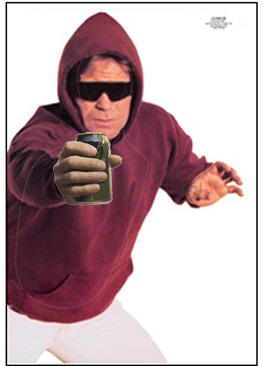
In this particular run of the shoot house, the situation was framed that you have pulled up to your home in your car and parked in the driveway. You get out of your car and you see… this. The “this” starts out with 2 targets across from you: one is a reactive target (i.e. if you shoot it properly it will fall down) with a threat indicator (a gun), the other is a reactive target with a not-threat indicator (hands up). The student begins by analyzing what they see and responding accordingly.

The student is then to move “into the house”. As they approach the opening, they see way down the hallway – about 15-20 yards away – this target:

When you look at this picture from the comfort of your office or living room, with no pressure, no need to make a decision, as you casually read this article, you can probably figure out what it is that you are seeing.

But when it’s 15-20 yards away, when you have a split second to make a decision, when you are under pressure, it’s not so clear.

Discernment – is this a threat or not – is difficult. Just because it is difficult, doesn’t mean it isn’t important; in fact, it means we need to work harder at it.

Reactions

With about a dozen students in class, responses were wide and varied.

Some people immediately extended their gun and shot.

Some people started to extend their gun, but realized they weren’t sure what they were looking at. (some thought “a grenade?”)

Some people stepped aside (out of line of sight, behind cover/concealment).

Some immediately questioned what they saw.

Some where not sure what they saw and what to do.

From there, responses continued typically with my interaction (i.e. me playing the part of either a “narrator” or role-playing the target).

Of those who wondered or weren’t sure what they were seeing, I asked them what they thought they should do. The basic idea? If you don’t know what it is, work to gain more information so you can become more certain about what it is. Some people wanted to get closer, and while that’s an understandable reaction, it’s not necessarily the safest tactics. What else could they do? They could shout commands, like “DROP IT!” If they did this, I roled-played the target and he dropped it. Of course, another solid response is “don’t go in the house at all; back out and call the police” (that’s really the best general response, but for purposes of the exercise we continue forward).

Of those that were quick to go to guns, I asked them why they did so. Some said “he was in my house”. One gentleman didn’t have his contacts in and wasn’t totally sure what he was looking at, but the general appearance and context was enough for him to perceive a threat. Generally afterwards, showing them what the target actually was caused a bit of reconsideration.

What’s key here is how people perceived the (total) situation, how they assessed threat, and how they chose to respond.

Response

I’m not going to fault any student for whatever their response was. This is class. This is the place to come to make mistakes, to learn, to become better. One of the hallmarks of training is how it provides a forgiving learning ground to learn what to do and what not to do, so when you actually have to do something in the unforgiving real-world, you can do it better and minimize chances of doing it wrong (and risk making things worse).

There’s a few take-homes here.

First, realize how situations can unfold. This scenario started with a context of “trouble”, so human nature is going to expect trouble to continue. When you see something else that’s abnormal – in this case, a strange person supposedly within your home thrusting an object towards you – when a split-second decision needs to be made, we process the situation based upon what information we have.

Take for example a recently released dashcam of an Opelika, Alabama police officer shooting a man on the side of the road in 2014. Every police officer knows that road-side stops are one of the most dangerous events in police work. It’s dark. Pull up on scene, man goes to exit his vehicle. As he exits, he turns towards the officer, something dark in his hands, and he clasps his hands together.

As the situation is unfolding, what might that officer be thinking?

Here’s a freeze-frame from 0:23 into the video. What does that look like?
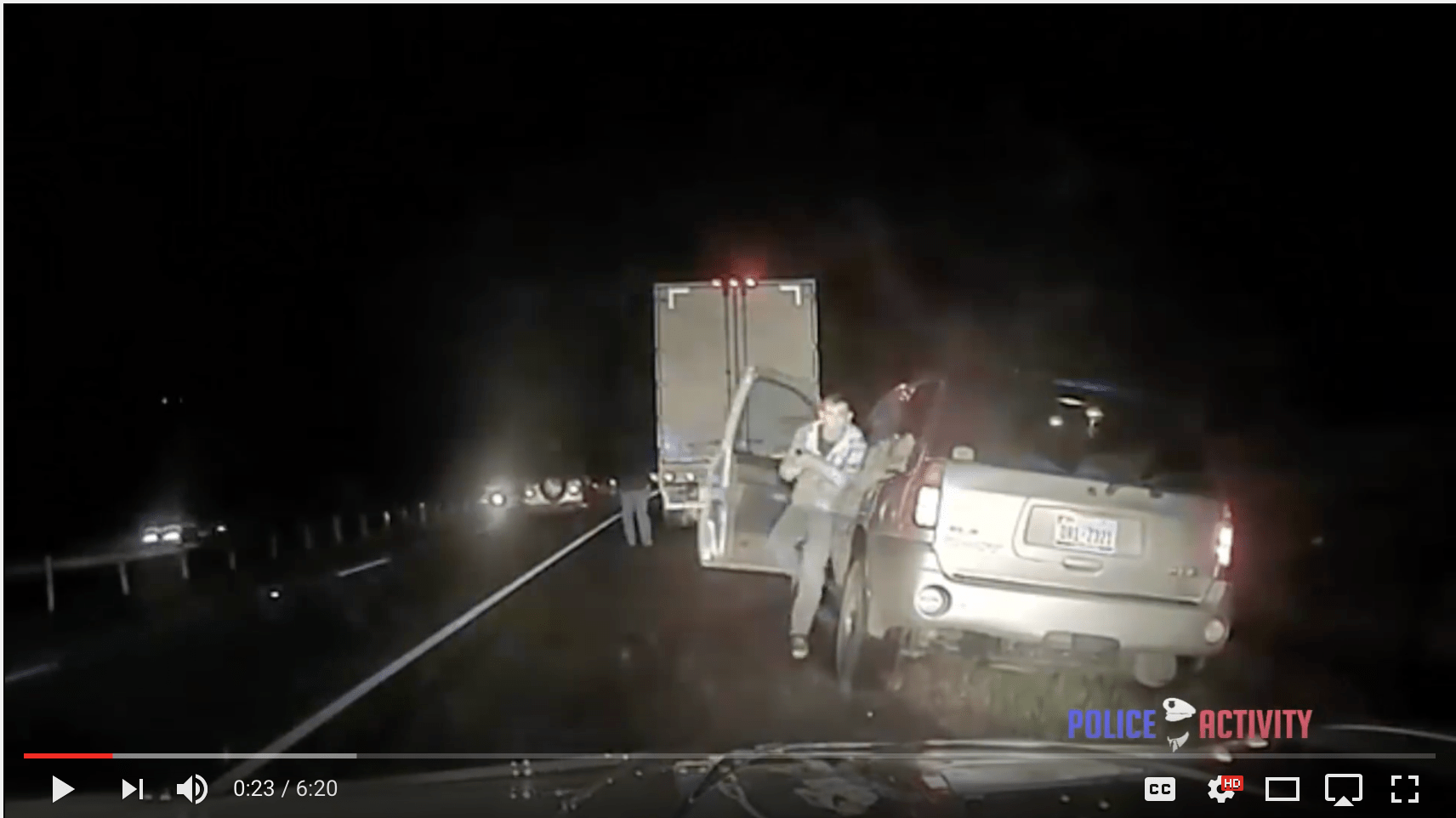
If you are someone educated in violent behavior (as police tend to be), that certainly looks like someone holding a gun, preparing to extend their arms to shoot. And not just shoot, but shoot at me.

It’s only in hindsight, it’s only with the benefit of sitting in our armchairs, that we can speak otherwise about this event. You can watch the full dashcam here.

I’m making no commentary on that specific event. What I am trying to point out is how there is reality in situations, how they frame events in our minds, and then how it affects our perceptions, especially in the seconds as events unfold. As well, simple objects that aren’t a weapon may not be so obviously-not-a-weapon as situations are unfolding.

We must work to be certain, or as certain as we can be.

Second, rid yourself of absolute mindsets. By that I mean mindsets like “if they’re in my house, they’re getting shot”. I hear this expressed far too often, with people proudly exclaiming how any unknown person in their house is getting shot, no questions, no discerement, no nothing. This is a recipe for trouble.

Claude Werner speaks of Negative Outcomes.  For example:

Deputies found a 32-year-old man who said that he and his wife were sleeping when they heard a noise in the kitchen.

The husband took his handgun and walked in the kitchen area, where he shot the victim.

After the shooting the husband recognized the victim as his younger teenage brother.

Full story, and Claude’s analysis can be found here.

Something as simple as shouting “Who’s there?” could have prevented tragedy.

(Aside: I highly recommend reading anything and everything Claude writes; if you need a place to start, start with his series on Negative Outcomes).

Think

There’s a time to go to guns, and there’s a lot of times not to. Even if we don’t shoot, pointing a gun at someone is aggravated assault. I’m not saying not to point guns at people when that needs to happen, but we need to be as certain as we can that it actually needs to happen. Because whatever happens, it’s likely it will become necessary for you to articulate why you did what you did. To be able to validly express the ability, the opportunity, the jeopardy of the situation.

At this point in one’s training, one must learn discernment. One needs to move beyond the simple physical skills of “point and click” and work to first engage the brain. In a sense, we should be reluctant to go to guns, but we should be eager to acquire the knowledge necessary to know if we should go to guns – or not.

Because in an instant, what will happen will happen and you cannot take it back.