Water Buffalo is TASTY

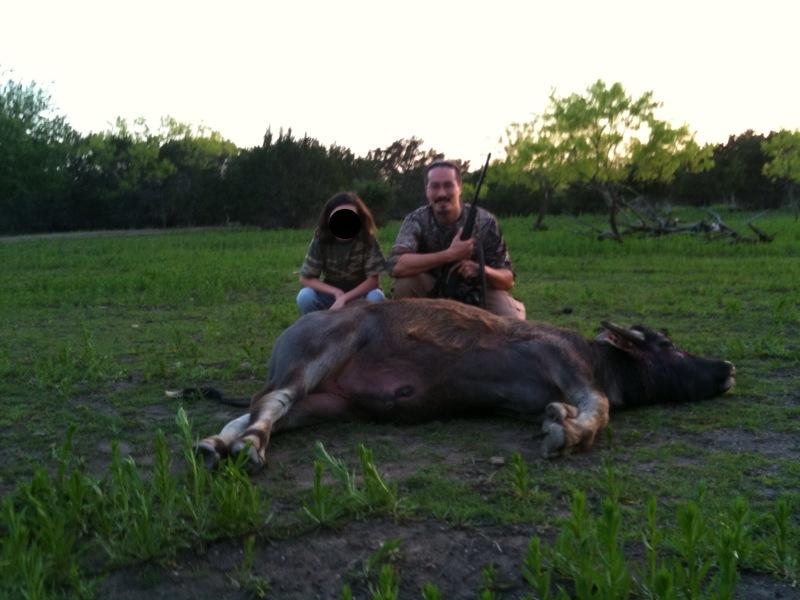
So a couple days ago I harvested a water buffalo.

I took the bulk of the meat to the butcher to be processed, but I kept a couple smaller pieces for myself to try out. I assume these are the tenderloins. You know the backstraps? They’re on the back of the spine. These cuts came from the front of the spine, down by the hips. Not very big.

I left them sitting in a pan in the fridge for about a day. The meat is red, very akin to beef. But there’s almost NO fat, no marbling. Maybe saw a dot of white here and there, but it’s mostly all just red meat.

I took the loins (I’m going to assume that’s what they are), cleaned them up, then cut off a couple small pieces (maybe 1/3″ thick?) and threw them into the frying pan. Totally plain. All I wanted to do was taste the pure meat with nothing to season it: no salt, no pepper, no smoke, no nothing. I want to know what this meat tastes like pure and simple, then we have a baseline and can figure from there what to do with it.

Oh Lord. It’s delicious. 🙂

It’s almost beef. I can’t put my finger on just what it is, because it isn’t cow beef. But it’s amazingly close in flavor. I figure if someone didn’t know what they were eating, they’d figure by the flavor they were eating cow beef. I want to say it’s a little richer tasting, a little stronger, but like strong in a good flavorful way… not like strong “gamey” or anything like that. Basically if you like beef, you’ll like this. Nothing to be afraid of.

Texture tho is different. I don’t want to say the meat is tougher than beef because I don’t think that conveys the right impression. It’s tender; sure cooking affects this and in my case it was in a medium heat pan for minute or two on one side then flip and another minute or two, just until you started to see the juices sweating through the flesh on the “up side”. But there’s certainly a little more chew to it than beef. Now, when we cut the loin to make these pieces we just cut. Looks like we ended up cutting with the grain. We made a few more slices against the grain and tried those. Made a fair improvement, but Wife pointed out something. Going against the grain helps on the initial chew, but after a little chewing it’s still the same sort of “chew” feeling in your mouth because the slicing only breaks it down so far… the rest of the breaking down that chewing does well, it’s the same in the end. But don’t let this deter you. It’s really not that bad, just different from beef.

Frankly, I’m stoked! 🙂

So, we’re about to commit heresy in the eyes of some. We’re chicken frying it. 🙂  Slicing up the loins against the grain, about 1/4″ to 1/3″ thick. A little flour, salt, and pepper (no heavy crust, just dusting), then into the pan they’ll go. Should be damn fine eating. Yeah it’s not high class, but I really don’t care. I’m about to wind up with a lot of it in the freezer… I’ll be able to be high-class and low-class and everywhere in between.

I’m certainly curious to see how the rest will turn out. For instance, how will steaks be? How will low and slow cooked roasts be? A beef roast in a crock pot could take 6 hours… would this need 8 or 10? A lot to figure out, but it’ll be fun.
Getting serious on 6.8 SPC

So I post about my hunting itch and Rog posts a link to this article by Frank James.

Here’s what didn’t sit well with me:

On one of my gunwriting trips a well known gunwriter/hunting specialist recommended to me Federal Premium .223 Rem. 55 gr. Barnes Triple Shock (#p223s) for hog hunting as he felt it was the only .223 load that worked in his experience. So I purchased 5 boxes (100 rds) at a big box store in northern Indiana and loaded the M&P-15. I must no longer be high on the gunwriter food chain as the ATK ammo fairy doesn’t like me as it once did. It is just as well, because this load also proved to be a disappointment. Yeah, it killed, but it didn’t drop ’em. On our first night I intentionally picked out the smaller animals as the targets of choice because I have such a dim view of this caliber on hogs. Even the little ones ran off after being shot and I know I shot ’em because both the guide (using thermal imagining) and I through my PVS-14 night scope saw them stumble, roll and get back up again. After we left, the ranch emailed us to inform us they were still finding dead pigs in a hay pasture close to the first night’s kill zone. I am NOT impressed with this load for use on hogs and feel it was over-rated. If it were made in a heavier weight maybe it would work better.

That’s the very load I was going to use for hunting (Federal P223S). The above isn’t promising. The load is rated for deer, but deer aren’t as tough as hogs. Still, it gives me pause.

I wonder why the problem. My guess is too light a bullet, because I know TSX in larger, heavier bullets have no problem dropping hogs. As well, in the Frank James article he uses some Black Hills 77gr JHP’s and has no problem dropping hogs. Makes me wonder if say the CorBon loads with the 62 grain TSX (the only factory load I know if that uses the 62 grain TSX, or rather a factory load that uses something other/heavier than the 53/55 grain TSX’s) might work out.

But really… it just increases my want to go to 6.8 SPC. I know that’s suitable. I’ve seen the results from Bill Wilson on some monster hogs.

I know it’s a bad itch because last night in bed I’m using my iPhone and poking around the Bison Armory website.

I think that may be how I start out. Buying a good upper, keeping it minimal in accouterments for now (other than a set of iron sights since Bison’s stuff are all flattop), swapping the scope and lower, and going from there. I just finished talking to The Tax Man so now may be the time to get this rolling.

Any 6.8 users out there with any advice or recommendations?

Hunting itch

I’ve got a big itch to go hunting.

Yes, turkey season starts today but I have little desire to hunt turkey. Thought about it but meh… just not really interested.

But… I just had my lunch, was flipping channels while I ate, and caught the tail end of that “Hogzilla” “documentary”.

Made me want to go hog hunting. I need some pork in the freezer.

But I also thought about my desire to use a .223 for hunting hogs. I think normal sized hogs should be fine with good ammo. But Hogzilla? Well… I’ll want to bring along something bigger. 🙂 Let the kids use the .223, and if it needs it, something 30-caliber would be good.

Note to self…

Note to self…. check to ensure the feeder works before you put 160# of deer corn into it.

*sigh*

Loaded 160# of corn into a feeder that appeared to be working. Finally remembered how to do a test run with them and nothing happened. Could be the electronics were dead enough to not trigger the motor (unlikely, given all other things about the electronics did appear to be working fine). I think the motor is fried. And trying to replace the motor will be a lot of fun with 160# of corn in the hopper.

Oh well. It’s my fault for forgetting to ensure it was working.

On the plus side, lots of hog tracks in the soft ground. Hopefully I can get back out there and repair the feeder in the next week or so, and maybe there’ll still be some activity on the camera. I want to do some hog hunting. 🙂

The Urban Hunt

In response to my home being invaded by a duck, Rog pointed me to an article about The Urban Hunt. It’s about a man and his adventure in urban hunting: rabbit, pigeon, squirrel, duck, and so on.

It’s a good read. Well-written prose.

Hunting is ethically cleaner than buying meat at a market, in part because it is more difficult. Unlike urban progressives who shop in high-end organic grocery stores, hunters are not casual carnivores. Though often accused of being bloodthirsty, hunters simply know what blood is—what it looks like, how it smells. The division of labor is one of the good things about living in cities: Not everyone has to hunt his own food, make his own clothes, and perform his own open-heart surgery. But the luxury of urbanism lets us forget that eating is always about blood, about one thing suffering and dying so another thing can live. With every bite—whether ortolan, salmon, or chicken burrito—we swallow a mouthful of death.

Tactical Hunting Review

My buddy Charles is starting a new online venture: Tactical Hunting Review.

It’s just starting so the website is simple, but I’ve seen the plans and there’s some great things in store… just takes a little time to develop. The intent? To provide a one-stop location for reviews of guns and gear, for “tactical” purposes, for hunting, for other sport. It can even cover things like training, schools, deer leases, you name it. It strives to provide complete reviews from industry people and people like you and me in the field. Visit the site and check out the sidebar on the main page as that explains all.

There’s also a forum to build community.

Check it out. It’s an interesting effort and I’d like to see it succeed.

Good luck, Charles.

A discussion of hunting ethics

The Hog Blog has started a discussion of hunting ethics, which was started from a posting on The Thinking Hunter’s blog.

They’re both excellent posts on the topic.

I don’t have much to add to the discussion, being the new hunter that I am. But I can say in my short time I’ve already had some ethical debates. Let me quote from The Hog Blog:

Reading all the way through your post, it strikes me that what you’re describing is a situational ethic (you called it conditional… which is the same, I guess).  It’s defined by where you’re hunting, what you’re hunting, and why you’re hunting it.  That means that what is “right” in one case may be “wrong” in the other… even though it’s really the same thing.  And that’s where I think the idea of trying to affix a single definition of ethics falls to pieces.  You can’t pigeonhole it.

At its core, a hunting ethic is a purely individual thing, no different than any other set of ethics, really.  At best, it’s framed by some common ideals, but when it comes down to it, it’s all about the hunter’s personal values and motivations.  And those motivations and values are subject to constant change and evolution.

I would have to agree here. As a case in point, let’s take my past deer lease. It was me and 2 other guys, C and M. Both of those guys are long-time hunters — they grew up with it, and I did not. For M, he’s really out for a trophy; sure he enjoyed the meat, but his criteria for a deer worth shooting was narrow. Then there’s me, and I was just out for my first deer, so anything legal was just fine by me. For M, he didn’t think it would be right to shoot a deer over a feeder. For me, I didn’t see a problem with it. To me, what’s the real difference? If you were some Indian tracking deer a couple hundred years ago, you’d still be looking to find them at the watering hole, at their food sources, or on trails leading to or from those places. So what does it matter if it’s a mechanical corn feeder or a grove of oak trees dropping acorns? It’s still shooting them at their food source. Is there a difference? Maybe… what if the land had been in your family for decades and it was your great-grandfather that planted all of those oak trees to help attract deer to the area (i.e. great-grandpa was making a long-term investment in his property)? Is there a difference? Perhaps, but I hope you can see that in the end, it’s all about putting food in the area to attract and keep what you want in the area.

This isn’t to say either of us have bad ethics, just different. We all do have a baseline of understanding a need for sustaining the area. We don’t want to shoot everything there, we don’t want to clean it out so there’s no population in the future… if you want to continue to hunt, you need to ensure there’s something to continue to hunt! But there are some that prefer to shoot them all and clear it out. Is that a bad thing? Again, it all depends how you frame it and the context. If the deer population were starving or diseased, clearing them all out might be the right thing to do. If the hunters were starving and couldn’t obtain food any other way, that’s different. If they just wanted to blow up all the Bambi’s they could, that’s different too. So again, it all comes back to what the other bloggers were saying: where, what, and why. Even then, we’re likely to disagree.

The discussion is worthwhile. I doubt we’ll come to a consensus, but to ensure we can examine ourselves and know why we do what we do and if we feel it’s right and good, that’s important to do.