Dove hunting

It’s dove hunting season here in Central Texas.

I know some people dedicated to it. Me? It’s just not my thing.

First, I’m not really a shotgunner. I just don’t shoot them much, thus I don’t get much practice shooting flying things (be it clays or birds). The times I’ve shot skeet I really enjoyed it, but I just don’t seek it out (handguns are my focus). Second, shooting doves seems like a lot of work for little gain. All the feather plucking, cleaning, prep, and so on… just for a little nugget of meat? I guess that’s why if I’m going hunting I tend to prefer bigger animals (e.g. I am dreaming of elk hunting one of these days). The cost-benefit ratio just seems slightly better there. So the dove thing just hasn’t appealed to me.

However….

A guy I know from Scouts and church is an avid dove hunter. Last year we were talking about it and he made comments to me that I should go out with him; I passed. This year he started on me again and I said “why not?”. So I pulled the 18.5″ barrel off my Mossberg 500 (it’s a field version, wood furniture) and put the field barrel back on with a modified choke. I went out and bought some 7.5 shot shells. Got my hunting license with the migratory bird stamp. And… I’m ready. 🙂

Haven’t gone out yet. I’ll be talking with my friend tonight to figure things out, but it looks like maybe this weekend.

I figure why not? Try it. If I get something, great. If I don’t, it should just be fun to get out and try. Lord knows doves are not in short supply around here…. I’ve seen 2 dozen in my yard at times, and I must admit when I see that I have thought about how tasty that could be, if only I didn’t live in the city. 😉

We’ll see how it goes. If any of you are dove (or bird) hunters and have tips for me, please share in the comments.

Feral Hog Anatomy

Via TacticalGunReview.com I found this TexasBoars.com forum thread. Because of that and some other things I’ve had well… I wanted to make one good posting about feral hog anatomy and kill zones, so I could have a good “one-stop” reference on the topic. So whenever I need a refresh on the topic, I can just pull up this article and have all resources in one spot.

I’ve spoken about feral hog anatomy before. That article included one of the better hog anatomy pictures I’ve seen:

Feral hog anatomy

TexasBoars.com has a great article on feral hog anatomy. They provide a nice shot placement picture:

Feral hog kill zone (from TexasBoars.com)

Feral hog kill zone (from TexasBoars.com)

Speaking of shot placement, the California Hog Blog talks about shot placement. They have great graphics showing the neck shot:
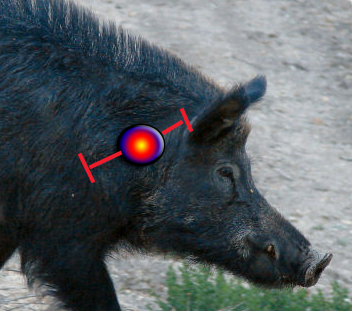
Feral hog kill zone - neck shot (from California Hunting Today's Hog Blog)

Feral hog kill zone - neck shot (from California Hunting Today's Hog Blog)

and the more traditional kill zone:

Feral hog kill zone - traditional zone (from California Hunting Today's Hog Blog)

Feral hog kill zone - traditional zone (from California Hunting Today's Hog Blog)

But while all of these are good, the TexasBoars.com forum thread has something that brings it home better than any other thing I’ve seen.

Is it this picture and description of the kill zone?

Feral hog - spine highlight (from TexasBoars.com)

Feral hog - spine highlight (from TexasBoars.com)

Here it is. A simple highlight of the “drop a hog in its tracks zone” DRT.
Don’t make the shot any further FORWARD or by NO MEANS any further BACK into the rib cage.

If the head is NOT DOWN the line would be horizontal.
The IMPORTANT FACTOR is don’t shoot high! If you shoot high the hog will likely hit the ground,, and then get back up once the “stinger” in the spine subsides as addressed in the video. If you hit a little low, thats OK.
A sign that a shot is HIGH is a SQUEAL. If the pig hits the ground and SQUEALS you should shoot it again to be safe. If the lungs or trachia are damaged and completely bruised the hog will not be able to squeal generally speaking.

No… it’s something else in the thread:

This video.

While the topic of the thread and video is more about bullet construction and performance, Kevin Ryer (TexasBoars.com’s admin) takes a freshly killed feral hog and dissects it. While doing so, it becomes very obvious where the kill zone is and why that’s the important kill zone.

Why does this matter? Because for people used to hunting deer or other such animals, the kill zone on a feral hog is slightly different. The chest cavity is a small target. It’s very low and forward. While the animal presents a large side to you, if you divide the animal in half horizontally, the lower half is really all you have to work with because of how the spine slopes as it approaches the head.

Here are a screen shots from the video that show what I’m talking about.

First, here’s where the 250# hog was shot in the shoulder. Entry wound. The knives are pointing to the hole, square in the shoulder.

Feral hog dissection - entry wound, square in the shoulder.

Feral hog dissection - entry wound, square in the shoulder.

He then cuts through the shield, removes the front leg, then gets into the chest cavity.

Feral hog dissection - location of spine

Feral hog dissection - location of spine

Kevin is holding the knife blade along the spine, and his left index finger is also pointing to it. Notice how the spine is about half-way through the animal… that is, about half their body is above it and half below it. This is lower than on a lot of other animals. Notice the bullet wound is below the spine. You have to aim lower than you may be used to.

And while the screen shots are nice, you really need to watch the entire video. There are a lot of comments Kevin makes, a lot of things he goes through. And again, while he’s focused on discussing the use of a fragmenting bullet, there’s a lot of importance placed on understanding anatomy and ensuring you get the bullet into the proper kill zone. It’s a well done video, and Kevin deserves much credit and thanks for making it.

The key thing is you have to shoot a little lower and a little more forward on a feral hog than you would on a deer. Think midline or a little below midline, and forward since the chest cavity isn’t that big. The target area is small, and, as Kevin points out in the thread discussion (read it!), depending what firearm you’re using it may be smaller. Shots have to be good and you have to know the anatomy clearly so you can ensure a good shot.

Thank you, Kevin, for all your work. It dispels a lot of myths and helps out a lot of hunters.

Crossbow?

A recent change in Texas laws made it permissible to use a crossbow during archery season (deer hunting).

I recall long ago (well before I became a gun owner) I never had a problem with hunting, just that it wasn’t for me. I always said tho that if I did hunt, I’d want to use a bow as it seemed more challenging. True that it is. Am I going to get into bow hunting? Likely I will someday, but not any time soon. One of my in-laws is a big bow guy and in talking to him it’s evident that there’s a lot of investment to get started. There’s the gear, but then also the time to know the gear and get good with it. I don’t have the time to dedicate, nor the desire to split my studying (and after all this home renovation, I don’t feel like spending the money). I’m trying to regain some focus in my life.

Nevertheless, as deer hunting season approaches, I can’t help but think about venison. I’m not really out to hunt for a trophy rack, just some meat in the freezer. Does are good for that, and does are rather plentiful. Texas Park and Wildlife has been working on herd management and has been instituting antler restrictions. For instance, you can bag a total of 4 deer during all seasons, up to 2 can have antlers, and the antlers must have at least a 13″ inner spread. I understand the reasons for the restrictions, and there’s a lot of debate on them. Not going to get into that here. Then there may be additional restrictions that prevent the taking of antlerless. So what does that mean? Either you bag a trophy buck or you go home empty handed. What does that do for meat hunters like myself? Leave an empty freezer. *sigh*

However, during archery season, antlerless could be taken.

The learning curve for a crossbow is a lot less than a bow. That same in-law of mine did work to talk me out of using a crossbow, and I respect his opinion. Still, the thought crosses my mind…..

Readers… any opinions to offer?

EPA Lead Ban?

The EPA is considering banning lead, like from ammunition and fishing weights.

Boneheaded move for many reasons. Clicky for details and how to address the schmoes in Washington.

ETA: While they may be schmoes, being rude or screaming declarations and ranting at them is not going to win them over. If anything, it will just reinforce their belief that gun owners, hunters, fishermen, etc. are just redneck morons that need to be herded and lorded over and controlled by any means necessary.

Put your emotions aside, write a brief letter expressing your opposition. In fact, you don’t really have to go into detail about it, just say “yes or no”. With the volume of correspondence they receive, yours will not be read, merely skimmed for key words. When I wrote my Congress-critters about the recent firearms excise tax issue, I received boilerplate “I support the rights of gun owners” responses from my 2 US Senators… when of course, I was writing them about taxes, but they just saw the “gun” keyword and that’s how it was registered.

Phrase your correspondence well.

Uncle Ted, WTF?

I like Ted Nugent. I read that Ted pleads no contest to deer baiting in California:

MARYSVILLE, Calif. – Rocker and celebrity hunter Ted Nugent will have to pay a $1,750 fine after pleading no contest in California to baiting a deer and not having a properly signed hunting tag.

California Department of Fish and Game spokesman Patrick Foy says game wardens saw Nugent kill an immature buck on a February episode of his Outdoor Channel TV show “Spirit of the Wild.”

Investigators found that the deer had been eating bait called “C’mere Deer.” Baiting wildlife is illegal in California.

Nugent originally faced 11 charges, including killing a deer too young to be hunted. In a deal with Yuba County prosecutors, Nugent’s attorney on Friday entered no contest pleas to the two misdemeanors.

WTF Ted? I have no problem with baiting, but if you’re not supposed to bait there (either by law or say by the request of the landowner) then you need to follow that law/rule. Then you don’t have the right tag. Then you target a deer that you shouldn’t have (and I’d reason with all your field experience you ought to know how to age a deer). And to top it all off, you got caught because you filmed it and decided to play it on your TV show.

Good f’ing grief!

Come on, Ted. What were you thinking? Or rather, why weren’t you thinking?

Updated: A posting to Ted’s official Facebook page:

To my Fellow Outdoorsmen…. You may have read the news that I pled no contest to two misdemeanor game violations in CA. I should have been better informed, more aware and I take full responsibility. Our honorable hunting lifestyle is my deepest passion. Ted Nugent

Barnes VOR-TX

A couple of weeks ago, Barnes Bullets announced a new line of loaded ammunition called the Barnes VOR-TX. I obviously missed the announcement, and I’m quite the fan of Barnes Bullets (even a member of their Club-X). Another page on the VOR-TX here. Apparently it will be available on August 1, 2010.

While I’m starting to lean towards 6.8 SPC for hunting, I still can’t get away from .308 Win as my go-to caliber. Barnes will be offering this VOR-TX in both 150 and 168 grain TTSX (for .308 Win). That’s what intrigues me about this round: factory ammo with a 168 grain TTSX. No one offers factory ammo with a 168 TTSX; International Cartridge Co offers 150 grain TSX and TTSX, and DoubleTap Ammunition offers a 150 grain TTSX. But again, no one does 168 grain TTSX.

I’m still not doing a lot of rifle ammo reloading, so for now I still have to look to factory ammo for my hunting rounds. I’ve been using Federal’s P308H, which is a 165 grain TSX bullet and an overall fine round. Everything I’ve taken from hogs to deer to that water buffalo was taken with that round. But again, it’s a TSX bullet.

The Tipped TSX bullet (TTSX) is the evolution of the TSX. That polymer tip improves the ballistic coefficient. A .30 caliber 168 grain TSX BT (cat# 30844) is listed as having a B.C of .404  & S.D. .253 (the 165 grain TSX is B.C. .398 & S.D. .248) (source). A .30 caliber 168 grain TTSX BT (cat# 30878) is listed with a B.C. of .470 & S.D. .253 (source). That’s a nice improvement. Of course, the reality is the distances that I’ll be hunting with this? an improved B.C. won’t have a huge impact (but every bit is welcome). So what then? Well, that polymer tip greatly aids in getting the bullet to expand. Useful that.

Granted, to use the TSX vs. the TTSX isn’t a no-brainer as there are still advantages and application situations to one over the other. Nevertheless, to see the 168 grain TTSX offered in a factory load is welcome. Who knows… I may buy a box and see how it fares. Or, if I know what’s good for me, I’ll ignore all of this and get my butt to working on 6.8 SPC hunting loads instead. That .277″ 95 grain TTSX is panning out to be “the” bullet for 6.8 SPC.

What to cook… what to cook?

While out camping I got the call from the butcher that the water buffalo meat was ready to be picked up.

I got home from camping, unpacked, and figured that as long as I had the momentum, might as well get out and pick up the meat.

The chest freezer is full. I mean, all the way. It was probably 1/3 full of assorted beef, venison, and feral hog.

It’s a blessing for sure.

So… what to do first? 🙂  Wife took out a roast. We’ll crock-pot it tomorrow and see how it goes.

Anyway… now that I’m home, I’ll slowly be catching up on things. Bear with me.

A little more about buffalo meat

Yesterday I did a quick little sampling of the water buffalo meat.

It paid off.

For dinner, Wife sliced the loin meat into maybe 1/4″ or at most 1/3″ slices against the grain. That is key — going against the grain. She then also pounded the meat with one of those tenderizing hammers, and sprinkled some meat tenderizer (the salty stuff) on it. Let it sit for a couple hours.

That made a difference for sure. Eating that meat for dinner and the meat was far “softer”. It’s still got a little bit of chew to it, that’s just gotta be the characteristic of the meat. But it made for a positive difference.

So that seems key in preparation: do things to help tenderness.

Again don’t get me wrong, it’s not a tough meat, but there is more “chew” than beef. Once I get the rest of the meat back from the butcher, we’ll see how that goes. That meat is aging at least a week. And then we’ll see how other preparation techniques work out on other cuts.