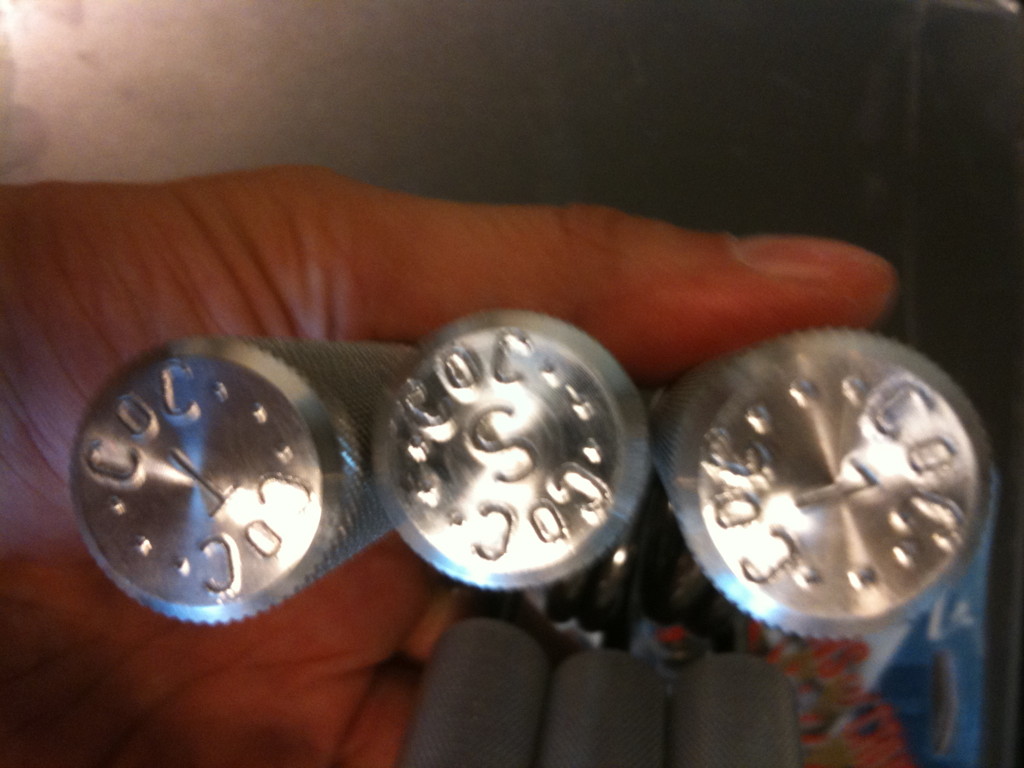
Aiding my grip

Grip.

It’s important. You don’t get through the day without using your hands to hold onto something.

Sure a lot of the tasks in our modern world don’t require much grip strength, but like many things in life stronger is better… rare is the time when something is “too strong”, more often you run into the problems of “too weak”.

In shooting sports, especially with a handgun, grip strength matters when it comes to management of recoil.

When lifting heavy weights, grip strength matters.

I started having some issues with my left hand’s grip strength when deadlifting. Switching to mixed grip helped, but I still want to work on my grip. Granted, one of the best things is to ensure a rock solid grip when I do any of my lifting no matter the exercise… no letting my hands just hook onto the bar, grip the bar. But the other day I was browsing around the EliteFTS website and thought why not… I’ll get some grippers.

These aren’t your normal grippers that you can buy at the sporting goods store

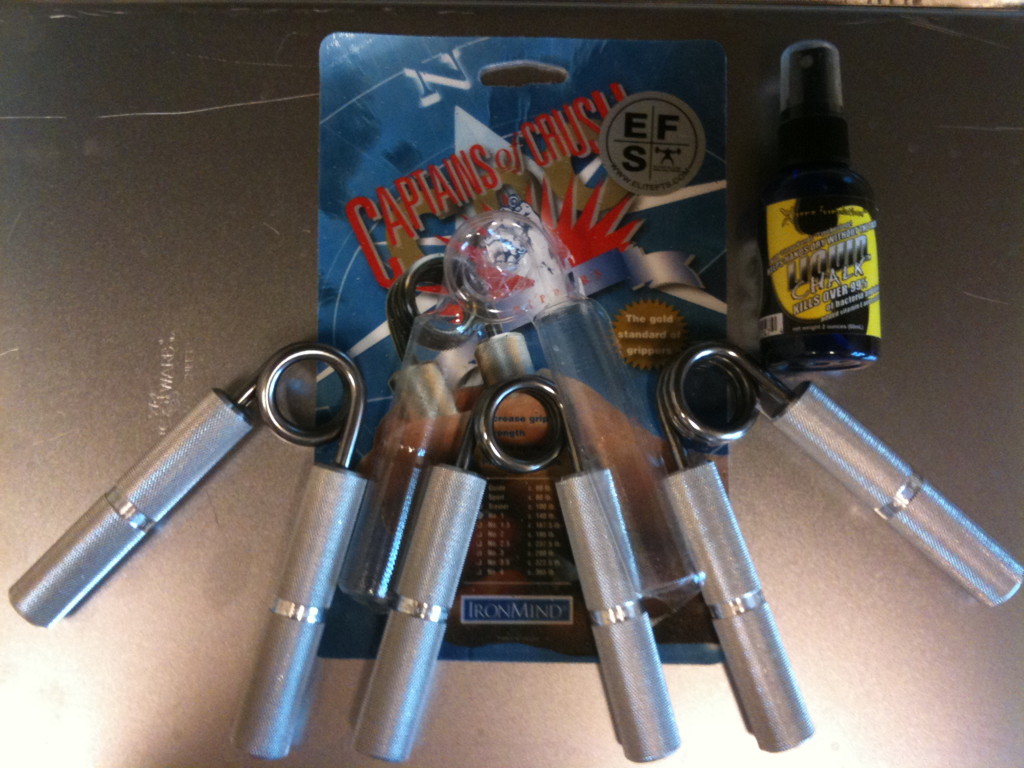
These are Captains of Crush hand grippers. They’re much higher quality and much more difficult to close. But how difficult depends, because they make a wide range of them.

I picked up the Sport, Trainer, and No. 1. The Sport is the second in their lineup, rated at 80# of pressure to close. The Trainer is next in line, rated at 100#, and the No. 1 is next, rated at 140#. I really wasn’t sure where to start, so I figured to get all three, especially because that works progressively because hey… getting strong doesn’t mean squeezing a light weight for thousands of reps. It’s like any strength training: doing a 3×5 or 5×5 set with maximum intensity. Plus a little warm up.

I have no problems closing the Sport, and the Trainer I can close well enough to provide me my initial workout — this is my work load. The No. 1? With my right hand I can close it if I’m fresh and dig in. My left hand can’t fully close the No. 1.

There’s a lot to grip training, well beyond “crush strength”, but this is a reasonable start for me as something to add in. Plus, I’m not just going to crush but crush-and-hold. Grip isn’t just grabbing and letting go, but grabbing and holding. So any work I do will involve crushing and holding for a period of time. Exactly what my workouts here will be remains to be determined, but I figure it will be something I do on my way home from the gym… just stick the grippers in my bag and squeeze while I walk home. Multitasking. 🙂

We’ll see what difference, if any, it ends up making on my grip strength.

You may have noticed another thing in the first picture: Liquid Chalk. Purchased that on a whim, knowing nothing about it. I can’t use true chalk in my gym but hey, if I can have something to help my grip, great. Now, from shooting I know about Pistol Pro Grip but honestly I don’t like that stuff because it leaves a white residue/mess everywhere and I just don’t like how it makes my hands feel.. almost too dry, but no question it works. But that won’t fly in the gym since it leaves a mess. So this Liquid Chalk? We’ll see if it helps any. I have sprayed it a couple of times on my hands at home just to see what it does and it does leave a bit of a “dry” chalk-ish-like feel on your hands, but I’m not sure how well it will actually help. Plus, as I now read various reviews, it appears the spray clogs up pretty quickly. Hrm. We’ll see.

In the end, improving my grip is good. I see no downsides to it. We’ll see how well these products help.

on how to drop the slide

Gun bloggers are presently all a flutter about how to drop the slide on a semi-automatic handgun.

I think it started with Caleb and this “quote of the century” post. Actually no… it goes back further, to this thread on pistol-forum talking about a “tactical ninja kick” as a way to drop the slide (if you don’t know, don’t ask). Then Caleb’s post, where he was specifically trying to point out that the “it’s a fine motor skill” argument isn’t a valid one in this case (thumbing the slide lock vs. racking the slide) because they’re both fine motor skills. But IMHO the post wasn’t worded well and people thought he was bagging on the techniques, not the argument. So Caleb posted a follow-up article that went deeper into the issue. I think he still didn’t present the argument well enough — that he’s upset about the reasons put forth for justifying the technique, not the technique itself. But here we are. Heck, even KR got into it, with some very valid presentation.

Now, Shelley Rae posted to GunNuts about a recent failure she had during an IDPA match. The interesting part is that her slide stop/release broke. She normally thumbs that lever to get the gun back into the game faster, but it broke, she diagnosed the problem, reached over the top to drop the slide, and continued with the match.

And of course… this justifies everyone’s way as the best way, and everyone can take this as proof their way is right and best.

I’d like to take a different approach.

It depends.

(and I am talking about the techniques, not the “fine motor skill” justification because strictly speaking Caleb is right, they are both fine motor skills… I think tho what people mean isn’t the strict definition of fine vs. gross, rather that it is a more precise thing to thumb the lever, involving just your weak thumb vs. more body/muscle/parts involvement in reach and rack; but perhaps we’re splitting hairs).

Now personally, I’m biased towards the line of thinking that Karl puts forth because he’s my mentor and I spend a lot of time around him. But as for which technique one should use? I’ll put forth that it depends upon your goals and/or problem set and/or operational context.

You can’t serve two masters. So in weightlifting you can’t try to gain mass and lose fat: pick one, focus on it. I’d say the same applies here in gun work. What is your goal? Competition? Self-defense? Pick one, because you can’t serve two masters.

In competition, all that’s on the line is if you end up in the winner’s circle or not. Most action shooting sports have time as a critical factor, and the less time you take the better. Thus, techniques that allow you to be faster are generally more desirable. In this case, there’s no question that thumbing the slide lock/release is going to be faster than reaching over the top to drop the slide. This is going to be a more desirable technique for this context.

In self-defense, your life is on the line. Seconds still matter. So, one could say thumbing the slide lock/release is better. But will it always be? It’s cold out now… you have gloves on. Can you thumb it? You’re covered in blood. Can you thumb it? You lost your thumb, can you… well, no you can’t. When your life is on the line, you need things to not go wrong, you need things to go your way. It’s better for things to be “bulletproof” than “fast but risky”. Failure of the gun in a competition isn’t a big deal; failure of your gun or technique in a gunfight is a big deal.

Let’s go back to Shelley Rae’s video. Failure of the component is rare. 99.9% of her competition shooting will be better off thumbing the slide lock/release. So in the context of the game, something went wrong, she lost a few extra seconds to diagnose the problem, but she got it corrected and finished the match. Life goes on, all is fine. Now, let’s pretend the same video was of a gunfight. Those same few seconds where your brain is going WTF? your OODA loop is resetting, you have lost focus on the fight, not to mention she continued to move out from behind cover while dealing with the problem… what could that have cost her in a gunfight? Reaching over the slide she never would have noticed the problem and never would have had a WTF? moment; may have cost her 0.5 seconds more to do that technique always, but that’s a lot better than how things played out (again, pretending it wasn’t a match video).

I’ve been shooting the FAST drill because it’s a good drill. On that drill, 5 seconds is considered Expert and is a tough number to achieve. But to achieve that number, you’re going to have to use the slide stop/release to drop the slide because reaching over the top to drop the slide just takes longer, and the nature of the drill and limits of human ability just work out as they do. But for me? I’m fine with never breaking the 5 second barrier in that case, because I train primarily for self-defense thus my go-to technique is reaching over the top of the slide to drop the slide (no thumbing for me). Thus if the best I can ever do is 6 seconds, I’m OK with that because I know what master I am trying to serve.

There are reasons for each technique. They both have their strengths, they both have their weaknesses. They can be applicable to a wide range of situations, they may be more appropriate for one situation over another. So, instead of just saying “mine is right” or “mine is best” always, step back and examine what each technique brings to the table (good and bad). Weigh that against your context, be willing to accept the strengths and weaknesses, know and understand how to deal with them, and be sure you know what master are you serving. Work towards that end.

Watch and Learn

Dave Sevigny shooting some IDPA drills

Here’s some things we can learn:

  • Look at Dave’s forearms. Notice all the muscles? Yes, grip the gun hard.
  • When reloading, notice Dave brings the gun in, keeps it high, and his eyes shift to focus on what he’s doing (e.g. looking at the magwell).
  • When shooting on the move, knees are bent, feet are rolling. In addition, his lower body is oriented towards his end destination (hips square to it, toes pointed at it), his upper body then rotates like a turret to engage the targets. Doing this allows you to move quickly with less chance of tripping.
  • When shooting one-handed, the other hand doesn’t dangle. It’s in a well-defined location on his chest/torso.
  • Also when shooting one-handed, easiest to see when Dave is shooting with his left hand, notice the position of his thumb? Contrast this against the thumb(s) position when shooting two-handed. Yes, curl the thumb down, like making a fist; you’ll have a stronger grip.
  • To go fast, you have to move fast but also efficiently. Dave has no wasted motion.

Another local

He linked to me, I’ll link back: A Rock In A Sea of Chaos.

A gun guy and blogger right here in Austin.

Some time ago, TXGunGeek and I tossed around the idea of having a Texas blogger gathering/shoot. It never came to pass since we’re both way too busy. But geez there are a lot of such types, so it would be cool to have such a thing one of these days.

Stronger people shoot better

Strong people are harder to kill than weak people and more useful in general.
– Mark Rippetoe

A difficult premise to argue against. The stronger I get, the more I appreciate the usefulness of it.

So if being stronger can help me shoot better, well I’m all for that. I was reading articles on Charles Poliquin’s website, and one in particular caught my eye: “Tips To Increase Firearm Shooting Accuracy“.

I’m…. not sure what to make of the article.

I’m not questioning Poliquin’s knowledge as a strength coach (his résumé). But I don’t know what he knows about shooting. Perhaps someone can enlighten me about a few things I saw in the article.

First, the article starts with this statement:

Did you know that your rotator cuff strength is a reflection of the amount of weight you can lift in the barbell bench press?

Then later in the article when suggesting exercises, 3 isolation exercises are given — with no mention of bench press. Well, if rotator cuff strength and bench press are so related, why shouldn’t people just bench press to improve their rotator cuff strength? Granted, some people may have injuries or other limiting factors, but in general it’s agreed that compound exercises, like the bench press, are overall superior for developing strength and a healthy body. Perhaps the article suggests 3 isolation exercises merely to say “here’s 3 exercises that specifically target the rotator cuff”. Still, why no mention of bench pressing as an avenue was odd.

Second, Poliquin states:

The larger the caliber of the handgun, the more the rotator cuff helps shooting accuracy. As more law enforcement agencies are switching from the 9 mm to the 0.40 and the 0.45, it’s even more important to have a strong and healthy rotator cuff. One of the reasons agencies are using larger calibers is today’s obesity epidemic. If this unhealthy trend worsens, cops will need ammo strong enough to bring down rhinos and elephants.

Um….

He’s saying that the reason LEO’s are adopting the fo-tay is because of fat people.

And if people keep getting fatter, we’re going to need to arm our LEO’s with .500 Nitro Express.

I am not sure how well he understands ballistics and the development of cartridges. And I’d LOVE to know where he got his information that the Glock 22 came about because of Grimace. 😉

So… I asked.

Hi John,
Thank you for your email and for your interest in the free articles provided at charlespoliquin.com! The articles have a list of references at the bottom, so you can refer to those. Unfortunately, I am unable to provide specific references for bits of information provided within the article.
Kind Regards,
Stephanie
Poliquin Strength Institute

I’d rather they made the effort to find out, because the claims are… questionable, in my mind. I have asked for more information, we’ll see how it goes. Frankly I’m most curious as to where the “fo-tay fo fatties” tidbit comes from. That’s a new one to me.

The article doesn’t come across as the most well-written. Nevertheless, I’ll agree with the general premise that having a strong, stable base does improve your ability to shoot. A strong grip, as influenced by forearm muscles or, as the article states, rotator cuff health, certainly plays into one’s ability to manage recoil and thus shoot better. And when it comes to shooting, especially long guns (i.e. shouldered guns), a healthy shoulder will help you manage things.

What are you waiting for? Hit the weights!

Slow down to go fast

If you want to shoot faster, you’re going to need to slow down.

Read on. It will make sense.

When we tell students to go faster, they make everything go faster. It’s understandable they do this, but it’s not necessarily the way to go.

For example, we teach students a proper 4-step draw. Look at the following diagram (be in awe of my drawing skills!):

In a proper 4-step draw, gun starts on the hip in the holster at point A. Gun is withdrawn from the holster and brought up to point B, then pressed out to point C. We teach this, the students perform it just fine… when there’s no time pressure. But when we put the under time pressure, the 4-step draw goes out the window and the students make a “bowling” motion, flinging the gun out from A to C.

It makes sense to do this. We’ve been taught all our lives that the shortest distance between two point is a straight line, and certainly it’s less distance from A to C than from A to B to C. And chances are it does take less time to move the gun from point A to point C than to go from A to B to C. But let’s step back a moment.

When you are trying to shoot fast, exactly what are you trying to accomplish? If the goal is to make the gun go bang as quickly as possible, that’s one thing. But usually, we aren’t out to just make noise. We’re trying to be as quick as possible at getting an acceptable hit. We want the time between the “go” signal and the bullet making a hole in the target is as small a time as possible. So to accomplish this, we need to move slowly through point B.

In order to shoot and get an acceptable hit, there are a lot of things that have to happen: the gun needs to be oriented towards the target; your eyes need to pick up the front sight and align the sights for a proper sight picture; your finger needs to work the trigger smoothly to make the shot break without disturbing the sight picture; grip, stance, breathing… there are lots of things that occur. When you go bowling (from A to C), these events tend to happen serially: gun gets thrown out there, you have to take a moment to let the gun steady itself because it shook when your arms hit full extension, your eyes have to hunt to find the front sight, you work to line up your eye with the sights with the target, then you put your finger on the trigger and press. Lots of things, and if they happen in series, that’s a lot of time consumed.

We cannot eliminate the need to perform many of these steps, so what can we do to reduce time consumed? Perform some of these tasks simultaneously. So for instance, you can put your finger on the trigger and start pressing the trigger as the gun is being brought up to the target. But… doesn’t that sound unsafe? It can be, if you’re bowling, because where is that muzzle lined up while you’re pressing? And what if the gun goes bang before the gun was properly aligned on target? Yeah, it was faster, but it was hardly accurate.

What if we move from A to B to C? Once the gun is at point B, the muzzle will be roughly aligned with the target. You start to press the gun out to point C and your finger can start to take up the trigger slack. In your peripheral vision you’ll start to pick up the front sight. And lo, yes, performing all these steps simultaneously will save on time and allow you to “shoot faster”.

Here’s a fantastic example:

That’s Mike Brook shooting the F.A.S.T. Drill in 4.92 seconds. A sub-5 second time on the drill is excellent and difficult to achieve. Does it seem like he’s shooting fast? No, but only because of how the drill starts: 7 yards, 2 shots on a 3″x5″ index card… small target, and you have to slow down. But look at Mike’s presentation. He gets the gun quickly out of the holster, moves from A to B, then from B to C he’s moving slowly so his eyes can find the sights, the sights can be aligned, and he can press off the first shot accurately.

Mike had to slow down to go fast.

Note that the exact speed at which YOU will move will be different. Don’t get hung up on the particular speed someone else is moving at, because you will move at a different speed. You want to move at the speed which enables you to get acceptable hits: as accurate as YOU can, as fast as YOU can. If you wish to improve your speed and/or accuracy, read this article.

I’ve been working on this myself. It’s not about moving everything quickly, it’s about what it takes to make the shot in the best possible time. In order to do that, you may need to slow some things down, like pressing the gun out a little slower, pressing the trigger a little slower. But note, some things may need to go faster, like how quickly you get your hand to the gun and the gun out of the holster and to point B. Everything can’t just move at 100 MPH… you have to vary things, and know what needs to go fast and what needs to go slow, so that ultimately you can go fast.

KR Training October 2011 newsletter

The KR Training October 2011 newsletter is a little late, but now available.

Of key importance is the 2012 schedule is starting to take shape.

As always, lots of good things crammed into the newsletter. Worth at least a click and a skim.

How to get both faster AND more accurate

Whenever we’re teaching new skills to students, we’re always going to push them to go faster. I know that seems wrong on the surface, but class isn’t the time to master a skill. Class is a time to learn skills, be exposed to new realms, and to get pushed outside of your box. Some people have never shot a handgun at a speed faster than they can casually plink a can off a fencepost, so pushing them to go faster is an attempt, especially in defensive pistol skills classes, to show them how fast they’re going to have to go and show them where their present skills lay in relation to certain standards of performance. It’s about showing students what to work on after they leave class using the new skills learned during the class.

If you ask people what’s more important, speed or accuracy, many will probably say accuracy. Or certainly, when they shoot you can see they’re focusing on accuracy. Then we push them to go faster, and their accuracy goes to pot, typically because they’ll slap the trigger and/or forget about good sight picture, or both, because now they’re focusing on speed and trying to get the shots off before the buzzer or because they’ve got some instructor hollering for them to go faster. So which is more important, speed or accuracy? Neither. They are both important. The world’s fastest miss isn’t going to get the job done, be it in competition or self-defense. The world’s slowest hit more likely means you got taken out, either of the competition or the fight. Neither of those are acceptable. The trouble is, the two tend to be inversely related: if you want to be accurate, you have to slow down; if you want to be fast, you’re going to lose accuracy. The trick is finding the balance that YOU can do that allows you to get acceptably fast, acceptably accurate hits. What is acceptable depends upon the context.

So how to get better at both speed and accuracy?

This isn’t THE way, it’s just one way.

First, you are going to need a timer. PACT makes some good  timers. There’s Competitive Edge Dynamics. I know there are shot timer apps for smartphones, but they can vary… some aren’t the best quality, I know that recent iPhone’s (iPhone 4’s) have a noise-cancelling mic so the shot timers don’t really work so well any more. But you need a timer, else you’ll never be able to work on the speed portion of the equation.

Now, pick some sort of drill or standard. For simplicity of explanation, I’m going to pick a defensive standard of “3 shots, 3 yards, 3 seconds” in a 6″ circle. That standard is based upon the average statistics of a gunfight, and if you carry a gun for personal defense you ought to be able to set up a 6″ paper plate at 3 yards and from a concealment draw get 3 shots into that plate within 3 seconds. So our acceptable speed is 3 seconds (start from concealment, draw; end after the 3rd shot was fired). Our acceptable accuracy is all 3 hits within the 6″ circle.

If you want, shoot the drill “as written” to see how you do. Who knows, you may have a skill level that can already clean it, on demand, every time. If so, great. Then you’ll skip most of what I’m saying and move to the end where I talk about how to make it harder. If you can’t clean the drill, don’t be hard on yourself. Consider it your current ability, mark it down, and set a goal to improve.

Now, remove the par time from the equation. You’ll shoot the drill (3 shots at 3 yards into a 6″ circle), with no time limit. Remove the pressure of time, just focus on being able to clean the drill, consistently, on demand. This is working on the accuracy leg. Work to get it so you CAN shoot the drill. If you are unable to shoot the drill at all, then there’s something else that needs addressing, perhaps you don’t yet have the fundamental skills necessary — give us a call, we’ll help you out.

Once you are able to shoot the drill with no time limits, now you should time yourself. This isn’t adding a timer to pressure yourself, rather, this is merely putting a stopwatch against what you are already shooting. See how long it takes you to shoot the drill. Perhaps it takes you 5 seconds to shoot this drill. Fine. Don’t sweat the details or agonize over “sucking, because it’s not under published par time”. This is what you can do, this is where your present balance of speed and accuracy lies. That’s fine, because you are working to improve it. So, focus on that improvement.

Now that you know how long it takes you, that becomes your first par time. So it took you 5.0 seconds? Set the timer’s par time for 5.0 seconds and now shoot the drill against the buzzer. You should have no problem shooting it because you’ve already demonstrated you can shoot it in that time. However, now with the knowledge of the timer pressure on you, it’s going to mess with your head and you will perform differently. Don’t. Remind yourself that 5 seconds is 5 seconds. Just shoot it exactly like you always have and you’ll be fine. You may also find that you shot it in less time and surprise yourself. If that’s the case, that’s fine. If you shoot the drill less than 100%, then start to analyze what you’re doing wrong.

Once you demonstrate to yourself you can shoot within that par time, now it’s time to lower the par time. This begins work on the speed leg. So you shot it in 5.0 seconds? Lower the par time to 4.5 seconds and try again. If you’re able to do that on demand, consistently, repeatedly, within the par time and 100% clean? Drop the par time again. Eventually you’ll get to a point where you cannot shoot it 100% clean within the time, so you’ll stay at that par time and analyze why you’re not getting the job done. Are you too slow clearing your concealment garment? Too slow getting the gun out and getting off the first shot? Presentation too slow? A shot timer that records each shot is useful here so you can see things like how long it takes from start buzzer to first shot; how fast your “split times” are (time between each shot). There are zillions of things that could be in play here, no way I can analyze within the scope of an article. But this is how it goes.

Note that there may be multiple issues to resolve, and it may take fixing a couple small things to add up to get you there. For instance, shaving 0.2 seconds off your draw and getting your split times from 0.40 to 0.35 may add up to enough improvement. It’s all dependant upon your particular situation. But you need to be able to analyze what’s going on.

Not only does a timer help with analysis, have someone watch you. It’s generally better if the eyes upon you are knowledgeable ones. You could take video of yourself and post it for folks to critique. There’s always taking classes or private lessons with instructors. Yes, we KR Training instructors are open to private instruction, just contact us.

But this is the general cycle of things. You have to pick a drill/standard because you need something you can repeat. You need to time yourself and keep clean targets so you can measure your progress. Consider keeping a diary and record of what you’re doing. Start by shooting the drill with no concern for time just to ensure you can shoot it; if you can’t, analyze why and work to correct. If you can, then time how long it takes you to cleanly shoot the drill and make that your starting par time. From there, work to decrease your par time. What you should see is your speed increases, your accuracy decreases. Eventually accuracy decreases too much, so you stop going faster and focus on the accuracy. When accuracy improves, you go back to working on speed. It’s an alternating series.

Once you’re able to nail a drill and the drill is no longer challenging, change the drill. Lower the par time. Make the target smaller. Shoot from a further distance. Shoot it one-hand-only. Add in a mandatory reload. There’s numerous things you can do to work on your skills and continue to challenge yourself to improve.

Finally, remember to be patient. Improvement takes time and dedication. You will get there.
He’s not from Austin

Sheriff Chuck Wright opened his news conference by saying, “Our form of justice is not making it,” and he said, “I’m really aggravated.”

He said, “Carry a concealed weapon. That’ll fix it.”

[…]

He encouraged women to walk in groups, and he ended by saying again, “I want you to get a concealed weapons permit. Don’t get Mace. Get a firearm.”

Full Story.

Yeah, there are more gun owners in Austin than you might think… but Austin’s Police Chief, Art Acevedo? You’d never hear him say something like that.

Chief? I’d love you to prove me wrong.

More bitter clingers

As a follow up to the jackass CHL instructor story, Karl sent me this editorial from The Washington Times.

By comparison, Gallup found the number of Democrats willing to come out and admit to having a sidearm jumped 8 points from 32 percent to 40 percent. Since Mr. Obama’s inauguration, the ranks of gun-toting women swelled by 10 points to 43 percent.

[…]

There are now more Democrats with guns than there are liberals who want to take them away.

Mr. Keller is welcome to hold his opinion, no matter how based in ignorance it is. Facts are difficult to argue against, and in the face of them he’s not doing much to help things.