It’s not a miss, it’s an unacceptable hit

You’re at the gun range practicing. After shooting, you look at your target and examine your holes. Inevitably there are some holes in places you didn’t want them. If you are like I was, you call them “misses”, note them, maybe a little disappointed, but you chalk them up and move on. The gravity of those holes isn’t great.

I no longer will call them misses.

I will call them “unacceptable hits“.

Every bullet you fire goes somewhere — it always hits something. The question is, is the something you hit acceptable or unacceptable?

For you see, if you don’t hit exactly what you intended to hit, it does you no good.

If you’re shooting for a tight group and get a flier? You blew your group. Unacceptable.

If you’re shooting for score and hit outside the top-point ring? You’re down points, you lose the competition. Unacceptable.

If you’re hunting, nail the deer in the vitals and the buck drops DRT (Dead Right There)? Acceptable. If you gut-shot him and he runs off, never to be found and suffers a slow painful death? Unacceptable.

If someone is attacking you, you must place every bullet in the vital area (vertically between the tracheal notch and xyphoid process, horizontally between the nipples). This is the only way to (eventually) guarantee the attacker will stop. These are the only acceptable hits. If a shot lands in the stomach or shoulder or thigh? Maybe eventually the attacker will stop, but in the meantime they continue their attack. You failed to stop the attack and the attacker is able to carry on with their destruction; unacceptable.

If in that attack you totally miss the attacker and the bullet lands and damages someone’s property? Unacceptable. If the bullet hits an innocent person? Unacceptable. If the bullet hits your spouse or child? Unacceptable.

Every bullet that flies will hit something. What is acceptable is a very narrow band. What is unacceptable is quite wide. The implication is in practice, you must work (hard) to get acceptable hits and nothing else. If that means you must slow down, slow down. If that means you need to improve your sight picture, improve it. If you need more training, get more training. Don’t let your practice sessions be nothing but ballistic masturbation — have purpose.

Yes, from time to time we’ll still make unacceptable hits, especially if we’re working to improve a weak area. But this is about mindset. I recall a story of some competition shooter (forgot who) who became as good as he was because of how his Dad trained him. They would go out to the range and practice. As soon as the shooter made a non-A-zone hit? They packed up and went home. If he wanted to shoot, he had to get only A-zone hits. That’s motivation to get only acceptable hits.

You will fight like you train. Train to make only acceptable hits, so when you are in the fight for your life, you’ll only make acceptable hits.
Combative Pistol 2 – How to fix a double-feed

I spent October 23-24, 2010 with Tom Givens of Rangemaster taking his Combative Pistol 2 course, hosted at KR Training. While my general AAR is here, there were some things that came up in class that I wanted to speak about in greater detail. What follows is inspired by something Tom said or we did in class, but is ultimately my take on things and how thoughts gelled in my head. I would encourage you to train with Tom Givens, if you ever have the chance. Reading my blather is no substitute.

How To Fix a Double-Feed

Malfunctions should be rare, but they can happen.

When they happen, you need to address them.

When the gun goes click instead of bang, you give it the old “tap, rack, bang” drill. When there’s the old stovepipe malfunction, give it the “tap, rack, bang” drill.

But what about a double feed? That’s a lot more involved. First reaction should be to tap, rack, bang, but it’s only going to fail again, so now you have to lock the slide back, rip the magazine out, rack rack rack, then seat a fresh magazine, rack the slide, and back into the fight. Wow. That’s involved. That’s slow. Givens was able to do that in about 4.5 seconds, and that wasn’t counting doing something like moving to cover before dealing with this involved malfunction. He was able to shave almost a half second off by skipping the lock and just ripping the magazine out… possible, but can be harder to do if you don’t have the grip strength.

The reality? If we consider the average gunfight of 3 shots, 3 feet, 3 seconds well… 4.5 seconds to fix a malfunction (and that’s by a very practiced and skilled individual), that’s still too long.

So you want to know the fastest way to fix a double-feed?

Drop the gun on the ground and draw your backup gun. (Givens was able to do this in about 2.5 seconds, from his ankle holster).

You do carry a backup gun, right?

OK, that settles it

Yesterday I was waffling about rifles.

This morning, it’s settled.

I went to the local indoor gun range to recheck zero. I took my 6.8 and my .308 bolt-action. I haven’t shot the .308 since the water buffalo, so I figured it would be right to verify it. I knew the 6.8 was where I wanted it, but I had cleaned the gun when I got home so I wanted to shoot it to ensure all was truly good.

I’m glad I did.

I shot the .308 first. The results surprised me: the holes were all over. I’m not totally sure why. Yes, everything was within a 3″ circle at 100 yards, but it should have been around 1″ circle. Things did not go where I was aiming. Sure, it’s still “minute of dead deer”, but after 5 shots I figured it let the rifle cool down and I’ll try again later. I switched to the 6.8 (I’ll recount that momentarily), then came back to the .308. This time 5 rounds and while the grouping was much better, it still wasn’t as tight as it should be. Still, she should be good to take anything out to 250 yards (put the crosshairs in the middle of the target zone, press trigger, it should handle it), but she is going to be backup gun. I’ll have to look deeper into her issues later.

But the 6.8? Oh… she sung.

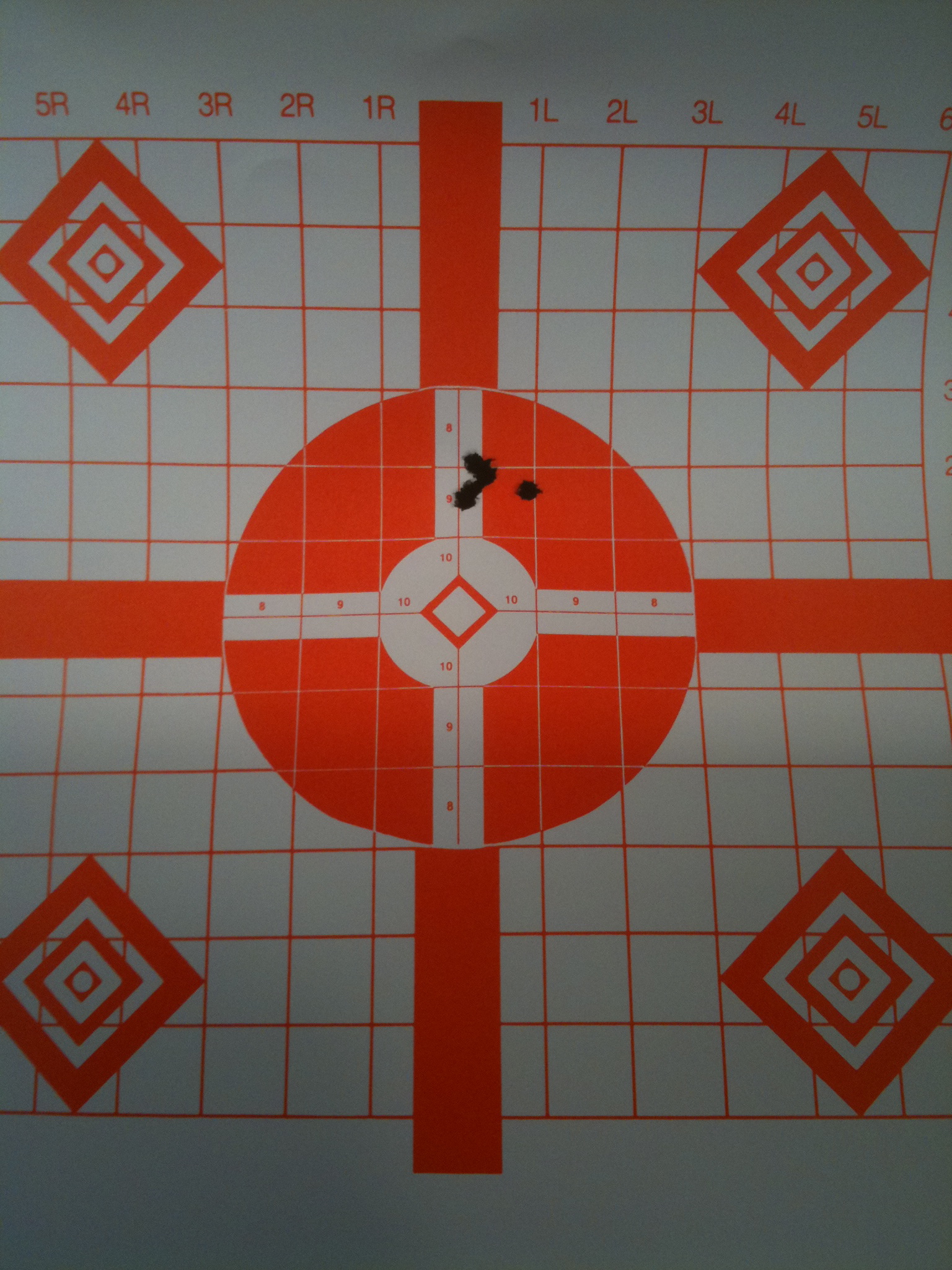
That’s 5 shots of SSA 6.8 SPC 85 gr. Barnes TSX tactical load at 100 yards. It’s shooting where I want it, grouped decent enough. I should have shot 7 to 10 for a better grouping average but I didn’t have a lot of time this morning and the range was getting pretty busy. Still, it felt right, it was consistent with the last time out.

I can only wonder if the gods are saying to me to leave the .308 behind and shoot the 6.8. It’s what I want to do, and seeing how things went this morning, I feel confident the 6.8 is going to perform this time around and the water buffalo incident was a fluke. The .308 will go with me, but I reckon she’ll be cold all weekend. 🙂

Wish me luck.

Combative Pistol 2 – First Shot

I spent October 23-24, 2010 with Tom Givens of Rangemaster taking his Combative Pistol 2 course, hosted at KR Training. While my general AAR is here, there were some things that came up in class that I wanted to speak about in greater detail. What follows is inspired by something Tom said or we did in class, but is ultimately my take on things and how thoughts gelled in my head. I would encourage you to train with Tom Givens, if you ever have the chance. Reading my blather is no substitute.

The First Shot

Who is the guy that wins?

Many people say it’s the first guy to shoot.

It’s more correct to say, the first guy to get fight-stopping hits.

It’s simple. If the first guy to shoot misses but the second guy nails the first guy square in the chest? The second guy wins. If the first guy shoots and nails the second guy square in the chest, the first guy wins.

There’s a lot implied in that statement.

It implies speed. You have to be fast.

It implies accuracy. The vital area to hit is small and you must hit it. Hits anywhere else just waste time and ammo, and give him a chance to shoot back.

It implies economy. You cannot waste time. If you present the gun and your sights aren’t perfect, take the 0.25 seconds to fix them then press off the shot. Because if you shoot in 1.0 seconds and miss, you’re now down one bullet, one second, and falling behind the curve. To readjust and get a second shot off could take you 1.5 seconds total. But if you shoot in 1.25 seconds because you took that instant to correct yourself and got the fight-stopping hit? That’s the better choice. You have to be fast, but not so fast you miss. You have to be accurate, but not so accurate you take too long.

Which shot is your most important shot? Your first shot. Which shot is the easiest to blow? Your first shot.

The first shot is most important because it may be the one that ends the situation… you may not get nor need any further shots. That first shot must count. But it’s the easiest to blow because you have to pull the gun out, get your hands on it, get gripped, push it out there, finger contact the trigger, finger press the trigger, eyes find the sights, line up the sights…. gosh, there’s a lot to have to do. Subsequent shots? You really just have to reacquire the sights and press the trigger again… harder to blow those shots.

Work on your first shot. Work on it being fast, accurate, solid. It may be the only one you ever get. It may be the one that saves your life.

Rifle waffle

Deer season opens this coming weekend (gun; archery was last month). I’m getting excited. Already been having dreams, and have been waking up early in anticipation of having to get up early to get out to the property.

I need to run my rifles back by the local indoor range just to (re)verify zero. They should be where I want them, but I can’t help but want to re-verify to be sure. The thing is, using the 6.8 SPC rifle is new… and while I know it will do the job, gosh but something makes me want to use my .308 bolt-action instead. Maybe because it’s proven? Maybe because it’s a big-ass .308″ 168 grain Barnes TSX instead of a 85 grain .277″ TSX. I don’t know. I know it’ll work. I really want to use the 6.8 to take the deer, but the .308 is going to come with me. Maybe it’s the false start with the 6.8 that’s making me waver a bit.

So as I’m packing the rifles up for the range trip, I see that I don’t have as much Federal P308H as I thought I had. This is a Federal factory load, .308 Winchester, 165 grain Barnes TSX. It’s a good round, always performed well for me. But it got me thinking… I want to start on rifle cartridge reloads after deer season calms down. I thought to do .223 Rem to get me back into the swing of rifle reloading. 6.8 is something I want to do. But gosh… if I don’t have a lot of .308 maybe I should just do that to get stocked up.

Too many things buzzing through my head. 🙂 Right now, just need to focus on the deer.

Combative Pistol 2 – now with pictures!

Lynn Givens was kind enough to send me some pictures from the recent Combative Pistol 2 weekend. I have updated my AAR posting with those pictures.

Here’s one of me on the line:

That PDT Camo Tactical Target is a great target. Well-designed and allows for a lot of very good drills. Tom Hogel (a KR Training assistant instructor) I’m sure is standing over my shoulder watching to see what he can give me hell about. 😉

Combative Pistol 2 – It

I spent October 23-24, 2010 with Tom Givens of Rangemaster taking his Combative Pistol 2 course, hosted at KR Training. While my general AAR is here, there were some things that came up in class that I wanted to speak about in greater detail. What follows is inspired by something Tom said or we did in class, but is ultimately my take on things and how thoughts gelled in my head. I would encourage you to train with Tom Givens, if you ever have the chance. Reading my blather is no substitute.

It

  1. Have it.
  2. Be willing to use it
  3. Use it well

Rangemaster – Defensive Shotgun DVD review

When Tom Givens was in town, I was able to pick up a copy of his Defensive Shotgun DVD.

As I’ve written before, my preferred home-defense tool is an AR-15. But in the past some months, I’ve softened my “anti-shotgun” stance. In fact, I find myself more and more drawn to wanting to study the shotgun. So being able to obtain and view a copy of Rangemaster’s DVD provides me with continued exploration of the platform.

Overall? It’s a good DVD providing entry-level information on the topic. If you’re an experienced defensive shotgunner, you may not find much use for thise DVD other than to round out your library. If you’re new to exploring the shotgun as a home or office defensive tool? It’s a good DVD to get you started.

The DVD is divided into 3 sections: introduction, hardware, and software. Tom starts out giving some history and evolution of the shotgun, which is both informative and useful (despite what you may think about a history lesson). He goes into discussion of different types of shotguns, parts, nomenclature, and ways to accessorize the shotgun for maximum performance in the home/office defensive situation. It’s important to understand that Tom is framing things from that particular context: home-defense, office-defense, civilian application. This is not some “high-speed, low-drag black ops” sort of context, nor police work, nor military work, nor something like skeet or sporting clays or duck hunting. Sure, much of that information could be useful there too, but understanding the context of the DVD helps to frame not only who should buy this DVD but also keeps the topics and discussion focused.

A good deal of time is spent talking about ammo, because there is a lot of misconception out there. One strong point Tom makes is how you must pattern your ammo in your gun, because very gun-ammo combination could be different… even the same brand/label of ammo out of the same brand/label of gun (but a different instance of that gun) could behave differently. Tom spent time on the range and went through different ammo with different shotguns to demonstrate performance and how you must pattern and know what’s going on. While a lot of video time was spent to demonstrate this topic, I thought it was one of the better parts of the DVD because people talk about patterning being important but being able to see it hopefully will impress upon the viewer just why it’s important.

Time is then spent talking about basic techniques, from ready positions to reloads. The DVD doesn’t go into great detail about tactics and gunfighting, just basics of how to operate the shotgun. If you really want details of tactics and fighting, attend classes or look elsewhere for that information. That’s one reason I state this DVD is “entry-level” because it spends a lot of time talking hardware, importance of patterning, and basic mechanical shooting skills. It’s good for what it provides.

If there’s any downside to the DVD it’s production. It’s not bad production, just not uber-slick expensive production. It doesn’t look cheap, just that Tom didn’t have a million dollar budget; nothing wrong with that. The only thing I found myself desiring, production-wise, was a better DVD menu/index of all the sections of the DVD so you could easily skip around to each discussion topic or segment. I also noted that while there was discussion of semi-auto and pump shotguns, most of the DVD was oriented towards pump shotguns. It would have been nice to have a little more use of semi-auto shotguns, but perhaps it’s more of a subtle bias — I know I’d rather have a pump shotgun in a defensive situation because it’s simpler, less finicky, and can run even in the worst conditions. Plus, pumps tend to be less expensive and one big argument for the shotgun as a defensive tool is the low-cost.

If you’re looking to utilize a shotgun for home or office defense but don’t know where to start? This DVD will help you out. I will say tho that it’s only a beginning: you will want to seek out proper instruction to really know how to utilize a shotgun in a defensive context.

Art of the Dynamic Shotgun – outtakes

Outtakes from Magpul’s latest, “Art of the Dynamic Shotgun

Yeah… I want to get that DVD. As much as I’m a proponent for the AR-15 man… something about the shotgun is singing to me.

Combative Pistol 2 – Hitting things

I spent October 23-24, 2010 with Tom Givens of Rangemaster taking his Combative Pistol 2 course, hosted at KR Training. While my general AAR is here, there were some things that came up in class that I wanted to speak about in greater detail. What follows is inspired by something Tom said or we did in class, but is ultimately my take on things and how thoughts gelled in my head. I would encourage you to train with Tom Givens, if you ever have the chance. Reading my blather is no substitute.

Hitting Things

Yes, we need to “shoot things“. But more importantly, we need to hit things.

If you have to shoot, you have to hit.

So sayeth The Givens.

It seems so simple, it seems a “no-brainer”, but is it really? Look at how many times we shoot and miss. Oh sure, maybe you hit paper, but look at how we’ll rationalize our crappy shooting to satisfy our egos. Can you get your hits inside an 8″ circle at 25 yards? or a 3″ circle at 5 yards? 3 shots in a 3″ circle at 5 yards in 3 seconds? Can you do it on demand? Always?

You have to have the ability to deliver fight-stopping hits. The goal is not to kill, it’s to get the other person to stop. If you can do that without ever firing a shot? Great. If you can do it without drawing your gun? Great. If you can do it by avoiding the area and situation entirely? Great. But if you have to shoot, you have to hit.

It’s not just fight-stopping hits, but that you are responsible for any bullet that doesn’t hit the intended target. A good number of the confrontations Givens’ students were in? Public areas. Shopping malls. What are in shopping malls? Lots of non-involved people. You don’t need one of your bullets ending up in one of them.

During one qual course I shot one weak-hand-only shot that totally missed. It hit paper, but completely outside of any target area. There was no excuse. I saw the sights, I called the shot, but I still let the round go… because of pressure, because being ingrained that the shot has to get off, whatever. And all I kept thinking to myself was: oh shit! That wasn’t just a miss… that was a potential hit on an innocent person… maybe even my Wife or Kiddos.

Let that sink in on you.

When you practice, don’t shrug off your misses, because those misses could have even greater cost and impact than your hits.

Train to eliminate missing. Train to improve your ability to hit. Givens mentioned how almost every qual course out there he can clean. Seems a reasonable goal to strive for, doesn’t it? You can’t clean it if you miss even one shot.