Survey says…

Austin Police Department released some crime figures for the SXSW festival:

City wide:

149 arrested for driving while intoxicated
96 arrested for public intoxication
28 arrested for aggravated assault
309 arrested for theft

Downtown:

22 arrested for driving while intoxicated
45 arrested for public intoxication
4 arrested for aggravated assault
66 arrested for theft

As soon as I read that, what came to mind was John Farnam’s saying about staying safe and managing risk in life:

Don’t go to stupid places; don’t associate with stupid people; don’t do stupid things. We will add to that, be in bed by 10 o’clock.

SXSW fails on all 4 counts. 🙂

Unpossible

A Westlake High School student was robbed at gunpoint in the school’s parking lot Thursday [Feb. 27, 2014] afternoon, the school’s principal says. Principal John Carter says the student was not physically harmed. He says it happened at around 4:30 p.m. The student was approached by a man with a gun who took his cell phone and then fled the scene. The student immediately reported the incident to school officials, Carter says. The Travis County Sheriff’s Office is investigating the incident. Carter says as a precaution the school will have extra security staff in the parking lots on Friday.

Original story. (h/t Paul Martin)

But I thought guns weren’t allowed on school property. It’s a gun-free zone, right? Or does this mean that criminals don’t obey the law?

Westlake is the “rich folks” part of Austin. Crime never happens there, right? Well granted, it’s not I-35/Riverside (one of Austin’s crime hotspots), but folks — no where is immune. Not “the good parts of town”, not “in gun free zones”. This doesn’t mean everywhere is a battleground, just that you should not be lulled into thinking that there’s some impenetrable bubble around certain areas. Shit can happen, anywhere, to anyone.

Updated (2014-03-13): I work with folks who have kids that attend Westlake High School. The story is legit. Apparently some dude was combing the parking lot, breaking into cars. This student just happened to stumble upon dude, dude pulled a gun, demanded phone, bailed.

School just let out. Kids everywhere. And doing this? Yeah… just remember that if criminals had the same smarts, standards, and ethics as you, they wouldn’t be doing what they’re doing in the first place.

What would you do?

Watch this video.

Here’s intro story (not much text, watch the video).

Here’s follow up.

Now let’s take in a few things.

The people in the video have no respect for the law.

The people in the video have no respect for (your) life.

They understand how to do what they want, that suits whatever makes them happy and don’t give even half a fuck about you — unless you get in their way, then they’ll hurt you (evidenced by the guy that got run over).

The people in the video understand gang mentality, in the sense of strength in numbers.

They have no fear of the police. In fact, the police feared for their own safety and left.

They don’t fear repercussions from “the system”, given they aren’t hiding their faces on the video and in fact are uploading these videos to YouTube.

Granted, you may not live in Oakland, but that doesn’t mean where you live is immune from people who celebrate their disregard for you. People like this, obviously, exist in this world. Heck, just a couple weeks ago a nasty beating was caught on tape in downtown Austin.

What are you doing to keep yourself safe in the face of this reality?

Do you leave it to others to manage your safety? Again, the police didn’t and couldn’t deal with this and left (I don’t blame them one bit). According to the follow-up article:

“This has been going on for years,” said Alameda County Sheriff’s Office spokesperson Sgt. J.D. Nelson.

“The powers that be in Oakland have depleted the Oakland Police Department, so, this is the kind of activity you’re going to get.”

(Oh, and that Austin beat-down? Happened 2 blocks from APD headquarters).

So what can you do? The police can’t save you. The government can’t save you. Tell me, what can you do? Tell me how constructing a legal system that abridges the law-abiding from protecting themselves from such animals creates a better, more peaceful, more enlightened society? Tell me how banning guns, knives, and other useful self-defense tools is a wise course of action, given what you saw in that video. Tell me how not getting education, training, skills, and knowledge on how to keep yourself safe is not worth your time or money (because just having a gun isn’t enough).

You must accept there are animals in this world.  You must accept there are horrible people who do not hold the same standards as you. That because you cannot fathom behaving in some savage way doesn’t mean such savagery doesn’t exist. Once you overcome denial and ignorance, then we can start talking about real useful solutions to these problems.

iReportAustin.com

Just learned the Austin Police Department has an online incident reporting system: ireportaustin.com

Of course, don’t use this for emergencies — dial 911.

But this seems a good resource to submit tips (including anonymous tips), and crime reports (harassment, burglary, criminal mischief, assaults, threats, theft, lost property, etc.).

Why would you want to report a crime? I mean, even if it seems something minor and not worth it, it does have effects. It helps APD look for crime trends, find hotspots, and establish data and paper trails. This can be important because when citizens call APD for help, like increased patrols, they are going to pull up data for the area. If there’s no data to support the extra patrols, it’s going to be hard for them to justify the resource expenditure.


It happens in seconds, but you’ll pay for it for a long time.

Smash and grabs are happening in Austin (not surprising, given Austin’s crime rate):

“Apparently it just takes a minute to shatter that glass and grab a purse,” said Sharon McMillan.

She was picking her son up from a birthday party at Brentwood Park Saturday afternoon. “So, I quickly parked and left my purse in the car, knowing I would only be just a couple minutes,” she said.

She locked the car doors. But when she came back, a window was shattered and her purse was gone.

(h/t Michael Cargill)

Only gone a couple of minutes. I’m sure you’ve done this too. We think nothing of it. Just running in really quick — to the house, to the convenience store to buy a drink after gassing up, whatever excuse. Crime only takes seconds to unfold.

“I never leave my purse in the car, but of course that day I did, thinking, the car was in sight, and we were just a few hundred yards away,” she said.

The women say they tracked their credit cards, and found that the cards were being used at a few businesses on West Anderson Lane.

“Immediately, we got on the phone with our credit card company and the bank and canceled the cards,” Spradling said. “It was probably 40 minutes from the time we got to the park and until everything was canceled, and already they had $600 on the credit card.”

And the subsequent crime continued very quickly, faster than you could respond. Within 40 minutes, already $600 in fraudulent charges rang up.

Think about it.

You thought things would be safe. That it’s just a couple minutes. But what would it have cost you to pick up your purse (or put your phone or wallet in your pocket, whatever) and bring it with you? Just another second or two, if that? But failing that, look at the cost you now have to deal with. Smashed car window. Time off to get it repaired. Dealing with insurance, and certainly the cost of repairs/deductible. Losing all your credit cards and other identification, whatever else might have been in the purse. Now you have to replace everything, monitor your credit and identity for further fraud. Whatever the specifics wind up being, it’s certainly a FAR greater cost in time, money, emotion, energy, to deal with the aftermath than it would have been to just take your purse or wallet with you.

Learn from their mistakes.

Austin’s crime rate

I recently came across a bunch of data about the crime rate in Austin. I’m not sure where city-data.com gets their raw data (and apparently they don’t disclose it), but let’s just take it at face value.

Austin’s crime rate seems to have declined. There’s fluctuation from year to year, but if you look at the span from 1999 to 2011, it’s gone down overall (using city-data’s “crime rate” number).

But if you look at some specifics, it’s gone up. Over that time span:

  • Murder has held steady
  • Rape is lower, but only after a number of years of significant rise (the low 2011 number may be an anomaly)
  • Robbery is hard to call. The 1999 and 2011 numbers are about the same, but in between there was a significant rise.
  • Assaults are up.
  • Burglary is again one of those where 1999 vs 2011 are about the same, but there’s a massive rise in between
  • Theft is up
  • Auto theft is down
  • Arson has weaved up and down, and after a significant drop, appears to be on the rise again

And using City-Data’s numbers, Austin’s crime rate is significantly higher than the US average.

City-Data then breaks some numbers down.

Violent crime rate? Almost always higher than the US average.

Property crime rate? Significantly higher than the US average. I know property crime is a big problem in Austin.

Austin is lower than the US average murder… but murder is so statistically rare, whereas property crime and assault isn’t. And note that while some assaults are just as simple as that, “aggravated assault” used to be called “attempted murder”; basically they were trying to kill you but you lived — can’t call it murder unless they die. And due to our improvements in medical and Emergency Room care, there’s a high probability that if you are attacked but get to an ER with vital signs, you have a high likelihood of living. So, consider that when you look at violent crime numbers.

Rape has generally been higher in Austin. I do wonder what role in the data the University has.

Robbery is higher than the US average, every year.

Assault fluctuates year over year vs. the US average, but it’s still high.

Burglary is significantly and consistently higher than the US average.

Same with theft.

Austin is a high crime city. It may be getting better, depending who you ask, but it’s still high.

Here’s another tidbit.

Full-time law enforcement officers? Lower than the Texas average.

Hrm.

Well, if you break the crime down in Austin, it seems we can see a few things:

  • Crime rates are higher than average (vs. the US in general)
  • Crime rates are generally rising
  • Theft is the most likely crime you will encounter, followed by burglary, then assault.
    • While you have to take care to secure your person (you are more important than “stuff”), you should also take steps to secure your stuff and make your stuff-holding-locations (house, car, etc.) to be less tempting targets.
  • Not enough police to really stop and prevent crime. You are on your own when it come to the first line of prevention.

Take the data for whatever it’s worth.

Home Break-in – What can we learn

I read about a home that was broken into. As I read the details of the break-in, I got curious and went to Google Street View
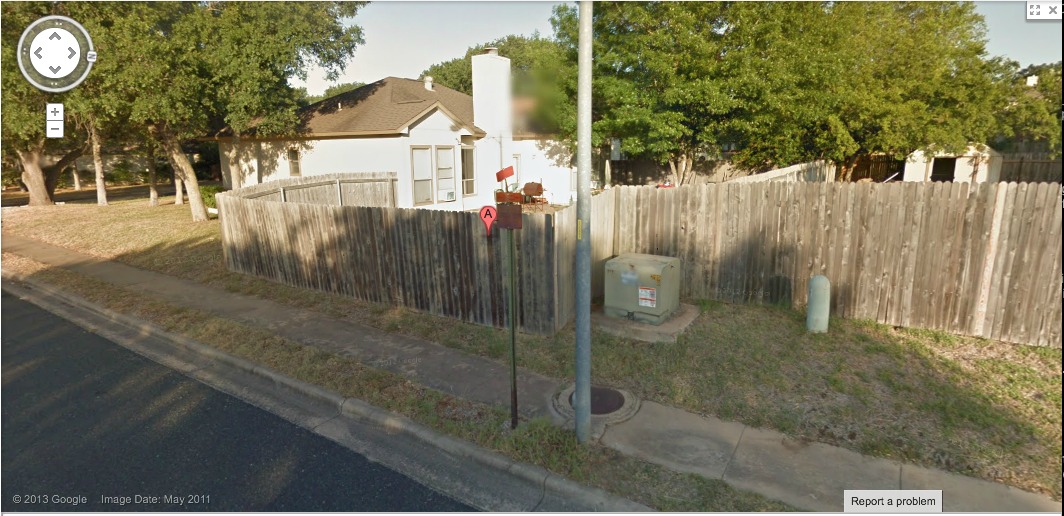
Please understand, I’m not trying to scold or demean the homeowners. When I saw some other pictures of the result of the break-in, my heart sank. I can imagine the feelings of hurt, violation, anger, and then the realities of having to deal with the aftereffects. I wouldn’t wish that upon good people. What I wish to do is look at a few things and see what we can learn so we can all work to reduce our chances of being victims.

The essential details are that the break-in occurred during the day while the homeowners were at work. The burglars removed the window A/C unit, which then made for easy entry into the home. They ransacked the house. Unsure of exactly what they were looking for as “big ticket” typical theft items were not taken (one person suggested identity theft was the movie). So, at this point I don’t know what nor why things happened, but I’m not sure it matters much at this point. What we’re interested in here is what we can learn so we don’t become victims ourselves.

First, the break-in happened during the day on a weekday. While everyone talks about the breaking of glass in the middle of the night, that’s actually rare. Most break-ins happen during the day because that’s the most likely time 1. no one is home, 2. no neighbors are home.

Second, they pushed in the window A/C unit. I do not know the situation of this particular unit, but from what I can see in the picture, I’m not convinced the unit was secured. Having brackets not only support the weight of the unit, but they make it more difficult and cumbersome to remove the unit. Panels along the side, strong bars/dowels to keep the partially opened window from being slid further upwards. These are things that can make it more difficult.

Third, see in the foreground that power converter/transformer/box? I would not be surprised if that aided entry into the backyard. Hop on top of that, and it’s easy to hop over the fence. There’s nothing they can do about the box, nothing they can do to prevent access to the box. But, how about planting some big thorny holly bushes or cactus on the other side of the fence? Most people do look before they leap, and giving no clear and safe landing area can’t hurt you (but can hurt them).

It’s possible entry was gained into the backyard through the normal fence gate. I don’t know if the gate was padlocked in any way, but if not, padlocks are useful things.

Fourth, look in the backyard of the neighbor on the right. See the wide-open door on their shed? Granted, it’s possible when this picture was taken that homeowner was doing something and the doors are normally shut — it’s just a snapshot in time as the Google Streetview Car drove by. But still, consider the implications of sheds — which generally hold tools and other property that either can be directly used or easily sold for fair gain. Keep doors closed and locked.

It must be accepted that no home is truly secure. Our homes are made of sheetrock, wood, glass, and other easily broken materials. If someone wishes to gain access, the construction of our homes will not stop them. But consider most property crimes like this are crimes of convenience. The criminal doesn’t want to work hard (if they did, they probably wouldn’t be criminals in the first place). They want an easy target. The best you can do is work to make your home a difficult target. I mean, your home and the home next door both have tv’s, game consoles, jewelry, tools, and other desirable goods. If you make your home a more difficult target, if they’re going to have to work more or risk pain, problems, and hassle to get into your home, they’ll probably choose another home.

If you live in Austin, here’s where your car will get broken into

Our friends at krimelabb were featured on local KEYE-TV about the most likely places your car will be broken into.

Let’s get to the good stuff:

So where are the hot spots?

According to police reports from the past year, coming in at number three is the UT campus. The sheer number of faculty, staff and students who drive to the university, make it a prime target.

Coming in at number two is anywhere along the I-35 corridor. “The criminal wants to make a quick getaway. They don’t go deep into a neighborhood where they’re passing over speed bumps and stop signs,” added Darby.

And the number one spot you’re most likely to have your vehicle broken into is Burton Drive in East Austin. The area has the most apartment complexes on any street in all of Central Texas. Residents in the neighborhood are get hit all the time.

So it’s about places with lots of cars and also lots of people. The article reports most break-ins happen between 10 PM and midnight — when we’re still awake, but perhaps as many people around. And yes, under cover of darkness. Seems Sunday’s are the most popular day too.

But what causes the cars to get broken into?

“Some people don’t lock their cars,” said Austin police detective Damon Dunn.

[…]

“Mainly your electronic items because that’s what the crooks are looking for,” added detective Dunn.

I have a friend that used to work in the Maine legal system. He never locked his car doors. His take? Leave nothing in your car. Your car should be nothing but your car. Thus, there’s nothing inside for them to steal. If they do want to break in to look, having the doors unlocked means they (hopefully) won’t smash your windows — just open the door, see there’s nothing, close it and leave. If they want your car itself, he says there’s almost nothing you can do as they will take it. So to lock or not to lock isn’t so much the issue, as it is leaving things in your car that the thieves want.

I see it frequently. People at the gas station leaving their car doors open, iPod’s and phones left in the car. Expensive stereos. Then all manner of stuff in the car too: your books, gym bags, other junk. If it’s something someone else could use directly or sell, it gives them reason to try to take it.

Just because you don’t live in one of the hotspots doesn’t mean you won’t be victim. My own neighborhood has been hit, and I’m sure if you look through enough crime reports, you’ll see yours has been too. Take some time and look at the data krimelabb has compiled; you might be surprised, but more importantly, you’ll be informed.

Little things can help keep us safer

“(Hubbart) began to sexually assault women in their homes in 1972,” the petition said. “He committed 25 or 26 such assaults that year, all of them in the Los Angeles area. He would drive around in the early morning and look for homes that had garage doors open, indicating the man of the house had gone to work. He would also look for children’s toys, believing that mothers would be protective of their children and more likely to cooperate with him. He would bind the women’s hands and cover their faces, then sexually assault them.”

Regarding Christopher Hubbart, a serial rapist, and his release.

This isn’t about the horrible things Hubbart did. But it does afford us a chance to learn so perhaps no one else will become a victim of such a monster.

Look at what Hubbart did. He didn’t attack in the middle of the night. He didn’t stroll around a college campus or a dim parking lot.

No, he drove around neighborhoods — like yours — looking for signs of vulnerability:

  • Open garage doors
    • Not just being open, but then empty… with signs the “alpha predator” was not around
  • Children’s toys
    • Children usually mean there’s a woman nearby
    • That women will be willing to “give him what he wants” because he can always play towards injury of the children

I see it constantly as I go around town. People leaving their garage doors open, windows open, doors and windows unlocked. Signs that say “come on in”. It makes for easy access, and it shows a lackadaisical attitude towards one’s personal safety. That you don’t care, that you don’t think it could happen to you, that you’ve never considered that it could… and thus you are all the more vulnerable, and all the more susceptible prey to the sick predator.

Kids toys left out also raise signals like that there’s probably a video game console inside — make a quick buck by selling it. Various signs that help to make your home, and perhaps you, more appealing. And yes, Hubbart’s notion of the woman being more willing to submit out of fear of injury to the children? Just another angle to take advantage of.

No, this is not right. But the sad part is it happened over and over. He committed a couple dozen of these. Where was the fighting back? Where was the unwillingness to be a victim?

And are you really going to tell me these women would have been better off without a gun? And without the determination and mindset to use it, to prevent their attack, and the possible future attacks of others?  Are you saying they should “just give him what he wants?” because that’s the mantra so many utter as the proper response to being a crime victim… but Hubbart is what happens when you “give them what they want”.

No. Learn from this horrible situation. Learn how you can do a few simple things to make yourself less appealing as and more difficult to be a victim. If you’re going to become a statistic, make it one for the “win” column.

Little woman vs. big man

A common sales pitch of martial arts is that learning my deadly art will allow a 100# woman to fight off a 300# gorilla.

As well, one common refrain about the use of tools in self defense, is that the tool becomes a way to overcome the force disparity that a 300# gorilla poses to a 100# woman. If you can have a baseball bat, pepper spray, gun, it “levels the playing field”.

So which is right? Or are both right? Or are both wrong? Or is there something else?

Rick Randolph writes that there’s actually something else that matters more:

While it may be unrealistic to think we can teach any 110 pound person to knock out a 220 pound attacker … or use pressure points or joint locks, that is not what self-defense is. See “fights” in a self-defense sense aren’t won with techniques, they are won with what Coach calls indignation.

Bad guys aren’t looking for a fight. They are looking for a victim. Give them a fight, even an unskilled one, and often times they will go look for a “better” victim

[…]

Lets face it: it wasn’t their physical skills that saved them. None of the stories tell of fancy techniques. Simply that they chose to fight. And that is the reality of self-defense. It is less about how you fight but more simply about the fact that you fight.

Make the decision you will fight now. You don’t want to wait until you have to.

Self-defense classes shouldn’t be so much about teaching people how to fight, and more about empowering them to fight and fight with everything they have.

And that’s what it is: mindset. You must have the mindset to fight. I’ve heard some say that you should become angry, or Rick above says to be indignant, which is probably a more accurate term. Use that. Let it drive you to drive them off.

Yes, I think there is great merit to using tools. That’s one of the things humans have that other animals don’t. We are gloriously mediocre in our senses and our skills, not really good at any one thing, but decently good enough at a lot of things. And one of those things we’re decently good at is using our brains to create stuff, stuff that helps us overcome our shortcomings and mediocrity. We can’t move fast, so we invent cars and planes. We can’t see well, so we invent telescopes and night vision goggles. And our fangs and claws aren’t much, so we have knives and guns. Tools are useful things and we should use them.

But the tool doesn’t matter if you’re unwilling to use it. If you buy a gun, shove it in a drawer, that does you no good. If you practice with that gun but merely plink or slow target shoot with it, that does you no good. Might you want to take classes to learn about good defensive handgun skills so you can use the tool well under pressure? Or how about taking Force-on-Force classes so you can be put into realistic scenarios and see how you’d react. Maybe see how you might be able to channel some indignation. When you read news articles, put yourself into the story and figure out how you would react to being mugged, beat up, raped, or otherwise left for dead. What would you do? Because if you play out these scenarios in your head, basically a visualization technique, and your response in them is to choose to fight, to choose to be indignant, you’re setting yourself up for success.

I don’t want people to become bitter or negative about the world and live their life in some ugly way. I do want people to acknowledge tho that the world does have ugly elements that are willing to infringe upon your life and turn it into something you could never imagine in your worst horrors. Hopefully it will never happen, but if it does, I hope you will have prepared beforehand. Whether it’s acquiring the tools, the skills, or more importantly the mindset and mentality to fight. That is what will enable a 100# woman to overcome a 300# attacker.