On primer selection

The reason I’m spending so much time looking into this .223 Remington hunting load? Because it’s interesting.

Sure I could just pick a few things and go, but the way the market is right now I don’t have every possible option. I can only get what primers or powders some retailer happens to have in stock. I can’t just get any primer and powder I want and dial in some existing load recipe and be done with it. Because only so much stuff is out there I’m being forced to learn and explore a lot of things in the ammo reloading process. It’s kinda cool. As I uncover more things it changes any plans I may have laid. Frankly, I’m finding it all pretty darn interesting.

I mentioned some of my findings in the previous article, but now I want to talk about primers.

The only small rifle primers I could find were CCI #41 and Magtech PR-SR. I could find decent info on the CCI primers, but not much on the Magtech’s as Magtech isn’t touted in the marquee names of ammo (Federal, CCI, Winchester, Remington). However Magtech does make decent ammo; I’ve used some of their stuff for practice and it’s worked fine, and many others online echo similar experiences. I figure these are the same primers they use in their manufactured ammo, and what reports I can find about their primers are generally positive, so why not give them a try. Certainly, beggars can’t be choosers. The CCI #41 are considered the same as the CCI 450 magnum small rifle primers, but just a bit “harder” to combat possible slam-fires.

I’ve got both types of primers on order.

When I looked at the data in the Barnes reloading manual, of course many powders were available but the top performers appeared to be TAC, H-4895, and Varget. So I ordered some jugs of those and figured they’d be a reasonable place to start. They’re also reviewed well for .308 Winchester loads so if the powder doesn’t work out for the .223 loads maybe it will for the .308.

So what powders to pair with what primers?

I’m not aware of any hard-fast rule that says I must do this or I can’t do that. But I have learned that in general magnum primers are better with spherical powders. This article phrases it nicely:

To begin, the main difference between a standard-force and a magnum-force primer is in the length of its burning time. A magnum-force primer burns longer than a standard force and therefore tends to increase chamber heat variously depending upon the primer’s own power, the powder involved, and cartridge case size plus bullet weight. As a rule of thumb, standard-force primers have been recommended for all rifle situations except those employing ball-type powders and those using more than fifty grains of slow-rate extruded powder such as IMR-4350, H-4831, and IMR-7828. In handguns, it has been common to see recommendations for magnum primers in all ball-powder reloads and all magnum-length cases. A lot or reloaders follow these generalities solely for the “safe of ignition”, no thought being given to accuracy considerations.

I spent some time looking at the .223 Remington data in my Speer #14 manual. It’s recipes use CCI 400 or 450 primers, and even says the CCI #41 primer may be substituted for CCI 450. In the data tables, any powder marked to use the magnum primer is a spherical powder. So there you go. However, I’ve also read lots of reports of people mixing and matching, so I would gather it’s no hard rule. But it sounds like any load: start low and carefully work your way up. Your gun’s sweet spot may vary.

Then throw in things like from Ramshot’s own FAQ:

Q: It’s been my experience that I need to use a magnum primer with spherical powders. Do I need to use a magnum primer with Ramshot powders?
A: While this may have been true with spherical powders in the past, Ramshot powders employ a new technology of coatings which increase ease of ignition, cleanliness and in most cases decrease temperature sensitivity. You also have to take into account your firearm’s accuracy which may or may not perform better with magnum versus non-magnum primers.

So yeah… easy answers. 🙂

I also can’t help but wonder… given the rifle I’m working these loads up for is an AR-15 with a carbine-length gas system, might a (theoretically) faster-burning powder be better? perhaps even coupled with a magnum primer to get as much burn in before the gases start to cycle back? I don’t know, just ignorantly wondering aloud.

Then I have to consider it’s rather cold out right now, and I’d likely want to develop the load below max so come summertime the same load doesn’t become an over-max load.

Ultimately it points to one simple thing: start with minimum loads and slowly work your way up.

My current thinking (and this could change in an hour): as soon as I have all of my components in, I will load minimum loads (strictly following the Barnes #4 book data) varying on powder and primer combinations. Bullets will be the same, cases will be the same, C.O.L. will be the same, Lee Factory Crimp, so all that varies is powder and primers. I will load 5 rounds of each of the 3 powders with each of the 2 primers (yielding 30 rounds total). I’ll then take these to the gun range along with some factory loads. While the factory loads won’t provide apples-to-apples comparison, they’ll still provide some sort of reference point. Shoot things and see how they do. The main thing will be looking to see how the powder and primer combinations work out. Whatever combination appears to work best, continue with that combination of powder and primer and now bump up the powder charge (on a subsequent reload and range session) and see how things go. Granted this isn’t definitive… it’s always possible some powder-primer combo with a minimum charge may perform differently with a larger charge. But this sounds like a good way to start. If you more experienced reloaders reading this have suggestions otherwise, I’m all ears.

Various articles on reloading

In all of my Googling around about reloading (handloading) ammo, I’ve come across some interesting articles

About Load Density.

General Reloading Tips.

Right now my mindset is thinking about the .223 Remington reloads that I’ve been writing about lately. I’ve got some Barnes TSX .224″ 53 grain on hand and have some 62 grain on order. I’m wanting to use the 62 grain (I’d like a heavier bullet), but just in case this particular rifle can’t stabilize 62 grain (it should) then I’ll fall back to 53 grain.

So I’ve been thinking about what powder to use. TAC meters very well and seems to produce some of the highest velocities at a relatively low density (by comparison). H-4895 and Varget produce velocities on the lower end of the chart (tho still quite fast), and have at or just over 100% load density. In reading the article on load density and the general tips, it seems to me I’d be likely to eek out a more accurate load using the H-4895 or Varget, based on filling the case up plus the shape of these 2 powders. However, the TAC’s accuracy may be good enough for hunting, plus a little extra velocity out in the field I believe would be useful. On the same token however, I don’t think the differences will amount to much in the real world… this is all just looking at tables and numbers.

That general reloading tips article has a bunch of other useful tips about extended brass life, measuring lands. Good stuff.

Fr Frog has an article about how to develop an accurate load.

Fr Frog also discusses how changing just one component can affect the performance of a reload. Components are not directly interchangeable. I liked this bit of math for determining your “work up” increment:

No wonder the reloading manuals caution you to drop at least 10 percent from any maximum charge data and slowly work up. A good rule of thumb for the amount of an increment to use when working up from a starting load is to fill the case to the base of the neck with the powder you are using, dump and weight the powder, and to then use 1 percent of that weight as an increment. As an example, if your case would hold 55 grains of the powder you are using a good “increment” would be .5 (5/10) of a grain. Once you get “in the ball park” for accuracy (see the article on load development) you could then cut that increment to about half (say to .2 gr in this case) to fine tune things.

Tons of random reloading snippets of knowledge.

Everyone talks about looking for signs of high pressure, but often they don’t explain what that can be. While this isn’t in-depth, this page has a quick list of things to look for:

Watch for signs of high pressure while working up a handload. This means extraction difficulty (however slight), flattened primers, cratered primers, ironed-out headstamps, polished headstamps, ejector marks, case-head expansion, and excessive recoil and muzzle blast. And anything else whatever that strikes you as abnormal about the load.

Article on safety.

Anatomy Lesson – Pigs & Deer

You hear various mantras about shot placement when hunting for certain animals.

“Only shoot them broadside.”

“Take out the shoulders, they won’t go anywhere.”

“Headshot.”

“Right in the neck, takes out the spine.”

“Texas heart shot.” (bleah)

I don’t think there’s any one and only right way, other than the way that puts the animal down as quickly and humanely as possible. What that is remains the subject of much debate.

What I think ultimately gets you there isn’t just having some blind or relative notion of where to shoot. That is, it’s not just about “broadside, just up the leg” because that only tells you how to shoot in that particular instance. If that shot doesn’t present itself, you’re out of luck or you may end up taking a marginal shot. I think a better course of action is to understand anatomy. If you can know the animal’s actual anatomy, you can adapt and make better, more informed decisions about what is presented to you and if it’s a good and ethical shot.

Whitetail Deer Anatomy

Take a look at the pictures from deerhunting.ws’s anatomy page (I’ve made a PDF of that page, in case it ever goes away). I like how it shows the animal, the muscles, the organs, the circulatory system, and the skeleton. Layers, so you can better understand how all the parts fit together. Plus they keep an outline of the animal’s body around so you can learn relative placement of these things.

This article on about.com discusses some of the possible shots. Every hunter will have their own assessment of “what is ethical” and this article provides a good starting point for the discussion.

Feral Hog Anatomy

Found this picture:

I’m not sure where the picture came from or who made it (if you know, please let me know so I can properly attribute it). It’s a good illustration of their anatomy.

TexasBoars.com has this great write-up of pig anatomy, including pictures taken of an actual pig in various states of field dress so you can really see how it looks on an actual pig. This is very important because you need to learn where that “shield plate” is. They also have another picture at the top of this page that shows the kill zone.

Another good article from the California Hog Blog. It shows not only a good kill zone (and also discussions of neck shots), but also argues against the head shot.

Cartoon Bop

Cartoon Network was tuned in on the TV.

A “commercial” comes on… one of those spots that has a montage of the network’s original shows and characters to promote the network itself. And then… the soundtrack.

Blitzkrieg Bop, by The Ramones

I don’t know what to make of it.

The Ramones being used as the bed music for a commercial to promote Time-Warner’s products.

Something just doesn’t seem right about that.

On the flip side, it should expose a new generation to The Ramones, which is cool.

But part of me wonders what people would think if instead we told them to beat on the(ir) brat with a baseball bat. 😉

Miniatur Wunderland

Miniatur Wunderland has been around for a while, but someone sent some pictures of the place to me today and I went and looked at it again. The place is simply amazing.

Watch this “drive through”. If it wasn’t for the occasional giant showing up in the background, you’d swear you were on a real train ride.

And check out this water-way shot

I’ve always found miniature trains fascinating. Many times I’ve wanted to get into it, but I simply don’t have the space to do it. It’s a bit of engineering, a bit of art, and you have to just remember to have a child-like wonder about the world to really enjoy it.

Happy Bill of Rights Day

Happy Bill of Rights Day.

Go read it.

For more on Bill of Rights Day, there’s an article here and here.

Educate yourself about the basic rights that we US citizens are supposed to have, and that government is not supposed to limit (remember, these documents are supposed to limit government, not the citizenry). Alas, every day we creep closer and closer to losing them; that the limits are being put upon the people and the government runs rampant and unchecked. The first step to ensuring our freedoms are not taken from us is to learn about these documents and embrace their fundamental message.

Go read.

Almost ready to start

Slipped out to Cabela’s after work.

I was pleased to see they had Lee Factory Crimp dies sold solo (most of the dies Cabela’s sells are die sets and I was afraid I’d have to buy a whole set just to get the crimp die). I picked up the .223 Remington, .308 Winchester, and the .38 Special/.357 Magnum one. Loading Barnes TSX in .308 was my original desire but that got set aside for now. And I was curious to try out the crimp on the .38 Special loads I’m working with the Berry’s bullets since they are plated and have their own crimping issues to deal with. The lone die wasn’t too expensive so hey, why not.

I also picked up a Hornady OAL Gauge and a threaded case insert for .223 Rem and .308 Win. Why? As I’ve been scouring the Internet for information I read that the Barnes TSX’s do well seated at 0.050″ off the lands (tho it can vary from 0.030″ to even 0.100″ according to other things I read in the Barnes newsletter archive). Am I looking for that sort of benchrest accuracy? Not necessarily, but also why not try to get the best performance I can? In a lot of respects, this is just newbie curiosity for me. Found a couple useful articles about the OAL gauge here and here.

Next time I get involved in a hobby, I want it to be something inexpensive and easy to get going with. Martial arts? big investment of time and money. Motorcycle? big investment of time and money. Guns? big investment of time and money. Hunting? big investment of time and money. Reloading? big investment of time and money. Sheesh! 😉

But I think this finally gets me all of the equipment I need. All that’s left is for my orders of primers and powder to arrive. If all goes well that will be next week and I can spend part of my Christmas vacation working up some loads. Can’t wait!

My Secret Talent

Well, I guess it’s not going to be much of a secret any more.

I sew.

Yes, some people love the dichotomy. Big me with my guns, motorcycles, martial arts, beer, hunting, etc…. and sewing. One of these things is not like the other.

I learned to sew out of necessity, to mend things. As a child I watched my Mom sew things to mend or adjust clothing. I’d often pull out the sewing kit myself just to dink around. As a kid, one Christmas my sisters and I bought our Mom a sewing machine; she never used it, but my sisters and I would always fiddle around with it. Fast-forward to about 5 years ago and I caved in and bought a sewing machine because it was much less painful to sew patches on Scout uniforms with a machine than by hand.

Make no mistake — I am not a seamstress. I do not have mad skillz. I actually think about taking some classes to learn how to sew things like clothing. But for now, I can do some things.

I made a toy pillow and mattress for Daughter’s doll crib a few years ago. We pulled the doors off Daughter’s closet and I fashioned some neat curtains for it. I’ve done a few other things too, tho no clothing because the notion of that intimidates me (at least until I can get more training; man knows his limits).

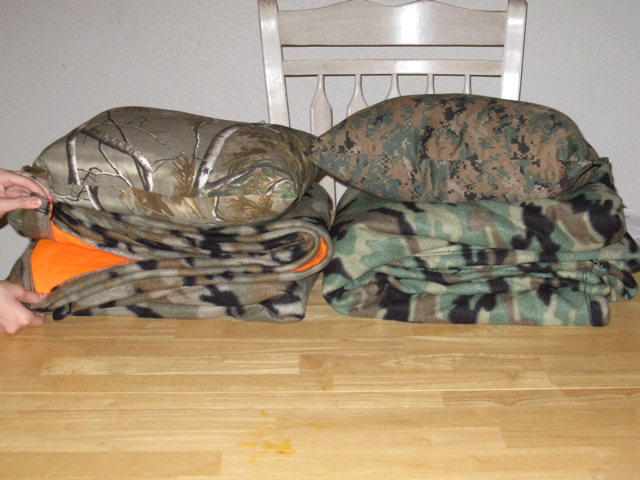
My latest project: blankets and pillows for my nephews.

A couple years ago Wife’s brother’s wife made some blankets and pillows for our kids that were pretty neat. When thinking about Christmas presents for my sister’s boys, I thought making them blankets and pillows would be neat as well. I asked Sister what colors the boys liked and headed over to Jo-Ann Fabrics. The plan was to make them double-sided blankets, with one side being a “novelty” cloth and the other side being this fuzzy fleece; fun and warm. When Daughter and I got to the store, they didn’t have much of the fuzzy fleece nor did we find much for cloth in the colors and patterns we wanted. We picked what we thought might be good, then I called Sister to ask her what she thought. Snapped a picture of the cloth, sent it to Sister (iPhone love!). I asked her to be honest and she said there was a good chance some of those wouldn’t be well-accepted. Fair enough, that’s why I was asking. While talking on the phone I was staring at a shelf full of camouflage cloth and asked her what the boys would think about that. She said it’d be great and the would love it.

So here we are.

Picked two different camo patterns so they boys could tell their blankets apart. Both fleece.

Originally we wanted to sew a fleece “blaze orange” on the other side of both blankets. Unfortunately with the bolts of orange fleece they had, only one gave us enough to do what we wanted (I wanted 2 yards, the other bolt only had 2 1.5 yard pieces). So we grabbed some of that black fuzzy fleece. Thus one blanket has camo on one side and hunter blaze orange on the other, and the other blanket is camo and the fuzzy fleece.

Jo-Ann’s also had some regular camo cloth, so I picked up a yard of two varieties and some poly-fill and made some very fluffy pillows too. I felt really geeky because I was all excited to find just bolts of Realtree AP. Gosh… now I could sew my own hunting clothing. 😉  In fact, Daughter wants me to make her a t-shirt with the leftover camo cloth; again, clothing intimidates me but who knows… maybe Jo-Ann’s will have a pattern and I can give it a try.

All very soft, very warm. Daughter helped me sew things, did some good product testing, and gave her seal of approval. No they aren’t perfect (there are obvious spots where things aren’t in nice straight lines), but they work and should hold up well. I’m generally pleased with the work and hope my nephews enjoy them.

To Crimp Or Not To Crimp

That’s my current question.

So in trying to work with these Barnes TSX .224″ 53 grain bullets, do I need to crimp them or not?

From Barnes’ FAQ:

Do you recommend crimping your bullets?
We usually don’t recommend crimping our smaller-caliber bullets. However, if you choose to do so, a light crimp is best. Heavy caliber bullets (.375 and up) for large game require a heavy crimp, as do most revolver and lever-rifle loads.

From Barnes’ April 2007 Newsletter:

Question: When reloading magnum calibers with TSX Bullets, do I need to set up my die to add a factory-style crimp to prevent cartridges in the magazine from losing their grip on bullets under recoil? I have loaded short-action and long-action rounds without placing a crimp on the bullet, and have never had a problem. I have been told that reloading magnum cartridges is a whole new ball game. Any information you could give would be appreciated.Keep turning out those TSX Bullets and I will keep loading them. Thanks for the help.

—Randall Miles

Answer: In the past Barnes has recommended not crimping anything smaller than .375 caliber if proper neck tension is applied. However, there are exceptions to this rule. Cartridges used in autoloaders should be crimped to prevent bullet movement as the action cycles. Some of the light-for-caliber TSXs require crimping due to their short bearing surface. Sometimes a light or Lee factory crimp will improve accuracy in a standard or magnum cartridge. Finally, with some of the extreme magnum cartridges (e.g. .30-378, .338-378, etc.) it is a good practice to always crimp.

Ultimately, it is up to the shooter to determine what will yield the best results in his or her rifle.

Thanks for a great question.

—Ty

So it sounds like yes I should crimp.

And it sounds like I’ll need to buy a Lee Factory Crimp Die. Or do I? I found this article that shows yes in fact crimping makes some sort of difference. There’s this guy that doesn’t speak highly of crimping (for maximum accuracy). The more I Google around, there’s just a zillion opinions, of course. But one interesting thing that comes up is a lot of people don’t think much of Lee dies to begin with but do like their factory crimp dies. Go figure.

Given these will be shot out of an AR-15, I figure I should crimp. And it sounds like the roll crimp my RCBS dies will do isn’t going to be the best thing. *grumble grumble* More shopping to do.