My DIY Tire Drag Sled v1.0

I might be taking the week off from the gym, but I’m not taking the entire week off from working out.

Behold…

My tire drag sled!

I’ve been wanting to get back to doing conditioning. Sure I walk to/from the gym, but it’s not enough… makes for a good warm up and cool down, but doesn’t really do much for my conditioning levels. There was a short time where a guy brought his Prowler to the gym and that was awesome, but he stopped coming at that hour. I tried sprints, but it was hell on my knees and shins. Machines at the gym are boring as hell and don’t work me enough. I’d do hill sprints… if there were hills around here within easy distance (I’m not going to drive an hour just to sprint). I’d love my own Prowler, but they are costly and they’re going to make a LOT of noise. I’m trying to be somewhat considerate of my neighbors. A drag sled would be cheaper, but being a sheet of metal would still be loud. I read a lot about these tire drag sleds and figured why not give it a try.

My goal? Improve conditioning. If it helps me shed some fat? I certainly would like that end result. But I really do just want to bring up my conditioning levels because getting winded sucks.

I stopped into a small Mom & Pop auto repair shop on the drive home from the A-Zone range and asked if they had a tire I could have. They had a stack, gave me one. Awesome. Cost me nothing but a little time and trouble, and it was very kind of them to just give me a tire. Thinking about it tho, next time I might seek a truck tire instead of just any old tire, as a truck tire will be a bit bigger and heavier.

I’ve been researching ways to put this together. There are a zillion ways online, but here’s what I did.
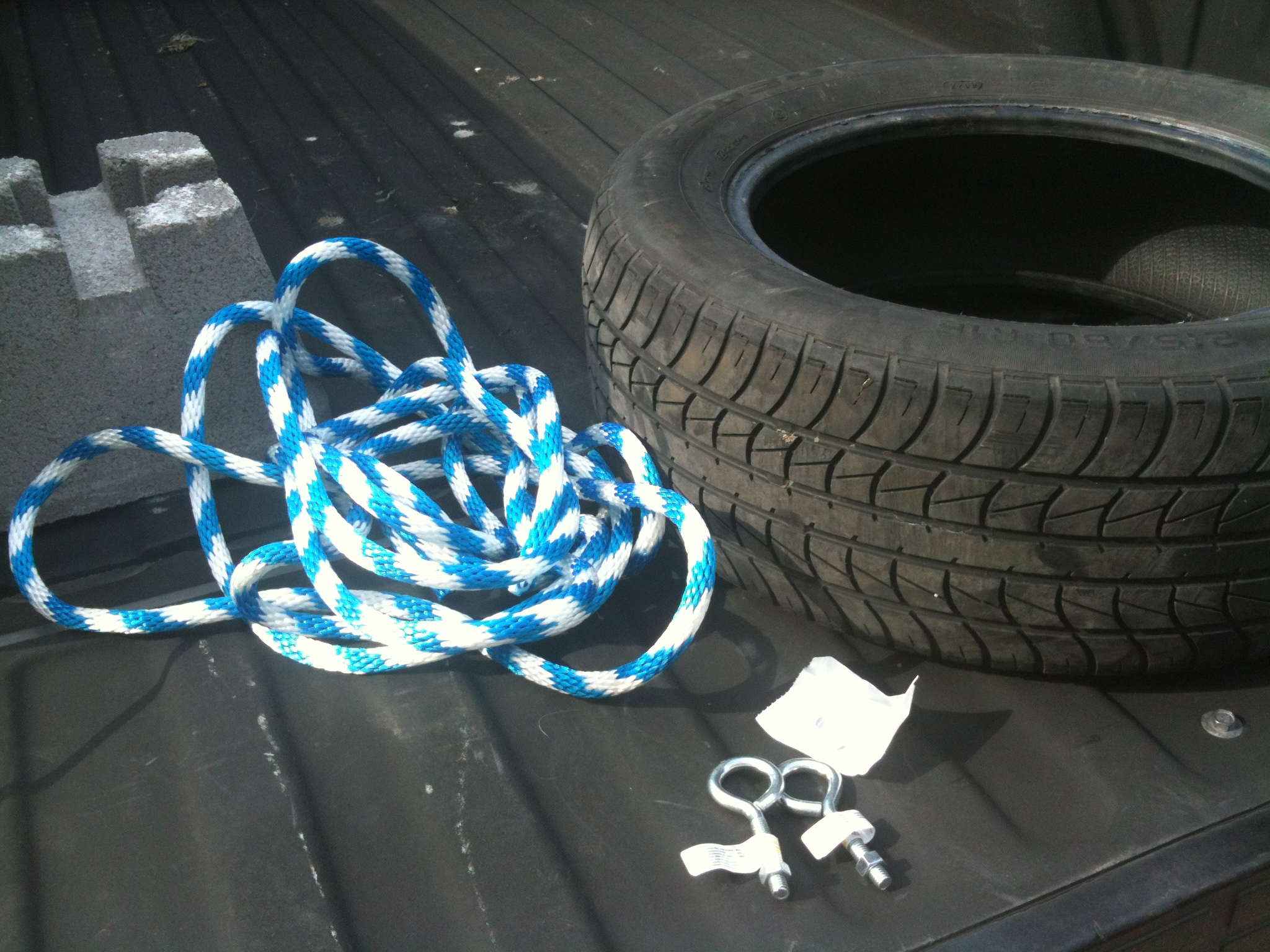
Materials:

  • tire
  • 25′ of 5/8″ nylon rope.
  • 2 3/8″ eye bolts, with nut
  • 4 3/8″ fender washers
  • some scrap wood
  • a patio deck block

I took my drill, inserted a 3/8″ bit, and drilled 2 holes in the tire.
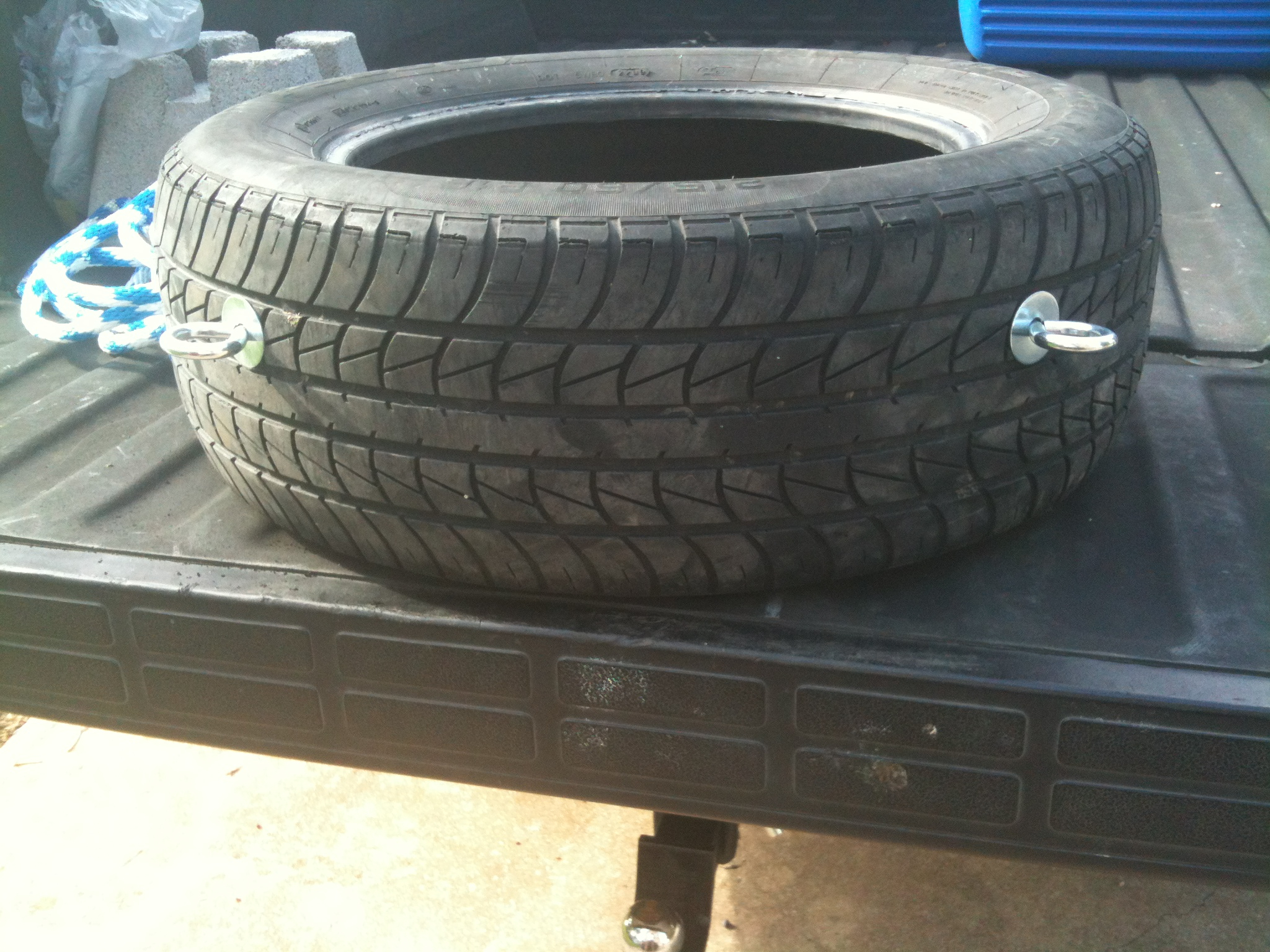
I just picked a spot for the first hole, and opted to drill it just above the midline in hopes that will affect the balance of things and keep the tire flat on the ground (instead of putting it at midline or below it, or even too close to the edge). In terms of where to put the other eye bolt? I just held my hands out and measured that way — it’s basically “shoulder width” apart.

It’s a little tough getting the bolts in there, due to all the steel belting, but just keep working at it. I did opt to put a fender washer on each side, to ensure a good hold, but no need for anything like a lock washer since the tire will give enough and should put ample backpressure on the nut to keep things secure.

I took the rope and cut it in half. I tied large loops in one end using a double bowline knot. These will be the handles. I wanted thick rope to make it easier to grab, and large loops so it doesn’t compress my hands too much when pulling. The double bowline should remain secure. I must admit this is NOT the material I wanted to use… the rope doesn’t hold the knot very well, and I probably should have gotten 30′ instead of 25′ because I lost a lot more than I anticipated to the knots… it’s just thick and doesn’t hold very well, tho you can pull VERY hard and get the knots to tighten up better. I would have loved chains, but that would be very costly. I did look at tiedown straps, but they all would come with a ratchet and I don’t need it and the price was just getting too costly.

The other end of the rope was tied in a sliding knot. I forget what it is… it’s not a two-half hitches nor a taught-line hitch, but a similar variant. I figured a sliding knot would be necessary so I could fine tune the rope lengths to ensure they were the same size after all this knot tying. I opted to go for 2 separate rope handles because I felt that might be a little more secure and might give me some more options in pulling… but I could be wrong… it could become hampering if I try to do things like sideways pulls. But we’ll see. There are so many options out there on how to make a sled.

I had some scrap wood that happened to be just the right size to fit in and fill the tire. I did have to use my circular saw to cut it in half so it would go in, but that’s all I did.. just cut, put it into the tire, and let it be. No securing it down, nothing. It should be fine.

And then finally there’s the patio block to provide some weight. I weighed the whole contraption and it’s about 80#. My understanding is, for my goals, that’s potentially a lot of weight…. maybe too much to start with. I might start with just the tire itself to break myself into it. Start light, even too light.

In the end it cost me about $25, most of that for the rope. The eye bolts and nuts were $0.85 each, the 4 fender washers $127, the patio block was like $6, and the rope made up the rest of it. Of course, the more you use junk you have lying around the house, the cheaper this project can be.

I paced off 75 yards up and down the street outside my house. My goal? Lift Mon/Thu, drag the tire Tue/Fri. I have some simple routines from Andy Bolton and I’ll start with those and see how I do. It won’t be just a pure drag. I’ll probably do some light stretching, basic calesthenics to get my body warmed up, then drag, and a little cooldown and stretching. I doubt it’ll take me more than 30 minutes.

We’ll see how it goes. 🙂

On small guns

Too many people who carry a gun for personal protection choose to carry a small gun.

Why?

I reckon because they’re more concerned with daily comfort. I get a lot of fellow Texans going on about the summer heat, and how in the summer they’ll carry some tiny gun in their pocket because anything else is too hot or uncomfortable or hard to wear and conceal in summer clothing.

If that’s your choice, it is. But I myself and many others I know strap on a full-sized gun every day no problem, even in the Texas heat, and we don’t have to wear a trenchcoat to do it.

I was reading an interview with Tom Givens. I just adore Tom because he’s got so much knowledge, and is able to say everything so dead on. He’s one of the most credible sources in this area, given his personal background and that he’s had about 60 students involved in self-defense shootings. We know what he teaches works. We know he speaks from truly knowledge, not Internet Toughguy or “been around guns all my life” bravado.

I think the place where most people who carry a micro gun screw up is that they think the primary purpose of my pistol is to be comfortable and concealed. No, the primary purpose of your pistol is to fight for your life in a sudden, unforeseen crisis. So, when that crisis presents itself, that little, bitty gun is hard to grab in a hurry, it is hard to handle correctly, it’s hard to hit anything with, it doesn’t hold many bullets, and when you hit somebody with it, it doesn’t hurt much. It’s not the optimum thing to fight with. If a fight starts, I want the biggest gun I can get with the most bullets I can get in it and the biggest bullets I can stuff in it.

As an experiment, I tried carrying the M&P Shield for a while, but I gave up on it. I do believe that gun fits particular circumstances, and if it’s the biggest gun you can get then so be it. But if you can get bigger, why shouldn’t you? Tom continues:

But think about that, if you reach for a pistol only because there is a deadly threat to you or somebody you love, you better have a pistol you can fix it with. I’ve interviewed an awful lot of people after gun fights and I’ve never had anybody say to me, “You know, when the bullets started coming back this way, I wished I had a smaller, less powerful pistol with less ammo in it.”

So Caleb asks if you’re underpowered with a wheelgun:

…and as I sit here typing this am carrying a Kahr PM9. All of those guns are not my first choice, but they’re guns and that’s something.

If it’s not your first choice, then why did you choose it? Granted, circumstances may dictate, e.g. a need for very deep concealment. These things happen. But if you have the choice, why would you intentionally cripple yourself? Tom’s thoughts:

I think carrying a small, inadequate pistol may be better than nothing, but I’m not really sure about that. You might be better to just take off running instead of shooting somebody with a thoroughly inadequate gun.

In the end, it’s your life and your choice as to how you wish to value it. And yes, I’m with Tom on this one because well… a good way to help you on the road to success is to see what other successful people do and emulate them. You may not reach the same level of success as they do, or you may exceed it. But no matter exactly where you end up, your chances of succeeding due to following success tends to be greater than if you take some other path.

I’ll leave you with these words from Mr. Givens:

One of the things we do in training is reintroduce the reality of why we carry a gun, and to put a sense of urgency into it. Maybe you’ll never need it, but if you do need it, you are going to need it horribly and maybe it is going to be your life at stake.

I saw a tagline the other day on an Internet forum that I thought was just incredibly bright. It said, “It’s not the odds. It’s the stakes.” And boy, there’s a lot of wisdom in that statement.

We don’t carry the gun because of the odds we’re going to need it today. We carry it because the stakes are our own life or the life of a loved one. That is what we are literally betting. So if you go out unarmed or you go out inadequately armed, you are betting your life, you are betting your children’s lives, you are betting your spouse’s life. I am not willing to bet the lives of the people I love on some tiny, little pocket rocket.

True Nutrition Whey Flavor #1 – Strawberries and Cream

I bought the TrueNutrition.com 38 Flavor sample pack.

Strawberries and Cream.

Tastes like the name says. I liked it. A little weird to see this white powder turn pink when you mix it (I used milk), but the taste was fine. Strawberry-y and creamy. Nothing too bad.

2012-07-16 Dry Fire Practice

Following the TLG 4-week sample dry fire routine.

Week 1, Day 1

Basic routine

  1. 20 reps of Wall Drill, from extension 2H
  2. 5 reps of Wall Drill from extension, SHO
  3. 5 reps of Wall Drill from extension, WHO
  4. 20 reps of Wall Drill from press-out, 2H
  5. 5 reps of Wall Drill from press-out, SHO
  6. 5 reps of Wall Drill from press-out, WHO

Simple enough.

I’ve mentioned in the past that I’ve finally hit a breakthrough with my eyes and am able to shoot both eyes open — I still see “double” but my brain is able to cut the path and know the right visual input. I shot the dry routine this way, and will keep shooting all my dry routines this way, because obviously shooting this way is NOT ingrained in me because as far as I can recall my life-fire is still closing one eye.

Shot with my full-sized M&P9, racking the slide for a proper trigger break every time. Of course, couldn’t practice reset. If someone can make a trainer in the M&P form factor that can simulate reset with a good ApexTactical-like trigger, oh, I would buy that in a heartbeat. I will generally practice this way, unless noted otherwise.

Also noticed a strong desire to firm up my grip, especially the ring and pinky fingers on both hands… which causes a lot of “pull” and tension in the wrist flexors. But that really helps me prevent any movement in the front sight as I work the trigger. Tight tight tight… and if you think you’re tight, you probably aren’t.


Dry Fire routine

I document my weightlifting because if you want to know progress, you need to measure it, and to measure it you need to record it.

I also think that the fact I post here somehow keeps me accountable.

So… I’m going to see about doing that with dry fire practice.

And like my lifting, it’s good to start with an established program. It gets you off the ground, it gets you working on things, and it can then help you see where you are strong and where you need more work. I know of some places I could use more work:

  • snub in general, but especially on the press-out ensuring I can get the timing for taking up all that long, heavy trigger press
  • longer-distance shooting, like 15-25 yards. Group shooting, shooting against the clock.
  • WHO
  • shooting more standards, more classifiers and qualifiers. Pushing myself and again, measuring myself.

and the list could go on, but I need to write writing and get to my point. 🙂

So I’m going to try embarking on a more regular and established dry fire routine, and document it here.

Where to start? I’m going to start with Todd Louis Green’s blog post that presents a 4-week dry fire routine. I think that’s a reasonable place for me to start. It keeps the individual practice sessions short, but the frequency is high and in many regards that’s more important. The routine focuses on all the fundamental skills, including one-handed shooting. I think it will make a good starting point.

I’ve been wanting to do this for a while now, but there’d always be some reason to not do it. Well, that shit stops now, and this shit starts now. 🙂

And so with that, off I go.

Taking a break

Not going to the gym this week.

Last week I woke up questioning the need to roll to the gym. The last workout only got me through 2 sets of assistance work. Not that assistance is something to live and die by, but it’s evident I need a break.

2x/week is a nice template, and by design it doesn’t have a deload week. I don’t think I need to add in a formal deload week, but every so often I probably need one. Now is one of those times. When I start back up again next week, I’ll just start cycle 12 over.

That said tho, I did pick up something over the weekend, and if I can get to the store today to buy a few parts, I hope to start working with that this week. More later.


AAR – BP2 & Skill Builder @ KR Training, 14 July 2012

Saturday July 14, 2012 was a bit of a different day for me at KR Training. The morning was a Basic Pistol 2 class and the afternoon was Skill Builder. It’s the Skill Builder that made things different, for me at least.

I thought BP2 ran well, and was fairly standard for what a BP2 is. People come to realize how vital trigger control is towards ensuring acceptable hits. They get their first taste of shooting to higher standards, such as trying to get all hits into a 6″ circle, shooting under the pressure of a timer, and realizing that yes, they can do it… they may need some practice, but they can do it.

But one thing dawned on me during this particular class (and note, this was just something that hit me; it is no commentary on the students). This is probably one of the hardest classes we provide. It’s not that the skills a particularly difficult. Rather, it’s a huge mental shift for most people. If they’ve shot guns before, they’ve never shot them like this. We bring a particular focus, a particular discipline. It’s not just plinking tin cans off the fence post, it’s not just aimlessly poking holes in paper until the box of ammo is empty. There’s now a focus, a point, a purpose, a direction. That everything done, every motion, every action, the way to grip, the way to hold, where to hold, how to hold, how to look, how to do, every little movement is intentional, thought out, and with meaning and purpose. Everything is geared towards making you efficient and effective at getting acceptable hits. And it’s a big shift from how people have shot guns in their past. Making that mental shift is difficult.

But it’s great to see so many people willing to make the shift. 🙂

Then came Skill Builder.

I’ve been looking forward to SB for a while. It’s something that Karl’s been working on for a while, and it’s still evolving. I’ve been looking forward to seeing and experiencing the class, given some prior discussed plans for SB’s ultimate direction. But even what I saw was different from what had been discussed, but when Karl explained his reasoning for the refined direction, it made a lot of sense. Read: KR Training doesn’t teach static courses based on 20-year-old material; constant evolution, constant improvement. It also shows why it’s important for you to keep up with your training, because things change.

Another different thing? I shot the class, instead of being full-time assistant. Oh sure, I assisted and did whatever needed to be done, but I was up on the line shooting the drills.

And I shot it with my snub. 🙂

I’ve wanted some more work with my snub, one reason being the Defensive Pistol Skills BUG class coming up in a couple of weeks. But also because I thought it’d just be fun to shoot it this way.

I shot with my S&W 442 as long as I could. That gun is set up with the DeSantis Clip Grip. That means: airweight gun, pinky dangle, and my hand gets to soak up all that recoil. I was using my .38 Special plinking reloads, but even still… the hand got tender after a bit. I’m glad I brought my S&W 640 as well. That means, all steel gun, factory grip which is full sized and rubber, and that means my hand absorbs a lot less of the recoil. I got through probably 40% of the class with the 442 and did the rest with the 640.

I shot respectably. I’m generally pleased with my shooting, given the limitations. However, I had more than a few times where I dropped the hell out of a shot. Even with the improved triggers in my snubs, that’s still a long heavy trigger press. The sights are crappy, and the grip angle is a little more “downward” than is comfortable and typical with my semi-autos, so it’s some adjustment. What it means is: more practice. Especially practice on the trigger press during the press out — given the trigger, it’s a VERY different timing than the press-out with a semi-auto. I admit, most practice I do with my snubs has been dry fire, and that just doesn’t give the same feedback. So again, I’m glad I shot the course and did so with my snub. Still, I can work on improving the timing of my press out in dry practice.

That said, SB is certainly more geared towards semi-autos, and that makes sense given 99.99% of students use semi-autos. I actually can’t remember the last time a student in a regular class used a revolver. But the COF’s ran generally fine, generally organized in a manner that worked with varying capacities, and tho I missed the tail end of a few drills due to low-capacity and slow revolver reloading and given a few drills are really geared towards semi-autos, I really liked what Karl put into the course. I like the evolution, and I think SB is really worthwhile. It’s tough, but it’s tough because it focuses on those key fundamentals that everyone needs, and presents it in a manner that will test you, help you practice, and show you where you need more practice.

Other than coming home totally exhausted and a little sunburned (stupid me didn’t put on sunscreen), it was a fine day.

Sunday Metal – Judas Priest

Judas Priest covering Joan Baez’s “Diamonds and Rust”.

I actually like Priest’s version better than Joan’s original, and I like this acoustic “power ballad” version best of all the ways they’ve performed it.


City of Austin crime data

I was reading an article interviewing Tom Givens, and Tom is a data man. He doesn’t teach what he teaches because of something he read on the Internet or because he wants to be a tough guy. No, Tom likes looking at hard facts and evidence. Granted, Tom lives in Memphis, TN, one of the most crime-infested cities in America. In the interview Tom said:

All you have to do is go to the Bureau of Justice Statistics or the Uniform Crime Reporting system and look to see what actually happens. Look at the crime tallies for your own area, break it down by population and see what the actual threat level is.

In my city, you have about a one in eighty chance of being the victim of an aggravated assault this year alone. There are 7,500 of those, a couple thousand rapes, and five or six thousand armed robberies, so when you break it all down, you have a one in twenty chance of being involved in a violent crime this year in my city; about one in fifty in the country as a whole.

So I wondered… what about Austin?

Let’s look at a few things.

I looked at the FBI 2010 Uniform Crime Report. I looked for Austin. Note that as of this writing, 2010 was the latest data; 2011 data was starting to be reported but didn’t yet have the Austin breakdown. It reports Austin with a population of 796,310 and lists “violent crime” (murder and nonnegligent manslaughter, forcible rape, robbery, aggravated assault)  at 3,790. That’s about 0.48%, or about 1 in 210. Property crime (burglary, larceny-theft, motor vehicle theft, arson) is 45,826, or 5.75% or about 1 in 17. Austin may not be as violent as Memphis, but it’s sure not crime free.

Here’s another Austin crime data analysis I found, that looks at the 2009 data and projects 2012 data. I’m not sure how they’re making their projections, but they are projecting an increase. Now, I’m not totally sure about this because they looked at 2009 data and skipped over 2010, which I briefly looked at above and by comparison, violent crime went down in 2010 (2009 – 4,024 reported incidents, 2010 – 3,790), and property crime too (2009 – 48,026, 2010 – 45,826); population was lower in 2009 (768,970 in 2009, 796,310 in 2010). So is the trend really upwards? Hard to say based on 2 years of data. But, they did have some relative numbers too:

The city violent crime rate for Austin in 2009 was higher than the national violent crime rate average by 21.86% and the city property crime rate in Austin was higher than the national property crime rate average by 106.12%.

In 2009 the city violent crime rate in Austin was higher than the violent crime rate in Texas by 6.59% and the city property crime rate in Austin was higher than the property crime rate in Texas by 55.84%.

So according to their data gathering, Austin is higher than both the national average and state average in both violent crime and property crime. I must admit, seeing the property crime numbers surprised me. I knew property crime was a problem, but didn’t realize how it compared.

And again remember, this is only reported crime. Lots of crime happens that goes unreported. Furthermore, I reckon this is only looking at Austin proper, and likely leaves out areas that we like to consider Austin but aren’t, like Westlake or Rollingwood, Lakeway, and even “greater Austin area” like Buda, Cedar Park, Round Rock, Dripping Springs, Bastrop, etc..

I looked at the Trulia crime map for Austin. It only listed data “from 6/7 to 6/14”. I wish there was a way to list more data, say all of 2012 so far, but if there is a way I couldn’t find it. Just looking at that one week of data, I saw a few interesting things:

  • Crime trends by day was pretty steady. 6/14 had a big dropoff and I’m not sure if that was because it was Thursday or maybe they didn’t have full data for the 14th? But every other day was pretty steady.
  • Crime trends by hour? Most happened in daylight, tho certainly into the early night as well. It seemed from about 10 AM through midnight, with peaking in the afternoon (3 to 6 PM). 4-6 AM seemed to be rather unpopular.
  • Crime was most prevalent downtown and in the University area. Neither are too surprising. East Austin wasn’t as crime-riddled as stereotypes would suggest, tho 78741 around Riverside/Oltorf/South Pleasant Valley was pretty heavy. More crime in north Austin than south Austin.
  • When you look at individual crimes, one thing to observe is the scattershot pattern — it’s all over the map. Basically, there’s no “safe place” in Austin. Crime can and will happen anywhere and everywhere. Yes some areas may be more prone, but no where is immune.
  • Robbery’s tend to happen in the afternoon.
  • Assault happens any time, but seems to be moreso at lunch, dinner, and generally in the evening. Alcohol involvement perhaps?
  • Burglary hourly trend was not a surprise to me: strong during the day, from about 10 AM to about 3-4 PM. Again, this is because most people aren’t home during the day, so that’s the prime time to strike.
  • Theft runs an hourly pattern similar to burglary, tho runs a bit longer into the night.

I bet I could spend a lot of time in krimelabb and find more interesting data. And City of Austin has their CrimeViewer, but it’s too limited for what I’m trying to do. Both are good resources, but neither gives me just a flat out list of data.

Take this data for what it is. And I caution against using this data as a way to “fine-tune” your behavior, like to think that walking around outside at 5 AM means you don’t need to carry your gun. Austin may not be the most dangerous city to live in, but it’s certainly got danger. Shit happens, folks. It’s up to you how you want to handle things when the flag flies.

Trying Trello

The new hotness in software development is “agile“. At my prior day job, it was waterfall. Sure they tried to adopt agile processes, but it really wasn’t going to happen. Due to the nature of the products and process, it just can’t be agile, tho they could try to adopt a few things and make some improvements. But at my new day job? Agile can make a LOT of sense. Take home: you can’t impart the process merely because it’s the new hotness or you think if you just adopt X process it’ll solve problems. Like any problem to be solved, you have to understand your problem fully and then apply the right tools to solve it, and that includes what processes you use.

However, it’s tough getting folks on board, so I’ve desire to try to sneak in agile stuff as we can. It’s nothing more than a commentary on human condition — we tend to resist change. If all this change is dropped on folks all at once, we’ll balk. I would too. Massive sudden change, especially when you’ve still got daily chaos and stress to manage, well… the change will be rejected. But if we can make little changes here, little changes there, over time we get there.

One thing I can tell is we all need a way to see the whole picture. We’ve got so many things going on at once, and it changes on a daily and sometimes sub-daily basis. I find myself often making lists and (re)telling my todo lists to my teammates merely to help ensure 1. I know what I’m doing and am on track, 2. that we’re all on the same page. By sharing with them I hope that if there’s a mismatch, they’ll speak up and correct. I’d rather be perceived as over-communicating than under-communicating.

But all this talk doesn’t solve the problem for everyone. The dev team is one thing, testing another, production another, sales another, marketing another… there’s so many things. Sure, we could use our issue tracking system, and there’s a lot of sense in that approach. But the issue tracker doesn’t work as well for non-dev folk PLUS it’s harder to get a 1000′ view. Yes, pictures/diagrams can make a big difference.

One thing from the agile/scrum world is having the daily stand-up meetings at “the wall”. Let’s set aside the meeting for now (again, baby steps), and just focus on the wall. I’ve suggested the wall, because I think that would be useful. Pick a wall in the office, divide it up in whatever way makes sense for us, then start populating it with sticky notes to represent all the tasks to be done. I think that’ll be useful at keeping a somewhat permanent record of the state of things (unlike a whiteboard, which will be erased eventually). Plus it allows anyone to just look at the wall at any time of the day to see where things are. CEO wants to know what’s up with Customer X? Just look at the wall. Did we ship Product Y yet? Just look at the wall.

Alas, one shortcoming is 1. we don’t have a lot of free wall space left in the office, 2. the wall is restricted to the physical. I’ve been searching for a digital wall solution and haven’t found much that thrills me. Something that we could access from any computer via a web browser (or even a platform-based app), and it would look good. But then we could also access from iOS or Android devices. In the office. Out of the office. At 3 AM, during office hours. From my desk, in a meeting on the shared screen. Whatever. Something with power to do what we need, but flexibility to work for anyone, not just the geeks.

So… I recently read this article from Joel Spolsky about “Software Inventory”. While I read it, it sounded like it was talking directly to me and our situation. I went looking at their solution:

Trello

I’ve only just started to play with it, but it seems like it could be the answer to my problems. I could see using this in my personal life, for Hsoi Enterprises, and for the day job stuff. Even if the rest of the office doesn’t buy into it, it could be useful for my own management of my tasks and issues to deal with. Being able to SEE everything instead of sorting through a bunch of text notes and to-do lists is sometimes much more useful, even if it ends up being redundant and a little more maintenance to keep 2 data stores in sync.

It’s still preliminary, but it’s promising.