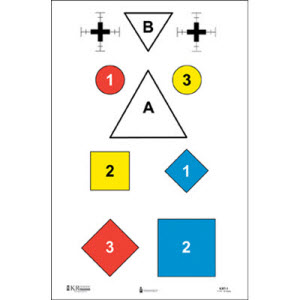
The KRT-1 Target is now available

Finally, we can reveal it to the world!

The KRT-1 target.

The KR Training instructor crew spent quite a while hashing this out, designing, revising, arguing, testing. But finally it’s here, available from Law Enforcement Targets.

If you go to LE Target’s website you’ll see tons of targets already in existence. Why in the world create another one?

The main reason? it fits on 18″ target frames, the same frames used for IPSC and IDPA targets. These are the frames we use at KR Training.

With few exceptions, most targets are designed to fit on 24″ frames. There are lots of useful targets, but when you put a 24″ target on an 18″ frame, the uprights won’t last long, nor will your training session (and it doesn’t help towards keeping cost and maintenance issues down either).

We designed a target that could be used for the KR Training curriculum, from defensive pistol training, to competition, command work, group shooting, you name it. It’s rather versatile. It has A and B zones that map to head and chest areas; and the numbered, colored shapes can be used for many drills. It includes two sight in areas with 1″ grid marks.

Of course, we hope this will be useful to shooters around the world, especially those similarly frustrated by using 24″ targets on 18″ stands. 🙂

However they learn, so long as they learn

My Sons’ room is a mess.

My Daughter is very good at organizing and cleaning.

She made an offer to her brothers, to clean their room for $50. She dropped it to $40 when Youngest said he didn’t have enough money.

Agreement was made, and she’s cleaning their room. Isn’t taking her long, and she’s getting $40 for it. Pretty decent rate of pay.

Wife is a little unsure about this arrangement, but I’m fine with it. Why? Because they are learning a lot.

Daughter is saving money to buy new cymbals for her drums. The cheapest cymbal pack, plus stands and so on? It’s going to run her at least $400, so she’s got a way to go…. but she just made 10% of it. 🙂   She’s setting goals, she’s working towards them. She’s seeing things she wants in life, and tho the kids know I’m willing to loan them money (with interest, of course… everything is a lesson), she refuses to do that because she’s learned that debt is generally to be avoided, especially for non-essentials in life. She’s being resourceful, looking for ways to earn more money, sooner. She’s not afraid of work. I also gave her more lessons in negotiation, which she didn’t have to use with her brothers, but she was enabled with just in case.

The Boys are learning the value of money and time. The landscaping I want in my yard? Sure I could do it and save a lot of money, but it’ll cost me a lot of time, and what else could I be doing with that time? And so, that’s what the boys are seeing… plus it means they don’t have to do something they find unpleasant. But, they’ll learn the bigger lesson when they realize they farted away their time, and also gave up a nice chunk of their money that they now don’t have for other things. But, it’s their money and their time, and they have to learn how to spend them wisely. Perhaps the $20 (each) was a worthwhile tradeoff, because I’ve seen how they clean their room… this way is certainly faster with a lot less complaining and more peace in the household. 😉

Whether good lessons or bad lessons, they are lessons and there are things to be learned.

Steve Jobs – weightlifting philosopher?

Numerous seemingly disparate things come together quite harmoniously in my life.

For example, my company, Hsoi Enterprises LLC, blends things like personal defense and computer software. Witness, the DR Performance Practice Deck for iOS.

So when I read this article, “11 Steve Jobs Quotes Applied to Weightlifting“, it brought two things in my life — Apple and weightlifting — together.

The reality is, most of the Steve quotes in the article apply to anything in life, or just to life itself.

The quotes that stood out most to me?

“Remembering that I’ll be dead soon is the most important tool I’ve ever encountered to help me make the big choices in life. Because almost everything — all external expectations, all pride, all fear of embarrassment or failure — these things just fall away in the face of death, leaving only what is truly important. Remembering that you are going to die is the best way I know to avoid the trap of thinking you have something to lose. You are already naked. There is no reason not to follow your heart.”

and

“Your time is limited, so don’t waste it living someone else’s life. Don’t be trapped by dogma — which is living with the results of other people’s thinking. Don’t let the noise of others’ opinions drown out your own inner voice. And most important, have the courage to follow your heart and intuition. They somehow already know what you truly want to become. Everything else is secondary.”

Tho every single quote in there applies and is useful to contemplate. Next time I’m under the bar — or under any sort of stress — these are some words of wisdom worth heeding.

Glock, the book

Paul Barrett wrote a book, Glock: The Rise of America’s Gun. I was offered a preview copy of the book but had to decline — I don’t have the spare cycles to read it, and am rather behind in my own reading list anyways. *sigh*

Nevertheless, it seems an interesting book and now has a new web home.


Uncle Bug

Looks like Unc is curious about bug-out-bags too.

Yes, this is really a bookmark for me so I can come back to it later and see what people commented on his site. 🙂

Updated: Unc’s part 2: what to put in it. Again, not a bookmark.

You’ve got a hammer, but everything isn’t a nail

Michael Bane and Michael Janich discuss an important construct in self-defense: that one solution isn’t always the appropriate answer.

Can’t embed the 5 minute video… you just have to click the above to watch it.

I like Janich and he speaks a lot of truth here. I’ve dealt with two realms of “self-defense” training: guns, and empty hand martial arts. In the past and even today, people tend to choose one or the other. As well, many schools tend to only teach one or the other, tho thankfully that’s improving in recent years.

The reality is, like Janich points out, if you have a gun that’s great but that is not the appropriate nor possible response in all possible situations. It doesn’t mean you need to become a black belt in some deadly art, but having more responses programmed in, from simple verbal commands, to escapes, to perhaps basic empty-hand strikes can be a useful thing to allow you to respond appropriately to what’s presented. Insights Training Center is a good place for this sort of integrated methodology. If you want to go a more traditional route, consider Filipino arts, like Pekiti Tirsia Kali (in Austin, check out Leslie Buck).

On the other side, a lot of people take empty hand training but won’t progress to the level of firearms. Well, many traditional martial arts will teach weaponry, but it’s interesting how much of that ends up being demonstration and never application. Granted, it’s difficult to apply sword or nunchaku in a modern context, but what’s the point in learning a weapon if you do not know how to actually fight with it? However, I’d argue to move beyond those weapons because technology has evolved (else we’d all be using clay tablets and not iPad’s) and firearms are the modern sword. Empty hand skills can take you far, but not far enough because I’m sorry… a 5’4″ 95# woman no matter how skilled is just going to have a tough time against a 6’6″ 275# strong man hell-bent on raping her. A gun is a force equalizer.

I know some argue against the notion of “another tool in the toolbox” because then you start to collect a zillion tools and won’t know how to deploy anything. This is true. But there’s a balance point, and it starts by having to acquire more tools. Let’s be literal with the notion of toolbox. If the only thing you have in your toolbox is a hammer, yes everything looks like a nail. You’ll pound screws, if you need a hole in something you’ll just have to whack the hammer through it, if you need to measure something it will be “3 hammers long”, and so on. Well sure that might work, but it’s not very efficient and could cause collateral damage. That’s why you have to acquire more tools for your toolbox: to have a screwdriver, to have a drill, to have a tape measure. There are enough basic tools that one needs in order to have a complete toolbox. The problem starts to arise when you start to acquire too many tape measures… how many rulers does one need? For me, a simple 25′ tape measure is fine and covers all my needs. But a professional carpenter might want a carpenters ruler. Most people only need a claw hammer, but the handyman might also have a drywall hammer, and the roofer a roofing hammer.

So most people don’t need a taser and handcuffs, but a police officer does. A bouncer at a nightclub needs a lot of empty hand arrest and control techniques, as well as good verbal skills. So you can see, toolbox contents, literal or figurative, can vary from person to person and situation to situation. What matters in this self-defense context is that you can go too far. Bragging about having 3608 techniques means… what? Consider Bruce Lee: “Take what is useful and discard the rest”. Or Antoine de Saint-Exupéry, “Perfection is achieved, not when there is nothing more to add, but when there is nothing left to take away.”  Whether you listen to the martial artist or the writer, they are both saying that it’s about stripping away, but first you must have something to strip away. If all you have is a hammer, you have nothing to strip away. If you have 3608 techniques, you have a lot you can strip away. In the journey of life, we start with nothing and acquire as we go along. This is the way it has to be, because how else can we find what is useful? How else can we discover what we need? How else can we know what to discard if we’ve never acquired it in the first place? The key, however, is to not just collect, but ensure you periodically review and discard the useless so your collection is meaningful. So, “another tool in the toolbox” is good, but only if it’s useful to you. If all you have is a hammer, it should be because you had an entire hardware store and were able to discard everything else.

2011-10-19 workout

Today was awesome.

“Week 1”

  • 5 reps – Bench Press (working max: 205#)
    • 2x5x45 (warmup)
    • 1x5x85
    • 1x5x105
    • 1x3x125
    • 1x5x135 (work)
    • 1x5x155
    • 1x12x175
  • Asst. #1 – Bench Press
    • 5 x 10 x 110
  • Asst. #2 – 1 arm dumbbell row
    • 5 x 10 x 45
  • Metcon – jump rope
    • 1 Tabata set – all single hop

Today was awesome. I have been having sleep issues and am actively working to fix them. Given I’ve had a couple nights of good rest, I think that’s playing in here, so I’ll take it.

As mentioned previously, I need to stop caring about “how much work to do”. That is, going back to prior workouts, seeing how I moved a particular weight to ensure that in this workout I do at least that and hopefully more. It really shouldn’t matter. Here’s the weight, just move it. I’ll move it however much I move it, and I can view progress later instead of pre-framing my head around a certain target. The only target should be to move the damn thing as much as possible, attack it, power through it, and strive to be awesome. 🙂

And so I did. A different mental outlook for this workout and sure enough… geez… 12 reps of 175? Last cycle I did 1x11x170 then 1x8x180. So 1x12x175? Yeah, I’d say that’s an improvement. Only reason I stopped at 12 was I knew I still had the 5 assistance sets to do and I didn’t want to tap myself out! I felt like I could have done a lot more.

So with that, the assistance work was strong and good. I’m working to have a slightly wider grip (index fingers on the hash rings instead of ring finger), and ensuring my elbows come in a little bit more. My shoulder seems happier, and who knows if this made enough of a leverage switch to account for the “strength boost”. The 110 was good, but I should go 115 next session.

Rows, another mental shift of not moving the weight or lifting it up, but thinking about pulling the elbow back. Focus on the tip of the elbow and moving it through space. That really helps to make the shoulder work. 45 is good, but I figure I’ll bump to 50 before too long.

And on rope… before I did the proper set I did some more work with the “running in place” stuff. I’d start with no rope, just moving my legs/feet in the air, getting my body aware of the motion, and figuring out what the pace of the rope should be. I did better, getting 4-8 skips before I’d tangle my feet up — same thing, sweeping my leg back with the rope and the foot gets caught. But that’s a slight improvement, so I’ll just keep at it. Meantime, I really jacked up the tempo of the regular work.

I need to bring up the tempo, because it was too slow to be any sort of intense-enough conditioning. See, I’ve beenn fluxing in my eating. At first I was trying to eat rather strict, lots of protein, minimizing carbs, and that wasn’t working too well. Then I spent too much time reading powerlifting stuff and a lot of them have the basic approach of eating like a bulldozer and just shoveling food. There’s a method to all that madness and it’s good, but the side-effect is… it’s making me fat. I’m not enjoying it. But this is just part of it… gotta experiment, swing one way, then the other, and find where things lie. And so, I’m refining again.

My goal right now is to take in about 35-ish grams of protein 6x a day. That’ll get me about 210g and that’s a reasonable number. I’m also not going to totally turn myself off to carbs but be a little more smart about when I ingest them. For instance, I work out in the morning so first thing upon rising, have some protein and some carbs so I can fuel the workout. When I return from the workout, more protein and carbs. Then throughout the rest of the day, try to stay off the carbs in terms of “heavier” stuff like pasta or rice or whatever, but do have lots of veggies and other such things. This is basically where I was in terms of diet some time ago, but I got a little to caught in the powerlifting stuff and need to swing back. It’s not so much that I’m trying to lose fat (tho that’d be nice), but more that I don’t need to be eating so much that I gain fat. Yes not shoveling could mean strength gains are slower, but heck, it’s not like Wendler 5/3/1 at this stage of the game for me is some fast-gaining program. So I think it’ll work.

Frankly, I have also thought about trying to just lose the fat, like trying to drop 20# and specifically target that endeavor for a while. I’m not sure tho, because I’m not at a point where I want to risk the strength gains. But, we’ll see. The bottom line seems to be finding the line where my body gets just what it needs, and no more.

Oh, another note. My “working max” went up 10# from last cycle. Generally the program approach is 5# on bench. The thing is, when I plugged a 5# jump into my spreadsheet, the math worked out such that none of my actual lift amounts changed! It was just an odd thing about the math and rounding off to 5# plates. So jumping up 10# in the working max allowed all the warmup/work lifts to go up 5#. So, there we go. I only went up 10# this cycle due to the math, which actually works out to a 5# jump. Odd how that was, but there we go.

Your huddled masses yearning to breathe free

Airport-type “security” screening to visit the Statue of Liberty.

(Look at the URL. Methinks “journalists” in New York have no idea what “to the hilt” means).

Ticket holders are screened at a checkpoint, manned by Park Police, before boarding a ferry for the short trip to Liberty and nearby Ellis Islands. The screening includes magnetometers and X-ray machines. A second check is conducted once visitors are on the islands.

[…]

[A visitor] was surprised by the rigorous screening, much like an airport, with screeners asking visitors to take off their belts and shoes.

This is freedom?

Oh the irony.

*sigh*

(h/t Unc)

I’ve been blacklisted

I guess I’ve made it to the big time now, because I’ve been made part of The Gun Blog Blacklist.

(if you don’t get it, don’t worry about it… it’s a bunch of silly drama llama stuff, but Google “gun blog blacklist” if you really care).

I didn’t ask to be listed, because I couldn’t care less about the drama. But hey, it’s nice to be recognized as part of the s00p3r s3c43t conspiracy. 🙂

What is a safe direction?

When it comes to the rules of gun safety, most people recite something similar to Col. Cooper’s 4 rules. I used to do the same, but over time came to prefer the NRA’s gun safety rules.

  1. ALWAYS keep the gun pointed in a safe direction.
  2. ALWAYS keep your finger off the trigger until ready to shoot.
  3. ALWAYS keep the gun unloaded until ready to use.

Why I believe that’s a better rule set is another discussion for another time (Karl Rehn of KR Training does write about it). What I want to focus on here is the notion of “safe direction”.

We are to ALWAYS keep guns pointed in a safe direction. Thus, we need to know what a safe direction is. Here’s how the NRA elaborates on rule 1:

This is the primary rule of gun safety. A safe direction means that the gun is pointed so that even if it were to go off it would not cause injury or damage. The key to this rule is to control where the muzzle or front end of the barrel is pointed at all times. Common sense dictates the safest direction, depending on different circumstances.

Emphasis added. I think that’s pretty plain and clear.

The reality is, while the definition is clear and simple, putting it into practice isn’t always so easy. The reason is, “safe direction” can change. What you may need to think about is “the safest possible direction, right now”.

Let’s say you’re at the gun range. You’re at the established firing line. Given that, it’s reasonable to say that pointing your gun downrange is a safe direction: if you pointed a gun downrange and the gun discharged, the bullet would eventually be stopped by the big dirt wall or whatever it is the range has as a backstop/bullet trap. The only thing that might be damaged between the gun and the backstop is the target you were shooting at, but of course that’s acceptable. Thus, downrange is a safe direction.

Right?

Well, generally speaking yes. But what if a person walked downrange because they wanted to put up a target? Now is downrange a safe direction? I would say no. This is why gun range rules have it that no one goes downrange if there are people/guns on the firing line, and that if people are going to go down that all guns are rendered safe (e.g. benched, unloaded, action open; holstered; etc.) and everyone steps off the firing line with no gun handling permitted while folks are downrange.

So when handling a gun, if your safe direction no longer is the safe direction, what do you do? You have to find what the safest possible direction is now.

Could that be up in the air? Maybe, but remember that gravity is always in effect: if a bullet goes up, it’s going to come down. Do you know where it’s going to come down? Can you guarantee it will not cause damage, injury, or death?

Could that be down at the ground? Maybe. I wouldn’t say directly down at your feet, given you probably don’t want to destroy your feet. Perhaps then angled down pointed just a few feet in front of you? Perhaps. Consider the ground surface. If it’s dirt, that’s one thing. If it’s a hard surface like concrete or tile, that bullet will splatter.

How about at that wall? Maybe. Could that wall stop a bullet? If it’s drywall, like most homes and buildings use for walls? No, that won’t stop a bullet at all (even birdshot will go through drywall). Cinderblocks and bricks? Better chance of stopping, but that could depend (e.g. a 9mm handgun round should stop; some rifle rounds could go right through). Consider that where the bullet comes to rest doesn’t stop where your eyes stop. My eyes cannot see through the wall, but I know that while the wall stops my eyesight, it does not stop a bullet. So, I must continue to consider beyond my eyesight to the point where the bullet would come to rest. If you want to see what bullets can go through, check out The Box O’ Truth for much information, experiments, and pictures.

What if you were in a personal defense situation? Let’s say you’re at a crowded shopping mall and hear shots fired. There are innocent/uninvolved people all around you. Where is the safe direction now? Of course, if the bad guy is in front of you, you could argue the safest possible direction at that moment is pointing the gun at him!

I’d like to think it should “go without saying” that pointing a gun at yourself is not a safe direction, no sir, not even a little bit safe. Alas, there are more than enough stories of people pointing guns at themselves, “relax, it’s unloaded”, press trigger, and tragedy ensues. Lots of rules violated, but that’s the one thing about safe direction: if you follow it ALWAYS the worst you might end up with is manageable damage to property, and injury to your pride.

This is also why there are multiple safety rules, because they provide layers of protection: there must be violation of multiple rules for truly bad things to happen. Point the gun in a safe direction but fiddle with the trigger? That can be OK. Point the gun in an unsafe direction and the trigger is never touched? That can be OK. Point the gun in an unsafe direction and press the trigger? That’s going to be a problem. This doesn’t permit you license to knowingly violate one rule while following the others; all the rules begin with ALWAYS and that means always.

Going back to the gun range situation, do not allow yourself to be lulled into thinking safe direction but violating it. I see it all too often where a line of people are on the firing line. Someone in the middle of the line goes to work the slide on their semi-automatic handgun. They want or need a little more strength, leverage, and comfort in working the slide so the gun comes in and gets turned sideways — much more ergonomic and better leverage for the person working the gun — but now where is the muzzle pointed? At the person next to them! If you point a gun at someone, that can be considered aggravated assault. Not to mention, it’s impolite, inconsiderate, and unsafe range behavior. Safe direction is an ALWAYS proposition.

The reality is, safe direction is fluid and dynamic. As well, sometimes the safest direction may not be an ideal safe direction: it may be the best you can do is point at the floor and risk some lead splatter in your shins because that’s the least risk of damage and injury of all possible choices. You must consider where the bullet will come to rest (a place you may be unable to see), what there is between the muzzle and that point of rest, if between those points there’s potential for damage or injury, and if that damage or injury is acceptable or not. You must ALWAYS point the gun in a safe direction. You must ALWAYS (re)evaluate if that safe direction is still a safe direction, and if not find the new safe direction and point it that way.

I wrote this article because I often mention safe direction, but can only give it lip service because I don’t want to distract from the larger point of whatever else I’m writing about. Now, I’ve got an article that elaborates on the topic and it’s simple to link to for further discussion. Feel free to link to this article to help in your discussions of gun safety and “safe direction” (please give proper credit). Shoot safe.