The Circle Jerks, “I Wanna Destroy You”. With bonus background vocals by Debbie Gibson (yes, that Debbie Gibson).
Month: July 2010
Changing switches
I am not an electrician, but I’ve been doing some small wiring projects around my house.
Some of the outlets are loose in that you put in a plug and the plug doesn’t hold very well. So as I discover a problem outlet I’ve been swapping the outlet for a new one. Doesn’t take long to do the actual swap work, the hardest part is figuring out which circuit breaker to turn of. There’s no wiring diagram for the house, no labels on the switches, but I’ve got one of those little gizmos that plugs into the outlet and emits a signal which another dohicky held against the breaker switch can pick up and tell me which circuit things are on. So it’s certainly not guesswork, just time consuming. And yes, while I’ve done my best to identify and label things, I always find out that the wiring in the house is pretty strange and well… maybe there’s logic to how it was wired but I sure can’t find it.
I changed the light switch in the laundry room to have a motion sensor switch. These would be good to have in other rooms of the house as well, especially from a security standpoint. Wife and I are still deciding which rooms and locations would be best.
And today I completed another change, which I’m very happy about.
The exterior lights are controlled by interior switches. I went in search of timer switches so the exterior lights could be on a simple timer. Well, Lowes didn’t have any simple timers. They had these $27-each digital timers, but man, they are cool! You set the date, the time, if you’re on Daylight Saving Time or not, and you even set what region of the country you’re in (we’re in “south”). Then you can program up to 7 slots of on-off times: for each day of the week, for the 5 weekdays, for the 2 weekends, or for all 7 days of the week. You can set actual on and off times, or — and this is the cool part — sunrise or sunset. Because it knows the date, the time, and your general location in the USA, it calculates the sunrise and sunset times and you can have the lights turn on at sunset and on at sunrise. That is COOL! I don’t have to adjust the timer all year to go on and off when I want (which is sunrise and sunset). Sweet! As well, I wonder if the switches have an internal battery or maybe a capacitor because after wiring switch 1 and programming it, I then learned that switch 2 was also on the same circuit as switch 1 so while I wired switch 2 I figured I was going to have to go back to reprogram switch 1. But I didn’t, and it was still the correct time. Nifty! I do hope it’s just a capacitor and holds enough to deal with short power interruptions, because I don’t want to change batteries… what a pain.
Anyway, nice stuff. Helps the house look nicer, work better (automation is good!), improves security. Can’t beat that for a few hours of work this morning.
On Shotguns
Like many (most? all?) people, I started out in the “shotgun for home defense” camp. For whatever reason, it’s the mantra firearm to utilize in that situation.
However, if you think beyond that towards the actual realm of application, plus if you do any actual work in that realm of application (e.g. a class like Defensive Long Gun), you start to see it’s not the best tool for the situation. For example, consider the longest shot you may have to take in a home defense situation. What if it’s something like 25 yards? Take a look at The Box O’ Truth #20 and notice the size of the spread at 20 yards: from 9″ to 17″. That’s a huge variance. Even at best, can you be sure to get all 8-9 pellets on target and not in an innocent person? Maybe, but maybe is of little comfort when the flag is flying. It’s due to that and many other factors that I’ve settled on an AR for home-defense. It’s the entirety of the platform that makes it a better fit for the context.
But for some reason I still had a desire for a shotgun.
Now, I still keep shotguns for home defense. Why? Easier manual of arms. It’s very simple for Wife or my kids to operate a shotgun, especially if something goes wrong (just keep pumping and shooting, and if all else fails it’s a club). Heck, it’s difficult for my young kids to operate that charging handle on an AR, but they can easily work the pump action on a youth 20 gauge shotgun. Some gun is better than no gun.
A few months ago it was maybe 10:00 PM. We heard a helicopter overhead, which isn’t usual because of medical helicopters. What became unusual was that the helicopter didn’t pass over but stayed in the area. We found a police scanner feed and listened in. Apparently the police were chasing someone and he hunkered down in a patch of woods close to my house. I went Code Orange. The reality was, he certainly could have run and wound up near or in my house. Slim chance? Yes. But better to be prepared and on guard.
What surprised me about my reaction to the situation? My gut response was to grab the 12 gauge, not my AR.
I’m not sure why.
On the one hand, I’ve been very handgun oriented lately and haven’t been practicing with my AR as much as I should. If I have been doing anything with a rifle, it’s been more along hunting or target shooting, not fighting. Monkey brain mode kicked in and brain reverted to “simple point and click interface” of the shotgun, not “OK, gotta figure out the holdover, blah blah”. While the logical part of my brain still buys into the AR for home defense, that night the shotgun just sung to me. In the end I didn’t have to pick anything up, eventually the police scanner provided no more information on the matter and the sounds of the helicopter faded. No idea what happened, doesn’t really matter.
Recently on the InSights Training Center mailing list, someone was asking about the SAIGA 12 for home defense. Now, these guys are big on the AR, but lead instructor Greg Hamilton gave the shotgun its due:
For general civil situations, the 7-8 shot, tube feed, pump shotgun is already more gun than is required to solve the situation. I’ve shot 1000s if not 10,000s of rounds though every type of shotgun over 25 years. Just shoot pumps now. I have a nice 11-87 that I don’t use and I would like a saiga with a really short barrel but it would just be for fun, as I don’t know what else I would do with it.
The shotgun is still a great weapon especially if you are poor. For $250 you’ve got something that you can take on multiple opponents with, with confidence in the reliability of the gun and in the cartridge. A screw on rail to the forend, weaver ring, and $50 flashlight and your looking good. Throw some extra ammo on the gun someway cheap and for <$400 you are ready to rock. It won’t win any picture competitions on AR15.com but it will smoke a couple scumbags with extreme prejudice.
and that’s what it’s all about.
Granted, this doesn’t take away some inherent limitations of the platform (e.g. those 25 yard shots). But with a little investment of time, money, and ammo, you can do you best to figure it out. For instance, back in that BOT #20 you saw that different ammo provided different patterns. You must take the time to seek which ammo will work best in your gun. Furthermore, if your shotgun has different chokes, try them out and see what difference they make. I’ve tended to lean towards whatever gives you the tightest possible pattern, minimize spread. Furthermore, with some additional way to carry ammo on the shotgun (e.g. side-saddle), throw a few slugs in there.
And practice. Pick up some dummy rounds and practice loading, reloading, getting that one slug in there, and so on. Take classes if you can.
So on that front, I opted to run the Team Tactics course a couple of weeks ago with a shotgun. I just wanted to see.
On the one hand, it was just plain fun to do. 🙂 There’s something viscerally satisfying about BOOM rack BOOM rack BOOM. 🙂 Of course, reloads were slow, but you manage the best you can. Even with a shorter 18.5″ barrel, it’s still cumbersome to move and navigate with the shotgun: an AR with a 16″ barrel and collapsible stock is overall much shorter and easier to move around with. Shooting weak-side (e.g. around the left-side of a barrier) was difficult with the pump, but do-able… just a matter of training those motor skills.
In the end, I’ve softened my “anti-shotgun for defensive purposes” stance. In the end, it all comes down to you and your particular situation — there is no blanket answer. I do look forward to doing more work with the shotgun, classes if I can. Curious to study it more in this context.
Barnes VOR-TX
A couple of weeks ago, Barnes Bullets announced a new line of loaded ammunition called the Barnes VOR-TX. I obviously missed the announcement, and I’m quite the fan of Barnes Bullets (even a member of their Club-X). Another page on the VOR-TX here. Apparently it will be available on August 1, 2010.
While I’m starting to lean towards 6.8 SPC for hunting, I still can’t get away from .308 Win as my go-to caliber. Barnes will be offering this VOR-TX in both 150 and 168 grain TTSX (for .308 Win). That’s what intrigues me about this round: factory ammo with a 168 grain TTSX. No one offers factory ammo with a 168 TTSX; International Cartridge Co offers 150 grain TSX and TTSX, and DoubleTap Ammunition offers a 150 grain TTSX. But again, no one does 168 grain TTSX.
I’m still not doing a lot of rifle ammo reloading, so for now I still have to look to factory ammo for my hunting rounds. I’ve been using Federal’s P308H, which is a 165 grain TSX bullet and an overall fine round. Everything I’ve taken from hogs to deer to that water buffalo was taken with that round. But again, it’s a TSX bullet.
The Tipped TSX bullet (TTSX) is the evolution of the TSX. That polymer tip improves the ballistic coefficient. A .30 caliber 168 grain TSX BT (cat# 30844) is listed as having a B.C of .404 & S.D. .253 (the 165 grain TSX is B.C. .398 & S.D. .248) (source). A .30 caliber 168 grain TTSX BT (cat# 30878) is listed with a B.C. of .470 & S.D. .253 (source). That’s a nice improvement. Of course, the reality is the distances that I’ll be hunting with this? an improved B.C. won’t have a huge impact (but every bit is welcome). So what then? Well, that polymer tip greatly aids in getting the bullet to expand. Useful that.
Granted, to use the TSX vs. the TTSX isn’t a no-brainer as there are still advantages and application situations to one over the other. Nevertheless, to see the 168 grain TTSX offered in a factory load is welcome. Who knows… I may buy a box and see how it fares. Or, if I know what’s good for me, I’ll ignore all of this and get my butt to working on 6.8 SPC hunting loads instead. That .277″ 95 grain TTSX is panning out to be “the” bullet for 6.8 SPC.
I’ve got a screw loose
Yesterday I pulled out my snub revolver for some dry fire. I looked down at the right-side of the gun and noticed a screw had backed almost all the way out!
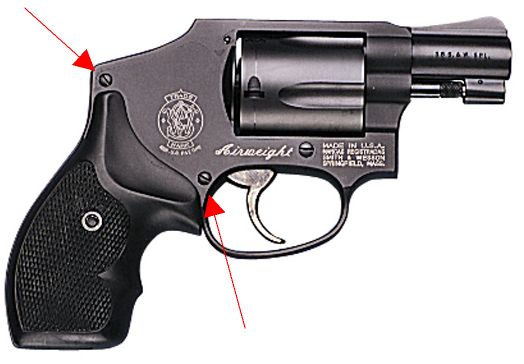
In the above image, you can see arrows pointing to two screws. These two screws help to hold on the side plate. In my case, it was the lower screw that was nearly backed out. I immediately obtained a screwdriver and ensured all three of those side screws were tight (the upper one hadn’t backed out, but wasn’t tight; the crane retainer screw was fine). No, I did not use Loctite; I reckon that’s nothing you want that close to your action internals.
Just a note for folks — especially if you carry a snub. Check your screws. Do it now while it’s fresh in your mind.
My next thought was wondering if you can get replacements of these screws, just in case. I assume you can.
ETA: I assumed correctly. I droped S&W an email and asked if you could obtain replacement screws if needed, and sure enough you can. Just drop ’em a line or give ’em a call.
ETA2: Folks have been commenting that I should use blue Loctite on the screws to keep them from backing out. While I grant the joys of Loctite, I just did not feel right about using it on those screws given their location and relative softness.
So I asked the gunsmith that did the custom work on my 442, Verne Trester. His reply:
I wouldn’t use loctite, put some fingernail polish on the head only, then if you need to remove them use nail polish remover readily available at a drug store
There you go.
Nathan Taylor at the USSA ProAm
Local competition shooter Nathan Taylor has a video of his performance at the recent USSA ProAm. For how the match works, read this.
If you read the July 2010 KR Training newsletter, you’d learn that Nathan won 1st B class in Open Amateur.
Nice shooting, Nathan! I like watching the speed of his reloads, and I also like the fact that he’s honest about his performance… where he messes up or has a problem. He doesn’t hide it. Shows that everyone makes mistakes, and just because something flubs doesn’t mean all is lost. Always keep fighting! Lots can be learned from watching that video.
I Can’t Tell You Why
Every morning while I reload ammo, I bring my iPhone to the bench and use it to play music while I load. Nice to have the music while I work.
This morning I listened to The Eagles. Here’s one of my favorite songs, “I Can’t Tell You Why”
Loved that song as a kid, still love it now.
Guns and Catholics
Robb posts that Louisiana Catholic Churches are banning concealed handguns.
“We don’t think it is appropriate to have guns in churches,” said Danny Loar, executive director of the Louisiana Conference of Catholic Bishops.
Hrm. Methinks someone doesn’t get it and could use a review of Catechism:
Legitimate defense can be not only a right but a grave duty for one who is responsible for the lives of others. The defense of the common good requires that an unjust aggressor be rendered unable to cause harm. For this reason, those who legitimately hold authority also have the right to use arms to repel aggressors against the civil community entrusted to their responsibility.
and
2321 The prohibition of murder does not abrogate the right to render an unjust aggressor unable to inflict harm. Legitimate defense is a grave duty for whoever is responsible for the lives of others or the common good.
Note the use of the word duty. By banning law-abiding citizens the ability to defend themselves — because no fighting on sacred ground is only honored in The Highlander — they are denying parishioners their ability to fulfill their God-given duty.
KR Training July 2010 Newsletter posted
The KR Training July 2010 Newsletter is now up.
There’s a ton of stuff packed in this newsletter. Worth the read.
And here’s a special offer: if you’ve taken Beyond the Basics before and want to attend this Saturday’s (July 24) BTB session, refresher student price is $40!
Insert snappy title here.
Home renovations started yesterday. Things are crazy. The house is a wreck but you can see where things are taking shape. Wife is excited, so I am too. But consequently I’m behind in work and playing major catch-up (we’ve got professionals doing the work, but there’s always something to tend to).
No time to write right now.
But I can say I have upped my daily reloading output to at least 200 rounds a day. I won’t get done soon enough if I don’t increase the daily output. I’m really itching to try 6.8 SPC reloading (or at least, some sort of rifle reloading) and that won’t happen until all the 9mm and .38 Special are reloaded. The sooner they are done, the sooner I can get to rifle work.
Fell asleep at 7 PM last night, woke up at 5 AM. I guess my body needed sleep.
Anyway, I’ll be back later.
 Stuff From Hsoi