Monthly Archives: December 2009
Notes from the gun range
All of the “primer backing out” testing I did I opted to do at the local indoor gun range. Why? Convenience. The thing is, I don’t like going there because they let anyone and everyone go there. They’re right in town, very obvious, thus it’s where folks go. And they do attract the gamut of gun handlers. So I try to limit my time there to off times, when it should be fairly dead. Still, you can’t avoid people entirely, and here’s some things I’d like to point out.
- If you are going to teach someone how to shoot a gun, teach them the fundamentals at home with a dry, empty, unloaded gun. That is, teaching them the basics of how to rack a slide, how to load a gun (get snap-caps or dummy rounds), how to hold it, and so on. Doing this dry will help build a lot of confidence. As well, it’s loud at the indoor range and you can hear each other a lot better at home. Furthermore, at the indoor range you’re paying by the hour; use that time to do the thing you can do only there: shoot… other stuff can and should be done at home before getting to the range.
- Wear 2 sets of hearing protection: ear insert plugs AND the headset-style covers. It really cuts down on the noise, the “sharp” sounds from the echo, and you’ll jump and flinch a lot less.
- Eye protection is good too.
- Ladies, while we may enjoy looking at your breasts, the gun range is not the place for that… unless you like the feel of hot brass in your cleavage. Wear a close-necked shirt; your boobs will thank you later.
- Children are fine to come to the range, but young children should have 1. copious hearing protection (their ears are better than ours and it’s going to hurt them a lot more), 2. at least one adult per child to monitor them. Parents should not be juggling children. The person shooting shouldn’t also have to watch Junior.
- If you’re having to tend to Junior, please unload the gun and put it on the bench. While I appreciate that you’re at least pointing the gun in a safe direction (downrange), that you’re head is whipping around trying to find Junior while your finger is still on the trigger… that doesn’t make me smile.
- Please get proper training from good instructors. Just because you know how to point-and-click doesn’t mean you’re going to be passing along good knowledge to your girlfriend. Seeing some small woman struggle with the “slingshot” technique and boyfriend/husband chastising her to “try harder” instead of using a better technique, like the over-the-top, just pains me.
- Furthermore, that tends to lead to a loaded gun being pointed in all manner of direction as girlfriend struggles to rack the slide. That doesn’t make me smile.
- When you have gear that won’t fit in the lane, like your rifle case, please at least line it up neatly along the back wall. Leaving it just strewn on the floor where everyone has to step over it isn’t considerate.
- Please don’t flash your muzzle at me. That doesn’t make my wife smile.
Primer investigation – Part 4, Hopefully the end.
Happy New Year
And so, the time is once again upon us… that time when we will spend the next month putting the wrong date on things.
No resolutions for me, because I think it’s a bit silly to set things based upon a rollover of the calendar; you should always be setting and achieving goals. That said, a few months ago I did set some goals for myself that I put “end of 2010″ as the deadline for. A few I’ve already accomplished, such as starting to reload my own ammunition and trying out action pistol competition. I’ve got more things set for myself, my hobbies, my career goals, my wife (more and regular date nights!), and my kids.
Looking back, it was generally a good year. Some challenges in the day job, which I know took a toll on my mental, emotional, and even physical health and well-being. But in the end it panned out well and I think things are overall better off for it, both for me and for the company and project. I didn’t get to spend as much time with the wife and kids due to the job situation, but now that the job returns to normal (so to speak) that all should be something to remedy. For instance, I really want us to go camping once the weather warms up a bit. Time outside, with the family, fishing, renting canoes, just enjoyable time together.
I also want to go hunting more. My deer lease just did not work out on a number of levels (money lost, but education is usually not cheap), but I did get to bag my first deer, which was a high point. I’d love to bag some hogs every now and again over the coming months, including taking the kids out for their first hunts.
So while life hasn’t been perfect, that’s OK. If life was always grand well… it wouldn’t be very interesting. You need some low points once in a while to help you recognize the high points and truly appreciate them. When I look at the sum total of the past year and my overall life, it’s certainly in the black. Life is good. I’m thankful for what I have and I do what I can to keep and improve it. Like I say every morning to myself when I wake up, “Daub, don’t fuck this up.”
If you reflect back upon your past, I hope that it too has been one that meets or exceeds the expectations you set for yourself. If so, I hope you can continue the upward trend. If not, I hope you’ll continue to work to bring things in line with what you want. Life’s what you make it.
Peace and love to all.
Shopping List for a Hornady Lock-n-Load AP
I wanted a progressive reloading press. There are many out there, but it seems the big 3 contenders are Dillon Precision, Lee, and Hornady. After much research, including hands-on use of a Dillon 650 and a Hornady Lock-n-Load, I decided to get a Lock-n-Load. The Dillon was certainly a solid machine and there’s a big aftermarket for it too. As well, the different Dillon presses have different applicability (see Brian’s Enos’ FAQ on the topic). But for my needs as a general reloader that wants to reload metallic cartridges, both rifle and pistol (mostly pistol) in volume, across various calibers, the Hornady Lock-n-Load AP seemed to fit my needs best. It also felt like a “Dillon 650 version 2.0″ sort of thing, where they saw what was good and kept it and what was bad and improved upon it. There were just little things with the Dillon that bugged me (e.g. those little pins that retain the cases in the shell plate), and the LnL seemed to address those (retainer spring).
Trouble is, Hornady’s literature wasn’t too good at telling me what came in the box and what I needed to buy. foo.c was helpful in making my shopping list, but it seems Hornady changed what comes in the box! I obtained a “new” LnL, with the EZject™ system (foo.c’s is the prior generation). I don’t know everything that changed, but one thing for sure that changed was before the press only came with a powder drop rotor/assembly for rifle; now it has both a rifle and a pistol drop. That’s nice.
It also came with 1 large primer pickup tube and 1 small primer pickup tube. I didn’t know if it came with those or not so I picked up a few via MidwayUSA. So you don’t need to buy any more pickup tubes, but there’s no harm. Karl had lots of pre-loaded tubes at his bench, and there was something handy about that. I believe he said he’ll load tubes while watching TV. That can help your workflow when you’re loading… run out of primers, drop another tube in instead of having to pick up another 100 primers.
The die bushings. The press comes with 5, which is enough to get you started and certainly you can get by with that. However, the purpose of the bushing system is so you can permanently mount a die within the bushing and then caliber conversions are quick. So when you calculate how many bushings to buy, just note that 5 already come in the box. How many you actually end up needing all depends what you’re going to put into the bushings (and the powder drop will need its own bushing).
Of course, dies are separate but I already had those. My RCBS dies work just fine. I did pick up a powder cop die.
As well, you must buy the right shell plates for the cartridges you wish to load.
To get maximum use out of the 5 stations, instead of having one station for the powder drop and one station for the mouth expander, foo.c told me about Powder Funnels PTX, which is a powder through expander bushing for the LnL press’s case-activated powder drop. Things I’ve read are that the Hornady powder-through-expanders are OK but a bit of a pain. Supposedly this guy created his own, with the added benefit that it’s universal. I haven’t tried the Hornady versions (supposedly it’s the setup that’s the pain), but setting up the PTX was pretty simple and that it’s universal is quite nice. Seems to do the job just fine.
foo.c told me to get a 1/8″ dowel to use with the primer feed. It provides a little downward pressure to help feeding, plus you can put a mark or flag on it to let you know when you’re out of primers. I didn’t need the dowel as the LnL came with a little plastic rod just for this purpose. I will say, Karl’s Dillon 650 had a little buzzer gizmo that would sound when you ran out of primers; I like that because it’s one less thing you have to keep your eyes on so instead you can keep your eyes on more important things like powder level.
You’ll also need some little things, like mounting hardware. To mount the press on your bench you’ll of course need a bench, a way to drill 2 5/16″ holes, then hardware to mount it. My bench table is about 1.5″ thick and I found 3″ bolts worked just fine. So, 2 bolts, 2 nuts, 6 flat washers, 2 lock washers, all was good. Hornady doesn’t provide these as they can’t predict what your mounting needs will be, but it’s a simple trip to the hardware store. You might actually want to swap 2 of the flat washers for 2 fender washers and use the fenders on the underside of the bench to give a little more surface area.
And if you want, you can buy extras. For instance, the powder measures are the standard measures, but you can sink the money for the micrometer inserts. Since part of the joy of the die bushing setup is quick changes, you could look at buying multiple micrometer inserts and even other parts of the powder drop (or a whole new powder drop) to facilitate the powder portion of a caliber changeover. I’m sure there are other gizmos and doohickies out there you can buy to trick out your press.
Anyway, that’s about the basics: the press itself, shell plates, dies (including any special ones like a powder level/cop). Likely you’ll want more die bushings. Maybe a powder-through-expander, if that suits what you’re loading. Mounting hardware. Most of what you need will be in the press package.
We knew it all the time
Those who say they are for “reasonable restrictions” on guns actually mean they want to ban all guns, even when they say they don’t want to ban guns.
Primer Investigation – Part 3, Results
Hornady’s YouTube Channel
Hornady Manufacturing has their own YouTube Channel.
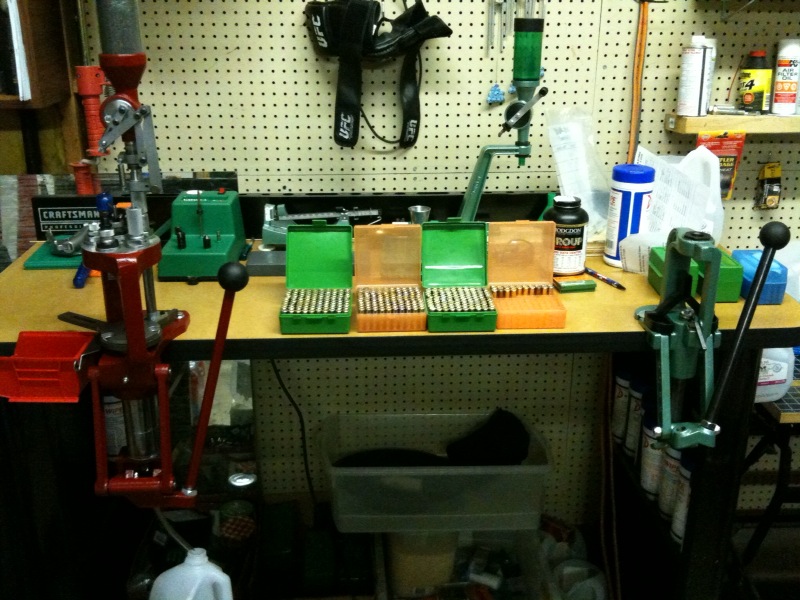
My Lock-n-Load AP is here and I’m hoping to get it set up some time this week…. just waiting for some final things to be delivered. It came with an instructional DVD that shows how to install and use it, and you can find all of those same videos on their YouTube channel. Nice touch, especially since it shows complete disassembly and assembly of parts.
Primer Investigation – Part 2, 43 Loaded
Link back to part 1, links forward to part 3 and part 4.
43 .223 Remington rounds loaded.
Each one has:
Bullet — Winchester .22 caliber 55 grain FMJ BT
Primer — CCI #41
C.O.L. — 2.215″ (came from the Speer #14 manual for a .223 Rem 55gr FMJ BT)
All are using TAC powder, but varying in amount. As well, the cases vary.
9 cases are new Remington left over from the first batch of .223. These were taken out of the bag, resized, and loaded. 3 cases have 25.0 gr of TAC, 3 have 25.5, 3 have 26.0.
25 cases are new Remington, but have received more prep. They were resized, flash hole deburred, primer pocket uniformed. 5 cases have 24.0 grains of TAC. 5 with 24.5. 5 with 25.0. 5 with 25.5. 5 with 26.0. I loaded a lot because if in fact there’s a new brass vs. used brass issue, I wanted to ensure I had enough “once fired” brass to work with.
9 cases are each loaded with 25.0 grains of TAC. 3 cases are used Winchester. 3 cases are used Federal. 3 cases are used WCC (NATO + stamp). All cases were trimmed to 1.75″-ish in length (about 1.753″, but could be 1.751″ or 1.752″). All of this brass is of unknown life (i.e. once fired? twice fired?) but inspection didn’t turn up any problems.
All rounds received a light Lee Factory crimp.
The main purpose of all of this is to shoot and look at primer pockets. I’ll also see if there’s any difference across the brass. I’ll also be taking a set of calipers with me to see how much things change.
I’ll also be shooting some Georgia Arms Canned Heat 55gr FMJ as a comparison/control.
Planning to go to the range first thing in the morning.
How to start working up a load
I recently stumbled across this bit of information on how to work up a load. It came from nodakoutdoors.com, posted by “Woodser”:
Probably the best advice that can be given to someone just starting to reload for accuracy is KISS. Keep it simple. Do not go out and buy several different bullets, several cans of different powders, and a couple different primers to start with. Start with one bullet, one powder, and one primer type and work on that combo with your choice of cases until you find a load that meets your specs. Start with the published COAL, the recommended minimum powder charge and work up 1/2 grain at a time until you find a combo that produces a circular grouping, no matter what the group diameter is. Then refine that load by changing the COAL, and incrementally vary the powder charge by 0.20 grains to tighten that grouping. Change only ONE variable at at time. Changing more, or using too many different components, can prove very frustrating.
If you find a combo that appears to have tightened the group as much as it will go, then change a component. THE FIRST thing I change is the primer. Many times I have found combos that yielded 1-1.5″ groups, and changing the primer reduced that by 1/2 or more.
When working up a new load for a new rifle, I start firing 3 shot groups, and when I have found a load combo to refine, switch to 5 shots, even with a light sporting barrel.
Then in a follow-up posting Woodser adds:
I forgot to add: When changing COAL from the published, always go longer by 10-15 thou. at a step. I am assuming the reloader does not have a throat gauge, or does not wish to take the time to measure the throat by other means. I do not on either count, I just shoot until I find the optimum COAL.
Gives me more reloading, shooting and range time, don’t ya know.
Since I enjoy the whole process, it is not a problem.
Those who measure the throat, and start at 5-15 thou. off the rifling, and do not vary it much during the whole load work-up cycle, may miss the sweet spot OAL for his rifle. Said sweet spot might well be 10 thou. off the lands, but it might also be 50-80.
I wish I had that advice when I started reloading. Granted, the only reason I can view that as really good advice is because of hindsight. But it’s something I’m going to take to heart as I go along.
The key would be to start with the known. So you have a good book, like the Speer #14 manual, or other solid sources of complete reloading data. Pick components (bullet, primer, powder, cases) based upon what’s established in the book. Of course these days it’s kinda hard to get exactly what you want due to supply and demand issues, but still pick something that’s in the book and as close as you can get… or at least, just pick one thing and stick with it. Work with that one thing. Vary powder and seek accuracy, working powder charges until you find what works best in your rifle. Then once you’ve exhausted powder (i.e. changing that one component), move to another component and see what happens.
And keep good records of everything.
